

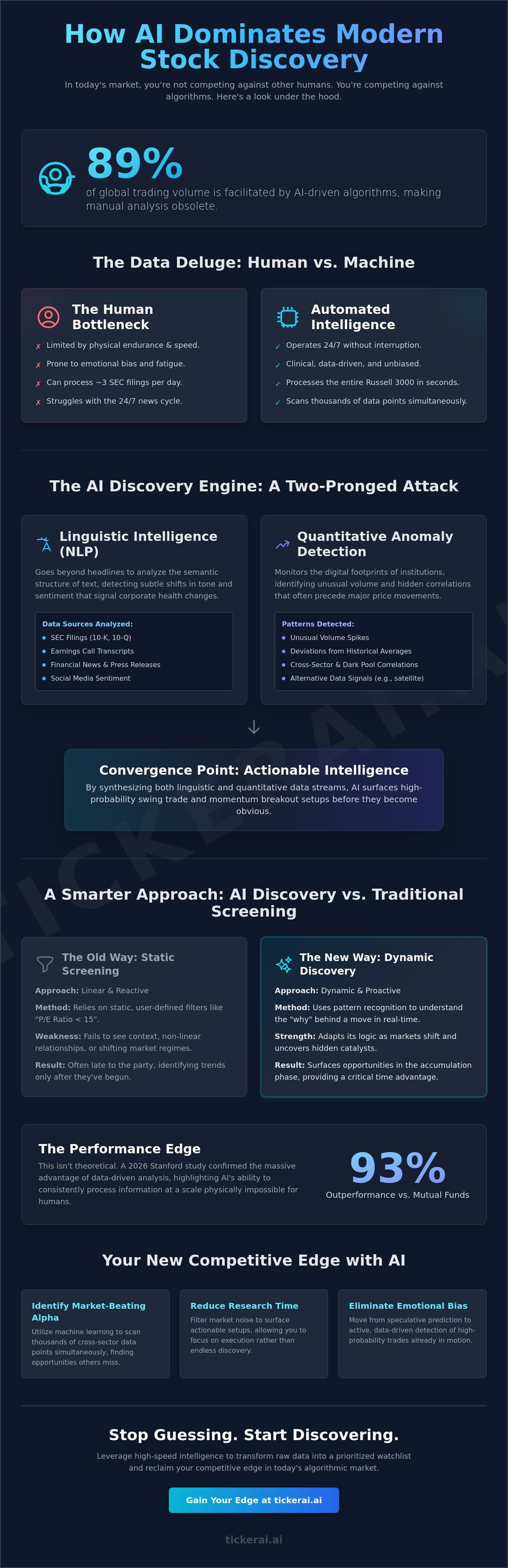
As of early 2026, AI-driven algorithms facilitate nearly 89% of global trading volume. This data confirms that the modern market is no longer a human-to-human environment. You're likely struggling with the relentless 24/7 news cycle and the physical limits of manual screening. It's frustrating to miss a momentum breakout because you were buried in spreadsheets or distracted by social media noise. Understanding exactly how AI finds stock opportunities is now the only way to reclaim your time and regain a competitive edge.
We'll break down the specific quantitative and linguistic mechanisms these systems use to detect high-potential stock setups in real-time. By moving past emotional bias and manual research, you can focus on execution rather than discovery. This guide provides a clear look at the logic used to filter market noise and identify high-probability swing trade setups. You'll see how technical indicators and sentiment analysis converge to surface the alpha that human eyes often miss.
Key Takeaways
- Identify market-beating alpha by utilizing machine learning to scan thousands of cross-sector data points simultaneously.
- Master the mechanics of how AI finds stock opportunities through high-speed Natural Language Processing and quantitative pattern recognition.
- Transition from speculative prediction to active detection by uncovering high-probability setups already in motion.
- Reduce research time and emotional bias by filtering market noise to surface actionable momentum breakouts and swing trade setups.
- Leverage high-speed intelligence tools to transform raw data into a prioritized watchlist for more precise execution.
What is AI Stock Opportunity Discovery?
AI Stock Opportunity Discovery is the deployment of advanced machine learning models to scan thousands of multi-dimensional data points in a single session. It isn't a passive filter. It's an active, high-speed hunt for "Alpha," the market-beating returns that exist outside of consensus valuations. By utilizing anomaly detection, these systems identify price-action discrepancies and sentiment shifts before they consolidate into a visible trend. This methodology represents the evolution of market intelligence, moving beyond simple data collection into the realm of actionable insight.
In the 2026 market environment, reactive trading is a liability. Institutional players move with clinical precision, often leaving retail traders to buy the tail end of a move. This is where Algorithmic trading and discovery systems provide a necessary edge. Understanding how AI finds stock opportunities allows you to move from a reactive trader to a proactive scout. A 2026 Stanford study highlighted the scale of this advantage, noting that AI analysts outperformed 93% of mutual fund managers over a 30-year period. This performance isn't a fluke. It's the result of processing data at a scale that is physically impossible for a human brain.
The Data Deluge Problem
The market doesn't wait for your morning coffee. It moves at microsecond speeds. The sheer volume of information is staggering. Every trading day, the market generates thousands of SEC filings, earnings call transcripts, and millions of social media signals. A human analyst can read perhaps three 10-Ks thoroughly in a day. An AI can process the entire Russell 3000's filings in seconds. This "Human Bottleneck" makes physical research a relic of a slower era. The data deluge is the primary barrier to retail alpha, as the mass of market noise hides high-potential setups from those without automated assistance, which is why many firms now rely on AI-powered insights from platforms like nodal-ai.io to maintain clarity.
Discovery vs. Traditional Screening
Traditional screening relies on static filters. You set a P/E ratio under 15 and wait. This approach is linear. It fails to account for the complex, non-linear relationships that drive modern price action. AI discovery is different. It uses pattern recognition to understand how a specific sentiment score in a press release correlates with a sudden spike in dark pool volume. It looks for the "why" behind the move in real-time. This dynamic learning allows the system to adjust its logic as market regimes shift. This is exactly how AI finds stock opportunities that remain invisible to standard scanners. By identifying these non-linear connections, the system surfaces setups with a higher probability of success.
The Mechanics of Discovery: How Algorithms Process Market Data
Modern market intelligence relies on a multi-layered processing engine. It isn't just about reading price charts. It's about the clinical synthesis of linguistic and mathematical data at a scale humans can't replicate. This high-speed integration is how AI finds stock opportunities before they become obvious to the general public. By the time a breakout appears on a standard retail scanner, the algorithm has already processed the catalysts that put it there.
Linguistic Intelligence and NLP
Natural Language Processing (NLP) is the core of real-time discovery. While a human trader scans headlines, AI analyzes the semantic structure of a 10-K filing or a 100-page earnings transcript in under a second. It detects subtle tone shifts that indicate underlying corporate health. For example, if a CEO uses more cautious language regarding "inventory turnover" compared to the previous quarter, the AI flags it as a risk anomaly. It filters the noise of the 24/7 financial news cycle to isolate specific signals that impact liquidity and institutional interest.
Quantitative Anomaly Detection
Beyond words, the system monitors institutional footprints. It identifies unusual volume spikes that precede major price action. These aren't just high-volume bars; they're calculated deviations from historical averages across multiple timeframes simultaneously. By cross-referencing technical indicators, the AI detects hidden correlations between disparate sectors. It might identify a specific energy precursor that historically signals a shift in tech valuations several days in advance. This predictive layer allows the system to surface setups while they're still in the accumulation phase.
High-speed discovery requires more than just the ticker tape. Modern systems integrate multiple streams of alternative data to build a complete picture of market health:
- Alternative Data Integration: Analyzing satellite imagery of retail parking lots or supply chain tracking to estimate quarterly performance before official reports.
- Sentiment Analysis: Quantifying market fear and greed through linguistic cues on social platforms and professional forums.
- Credit Card Trends: Monitoring anonymized consumer spending data to forecast revenue beats or misses.
This integrated approach is exactly how AI finds stock opportunities by looking where others aren't. It transforms raw, chaotic data into a structured roadmap for execution. If you're tired of being the last to know about a move, you can access real-time discovery tools that do the heavy lifting for you. The goal is to move from manual research to high-speed decision making.
Discovery vs. Prediction: Addressing the Black Box Myth
AI is often marketed as a digital crystal ball capable of seeing into the next quarter. This is a fundamental misunderstanding of market mechanics. High-performance systems don't guess what might happen. They detect what is happening right now. This distinction is critical to understanding how AI finds stock opportunities that possess high statistical significance. By identifying institutional footprints and linguistic anomalies in real-time, the system uncovers setups already in motion rather than gambling on future sentiment. It replaces speculation with clinical detection.
Risk mitigation is the secondary benefit of this detection-first strategy. AI excels at identifying "trap" setups by cross-referencing current patterns with historical failure data. If a momentum breakout looks promising but lacks the specific liquidity profile seen in past failed rallies, the system flags it as high-risk. This move toward "glass box" logic is becoming the industry standard. As of early 2026, regulatory shifts like the Colorado AI Act have increased the demand for "Explainable AI" (XAI). Traders now require systems that provide the "why" behind a discovery, ensuring the logic is transparent and repeatable.
Why Prediction Often Fails
Predictive modeling often collapses during "Black Swan" events because it relies on the future mimicking the past. Market regimes shift too rapidly for rigid forecasting to remain accurate. Detecting current momentum is statistically more reliable than trying to forecast a long-term price target in a volatile environment. AI wins by being faster, not psychic. It identifies the start of a trend while human traders are still debating the headlines. This speed advantage allows for tighter risk management and higher-probability entries before the majority of the market reacts.
The Logic of Probability
Every setup the system identifies comes with a calculated confidence score. This isn't a subjective opinion. It's a mathematical output derived from millions of historical backtests. The algorithm analyzes how similar clusters of data points performed in previous market cycles to assign a probability of success. This process eliminates the emotional bias that often leads human traders to "hope" a losing trade turns around. By focusing on purely mathematical opportunity identification, the system ensures every entry is backed by data. How AI finds stock opportunities is ultimately a matter of matching current market conditions against a massive library of documented successes and failures.
- Confidence Scores: Quantifying the strength of a setup based on multi-variable alignment.
- Historical Validation: Ensuring every discovery is grounded in documented market behavior.
- Bias Elimination: Removing the "hope" and "fear" that lead to manual execution errors.
From Breakouts to Swing Trades: Practical Opportunities AI Uncovers
Manual screening is a race you can't win. AI discovery shifts the focus from looking for setups to executing them. It uncovers momentum breakouts, mean reversion opportunities, and institutional positioning with clinical precision. By analyzing capital flow across industries in real-time, these systems identify sector rotation before it reflects in the major indices. This proactive approach is exactly how AI finds stock opportunities that retail traders usually miss until the move is already overextended.
Institutional tracking is a core component of this process. AI monitors "Smart Money" by analyzing dark pool data and block trade activity. It identifies where large-scale capital is positioning, allowing you to ride the coattails of major market movers. This isn't about following the herd. It's about detecting the underlying liquidity shifts that precede significant price action. When institutional accumulation aligns with positive technical indicators, the probability of a successful trade increases exponentially.
Detecting Momentum Before the Peak
The "Pre-Breakout" signature is a distinct pattern that AI is uniquely qualified to identify. It involves a specific convergence of tightening price action, a volatility contraction, and a subtle increase in relative volume. While a human might see a flat chart, the algorithm detects the pressure building behind the resistance level. AI filters out common "fake-outs" by using multi-factor verification. It ensures that the price movement is supported by broader market liquidity and positive linguistic sentiment. This rigorous filtering process ensures you aren't buying into a low-conviction rally that is likely to fail.
Swing Trading and Smart Watchlists
Manual watchlists are obsolete the moment you save them. They are static lists in a dynamic environment. AI-driven smart watchlists are always "on," updating as market conditions change. You receive dynamic alerts only when a specific setup meets high-probability criteria, such as a 90% match with historical success patterns. This automation allows you to integrate long-term investment ideas with short-term tactical entries without spending hours on manual research. How AI finds stock opportunities for swing trading involves identifying mean reversion points in volatile sectors, providing clear entry and exit signals based on mathematical probability rather than gut feeling. To start receiving these setups directly, get your TickerAI Full‑Access Subscription and automate your discovery process.
TickerAI: Your High-Speed Intelligence Partner
TickerAI applies the technical mechanics discussed throughout this guide to deliver institutional-grade intelligence. It transforms raw, multi-dimensional market data into actionable Swing Trade Setups. By utilizing proprietary discovery algorithms, the platform identifies high-probability entries while retail traders are still analyzing lagging indicators. This is the practical application of how AI finds stock opportunities in a high-frequency environment. It's a tireless, automated market oversight system that never sleeps.
Choosing the right tier depends on your specific tactical needs. The TickerAI Pro Subscription provides core discovery tools and real-time Smart Watchlist & Alerts. It's designed for the active participant who needs a high-speed filter for the daily noise. For those requiring a more comprehensive view, the TickerAI Full‑Access Subscription integrates Long-Term Investment Ideas with tactical setups. Both tiers prioritize clinical precision and rapid delivery, ensuring you move from discovery to execution without delay. Speed is the only currency that matters when a momentum breakout begins.
The TickerAI Advantage
TickerAI removes the volatility of human emotion. It replaces speculative chatter from retail trading forums with data-driven signals. You can tailor AI discovery to your specific risk profile, ensuring the alerts match your individual trading style. The workflow is streamlined for efficiency. The system detects a setup. It updates your smart watchlist. It sends a notification instantly. This allows you to focus on decision-making rather than the "Human Bottleneck" of manual research. It's a clinical approach to a chaotic market.
Securing Your Professional Edge
Professional traders are rapidly abandoning manual research for AI-driven discovery. The logic is simple. The cost of manual research, measured in missed momentum and hours of wasted screening, far exceeds the ROI of automated scanning. As of 2026, nearly 89% of global trading volume is algorithmic. Trying to compete without high-speed intelligence is a calculated risk that rarely pays off. This is why staying ahead through professional development at institutions like Trainetics Academy is crucial for those who want to master the digital skills required in today's markets. How AI finds stock opportunities is through the relentless processing of data that human eyes simply can't catch. Secure your position in the modern market before the window of opportunity closes.
Join TickerAI to discover your next opportunity and reclaim your competitive edge. Stop reacting to the news. Start detecting the setups that drive it.
Mastering High-Speed Market Intelligence
The transition from manual screening to automated discovery is now a requirement for the professional trader. You've seen that the primary advantage lies in detection rather than speculative prediction. By utilizing linguistic intelligence and quantitative anomaly detection, you can bypass the data deluge that paralyzes standard analysts. This methodology is exactly how AI finds stock opportunities before the retail herd recognizes a shift in momentum.
Efficiency is the only differentiator in a market where 89% of volume is algorithmic. You need a partner that prioritizes clinical precision over speculative noise. TickerAI provides the high-speed infrastructure to turn these complex mechanics into actionable results. With automated oversight and real-time verification, you focus on high-level decision-making while the system manages the hunt.
Upgrade to TickerAI Pro for real-time opportunity discovery and leverage AI-driven swing trade setups, real-time momentum alerts, and Smart Watchlist technology. Position yourself for the next breakout before it happens. Secure your professional edge today.
Frequently Asked Questions
How does AI actually find stocks with high potential?
AI identifies high-potential stocks by executing high-speed anomaly detection across massive datasets. It analyzes technical indicators, institutional volume shifts, and Natural Language Processing signals simultaneously. This multi-layered approach is how AI finds stock opportunities that remain invisible to traders using basic filters. By identifying these non-linear relationships, the system uncovers alpha in real-time.
Is AI stock discovery better than manual technical analysis?
AI discovery offers superior scale and speed compared to manual technical analysis. A human trader can only track a handful of charts effectively at any given time. AI monitors thousands of tickers without fatigue or emotional bias. It identifies momentum signatures across every sector in milliseconds, ensuring you don't miss a breakout because you were focused on a different screen.
Can AI predict stock market crashes?
AI focuses on detection rather than absolute prediction. While it cannot forecast "Black Swan" events with perfect accuracy, it identifies the structural volatility and liquidity contractions that often precede major crashes. It acts as an early warning system by quantifying risk levels through historical failure patterns and current market stress indicators. This allows for proactive risk management before the downturn accelerates.
What is the difference between an AI stock picker and an AI discovery tool?
An AI stock picker usually provides a static, one-time list of recommendations. An AI discovery tool is a dynamic, high-speed intelligence partner. It provides real-time monitoring and prioritized setups as market regimes shift. Platforms like TickerAI focus on active detection, giving you a continuous stream of actionable data rather than a passive, infrequent suggestion.
Do I need technical coding skills to use an AI stock finder?
You don't need any coding knowledge to leverage professional AI tools. The complexity is handled entirely by the underlying algorithm. Professional platforms provide intuitive dashboards and real-time alerts designed for immediate use. You focus on the final execution decision while the AI manages the technical processing and data synthesis in the background.
How fast are AI stock market alerts compared to news sites?
AI alerts operate at microsecond speeds, often detecting market-moving signals before news sites can publish a headline. By processing raw SEC filings and dark pool data directly, the system identifies catalysts at the source. This speed advantage allows you to position yourself before the retail crowd reacts to mainstream news reports that are often minutes or hours behind the move.
Is AI-driven trading suitable for long-term investors?
AI-driven discovery is highly effective for long-term strategies. It identifies institutional accumulation and structural industry shifts that signal multi-year growth potential. Investors use these tools to find high-conviction entry points, reducing the risk of buying into overextended rallies or missing major sector rotations that define long-term portfolio performance.
What data sources does TickerAI use for its analysis?
TickerAI synthesizes data from SEC filings, earnings call transcripts, real-time exchange feeds, and alternative sentiment sources. It cross-references these linguistic and quantitative streams to build a comprehensive market map. This data-driven approach allows the system to generate precise swing trade setups and smart watchlist updates for its TickerAI Pro and Full-Access subscribers.


