
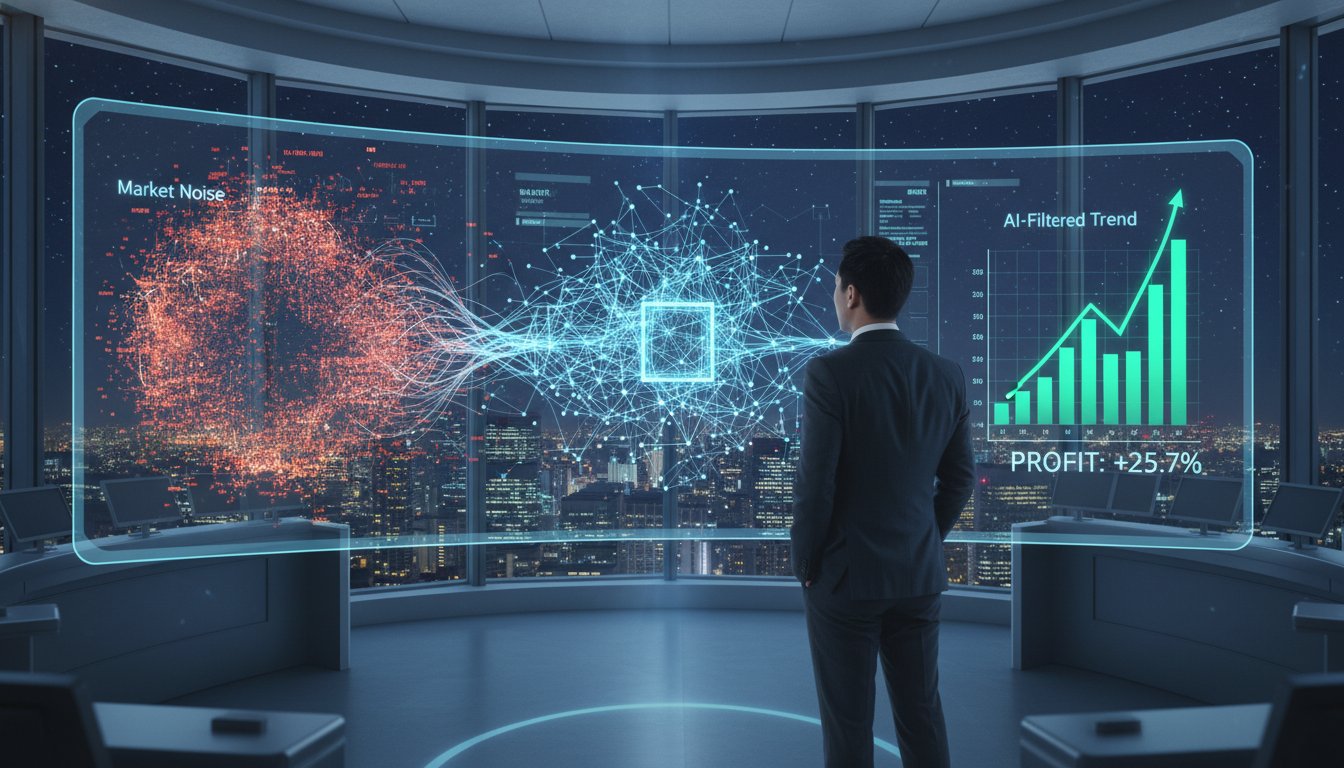
Did you know that 70% of all U.S. stock market volume is now driven by algorithmic systems? In a 2026 market defined by rapid volatility and agentic AI, manual scanning is no longer just slow; it's a liability. Relying on human eyes to catch every breakout leads to analysis paralysis and missed momentum. Professional traders are moving toward automated stock market analysis to filter the noise. This technology acts as a tireless scout. It detects high-probability setups while you're away from the screen.
You've likely felt the frustration of staring at dozens of indicators only to realize you missed the optimal entry. Emotional bias and screen fatigue often cloud the very setups you worked hard to find. It is a common struggle for those trying to scale their intelligence in a high-speed environment. You need a system that prioritizes clarity over clutter.
This article shows you how to leverage automation to transform chaotic market data into a precise, actionable watchlist without the manual grind. We'll explore the shift toward AI-driven discovery, the impact of new regulatory frameworks, and the exact steps to build a data-backed swing trade strategy that significantly reduces your screen time.
Key Takeaways
- Shift from static screening to dynamic, real-time monitoring to navigate the nanosecond volatility of the 2026 market.
- Understand how automated stock market analysis leverages data ingestion and filtering to eliminate analysis paralysis and indicator overload.
- Learn the critical difference between discovery tools and execution bots to protect your capital from automated strategy errors.
- Configure customized workflows that transform raw sentiment and price data into a refined daily watchlist of swing trade setups.
- Scale your intelligence with proactive scouting tools that detect momentum moves while you are away from the screen.
The Evolution of Stock Market Analysis: From Manual Scanners to AI-Driven Automation
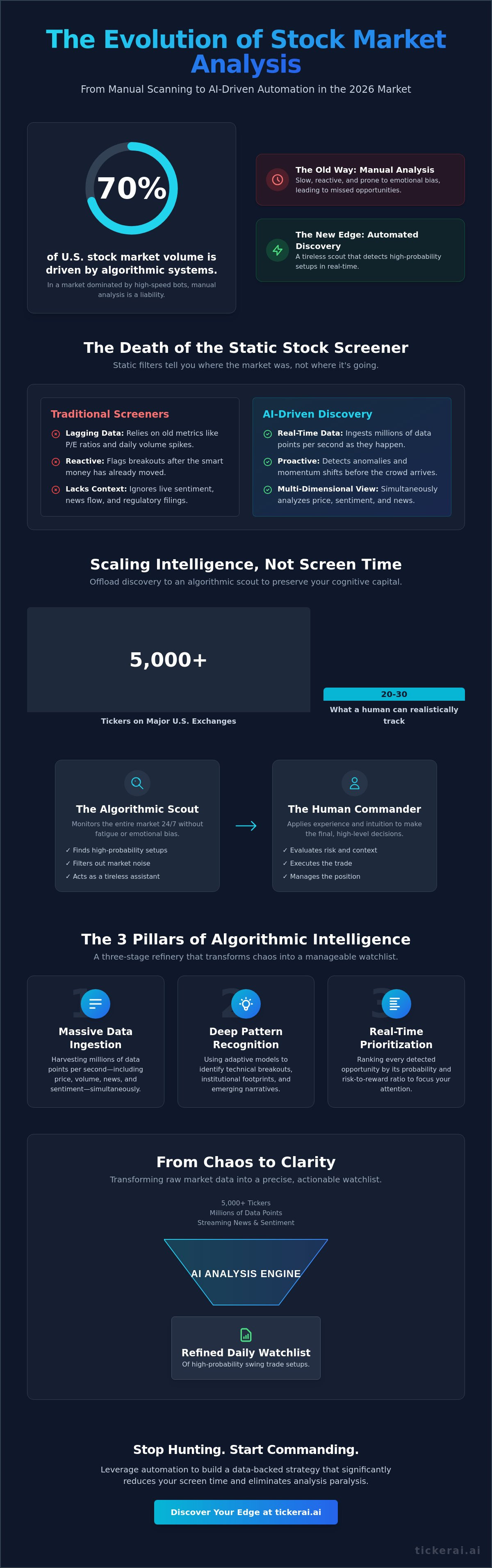
The market doesn't wait for your browser to refresh. In 2026, the era of clicking "scan" every thirty minutes is over. Algorithmic trading now accounts for roughly 70% of U.S. equity volume. This dominance has compressed the window for human reaction. Manual analysis, once the standard for swing traders, is now a bottleneck. It's slow. It's prone to error. Most importantly, it's reactive rather than proactive.
Modern automated stock market analysis replaces the manual grind with high-speed data ingestion. It isn't just about finding a stock; it's about detecting an anomaly before the crowd arrives. The workflow has shifted. You no longer spend hours searching for stocks. Instead, you spend minutes validating AI-detected setups. This transition allows you to scale your intelligence without scaling your workload. You move from the role of a hunter to the role of a commander.
The Death of the Static Stock Screener
Traditional filters are failing. Relying on static metrics like P/E ratios or simple volume spikes in 2026 leads to lagging entries. These numbers tell you where the market was, not where it's going. Static data lacks the context of live sentiment and real-time news flow. By the time a traditional screener flags a "breakout," the smart money has already positioned itself.
Today's market is multi-dimensional. A breakout on a chart is meaningless if social sentiment is plummeting or if a late-breaking regulatory filing contradicts the price action. Automated systems ingest these disparate data points simultaneously. They provide a dynamic view that static screeners simply cannot match. If you're waiting for a daily close to confirm a move, you're already too late. You need streaming analysis that updates as fast as the tape.
Why Human Intelligence Needs an Algorithmic Scout
The math is simple. There are over 5,000 tickers on major U.S. exchanges. A human trader can realistically track twenty or thirty with any degree of depth. Attempting more leads to "fatigue factor." Decisions made at 3:30 PM are rarely as sharp as those made at 9:30 AM. Cognitive limits are the primary reason manual traders miss momentum moves while away from the screen.
Automation solves this by acting as a tireless scout. It monitors the entire market 24/7. It doesn't get tired. It doesn't have an emotional bias toward a specific ticker. By offloading the discovery phase to automated stock market analysis, you preserve your cognitive capital for high-level decision-making. The scout finds the setup; the trader evaluates the risk and executes. This partnership is the only way to maintain a professional edge without 12-hour screen days. It is about efficiency and precision.
How Automated Stock Analysis Works: The Three Pillars of Algorithmic Intelligence
Efficiency is the byproduct of structure. To understand automated stock market analysis, you must view it as a three-stage refinery. It takes the chaotic overflow of global exchanges and distills it into a manageable watchlist. This process relies on three distinct pillars: massive data ingestion, deep pattern recognition, and real-time prioritization. Without all three, the system is either blind to context or buried in noise. It's the difference between a simple filter and a high-speed intelligence partner.
- Pillar 1: Massive Data Ingestion. Harvesting price, volume, news, and sentiment signals simultaneously.
- Pillar 2: Pattern Recognition. Identifying technical breakouts and institutional footprints through adaptive modeling.
- Pillar 3: Real-Time Prioritization. Ranking every detected opportunity by its probability and risk-to-reward ratio.
Real-Time Data Ingestion and Processing
In 2026, the speed of information has reached a terminal velocity. Modern AI systems now process millions of data points per second. This isn't limited to the ticker tape. High-speed ingestion is the foundation of modern AI in managing portfolios. It allows for the detection of swing trade setups that appear and disappear within minutes. Low-latency feeds are no longer optional; they're the entry price for professional-grade discovery.
Moving beyond basic price action is critical. Alternative data signals, such as real-time news sentiment and legislative filings, provide the "why" behind the "what" of price action. In the current market, a stock's movement is often dictated by an AI-generated summary of a central bank speech before a human has even finished the first paragraph. By incorporating these signals, automated stock market analysis provides a multi-dimensional view of risk that manual scanning cannot replicate.
Pattern Recognition and Machine Learning
Static "if-then" rules are too rigid for today's market. Adaptive machine learning models now identify the "fingerprints" of institutional accumulation by analyzing subtle shifts in volume and price spread. Pattern recognition is the core of automated discovery, functioning as the algorithmic identification of recurring market behaviors to predict high-probability outcomes. This allows the scout to detect momentum shifts before they become obvious on a standard chart.
The system learns from every market cycle. It doesn't just look for a head-and-shoulders pattern; it looks for the specific liquidity conditions that make that pattern likely to succeed. This reduces the "false breakout" rate that plagues manual traders. If you want to see how these pillars work in a live environment, exploring a tool like TickerAI can provide immediate clarity on your daily watchlist. This prioritization ensures you focus on execution while the machine handles the heavy lifting of discovery.
Analysis vs. Execution: Why Discovery Automation is the Modern Trader’s Edge
Execution is the final step in a trade, but discovery is where the professional edge is won or lost. Many retail participants confuse execution bots with analysis tools. While an execution bot is designed to pull the trigger, automated stock market analysis is designed to find the target. The distinction is critical. One handles the logistics of the order; the other handles the intelligence of the opportunity. Relying on automation for execution without superior discovery is a high-speed path to drawdown.
The biggest risk in 2026 isn't a lack of speed. It's the automation of a flawed strategy. A systematic survey of deep learning in finance confirms that even the most advanced models require human governance to remain effective across changing market regimes. By keeping a "Human-in-the-Loop," you leverage AI to filter thousands of tickers while retaining the final decision on every trade. This partnership prevents the catastrophic errors often associated with fully autonomous bots during unexpected liquidity voids.
The Risks of Hands-Off Execution Bots
The "set it and forget it" approach is a marketing myth that often leads to capital destruction. Execution bots often operate as black boxes, following rigid logic that can't account for sudden geopolitical shifts or legislative changes. In volatile markets, these systems can enter a feedback loop of selling that exacerbates losses in seconds. Discovery-focused automation avoids this trap. It identifies the setup but leaves the final risk assessment to the trader. You maintain strategic control. You offload the grunt work, not the responsibility. The machine filters. The trader decides.
The Power of the Automated Opportunity Finder
Focusing your energy on high-probability swing trade setups allows you to bypass the noise of low-quality tickers. Modern AI stock discovery platforms scan entire sectors in seconds, identifying institutional footprints before they're visible to the retail crowd. This builds a "Smart Watchlist" that updates in real-time based on your specific criteria. You aren't chasing the market. You're waiting for the market to meet your data-backed parameters. This proactive approach ensures your capital is only deployed when the probability of success is at its peak. It's a scalable intelligence model built for the 2026 environment.
Implementing Automated Workflows: Transforming Raw Data into Actionable Setups
Efficiency begins with a clear objective. To implement automated stock market analysis effectively, you must first define your core strategy. Algorithms don't guess; they follow logic. Whether you focus on momentum breakouts or mean reversion, your automated scout needs specific parameters to filter the noise. For entrepreneurs and teams looking to integrate these systems into a broader framework, Business With AI Strategist provides the consultancy needed to align technology with strategic goals. You are configuring a high-speed filter to match your unique risk profile. This prevents the 'indicator soup' that leads to analysis paralysis. Execution becomes a formality when the discovery is precise.
By moving away from manual trade selection, you eliminate emotional bias. High-conviction signals discovered by the machine are then manually verified by the trader. This is the 'Human-in-the-Loop' model in action. It ensures that you aren't just following a black box, but rather using a sophisticated scout to bring the best setups to your desk. You focus on the final 1% of decision-making while the machine handles the 99% of scanning.
Setting Up Your Automated Scout
Setting up your scout involves identifying the technical indicators that define your timeframe. In the 2026 market, simple moving averages are rarely enough. You must combine price action with relative strength and sector-specific filters. Filtering by market cap ensures you aren't distracted by low-liquidity traps that cannot support professional-sized moves. Real-time alerts are the primary defense against FOMO. They notify you when a specific trigger is hit. This allows you to ignore the screen until the setup is mathematically valid. You focus on the signal, not the noise.
The Daily Workflow of an AI-Augmented Trader
The daily workflow of an AI-augmented trader is structured and methodical. It moves from high-level scanning to surgical execution. This routine maximizes your intelligence while minimizing your screen time. Consistency is the byproduct of a repeatable process.
- Morning: Review the AI-generated 'Top Opportunities' list. This is your pre-market high-conviction pool.
- Intraday: Receive mobile alerts for momentum breakouts. This allows you to step away from the screen without missing a move.
- Evening: Analyze daily performance stats. Refine your scanning parameters to adapt to shifting market volatility for the next session.
This loop creates a scalable system. You aren't chasing tickers; you're managing a pipeline of data-backed setups. The machine handles the 24/7 monitoring while you provide the final verification. This ensures your capital is only deployed when the probability of success is at its peak. Ready to streamline your process? Start your 7-day trial of TickerAI to automate your discovery workflow today.
Scaling Your Portfolio with TickerAI’s Automated Opportunity Discovery
Efficiency isn't just about speed; it's about the quality of the filtered result. TickerAI acts as a tireless, 24/7 market scout. It bridges the gap between raw data and actionable execution. By deploying automated stock market analysis, the platform removes the manual grind of ticker hunting. It allows you to focus on high-conviction decision-making while the machine handles the global scan. You move from being overwhelmed by indicators to being empowered by data-backed setups.
Scaling your portfolio requires a system that is always on. TickerAI provides specific AI Stock Opportunity Discovery and refined Swing Trade Setups. You aren't just getting data; you're getting a prioritized list of high-probability moves. This isn't a passive tool. It's a proactive intelligence partner designed for the serious participant who values precision over volume. The platform filters the noise to deliver clarity in a chaotic environment.
TickerAI’s Discovery Engine
Proprietary algorithms form the core of our discovery engine. They detect institutional footprints and momentum shifts before they become obvious to the retail crowd. A curated Smart Watchlist & Alerts system ensures you only see the setups that match professional-grade criteria. Generic stock screeners provide noise; TickerAI provides actionable intelligence. Real-time alerts mean you never miss a setup because you weren't at your desk. The scout monitors the tape while you focus on your life or your primary career.
Professional Grade Insights for Every Trader
Transitioning to automated stock market analysis is the logical conclusion for any trader looking to scale. TickerAI offers two distinct paths for the modern participant. The TickerAI Pro Subscription provides essential discovery tools for the active swing trader. For those requiring the highest level of market intelligence, the TickerAI Full‑Access Subscription delivers the complete suite of alerts, setups, and Long-Term Investment Ideas. This ensures you have the right tool for both immediate momentum and long-term wealth building.
You aren't just subscribing to a platform; you're joining a community of data-driven investors who value time and clinical precision. This is about moving from "searching for stocks" to "validating setups." It's about working with an intelligence partner that never sleeps. Get TickerAI Full-Access and start discovering opportunities today.
Secure Your Edge in the 2026 Market
The 2026 market doesn't reward the trader who works the longest hours. It rewards the one with the most efficient intelligence. Shifting from manual scanning to automated stock market analysis is now a baseline requirement for navigating nanosecond volatility. By offloading the discovery of swing trade setups to high-speed algorithms, you eliminate the cognitive fatigue that leads to missed opportunities. You transition from a hunter of data to a commander of capital.
This evolution into a "commander" mirrors the strategic growth seen in other high-stakes industries; to see how top-tier professionals cultivate this level of authority, learn more about Branding TITANS™ and their insights on achieving market dominance.
TickerAI provides the clinical precision needed to thrive in this high-speed environment. Through 24/7 automated market scanning and real-time momentum alerts, you maintain a professional edge without the manual grind. It's time to focus on curated, high-potential swing setups that match your specific risk profile. Don't let another momentum move pass because you weren't at your desk.
Scale your market intelligence with TickerAI Full-Access and transform your daily watchlist into a data-backed engine of growth. Your intelligence is your greatest asset. It's time to scale it.
Frequently Asked Questions
What is the difference between an automated stock screener and AI analysis?
Automated screeners rely on static, rule-based filters like P/E ratios or simple volume thresholds. AI-driven automated stock market analysis uses machine learning to identify complex, multi-dimensional patterns. It adapts to changing market regimes rather than following a rigid script. This allows for the detection of institutional footprints that simple filters often miss.
Can automated stock market analysis predict the future price of a stock?
No system can predict future prices with absolute certainty. Instead, these tools identify high-probability setups where the risk-to-reward ratio is skewed in your favor. They provide a statistical edge based on historical data and real-time liquidity signals. You use the machine to find the opportunity, but you remain responsible for risk management and execution.
Do I need to know how to code to use automated stock analysis tools?
You don't need programming skills to leverage modern discovery tools. Most professional platforms in 2026 provide intuitive, "no-code" interfaces. You simply select your strategy parameters and risk profile. The system handles the complex algorithmic processing in the background. It delivers refined results directly to your dashboard or mobile device.
Is automated stock analysis better for day trading or long-term investing?
Automated analysis provides a significant advantage for both, but it is exceptionally effective for swing trading. It excels at identifying momentum breakouts and mean reversion setups that develop over several days. Long-term investors use it to find undervalued entries. Day traders use it to filter thousands of tickers down to a high-conviction daily watchlist.
How much does it cost to implement automated stock scanning in 2026?
Budgeting for professional tools usually falls between $50 and $150 per month in 2026. This range typically covers platform fees and low-latency data feeds. While basic services might start at $0, professional-tier discovery engines often cost more due to the complexity of their AI models. Many traders view this as a necessary operational cost to maintain a competitive edge.
Will automated analysis tools work on mobile devices for real-time alerts?
Most modern platforms prioritize mobile integration to ensure you never miss a momentum move. You can receive real-time alerts via push notifications or SMS the moment a technical trigger is hit. This allows you to step away from the screen without losing track of your watchlist. It ensures your intelligence system is always active even when you aren't.
How does AI handle market news and sentiment in its analysis?
AI utilizes Natural Language Processing (NLP) to ingest millions of news articles and social media posts per second. It converts this qualitative information into quantitative sentiment scores. These scores are then correlated with price action to determine if a move is backed by genuine news or just market noise. It provides a multi-dimensional view of the market that manual analysis can't replicate.


