
In the 2026 market, your biggest risk isn't volatility; it's the belief that manual chart-crawling still works. The elimination of the $25,000 PDT rule and the shift toward risk-based intraday margin has flooded the field with new participants. The barrier to entry has vanished. The barrier to profit has never been higher. You're likely asking: what is a trading edge and how to get one when every retail trader now has instant access?
You've felt the weight of information overload. Too many indicators, late entries, and the emotional exhaustion of "missing the move" are symptoms of a legacy process. It's impossible to compete with algorithmic speed using manual methods. You need a filter, not more data.
This guide breaks down the structural mechanics of a professional edge. You'll learn how to implement a systematic, AI-driven advantage that detects setups before they trigger. We'll explore the transition from manual scanning to automated discovery. This includes a step-by-step framework for identifying high-probability opportunities and the tools needed to automate your scout phase for maximum efficiency.
Key Takeaways
- Define a trading edge as a measurable, repeatable probability. Move beyond subjective "gut feelings" to data-driven execution.
- Transition from information asymmetry to processing speed. In 2026, the advantage belongs to those who filter market noise fastest.
- Implement a systematic framework for what is a trading edge and how to get one by defining your trading universe and primary signals.
- Identify and eliminate the structural pitfalls of FOMO and analysis paralysis. Replace manual scanning with high-speed algorithmic discovery.
- Scale your performance using TickerAI’s proactive scouting. Automate the detection of swing trade setups to focus exclusively on high-level decision-making.
Defining the Trading Edge in the 2026 Market Environment
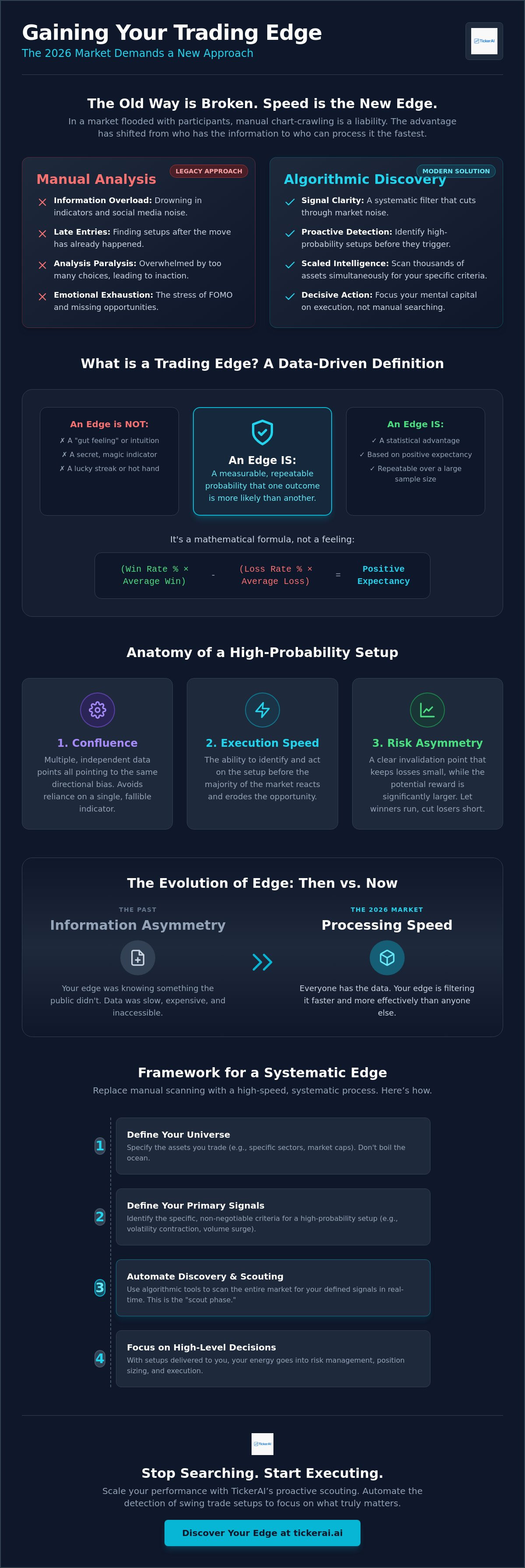
A trading edge isn't a secret formula or a lucky streak. It's a measurable, repeatable probability that one market outcome is more likely than another. In the high-frequency environment of 2026, relying on a "gut feeling" is the fastest way to liquidate an account. Professional traders don't guess. They exploit specific market inefficiencies that provide a statistical edge. This means your expected value over 100 trades is positive, even if individual trades result in losses.
The foundation of alpha rests on the mathematical relationship between your win rate and your risk/reward ratio. You don't need to be right 90% of the time. You need a setup where the wins significantly outweigh the losses over a large sample size. Many beginners confuse a "strategy" with an "edge," but they're distinct concepts. A strategy is your plan of action; an edge is the underlying structural advantage that makes the plan profitable. Understanding what is a trading edge and how to get one requires shifting your focus from individual "picks" to systemic advantages.
This philosophy of seeking a systemic advantage extends to other high-performance domains; for instance, athletes and coaches use ArmIQ to gain a data-driven edge in baseball arm health, managing physical durability with the same analytical rigor traders apply to their portfolios.
The Anatomy of a High-Probability Setup
High-probability setups occur at the intersection of technical, fundamental, and sentiment data. However, adding more indicators often creates noise rather than clarity. The most robust edges are usually the simplest. They rely on clear price action catalysts or institutional order flow rather than a "spaghetti chart" of lagging oscillators. A trading edge is a statistical outlier in market behavior that allows for a repeatable, positive expectancy. Look for these three pillars:
- Confluence: Multiple independent data points pointing to the same directional bias.
- Execution Speed: The ability to identify the setup before the majority of the market reacts.
- Risk Asymmetry: Clear invalidation points that keep losses small while allowing winners to run.
Alpha Decay: Why Edges Disappear Over Time
Markets are dynamic systems. When a specific edge becomes common knowledge, it's often "arbitraged" away by institutional algorithms. This is known as alpha decay. To maintain profitability, you must distinguish between temporal edges and structural edges. Temporal edges are short-lived, often based on specific news or temporary liquidity gaps. Structural edges are more durable, rooted in market mechanics or regulatory frameworks like the 2026 intraday margin rules.
You must constantly monitor your performance metrics. If your win rate or profit factor drops significantly over a significant sample size, the market regime may have shifted. Staying ahead means knowing what is a trading edge and how to get one that adapts to current volatility levels. Stagnation is the enemy of the professional trader. You either evolve your discovery process or watch your edge evaporate into market noise.
The Evolution of Edge: Information Asymmetry vs. Processing Speed
Historical markets relied on information asymmetry. Having an "edge" meant knowing something the general public didn't. That era is dead. Regulation and the internet have democratized data access. Now, the bottleneck isn't the availability of information. It's the speed of processing it. In 2026, the market is a battle of filters. Everyone sees the same data. The winner is the one who interprets it first.
If you're still manually clicking through charts, you're the liquidity for those who aren't. Information overload has become the primary barrier to retail success. Most traders drown in a sea of tickers, social media noise, and lagging indicators. They find the setup after the profit has been extracted. The critical window is the "Observation-to-Action" phase. If your observation takes ten minutes, your action is irrelevant. Capturing alpha requires a compressed feedback loop.
From Manual Charting to Algorithmic Discovery
The human eye is a bottleneck. You cannot scan 8,000 tickers for a specific volatility contraction in real-time. Institutions don't even try; they use machines. Utilizing automated stock market analysis allows you to bridge this gap. It's about scaling your intelligence. Machines detect patterns across the entire market while you focus on execution logic.
Consider a momentum breakout. A stock consolidates for three months on declining volume. A manual trader might find it during a weekend scan. By Monday morning, the price has already gapped 4% higher. An algorithmic scout detects the volume expansion and price breach in milliseconds. It alerts you while the trade is still in the low-risk entry zone. This is the modern answer to what is a trading edge and how to get one: seeing the move as it begins, not after it's confirmed by the crowd.
Quantifying Market Sentiment with AI
Sentiment is no longer a gut feeling. It's a quantifiable dataset. Modern AI stock discovery platforms use natural language processing to parse institutional smart money flow. They analyze SEC filings, earnings call transcripts, and thematic shifts instantly. They find the signal in the noise before the headline hits the terminal.
These systems detect anomalies that human analysts overlook. A subtle change in language within a 10-K filing can signal a massive fundamental shift. AI identifies these outliers before they become mainstream narratives. To capture alpha, you must filter the noise and focus on high-speed intelligence. If you want to refine your process, utilizing a smart watchlist can prioritize your decision-making and keep you focused on high-probability setups.
How to Get a Trading Edge: A Framework for Systematic Discovery
Establishing a professional advantage requires more than a preferred chart pattern. It demands a rigorous, repeatable pipeline that converts raw market data into actionable intelligence. To understand what is a trading edge and how to get one in the 2026 landscape, you must move from discretionary guessing to a modular workflow. This framework prioritizes speed and mathematical consistency over speculative intuition.
- Step 1: Define your universe. Narrow your focus to specific sectors, market caps, or volatility profiles. Trying to monitor the entire market leads to dilution. Professionals specialize in niches where they can quantify behavior.
- Step 2: Identify your primary signal. Determine if your edge is momentum-based, mean-reverting, or driven by specific catalysts like earnings surprises. Your signal must be a detectable anomaly.
- Step 3: Establish strict entry and exit criteria. Define your invalidation points before you enter a position. This eliminates emotional decision-making during intraday volatility.
- Step 4: Leverage technology. Use algorithmic scouts to automate the scanning process. You shouldn't be looking for setups; the setups should be looking for you.
- Step 5: Backtest and refine. Use hard performance data to validate your expectancy. If the data doesn't support the edge, the strategy is discarded.
Identifying Your Niche in the Market
Attempting to "trade everything" is a primary reason retail participants fail. Specialization creates depth. By narrowing your scope, you become attuned to the specific liquidity characteristics and institutional patterns of a sector. Whether you're focusing on high-growth tech or defensive utilities, your edge is sharpened by repetition within that niche.
Distinguish between different timeframes. Are you hunting for quick swing trade setups or managing long-term investment ideas? Each requires a different discovery logic. A swing trader values immediate momentum and volume expansion. An investor focuses on fundamental valuation shifts. Mixing these logic sets causes analysis paralysis. Pick one timeframe and master the discovery process for it.
The Role of Smart Watchlists
A static list of tickers isn't a tool; it's a distraction. Modern watchlists must be dynamic, organizing opportunities by theme and conviction level. This allows you to prioritize your focus on the highest-probability setups. When you automate the "scout" phase of your trading, you free your cognitive resources for high-level risk management.
Set real-time alerts for price action that validates your edge. You don't need to stare at a screen all day. Instead, wait for the market to hit your predefined triggers. This proactive approach ensures you're only active when the statistical probability is in your favor. It's the most efficient way to understand what is a trading edge and how to get one that actually scales with your capital. High-speed intelligence partners filter the noise so you can focus on the signal.
Common Pitfalls: Why Most Traders Lose Their Edge to Market Noise
Market noise is the primary predator of potential alpha. Many traders spend months researching what is a trading edge and how to get one, only to abandon their logic at the first sign of a trending ticker on social media. Chasing "hot stocks" without a repeatable discovery process is not professional trading; it's high-stakes gambling. This impulsive behavior, driven by FOMO, bypasses the systematic framework required to maintain a statistical advantage.
Analysis paralysis represents the opposite extreme. In the 2026 environment, the sheer volume of technical and fundamental data is staggering. Without a high-speed filter, traders become overwhelmed by conflicting signals. They wait for "one more confirmation" while the institutional move completes. By the time they entry, the edge has already been arbitraged away. Success requires the ability to act on a signal while the probability is still in your favor.
Another common failure is the "Holy Grail" fallacy. Beginners often search for a 100% win rate, neglecting the reality of market distribution. Professionals prioritize expectancy over perfection. They understand that a 55% win rate with a 2:1 reward-to-risk ratio is a gold mine. This shift in mindset is critical when setting realistic expectations for AI stock signals. Algorithmic tools provide a probability, not a guarantee.
Overcoming the Emotional Execution Gap
Even a mathematically perfect edge fails without disciplined risk management. The "execution gap" occurs when a trader hesitates or deviates from their rule-based system during periods of high volatility. Discipline is the bridge between a theoretical edge and a profitable account. You must treat your entry and exit criteria as immutable laws. If the market does not validate your specific parameters, the trade does not exist. Eliminating discretionary errors is the only way to protect your long-term capital.
The Danger of "Black Box" Signals
Trading "picks" without understanding the underlying logic is a recipe for disaster. When a trade goes against you, a lack of transparency leads to panic. You must know why a signal was generated to manage the position confidently. This is why learning how to interpret AI stock signals is essential for the modern professional. Avoid services that hide their methodology. To remove the noise and focus on high-conviction opportunities, utilize AI stock opportunity discovery to scan the market with clinical precision.
Scaling Your Edge with TickerAI’s Algorithmic Discovery
Scaling a statistical advantage requires a shift from manual detection to high-speed filtering. TickerAI acts as your proactive scout. It monitors the 2026 market in real-time. This allows you to capture the "Observation-to-Action" window effectively. If you're still wondering what is a trading edge and how to get one, the answer lies in systematic automation. You focus on the high-level decision. TickerAI handles the exhaustive discovery phase. This transition from manual labor to algorithmic oversight is what separates the hobbyist from the professional.
Choosing the right tool depends on your methodology and frequency. The TickerAI Pro Subscription is built for active participants who require consistent Swing Trade Setups. For those who need a total intelligence suite, the TickerAI Full‑Access Subscription provides deeper analytics and Long-Term Investment Ideas. Both tiers replace the fatigue of manual scanning with clinical, data-driven Smart Watchlist & Alerts. These lists don't just show prices. They prioritize opportunities based on your specific edge.
Smart Watchlists act as a sophisticated filter for a chaotic environment. They convert raw technical and fundamental data into actionable setups. Instead of staring at a screener for hours, you receive alerts that trigger only when your specific criteria are met. This preserves your cognitive capital for the most important part of the trade: execution and risk management. You aren't hunting for trades. You're waiting for the trades to find you.
AI-Powered Opportunity Discovery
Automated market scanning finds hidden momentum that human eyes miss. TickerAI removes the manual labor of fundamental and technical screening. We scan thousands of tickers per second to identify anomalies. This isn't just for fast-paced traders. It's a vital tool for discovering long-term investment ideas through objective, data-driven insights. You get the signal without the noise. High-speed intelligence partners don't sleep. They filter the chaos while you maintain your focus on market logic.
The principle of using high-speed intelligence to bypass manual noise extends beyond trading; in a competitive professional landscape, leveraging an AI resume optimizer Canada allows candidates to navigate automated recruitment filters with the same precision traders use to find market alpha.
Joining the TickerAI Community
Individual traders now have access to institutional-grade tools. Systematic research is the only path to consistent market performance. Relying on luck isn't a strategy. Relying on high-speed intelligence is. Professionals don't guess. They execute on data. You've learned what is a trading edge and how to get one by moving through this guide. Now, it's time to implement the tools that turn that theory into a repeatable workflow. Stop scanning. Start detecting.
Evaluate our AI stock discovery tools and start building your edge today.
Master Your Market Advantage in 2026
The 2026 market doesn't reward effort; it rewards efficiency. You've learned that a true edge is a repeatable, mathematical probability, not a momentary hunch. By shifting your focus from information gathering to high-speed processing, you place yourself ahead of the retail crowd. Success now depends on your ability to filter noise and execute on high-conviction signals without hesitation. A disciplined approach is the only way to convert theoretical alpha into realized profit.
Understanding what is a trading edge and how to get one is the baseline for professional consistency. To scale this advantage, you need tools that act as a tireless scout. TickerAI provides institutional-grade stock discovery, real-time market alerts, and AI-powered swing trade setups. This allows you to stop the manual grind and focus exclusively on high-level risk management. The tools for algorithmic alpha are no longer reserved for the big banks. They're available to any trader ready to systematize their workflow.
Your transition from a manual scanner to a systematic decision-maker starts now. Leverage technology to protect your capital and maximize your expectancy. Get TickerAI Full-Access and Discover Your Edge. You have the framework. Now, take the lead.
Frequently Asked Questions
What is the simplest example of a trading edge?
The simplest example of a trading edge is a mean-reversion setup during a technical overextension. For instance, a stock trading three standard deviations away from its 20-day moving average often presents a high-probability reversal signal. This isn't a guess; it's a statistical observation of price returning to its mean. By executing only when these specific conditions are met, you exploit a repeatable market anomaly with positive expectancy.
Can an individual trader really have an edge against institutional algorithms?
Individual traders maintain an edge by targeting liquidity pockets that are too small for institutional size. While algorithms dominate high-frequency execution, they often struggle with slippage in mid-cap or lower-volume setups. Your edge lies in agility. By using institutional-grade discovery tools, you can identify these niche opportunities before the larger market can pivot its massive capital positions. You aren't competing on speed; you're competing on niche selection.
How long does it take to develop a repeatable trading edge?
Developing a repeatable edge typically requires several months of data-driven refinement. You must backtest a strategy across different market regimes and then validate it with at least 100 to 200 live trades. This process ensures your results aren't a product of random variance. Understanding what is a trading edge and how to get one is a journey of moving from theoretical logic to proven statistical expectancy through consistent execution.
Is a high win rate the same thing as having a trading edge?
A high win rate is not synonymous with a trading edge. You can win 80% of your trades and still lose money if your losses are significantly larger than your gains. A true edge is defined by positive expectancy. This is the mathematical product of your win rate and your average risk-to-reward ratio. Professionals focus on the total profit factor rather than the psychological comfort of being right frequently.
How much capital do I need to start trading with a systematic edge?
Capital requirements have shifted significantly following the elimination of the $25,000 PDT rule in June 2026. Under the new risk-based intraday margin framework, you can start with much less. However, your account must maintain enough equity to cover the specific risk profile of your open positions. A systematic edge is scalable. Focus on perfecting the process with smaller capital before increasing your position size to match your growing equity.
What happens to a trading edge during a market crash or high volatility?
High volatility or market crashes often cause specific edges to expand or break entirely. Mean-reversion edges may fail during a systemic collapse, while momentum-based edges often see a massive increase in opportunity. This is why regime detection is critical. You must monitor your performance metrics in real-time to determine if the current market environment still supports your structural advantage or if a pivot to a different strategy is necessary.
Can AI completely replace the need for a trader to have an edge?
AI does not replace the need for an edge; it automates the discovery and monitoring of one. You still require a logical framework to manage risk and execute trades. AI acts as a high-speed scout that filters the noise of thousands of tickers, but the trader remains the final decision-maker. Learning what is a trading edge and how to get one involves integrating AI to scale your intelligence, not outsourcing your judgment entirely.


