

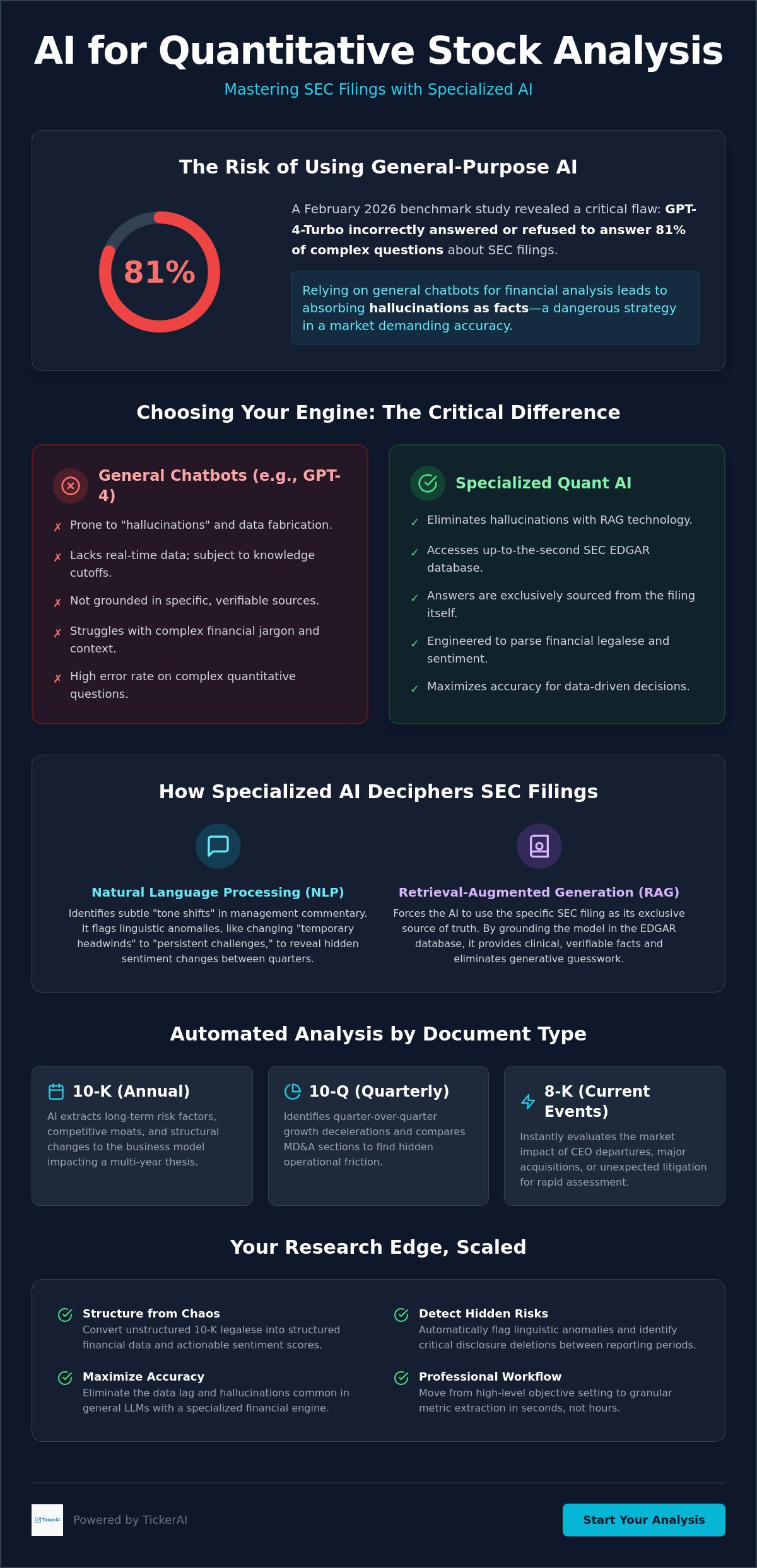
In a February 2026 benchmark study, GPT-4-Turbo incorrectly answered or refused to answer 81% of complex questions regarding SEC filings. This data point is a wake-up call for any participant relying on unrefined AI for quantitative stock analysis. If your current workflow involves pasting a 10-K into a general chatbot, you aren't just wasting time; you're likely absorbing hallucinations as fact. It's a dangerous way to operate in a market where speed and accuracy are the only currencies that matter.
We know the frustration of drowning in 100-page documents while missing the hidden risks buried in the footnotes. You need a repeatable research edge that doesn't sacrifice precision for pace. This guide provides a systematic process to master the use of AI for extracting market intelligence in seconds. We'll walk through the exact professional workflow for automated metric extraction, rapid year-over-year filing comparisons, and the detection of subtle disclosure shifts that manual readers often miss.
Key Takeaways
- Convert unstructured 10-K and 10-Q legalese into structured financial data and sentiment scores using specialized NLP and RAG technologies.
- Detect hidden risks by automatically flagging linguistic anomalies and identifying critical disclosure deletions between reporting periods.
- Maximize accuracy by utilizing specialized engines designed for AI for quantitative stock analysis to eliminate the data lag and hallucinations common in general LLMs.
- Implement a professional, repeatable workflow that moves from high-level objective setting to granular metric extraction in seconds.
- Scale your research by integrating filing insights into Smart Watchlists to monitor tickers with similar financial anomalies or regulatory shifts.
What is an AI Tool for Analyzing SEC Filings?
An AI tool for analyzing SEC filings is specialized software engineered to parse complex regulatory disclosures using Natural Language Processing (NLP) and Retrieval-Augmented Generation (RAG). It's a high-precision engine designed to navigate 10-K, 10-Q, and 8-K documents. This isn't a general-purpose chatbot. It's a professional-grade filter that converts dense, unstructured legalese into structured financial data and actionable sentiment scores. The primary function is to strip away the noise of corporate boilerplate to reveal the underlying fiscal reality.
The 2026 landscape has seen a definitive shift. We've moved from simple keyword searches to the semantic understanding of financial intent. Previous tools merely flagged the word "risk." Modern AI for quantitative stock analysis understands the context surrounding that risk, assessing whether it represents a standard legal hedge or a specific, emerging threat to cash flow. This evolution provides institutional-grade speed for retail investors. It's the core of automated stock market analysis, allowing users to scale their intelligence without increasing their hours at the desk.
The Core Technology: NLP and RAG
Natural Language Processing identifies subtle "tone shifts" in management commentary that a human eye might miss after hours of reading. If a CEO's description of "market headwinds" changes from "temporary" to "persistent" between quarters, the AI flags this linguistic anomaly immediately. To ensure accuracy, these tools utilize Retrieval-Augmented Generation (RAG). This architecture forces the AI to use the specific filing as its exclusive source. By grounding the model in the SEC EDGAR database, we eliminate the hallucinations that plague general LLMs. The result is a clinical, data-driven output that prioritizes verifiable facts over generative guesswork.
Key Document Types for AI Analysis
Effective analysis requires knowing which documents to feed the engine. The AI prioritizes different data points based on the filing type:
- 10-K (Annual Reports): The AI extracts long-term risk factors and competitive moats. It identifies structural changes in the business model that could impact a multi-year investment thesis.
- 10-Q (Quarterly Reports): These are used for identifying quarter-over-quarter growth decelerations. The tool compares the "Management’s Discussion and Analysis" (MD&A) section against the previous quarter to find hidden operational friction.
- 8-K (Current Events): This is about rapid assessment. When a company files an 8-K, the AI instantly evaluates the impact of CEO departures, major acquisitions, or unexpected litigation, providing a decision-ready summary in seconds.
By automating this ingestion process, the professional workflow moves from manual data entry to high-level strategy execution. You stop being a reader and start being an analyst.
How AI Deciphers Financial Legalese: The Discovery Mechanism
AI doesn't just process text; it scans for variance. In the high-stakes environment of AI for quantitative stock analysis, the most valuable signal is often a linguistic anomaly. If a company shifts its description of "supply chain stability" to "potential logistical constraints," the AI flags this as a cautious pivot before the market prices in the risk. This automated cross-referencing compares current filings against previous years to pinpoint exact deletions in risk disclosures. If a specific warning about a competitor or a product line vanishes, it's rarely accidental. It is data waiting to be exploited.
Assigning a numerical value to the Management Discussion and Analysis (MD&A) section transforms a subjective narrative into a systematic approach to stock investing. By quantifying the density of legal jargon versus plain English, AI scores the clarity of financial reporting. This discovery mechanism moves beyond simple summaries. It builds a data-driven narrative that allows you to act while others are still reading page ten. Clinical precision replaces manual guesswork.
Delta Analysis: The Secret to Alpha
The most critical information in a 10-K is frequently what management decides to stop saying. Manual readers struggle to track text changes across 100-page documents. AI tools solve this through delta analysis. They highlight every addition, deletion, and modification in real time. This is particularly vital in the "Material Changes" sections regarding revenue recognition or ongoing litigation. A subtle change in how a company defines "recognized income" or a new qualifier in a legal proceeding can be the first red flag of a deteriorating business model. You see the delta immediately. You act immediately.
Recent academic research, such as the study on AI Risk Disclosures in SEC Filings, highlights how rapidly these reporting patterns evolve. By monitoring these shifts, professional traders can detect institutional-level trends before they hit the headlines. This is the new standard for AI for quantitative stock analysis.
Quantifying Qualitative Data
Management optimism isn't a feeling; it's a metric. AI converts CEO commentary into a standardized sentiment index. This process filters out the corporate "fluff" and focuses on the objective weight of the statements. Does the tone match the balance sheet? If the sentiment index drops while earnings remain flat, the AI detects a divergence. This allows you to monitor Smart Watchlist & Alerts for tickers showing high obfuscation scores. You gain the ability to score the "honesty" of a filing, creating a significant edge in risk management. This proactive scouting ensures you aren't just reacting to the news, but anticipating the market's response to the disclosure.
Choosing Your Engine: General LLMs vs. Specialized Quant Tools
Selecting the right analytical engine is the difference between actionable alpha and expensive errors. Most retail traders default to general LLMs like ChatGPT or Claude because of their flexibility. However, these models suffer from significant data lag and a tendency to hallucinate under pressure. When performing AI for quantitative stock analysis, relying on a model with a knowledge cutoff from the previous year is a liability. You need real-time streams, not cached memories.
Specialized financial AI tools offer direct EDGAR integration. This ensures your data is pulled from the source seconds after a filing hits the public record. For swing traders, the "freshness" of an 8-K filing is non-negotiable. If you're waiting for a general model to update its index, the trade is already over. Balancing subscription costs requires a clear understanding of how to interpret AI stock signals. The value isn't just in the summary; it's in the speed and accuracy of the signal delivery.
The Hallucination Risk in Financials
General-purpose AI can invent EPS numbers or debt ratios if it isn't properly grounded. A February 2026 study published in the Fin-RATE benchmark revealed that GPT-4-Turbo incorrectly answered or refused to answer 81% of complex questions regarding SEC filings. This failure rate is unacceptable for professional research. Specialized tools mitigate this through "Source Attribution." You shouldn't trust a number unless you can click a link that takes you to the exact page and paragraph in the original filing. Professional verification protocols require this audit trail. Without it, your quantitative model is built on sand.
Integration with Quantitative Models
The most effective AI for quantitative stock analysis doesn't exist in a vacuum. It feeds filing data directly into technical chart pattern recognition. When an AI identifies a specific risk disclosure change, that insight should immediately populate your Smart Watchlist & Alerts. This creates a multi-factor setup where fundamental shifts are confirmed by price action. We prioritize discovery over simple summarization. The goal isn't just to tell you what management said. It is to identify the anomalies that will move the stock tomorrow. This integration turns static text into dynamic, tradable intelligence.
Step-by-Step: Building an AI-Powered SEC Analysis Workflow
Execution requires a systematic framework. To leverage AI for quantitative stock analysis effectively, you must move beyond casual questioning. A professional workflow treats the AI as a high-speed data excavator. This process filters out the 90% of boilerplate text that serves only as legal protection for the company, leaving you with the 10% of data that actually moves markets. Efficiency here isn't just about speed; it's about the clinical isolation of material facts.
- Step 1: Define your objective. Avoid vague prompts. Aim for specific targets like "Find liquidity risks in the technology sector" or "Detect changes in revenue recognition policy." Precision at the start dictates the quality of the output.
- Step 2: Input the ticker and select the target document. A 10-K provides the annual baseline. A 10-Q offers the quarterly pulse. Use both to establish a historical trend line.
- Step 3: Run targeted queries. Focus exclusively on the Management Discussion and Analysis (MD&A) and Risk Factors. These sections contain the highest concentration of non-standardized, qualitative data.
- Step 4: Validate the thesis. Cross-reference your findings with AI tools for long-term investors. This ensures your immediate discovery aligns with the broader institutional trend.
Phase 1: The Extraction Prompt
The prompt is your analytical lever. Use commands that force the AI to perform comparative logic. A high-value prompt sounds like this: "Compare the Risk Factors of this 10-K to the previous year and list all new additions or deletions." This immediately surfaces the "deltas" that indicate shifting corporate priorities. You should also instruct the AI to extract "off-balance sheet" arrangements and contractual obligations. These are often buried in dense tables or footnotes. Automated extraction brings them to the surface, allowing you to assess total debt exposure in seconds. Finally, summarize the "Legal Proceedings" section. Look for changes in the estimated liability or the arrival of new, aggressive litigation that could impact future earnings.
Phase 2: Validation and Action
Validation is the final safeguard. Given the hallucination risks inherent in general LLMs, you must verify the AI's summary against the original document text. Professional-grade tools provide side-by-side views for this purpose. Use them. Once verified, assess the market impact. Ask yourself: Is this a "hidden" catalyst, or has the price already adjusted? If the AI identifies a risk deletion that the market hasn't noticed, you have a potential entry point. The final step is execution. Set real-time alerts for subsequent 8-K filings to monitor the situation as it evolves. Upgrade to TickerAI Pro to start building your automated research workflow today.
Integrating Filing Insights into Your TickerAI Strategy
Execution is the final hurdle in any professional research process. Understanding how to prompt an engine is a foundational skill, but scaling that process across a thousand tickers requires a platform built for speed. TickerAI transforms the theoretical workflow into a functional advantage by automating the "Discovery" phase of SEC research. It doesn't just provide access to documents. It acts as a proactive scout, filtering the noise of the EDGAR database to surface the specific anomalies that drive price action. This is the practical application of AI for quantitative stock analysis. It bridges the gap between raw data and executed trades.
The platform allows you to move beyond the limitations of manual reading. By using Smart Watchlist & Alerts, you can group companies based on specific filing characteristics, such as unusual changes in debt covenants or shifts in revenue recognition. When a new filing matches your criteria, the system flags it immediately. You stop hunting for data and start reacting to it. This transition from "reading" to "acting" is what separates the casual trader from the professional participant. TickerAI Pro provides the infrastructure necessary to maintain this edge consistently across every reporting cycle.
From Data to Discovery
TickerAI scans for momentum breakouts that align with positive filing sentiment. It identifies "Institutional Buying" signals that often precede major filing disclosures. These signals act as a lead indicator, suggesting that smart money is positioning itself before the qualitative data hits the public record. By combining technical indicators with sentiment scores from MD&A sections, the platform reduces analysis paralysis. You aren't looking at a wall of text. You're looking at a prioritized list of high-probability setups. The goal is to focus your cognitive energy on decision-making rather than data entry. Clinical precision replaces the exhaustion of manual 10-K reviews.
Next Steps for the Active Trader
The path to a repeatable research edge begins with a structured setup. Start by configuring your first Smart Watchlist based on recent 10-Q filings within your target sector. Look for companies showing linguistic deltas in their risk disclosures, as discussed in previous sections. Once your parameters are set, monitor real-time alerts for 8-K "surprise" events. These current reports often contain the catalysts for rapid swing trade setups. TickerAI Pro serves as the final step in an automated stock market research workflow, ensuring you never miss a material disclosure. Join TickerAI to automate your market discovery today.
Secure Your Analytical Edge
The era of manual document review is over. Success in the 2026 market depends on your ability to isolate material changes in risk disclosures and sentiment shifts before the broader market reacts. By implementing a systematic workflow and choosing specialized engines over general-purpose chatbots, you eliminate the risk of hallucinations while gaining institutional-grade speed. This transition to AI for quantitative stock analysis is no longer optional for those seeking alpha in a high-frequency environment. It's the new standard for professional discovery.
You need a partner that filters the noise and prioritizes action. Discover high-potential market movements with TickerAI's AI-driven alerts. Our platform provides real-time market alerts, curated swing trade setups, and institutional-grade automated scanning to ensure your research stays ahead of the curve. Stop reading boilerplate and start executing on intelligence. Your next discovery is waiting in the data. Move with precision and confidence.
Frequently Asked Questions
Can AI tools for SEC filings accurately read financial tables?
Specialized AI tools utilize advanced layout-aware parsing to accurately read financial tables. General-purpose models often fail here because they treat documents as a flat string of text, losing the spatial context of the data. Professional-grade AI for quantitative stock analysis preserves the structural integrity of balance sheets and cash flow statements. This ensures that the relationship between line items and their corresponding values remains intact. Always verify table data through source links provided by the tool.
Is it legal to use AI for stock market research?
Using AI for research is entirely legal, provided you comply with standard securities laws regarding material non-public information. The SEC established an AI Task Force in August 2025 to monitor algorithmic transparency and prevent "AI washing." This means firms must be honest about how their models function. For the individual trader, using AI to parse public filings is a legitimate way to gain a competitive edge. It simply automates the extraction of public data.
How do I know if an AI tool is hallucinating financial data?
You identify hallucinations through rigorous source attribution. Professional tools ground their responses in the SEC EDGAR database, providing a direct link to the specific page and paragraph used for extraction. If a tool provides a metric without a clickable reference, treat it with skepticism. High-quality AI for quantitative stock analysis forces the model to cite its work. This transparency is the only reliable way to confirm that the AI hasn't invented an EPS figure or a debt ratio.
What is the difference between a 10-K and a 10-Q in AI analysis?
A 10-K provides a comprehensive annual baseline, while a 10-Q offers a quarterly pulse on operational velocity. In AI analysis, the 10-K is used to establish long-term risk factors and structural moats. The 10-Q is analyzed for "deltas" or changes in sentiment compared to the previous quarter. AI engines run comparative logic across these documents to identify where management is getting more cautious or where growth decelerations are beginning to surface.
Do I need coding skills to use an AI tool for SEC filings?
You don't need coding skills to utilize professional SEC analysis tools. Most platforms feature intuitive, chat-based interfaces or structured dashboards designed for financial analysts rather than developers. The focus is on financial literacy and the ability to craft precise analytical prompts. While Python can help with custom API integrations, the primary value of these tools—and intelligent research workspaces like Clarami—is their ability to deliver institutional-grade intelligence to users who prefer a streamlined, no-code environment.
Which SEC filing is most important for identifying swing trade setups?
The 8-K is the most critical filing for identifying immediate swing trade setups. It reports material events like CEO departures, major acquisitions, or litigation updates in real-time. While 10-Qs provide quarterly catalysts, the 8-K triggers the sudden volatility that swing traders exploit. AI tools monitor these "surprise" events, parsing the text in seconds to determine if the news is a bullish or bearish catalyst before the broader market reacts.
How often does the SEC EDGAR database update for AI tools?
Professional AI tools update in real-time by connecting directly to the SEC EDGAR RSS feed. This allows the system to ingest and analyze a filing within seconds of it becoming public. Speed is the primary advantage here. If you're using a tool that relies on periodic data refreshes, you're operating with stale information. Ensure your engine provides instantaneous access to 8-K and 10-Q documents to maintain your research edge in fast-moving markets.
Can AI detect fraud in SEC filings?
AI cannot legally prove fraud, but it's highly effective at detecting the linguistic red flags that often precede it. By calculating obfuscation scores and identifying shifts from plain English to dense, defensive legalese, AI flags filings that lack transparency—a rigorous approach to financial integrity also championed by AML Partners for Australian businesses. It also detects inconsistencies between management's verbal commentary and the actual financial disclosures. These anomalies act as a proactive warning system, allowing you to avoid high-risk tickers before a formal investigation begins.


