

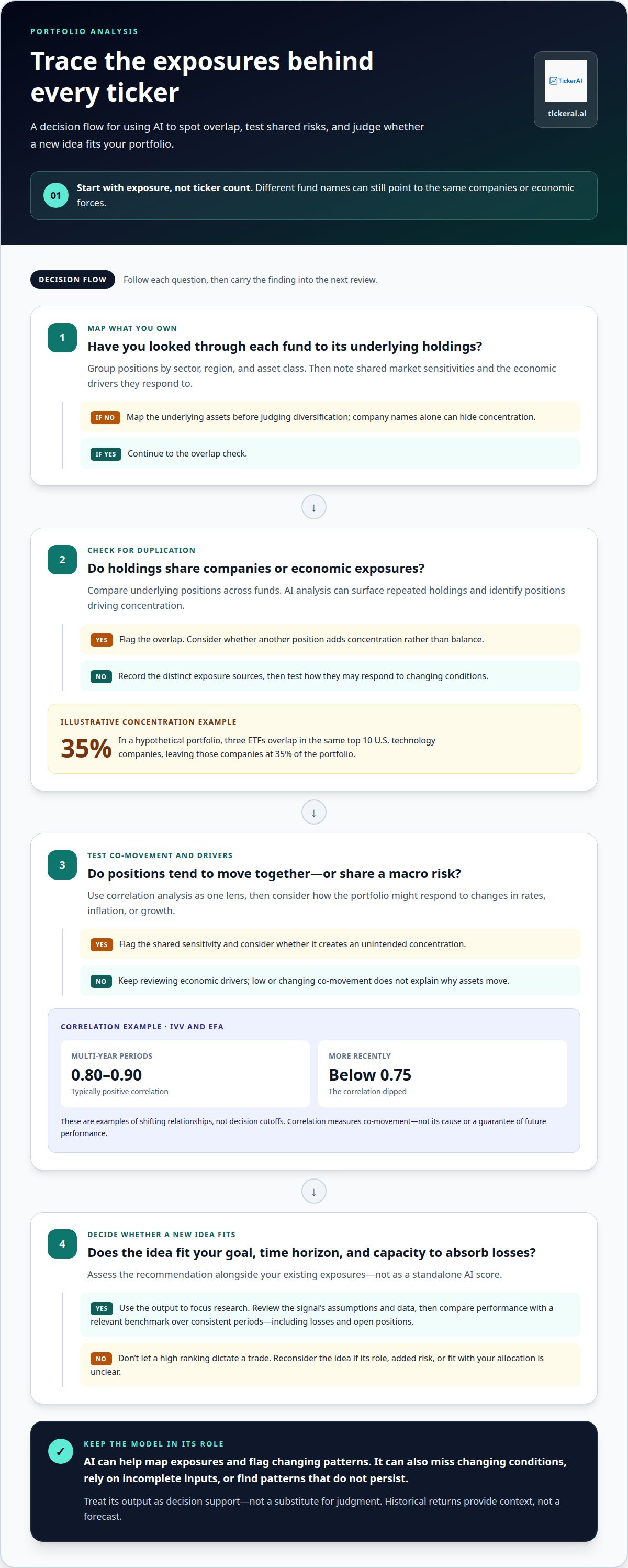
More tickers don’t necessarily mean more diversification. Creating a diversified portfolio with AI picks starts by measuring shared exposures, not counting holdings: in a hypothetical portfolio, three ETFs overlap in the same top 10 U.S. technology companies, leaving those companies at 35% of the portfolio. AI can help reveal this concentration and other macro risks that may be less obvious from ticker names alone.
It’s sensible to want a portfolio spread across assets, sectors, and regions. But adding holdings without assessing how they respond to the same economic forces can add complexity without meaningfully changing risk. This article explains how AI can help map those exposures, inform allocation decisions, and prevent common portfolio-building mistakes. You’ll see why reviewing overlap matters as much as finding new investments, and how to keep a portfolio clear enough to monitor.
Key Takeaways
- Assess how holdings respond to shared economic forces, not just how many tickers you own.
- Use AI analysis to identify macro exposures and inform allocations that fit your goals and investment horizon.
- Revisit your portfolio when your goals or financial circumstances change, rather than reacting to every headline.
- Look for overlapping exposures before adding investments, so diversification doesn’t become unnecessary complexity.
1. Understanding allocations and holding amounts
Start with a target mix across asset classes, then assign each holding a weight. An allocation described by the Office of the Federal Register, National Archives and Records Administration includes cash, fixed income, domestic equity, and international equity. The right mix depends on your goal, time horizon, and ability to tolerate losses.
International exposure deserves its own review. Before adopting advice, 65% of previously self-directed investors had no international allocation, while eight in ten held 10% or less internationally. Their median international allocation later climbed to around 35%. These figures illustrate how advice can surface a geographic concentration that ticker counts may hide.
In the U.S., tax treatment depends on account type, distributions, and whether rebalancing sells an investment at a gain or loss. An AI signal doesn’t determine your tax position. Consider the transaction and account context when assessing its implications.
To assess an AI investing service, identify its legal entity and search the applicable official financial-services register for its registration status. Review its privacy policy, data permissions, retention practices, and options for limiting or removing personal information.
A diversified portfolio can include cash, fixed income, domestic equities, and international equities. It may also include other asset classes when they fit your goals and risk capacity. Adding an asset solely to increase the number of holdings isn’t diversification.
Evaluate AI stock picks using dated recommendations and their subsequent outcomes. Compare them with a relevant benchmark, and review losses as well as gains across different market conditions. Separate closed positions from open recommendations so you can see clearly what happened.
Measure diversification by reviewing portfolio weights across sectors, industries, regions, and asset classes. Look through funds to their underlying holdings, then assess whether positions share economic exposures or tend to move together. This can reveal concentrations that company names alone obscure.
Choose allocations by matching your goal and time horizon with your capacity and willingness to absorb losses. Age can inform your time horizon, but it doesn’t set a universal stock-and-bond mix. Near-term spending needs and financial flexibility matter too.
Set a rebalancing schedule based on your target allocation, and review it when your goals or finances change, not after every headline. AI can miss changing conditions, rely on incomplete inputs, or identify patterns that don’t persist. Treat its output as decision support, not a substitute for judgment.
2. AI-based portfolio analysis
AI can map holdings by sector, region, asset class, and shared market sensitivities. Start by examining the underlying assets in each fund, then group exposures that respond to similar economic drivers. This helps distinguish a portfolio with genuinely different risk sources from one holding securities tied to the same market trend. For investors creating a diversified portfolio with AI picks, an exposure map can show where new ideas may add concentration rather than balance.
Correlation analysis adds another layer. IVV and EFA have typically shown a positive correlation between 0.80 and 0.90 over multi-year periods, while their correlation has recently dipped below 0.75. These figures illustrate why relationships between holdings can shift. A model can flag changing correlations, but correlation measures co-movement, not its cause or a guarantee of future performance.
Use a repeatable review: map each holding to its main exposures, measure overlap, then consider how the portfolio might respond to changes in rates, inflation, or growth. For example, funds with different names may still hold many of the same companies. AI analysis can surface that duplication and identify positions driving concentration.
AI-generated stock picks and broad-market index funds serve different roles. A pick may identify a specific opportunity, while an index fund provides exposure to a wider market segment. Compare each recommendation with a relevant benchmark and assess performance over consistent periods, including losses and open positions. Historical returns provide context, not a forecast.
A disciplined process for creating a diversified portfolio with AI picks uses model outputs to focus research, not dictate trades. Review the assumptions and data behind a signal, then decide whether it fits your goals and existing exposures. For a focused scan of potential opportunities, AI stock opportunity discovery can help surface ideas for further evaluation.
3. Common portfolio-building mistakes
A common mistake is treating an AI score as a complete investment thesis. A high ranking may reflect momentum or another model input, but it doesn’t explain how a position fits your objective. Before acting, identify the signal behind the pick, the risk it adds, and the role it would serve in your portfolio. If you can’t describe that role, the recommendation may not belong in your allocation.
Another error is assuming assets with different labels will offset each other during stress. In the 2022 rate-hike cycle, growth stocks and long-term bonds both lost value as interest rates rose quickly. That episode shows why an allocation should be assessed against economic drivers, not just asset names. Consider how each holding could respond to changes in rates, inflation, and growth.
Investors can also chase new signals without setting a position-sizing rule. Buying every highly ranked stock, for example, may leave one theme dominating the portfolio. Decide how much exposure a new idea can add, then assess its impact alongside existing holdings. Even a compelling recommendation needs to fit your intended risk budget.
Frequent changes prompted by headlines can turn a long-term plan into reactive trading. Revisit your allocation when your goals or finances change, not after each market story. A new savings need, a changed time horizon, or reduced capacity to absorb losses can justify a review. A dramatic headline alone doesn’t mean your strategy has changed.
Don’t confuse activity with progress. Replacing holdings repeatedly can make it harder to understand what drives results and why a position remains in your portfolio. Keep a concise record of each decision: its purpose, the assumption behind it, and what would prompt a review. This discipline supports more consistent decisions and highlights recommendations that no longer fit their original rationale.
4. Over-diversification and portfolio complexity
Adding holdings can create the appearance of diversification without changing underlying portfolio risks. Three ETFs, for example, may track different indexes yet hold many of the same companies. That means duplicated exposure, not three independent sources of return. Review fund holdings alongside ticker names to see what each position actually contributes.
Complexity also makes it harder to identify what drives performance. If a portfolio contains funds with overlapping sectors, regions, and market sensitivities, it may be difficult to trace a loss to its source. AI analysis can group positions by underlying exposure and flag holdings that serve nearly identical roles, making the portfolio easier to interpret.
Use a practical test before adding a new investment: identify its intended role, compare its underlying exposures with existing holdings, and decide what risk it changes. If it adds no distinct exposure or useful function, it may increase monitoring demands without improving the allocation. A holding should earn its place through its contribution, not its novelty.
More positions also mean more decisions to track. Each holding can have different performance patterns, rebalancing effects, and potential tax consequences when sold. Keep the portfolio manageable by consolidating positions that duplicate a role while preserving exposures that serve distinct goals. Simplicity doesn’t mean holding only one type of asset; it means understanding why each position remains.
The central trade-off is breadth versus clarity. Diversification can reduce dependence on a single company or market driver, but extra holdings don’t automatically reduce concentration. Use exposure analysis to find duplication, then retain positions with clear, complementary roles. To explore potential investments with a defined portfolio role, review AI-screened stock ideas.
TickerAI
TickerAI helps investors find and monitor stock ideas while assessing portfolio exposure. Its AI Stock Opportunity Discovery, Swing Trade Setups, Smart Watchlist & Alerts, and Long-Term Investment Ideas support research across different investing approaches. Use these tools to surface candidates and track market activity, then assess each idea against your allocation, risk tolerance, and existing holdings.
TickerAI can be a useful next step when you want a more structured flow of ideas without treating every signal as an instruction to trade. Keep portfolio decisions anchored to your goals and the role each holding serves. Explore TickerAI for AI-generated opportunities to review.
Put Your Next Portfolio Decision to Work
Make your next move a deliberate test of your investment process. Before acting on a new idea, define what would make it relevant: its role, the exposure it adds, and the evidence that would change your view. This keeps AI output within a decision framework rather than turning every signal into another holding. Creating a diversified portfolio with AI picks works best when analysis supports your goals and you retain responsibility for your decisions.
TickerAI can help you find ideas through AI Stock Opportunity Discovery, review Swing Trade Setups, and track candidates with Smart Watchlist & Alerts. Use these as inputs when evaluating potential positions, not as instructions to change your allocation automatically. Focus your research on the exposures you want to understand and the investment decisions ahead.
Contact TickerAI about your portfolio to explore a more focused way to surface and monitor stock ideas. Move forward with a clear process and make each decision count.
Frequently Asked Questions
How can AI help identify portfolio macro risk exposure?
AI can map holdings to shared sensitivities, such as energy prices, currency movements, credit conditions, and interest rates. It can also connect company-level data, such as input costs or overseas revenue, to those drivers. For example, you can assess whether several holdings depend on strong consumer spending. The resulting exposure map helps explain which economic changes could affect multiple positions at once.
How can AI tools detect hidden correlations that manual analysis might miss?
AI tools can compare return patterns across individual securities and the underlying holdings in funds, rather than relying on fund names. They can also examine relationships in different market conditions, revealing that two assets may behave differently in calm periods than during sharp declines. For example, a broad fund and a sector fund may share influential companies despite tracking distinct indexes.
How can AI tools help avoid over-diversification?
AI can flag positions that add little distinct exposure or portfolio function. To review, group holdings by role and check whether each new position contributes something different, such as geographic exposure or a separate source of income. If two funds repeatedly serve the same purpose, scrutinize the value of holding both. This focuses decisions on contribution rather than the number of holdings.
How do hidden correlations undermine the effectiveness of diversification during downturns?
Hidden correlations can cause investments that seemed independent to fall together during a market sell-off. Shared funding pressures, investor withdrawals, or exposure to the same economic shock can connect otherwise different assets. Losses may then affect several positions at once. Reviewing how holdings behaved during stressed periods can reveal these links and clarify where diversification rests on assumptions that could break.
How should investors aim to balance diversification, cost, and simplicity?
Prioritize exposures with a clear portfolio purpose, then weigh their expected contribution against ongoing expenses and management effort. Fund expense ratios, trading spreads, and frequent transactions can erode the value of small or overlapping positions. A focused portfolio is easier to monitor, but simplicity shouldn’t mean relying on one market driver. Keep holdings whose distinct roles justify their cost and attention.
What are the downsides of over-diversification?
Over-diversification can dilute the impact of successful positions while adding research, monitoring, and rebalancing work. It can also obscure concentrations: several funds may look varied while depending on similar companies or economic drivers. For example, a crowded collection of narrow funds can be harder to understand than a smaller group of clearly differentiated exposures. The key downside is complexity without a meaningful change in portfolio risk.


