
Institutional trading capabilities aren’t all-or-nothing. Institutional grade tools for retail investors can include real-time market data, analytics, professional charting, automation, and risk controls. These tools help individuals assess market activity and apply a strategy more consistently, but they don’t provide every advantage of an institutional trading desk.
It’s reasonable to expect more than a stream of charts and alerts. A tool’s value depends on how it supports decisions: Does it clarify market signals, make research easier to act on, and keep risk in view? Technology can support a process, but it can’t remove market risk or replace sound judgment.
This article explains what institutional-grade trading and research tools can offer retail investors and how to assess automation, AI analysis, risk management, and backtesting. It also covers how execution capabilities differ, which features matter for your approach, and how to tell whether a tool adds useful insight or just more noise.
Key Takeaways
- Assess trading tools by how well they support your strategy, execution needs, and decision-making, not by how sophisticated they sound.
- Compare the information and market access available to retail investors with institutional capabilities to identify where the practical differences matter.
- Use automation and risk controls to reinforce a trading plan, while understanding how assumptions can affect AI analysis and backtesting.
- Explore how curated trade setups, watchlists, alerts, and investment ideas can help turn market research into a more organized workflow.
Trading strategies and execution capabilities
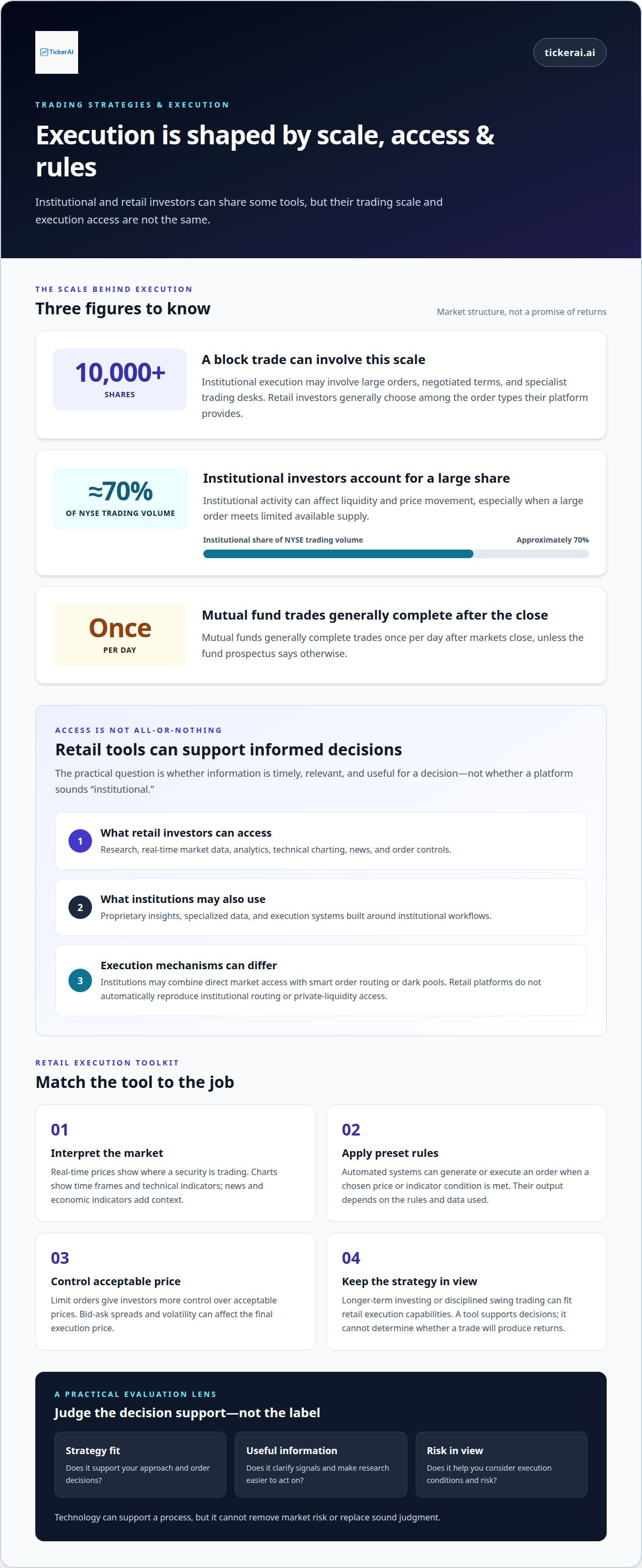
Institutional execution can involve negotiated terms, specialist trading desks, and large orders. A block trade, for example, may involve 10,000 shares or more. Corporate trading agreements establish terms between participating parties, shaping how an order is handled. These arrangements differ from ordinary retail order entry, where investors generally choose from the order types available through their trading platform. Private pension plans in the United States are subject to the Employee Retirement Income Security Act of 1974 (ERISA), according to the U.S. Department of Labor.
Scale influences execution. Institutional investors account for approximately 70% of NYSE trading volume. Their activity can affect liquidity and price movement, especially when a large order meets limited available supply. Retail investors can’t replicate a dedicated trading desk or negotiated institutional terms. They can still choose strategies that fit their execution capabilities, such as longer-term investing or disciplined swing trading. Mutual funds generally complete trades once per day after markets close, unless the fund prospectus says otherwise.
Market data, news, and analytics help investors interpret changing conditions. Real-time prices show where a security is trading, while charting tools display multiple time frames and technical indicators. Financial news and economic indicators add context, and analytics can help identify patterns or potential setups. These inputs inform decisions, but they can’t determine whether a trade will produce returns.
Retail-accessible automated trading systems can apply preset criteria without constant monitoring. Depending on its capabilities, a system might generate or execute an order when a chosen price or indicator condition is met. Automation makes a strategy more consistent, but its output still depends on the rules and data used. For manual execution, limit orders give investors more control over acceptable prices. Bid-ask spreads and volatility also matter: a wide spread or sharp price movement can affect the final execution price. Assess each tool by how it supports your strategy, market analysis, and order decisions, not by institutional-style branding alone.
Institutional and retail investor access to tools and information
Institutions and individuals can use overlapping platforms, but access isn’t identical. Retail investors can access research, real-time market data, analytics, and technical charting. Institutional investors may also use proprietary insights, specialized data, and execution systems built around their workflows. The practical distinction isn’t simply “professional” versus “basic.” It’s whether a tool provides timely, relevant information and helps turn it into a decision.
Direct market access gives an investor a more direct route to an exchange. Institutions may combine it with smart order routing, which directs orders across venues, or dark pools, which seek liquidity without publicly displaying trading intentions. These mechanisms address execution needs that differ from research access. Retail platforms can still offer useful market information and order controls, but they don’t automatically reproduce institutional routing or access to private liquidity.
Information timing requires careful interpretation. Public company announcements and filings can move markets as investors respond. Alerts and news feeds can help retail users notice a public update and assess its relevance, but they don’t provide advance access to proprietary institutional research. Compare sources by what they cover: company disclosures provide primary details, financial news adds context, and technical analytics show price and volume patterns. Combining sources can reveal opportunities while reducing reliance on a single signal.
Education and human oversight complete the workflow. Webinars, tutorials, and online courses can explain concepts such as market depth or order routing. Automation can then filter watchlists or flag conditions, while the investor evaluates context before acting. For example, a price alert may identify a move, but a person can review the associated news and broader trend. This hybrid approach keeps the tool focused on monitoring and insights, with judgment remaining central. Investors seeking a more organized discovery workflow can explore AI-driven stock opportunity discovery as one way to surface market opportunities for review.
Automation, discipline, and risk management
Automation can turn a trading plan into repeatable order rules. A system may stage an order when a defined price or indicator condition occurs, then apply preset limits. Automated systems apply risk parameters consistently, while professional traders may deviate from their rules. This control is useful only when the rule reflects the intended strategy. A faulty threshold can repeat the same mistake every time it triggers an order.
Order management tools help individuals track open orders, fills, and exposure across an equity portfolio. Routing tools can direct orders according to preset instructions, but routing doesn’t remove execution risk or guarantee a particular outcome. Risk controls can include stop-loss orders, diversification, and risk assessment models. For example, an investor can review whether a single position dominates portfolio exposure before adding to it. This analysis helps keep capital allocation aligned with the chosen plan.
Retail platforms with portfolio analytics, risk modeling, and backtesting differ in the questions they answer. Portfolio analytics summarize current exposure; risk models estimate how positions may respond to market changes; and backtesting evaluates how a strategy would have performed using historical data. Together, they provide a broader view than any single feature. Before relying on the output, compare the assumptions each tool uses, the portfolio details it displays, and how clearly you can interpret its results.
Institutional-grade tools can also introduce complex risks for retail users. A model built on historical prices may not reflect future market conditions, while missing or inaccurate inputs can distort analysis. Automation can execute an unintended trade if its trigger or order size is configured incorrectly. Risk models organize uncertainty, but they don’t eliminate it. Use their outputs to examine exposure and test assumptions, not as a substitute for understanding the strategy.
AI-driven analysis and strategy backtesting
AI analysis can scan financial data, company news, and price activity to surface patterns for further review. For fundamental analysis, an investor might examine revenue trends, debt, and cash flow alongside market conditions. A financial model organizes those inputs into assumptions about a company’s performance. AI can help filter large volumes of information, but the quality of its insights depends on the data and criteria used. Treat a potential opportunity it identifies as a prompt for analysis, not a standalone decision.
Backtesting evaluates a strategy against historical market data. For example, a trader can test whether a moving-average rule would have triggered trades in earlier market conditions. The result depends on the period tested, data quality, and assumptions about execution. Even a sophisticated model can mislead if it excludes relevant conditions or fits past patterns too closely. Use backtesting to compare a strategy’s behavior across different market environments, not to assume historical returns will repeat.
Pre-trade analysis helps define a potential entry, exit conditions, and risk exposure before placing an order. Post-trade analysis reviews the actual execution against the plan. A trader might compare the intended entry with the filled price and assess whether the strategy’s signal matched the broader trend. That review turns each trade into useful feedback. Understanding financial statements, technical indicators, and model assumptions also helps investors interpret AI outputs rather than accept them without context.
Hedge funds may use sophisticated modeling capabilities, but the useful benefit for individual investors is clearer analysis, not complexity for its own sake. Focus on whether a tool explains its signals, supports repeatable evaluation, and helps you review decisions before and after trades. To apply structured analysis to potential setups, explore AI-driven trade ideas.
TickerAI
TickerAI helps retail investors organize market research around potential opportunities, trade setups, and longer-term ideas. Its AI Stock Opportunity Discovery, Swing Trade Setups, Smart Watchlist & Alerts, and Long-Term Investment Ideas can support different research needs. Use these offerings to review curated market signals alongside your own analysis, rather than relying on a single chart or alert. They offer a practical way to assess how AI-supported tools fit into your research workflow. Choose insights that match your time horizon and approach, then evaluate them against your own risk criteria. Contact TickerAI to explore how its tools can support your research.
Build a research process that fits your next move
The right institutional grade tools for retail investors should fit the decisions you need to make, not add complexity for its own sake. Give each tool a clear purpose: surface ideas, monitor developments, or structure your review. Then decide how its output will inform your independent analysis. Connecting insight to action is how a disciplined workflow takes shape.
TickerAI can support your research with AI Stock Opportunity Discovery, Swing Trade Setups, and Smart Watchlist & Alerts. Use these tools to bring potential market developments into focus and decide what merits further attention. Keep your strategy, time horizon, and risk criteria at the center of every decision.
Ready to explore how these capabilities could fit your approach? Contact TickerAI to explore your options and take the next step toward a more focused research workflow.
Frequently Asked Questions
What tools do institutional investors use that are available to retail investors?
Retail investors can access charting, market data, alerts, AI-supported research, and portfolio analysis tools. These institutional-grade tools for retail investors can support research without replicating a fund’s full trading infrastructure. For example, TickerAI offers AI Stock Opportunity Discovery, Swing Trade Setups, and Smart Watchlist & Alerts. Treat research tools and brokerage order execution as separate functions when building a personal trading workflow.
What are the best tools for institutional-quality market data, news, and research for individual investors?
The right fit depends on the decision you need to make. For a company-specific review, prioritize financial statements, earnings materials, and relevant news. For market timing, focus on current prices, volume, and charting. Compare platforms by the securities and data they cover, how clearly they distinguish source information from analysis, and whether you can trace an insight back to its context.
How can retail investors access options analytics, volatility data, and professional-grade charting?
Use a market platform that displays options-chain information, volatility measures, and configurable charts within one research workflow. For an options contract, examine how its price and volatility change alongside the underlying stock, then compare chart intervals and technical indicators to understand the broader trend. Check that data timing and definitions are clear, since delayed or differently calculated metrics can affect interpretation.
How should you choose and set up professional investing tools for a U.S. retail account?
Start with your investing approach, then choose tools that support its research needs rather than adding every available feature. Set up a focused watchlist, choose alerts tied to relevant events or price conditions, and keep research separate from order placement. Before relying on automated signals, review sample outputs and test your workflow without committing capital. Keep investment decisions aligned with your own risk limits.


