

A fast-rising microcap can be a warning, not an opportunity. Pump-and-dump schemes follow a pattern: promoters inflate a stock’s price with misleading claims, then sell their holdings at the elevated price. To reduce your exposure and understand how to avoid pump and dump schemes, slow down and independently verify the company, its disclosures, and the reasons behind the price move.
Urgency is part of the risk. Promotions may frame hesitation as a missed opportunity, while a sudden spike can leave buyers exposed when the hype fades. Wanting a clear signal before committing capital is reasonable, but a persuasive post, private chat, or confident forecast is not evidence on its own.
This guide explains how these schemes work and how to assess microcap stocks, online promotions, and investment claims through independent research. You’ll learn which warning signs merit scrutiny, how to compare company claims with filings and trading history, and why relying on a tip or trying to time a promoter’s exit can expose you to losses.
Key Takeaways
- Look beyond a sudden price move: compare the company’s claims with its filings, financial statements, and longer-term trading history.
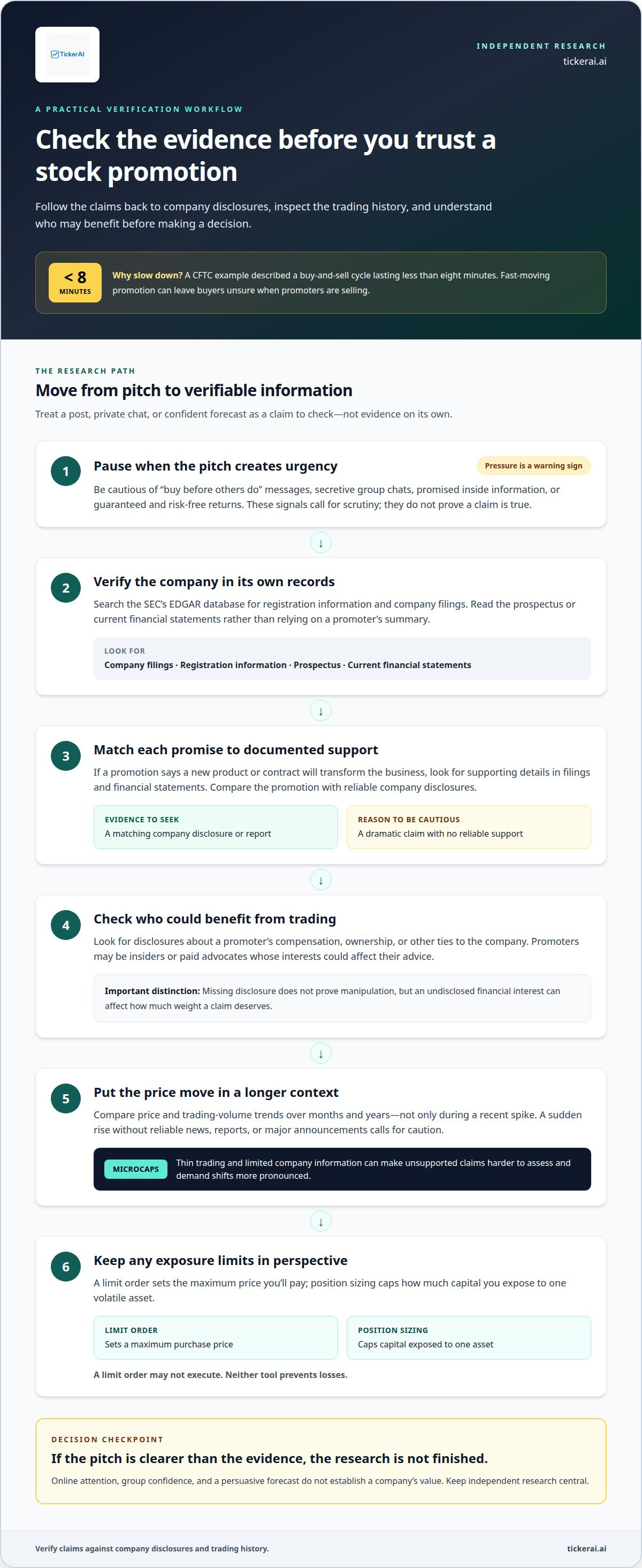
- Treat urgent tips, secretive group chats, and promises of inside information as reasons to pause and investigate independently.
- Check whether a promoter could benefit financially from trading, and weigh their claims against reliable company disclosures.
- Use AI-powered stock discovery and watchlist tools to organize market signals, while keeping independent research central to your decision.
What is a pump-and-dump scheme?
A pump-and-dump scheme uses misleading promotion to inflate an asset’s price before promoters sell. The manipulation can leave later buyers holding shares or tokens after demand collapses.
How the Scheme Works
A pump-and-dump scheme promotes an asset to drive up its price, allowing insiders or promoters to sell at a profit. Buyers may mistake online attention for evidence of a company’s value. Promoters can circulate false or misleading claims about products, contracts, or future growth. When investors buy in response, their demand can push the price higher, while the promotion may hide who benefits. A compelling message does not prove its claims are accurate.
The Pump and Dump Phases
The pump phase uses misleading positive information to attract buyers and push the price upward. Promotions may target microcap shares, where thin trading can make demand shifts more pronounced. The dump phase begins when promoters sell their holdings at the inflated price. As the hype fades and selling continues, the price typically falls. The two phases can move quickly: a CFTC example described a buy-and-sell cycle lasting less than eight minutes. That speed makes it difficult for buyers to know when promoters are leaving.
Virtual currency schemes can follow the same pattern. A group may hype a coin or token online, urge members to buy, and create a burst of demand. Organizers can then sell their holdings while later buyers face falling prices. A token’s newness or a chat group’s confident promises do not establish its value.
In the United States, market manipulation is against the law, and the CFTC advises customers not to participate in pump-and-dump trades. Enforcement actions can involve monetary sanctions. According to the Commodity Futures Trading Commission, a whistleblower may be eligible for an award of 10% to 30% if original information leads to a successful enforcement action resulting in monetary sanctions of at least $1 million.
If you’ve already bought an asset you suspect was manipulated, preserve promotional messages and transaction records, and don’t act on further urgent pitches. Report suspected stock manipulation to FINRA and local law enforcement. If the suspected scam was cyber-enabled, report it to the FBI’s Internet Crime Complaint Center.
Independent research and due diligence
Independent research helps separate documented information from claims designed to create demand. Compare what the issuer reports with the promotion before acting.
Researching Companies and Assets
Research means reviewing a company’s filings, financial statements, and trading history before deciding whether its shares merit attention. Thinly traded companies may disclose limited information, making unsupported claims harder to assess. Search the SEC’s EDGAR database for registration information and company filings, then read the prospectus or current financial statements. Compare price and volume trends over months and years, not just during a recent spike.
Evaluating Investment Claims
Test each specific promise against reliable company disclosures. If someone says a new product or contract will transform a business, look for supporting information in its filings and financial statements. A sudden price rise without reliable news, reports, or major announcements calls for caution. Guaranteed, risk-free, or extremely high returns are warning signs, not proof of value. Treat online stock offers as scams unless independent research establishes their legitimacy.
Checking Paid Promotion
Check whether a stock promoter has an incentive that could shape their advice. Promoters may be company insiders or paid advocates who benefit financially when investors trade. Look for disclosures about compensation, ownership, or other ties, then compare the promotion with public company filings. Missing disclosure does not prove manipulation, but an undisclosed financial interest can affect how much weight a claim deserves.
For digital coins and tokens, research the asset and the entities behind it. The CFTC advises against buying virtual currencies, coins, or tokens based on a single tip, especially one shared on social media. A group’s confidence cannot establish an asset’s value or legitimacy.
Limit orders set the maximum price you’ll pay, while position sizing caps how much capital you expose to one volatile asset. A limit order may not execute, and neither tool prevents losses, but both can help constrain exposure.
For a broader research workflow, explore long-term investment ideas alongside your independent review.
Promotion through social media and encrypted messaging
Social media can quickly turn a stock tip into buying pressure. Forums and private chats can make coordinated promotion look like independent enthusiasm.
Promotion in Social Media and Chat Groups
Promoters use public posts and encrypted groups to circulate claims about a security. WhatsApp, Telegram, and Discord chats may be presented as exclusive sources of market insight. A message might claim someone has inside information about positive company news, then urge members to buy before others do. That urgency can create demand and obscure who is behind the promotion. A large group or confident tone does not establish that the information is legitimate.
Avoiding Social Media Tips
Avoiding social media tips means treating posts and chat messages as leads to investigate, not instructions to trade. The UK Financial Conduct Authority advises checking investment information through reliable sources rather than relying on social media or group chats. Don’t share personal or investment details with strangers offering advice. If a message names a company announcement, look for the announcement in the company’s own disclosures before acting.
Impersonation adds another layer of risk. Fraudsters may use AI-generated videos or deepfakes that appear to show public figures endorsing an asset. A familiar face is not proof of a genuine endorsement. Check whether the person’s official channels or the company have published the same claim independently. The UK Financial Conduct Authority advises that suspicious group chats can be reported to Action Fraud.
Scalping a promoted stock means trying to profit from short-term price swings. But you can’t know when promoters will sell, and thin trading can make it difficult to exit as demand falls. A rapid rise in social media activity is not a reliable timing signal. Don’t treat a brief spike in posts or trading volume as proof that another profitable move will follow.
Before acting, separate the original claim from repeated reposts. Trace it to a company disclosure or another reliable source, and notice whether the post pressures readers to buy immediately. Pausing helps distinguish verifiable information from promotion designed to influence demand for a security.
How can I check whether a financial influencer or promoter is being paid to promote an asset?
Separate disclosed compensation from clues that suggest a financial interest. Stock promoters may be company insiders or paid advocates who could benefit when investors trade. That possibility doesn’t prove a post is misleading, but it is a reason to scrutinize its claims and timing.
Review the influencer’s post, profile, linked pages, and any attached campaign materials. Look for clear disclosures about sponsorship, payment, ownership, or another relationship with the company. Then search company filings and announcements for references to promotion, investor-relations activity, or the promoter. A missing disclosure alone doesn’t establish payment. Treat it as a reason to seek evidence, not as a verdict.
Compare the promotion with independent company information. If an influencer claims a new contract or product will drive growth, look for the same details in company disclosures or current financial statements. Note whether multiple accounts repeat identical claims, use the same promotional materials, or urge immediate purchases. These patterns can help you assess coordination, but don’t prove who paid whom.
Check credentials separately from compensation. If someone claims to be a FINRA-registered professional, use BrokerCheck to confirm their identity and registration. Contact the firm using the number listed in BrokerCheck or on its public website, not a number supplied by the person messaging you. Registration does not establish that a particular stock recommendation is unbiased or suitable.
Keep a record of the post, date, account name, disclosure language, and any company filing that supports or contradicts its claims. This creates a clear basis for reassessing the promotion as new information appears. If evidence suggests deceptive or coordinated stock promotion, report suspected manipulation to FINRA. For a more structured view of market signals, explore AI stock opportunity discovery as one input alongside independent research.
TickerAI
TickerAI helps investors organize market research with AI-powered stock opportunity discovery, curated swing trade setups, smart watchlists and alerts, and long-term investment ideas. These tools can surface stocks and market movements for further analysis. They don’t replace independent research: assess company disclosures and promotional claims before making an investment decision.
Use TickerAI when you want a structured way to monitor potential opportunities alongside your own due diligence. Treat alerts and generated ideas as starting points, not endorsements or guarantees. Reviewing the company, its financial information, and the reasons for unusual trading activity remains essential.
Contact TickerAI to learn more.
Build a More Deliberate Investing Process
Build a stronger investing process before the next volatile trade, not under pressure from a fast-moving price. Decide in advance what evidence would change your view, what level of uncertainty you can accept, and when you will step away. Writing down those criteria turns urgency into a decision you can review calmly later.
No tool can identify every manipulated asset or eliminate market risk. Use market signals to prioritize what to examine, then apply your own standards before committing capital. If a promotion makes a decision feel urgent, pause long enough to separate your process from someone else’s timetable. Learning how to avoid pump and dump schemes is about protecting the quality of your decisions, not predicting every price move.
Keep refining your standards as new information arrives, and let evidence, not pressure, set the pace. For questions about using TickerAI, Contact TickerAI with your questions. Move forward with a clear process and confidence in your judgment.
Frequently Asked Questions
What is a pump-and-dump scheme, and how does it work?
A pump-and-dump scheme is a form of market manipulation in which misleading promotion attracts buyers before promoters sell into the demand. The practical distinction is between an ordinary price rise and a promotion tied to deceptive claims and insider selling. For example, a share price rising after a documented business announcement differs from a surge driven by unsupported posts and pressure to buy immediately.
What are common warning signs of a pump-and-dump stock or crypto promotion?
Watch for pressure to act immediately, claims of exclusive information, and returns presented as certain. An important part of learning how to avoid pump and dump schemes is recognizing repeated messages that urge action while discouraging questions. Be cautious if several accounts repeat identical language or direct readers into a private chat. AI-generated videos and deepfakes can also imitate public figures. These clues warrant investigation, but no single clue establishes fraud.
How do low trading volume, penny stocks, and sudden price spikes signal manipulation?
Low trading volume can mean fewer buyers and sellers are active, so a burst of demand may move a price sharply. If promoters sell and buyers disappear, exiting may become difficult. A stock price below $5 does not by itself prove manipulation, and an exchange-listed security can fall below that price without being classified as a penny stock under U.S. rules. Look at the trading context, not price alone.
What steps should I take before buying a small-cap stock or cryptocurrency?
Before buying, match each major claim to a primary source and check whether the timing supports the promotion. If you’re learning how to avoid pump and dump schemes, compare company announcements with filings and financial statements. For a coin or token, research both the asset and the entities behind it rather than relying on one tip. If the case depends on urgency or unverifiable claims, pause instead of letting the promotion set your timeline.
What U.S. laws and penalties apply to pump-and-dump schemes?
In the United States, market manipulation through a pump-and-dump scheme is illegal. Enforcement actions can involve monetary sanctions.


