

A falling market is not, by itself, a reason to abandon a sound investment plan. How to invest with confidence comes down to matching your investment mix to your goals and time horizon, diversifying across stocks and bonds, and maintaining contributions when markets decline. Confidence comes from a plan you can follow, not from predicting the next move.
Market swings can make even a considered decision feel uncertain. That reaction is understandable: stocks and bonds behave differently, and neither eliminates investment risk. The aim is to build a portfolio and contribution routine you can stick with through changing conditions.
This article explains how investing can support long-term goals, how diversification across stocks and bonds works, and what to consider when choosing a mix. You’ll also learn why regular contributions can keep your plan moving during a downturn and how to assess market information without letting every short-term shift dictate your next decision.
Key Takeaways
- Match your mix of stocks and bonds to your goals, time horizon, and comfort with market risk.
- A market drop can test your plan; understand how much fluctuation you can tolerate before deciding how to respond.
- Regular contributions can keep investing consistent through changing market conditions. Automation can help make that routine easier to maintain.
- Use long-term investment ideas to explore opportunities, while treating research tools as inputs to your own decisions.
Financial literacy and portfolio diversification
Financial literacy helps you assess risk, compare assets, and understand how investment choices support wealth goals. About 43% of U.S. households correctly answered all three financial literacy questions in the 2019 survey.
Building a Diversified Portfolio
A diversified portfolio spreads investments across different assets rather than relying on one company or market segment. This can limit the effect of a single holding’s poor performance on your overall results. A mutual fund holding 100 stocks, for example, gives investors small slices of 100 companies. Funds can simplify diversification, but review what each fund owns to avoid overlapping exposure. Compounding can support long-term growth when investment returns remain invested, though values can also fall.
Asset Allocation Across Investments
Asset allocation is the distribution of a portfolio among categories such as stocks, bonds, and cash. Diversification spreads holdings within and across those categories, while allocation determines the overall balance. Choose a mix that reflects when you need the money and how much fluctuation you can tolerate. Review the allocation once or twice a year and rebalance if it has drifted from your plan. An advisor can help when your goals, risk tolerance, or financial circumstances need a more tailored assessment. According to the Internal Revenue Service, real estate investment trusts must pay out 90% of their profits each year to investors.
Researching Investments and Fees
Investment research means examining a fund’s holdings, costs, strategy, and performance before deciding whether it fits your portfolio. Compare its stated objective with the assets it actually holds. Check fees because they reduce returns, and compare performance over consistent time periods rather than focusing on a short-lived rise. Also look for concentration: a fund with many holdings may still be exposed to the same sector or companies. Compare information from several trusted sources before acting.
For U.S. accounts, tax treatment depends on the account and transaction, and capital gains can affect after-tax results. Tax rules can change, so consult a tax professional about your circumstances. Many people aim to invest around 10%-15% of their income; choose a sustainable amount and contribute regularly, such as monthly.
What should I do if the market drops right after I invest?
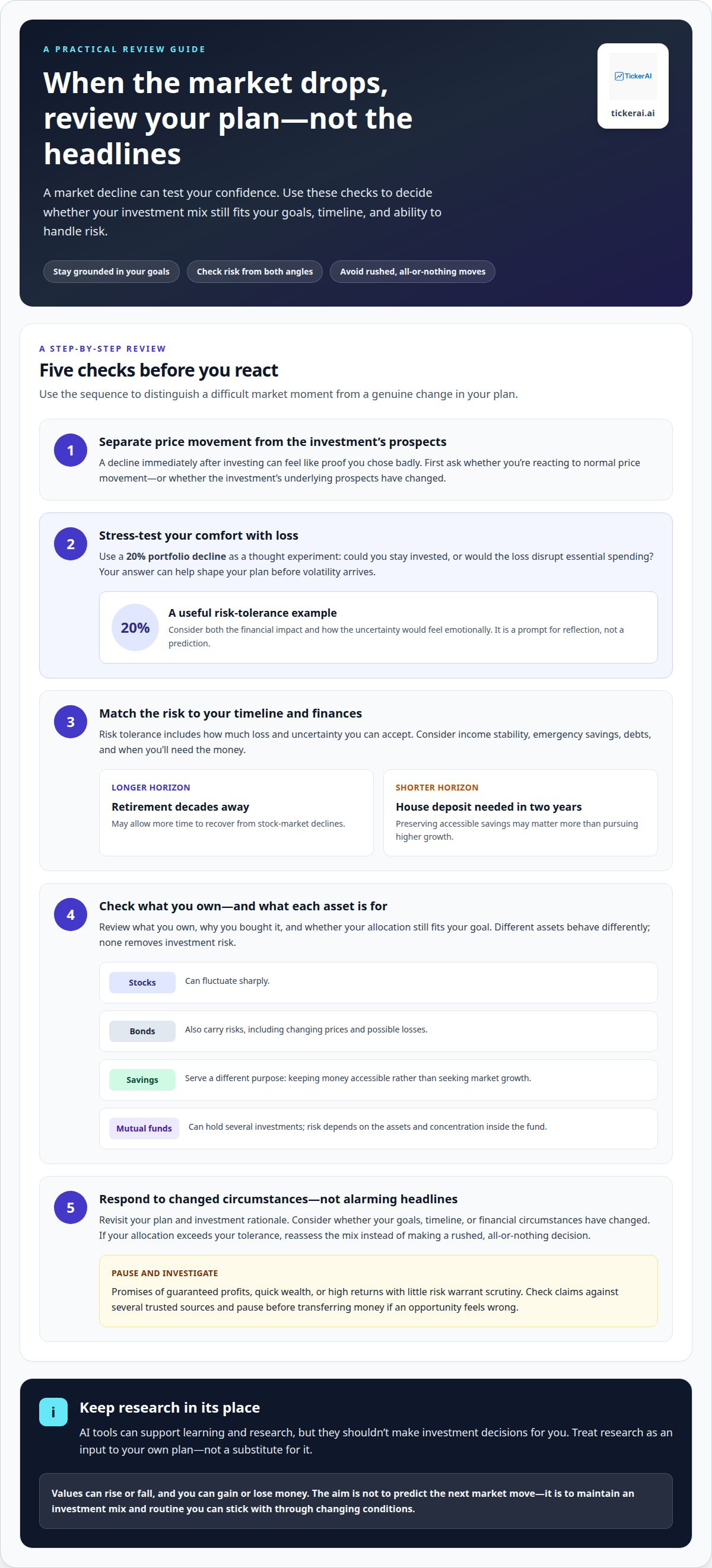
A market decline immediately after investing can feel like evidence that you made the wrong choice. First, separate normal price movement from a change in your investment’s underlying prospects. A 20% portfolio decline is a useful example for assessing your risk tolerance: could you stay invested, or would the loss disrupt essential spending? Your answer should shape your plan before volatility arrives.
Risk tolerance describes how much loss and uncertainty you can accept, financially and emotionally. Assess both. Consider your income stability, emergency savings, debts, and when you’ll need the money. A retirement goal decades away may allow more time to recover from stock-market declines than a house deposit needed in two years. With a short timeline, preserving accessible savings may matter more than pursuing higher growth.
Asset classes respond differently to market conditions. Stocks can fluctuate sharply, and bonds also carry risks, including changing prices and possible losses. A savings account serves a different purpose: keeping money accessible rather than seeking market growth. A mutual fund can hold several investments, but its risk depends on the assets and concentration inside it. Review what you own, why you bought it, and whether your original allocation still fits your goal.
Avoid emotional trades based only on alarming headlines. Revisit your plan and investment rationale, then consider whether your goals, timeline, or financial circumstances have changed. Investment values naturally rise and fall, and you can gain or lose money. If a drop reveals that your allocation exceeds your tolerance, reassess the mix instead of making a rushed, all-or-nothing decision.
Be alert to scam signals: promises of guaranteed profits, quick wealth, or high returns with little risk warrant investigation. Check claims against several trusted sources, and pause before transferring money if an opportunity feels wrong. AI tools can support learning and research, but they shouldn’t make investment decisions for you. For a structured view of potential opportunities, explore AI-supported stock research alongside your own plan.
Automating contributions and dollar-cost averaging
Dollar-cost averaging means investing a set amount at regular intervals, regardless of market prices. A fixed schedule buys more shares when prices are lower and fewer when they’re higher. It creates consistency, not guaranteed profit. Regular contributions can also keep a long-term plan active during volatile periods.
For an illustration, investing $100 monthly from age 30 to age 60 at an average 7% annual return results in about $122,000. The example shows how contributions and compounding can build over time. Actual results depend on investment performance, contribution timing, and fees. Starting with $25 or $50 per month can help someone start investing with an amount that fits their budget.
Automation can make a routine easier to maintain. Set a recurring transfer after reviewing essential expenses, emergency savings, and upcoming bills. Then direct contributions toward investments that fit your chosen allocation. Keep enough cash available for near-term needs: investing money you’ll need soon can force a sale at an unfavorable time. Interest and investment returns compound only while they remain invested.
Self-directed investing lets you choose and manage investments yourself. Automated investment options can handle recurring contributions or portfolio management, depending on the account and service. Compare costs, investment choices, and level of control. Federal tax treatment varies by account type, so understand the relevant rules before choosing a brokerage or retirement account.
To open and fund a U.S. account, choose a brokerage or retirement account type, complete the provider’s application, and connect a funding source. Deposit money, select investments suited to your plan, then set a recurring contribution if available. Consult a tax professional about how account rules apply to your circumstances. In general, review your schedule when your income, expenses, or goals change, rather than reacting to every market move.
Investing in stocks and bonds
Stocks represent ownership: buying shares gives you exposure to a company’s performance. Bonds are loans to governments or companies, which generally pay interest under stated terms. Both can lose value. Stocks respond to company results and market expectations, while bond prices can move with interest rates and credit conditions. Economic shifts may affect each asset differently, which is why portfolios can combine them.
According to the U.S. Securities and Exchange Commission, 7-10% annual is a useful estimate for long-term diversified investments in U.S. stocks, based on historical averages. Treat this as historical context, not a forecast for a particular holding. A single company’s shares can perform very differently from a broad stock-market portfolio.
Bonds can add a different return and risk profile, but they aren’t risk-free. Their value can decline, and issuers may fail to meet their obligations. Consider the purpose of each holding: stocks may support long-term growth goals, while bonds can contribute income or diversify exposure. The right balance depends on your goals, time horizon, and tolerance for market changes.
Index funds and exchange-traded funds, or ETFs, are investment structures, not separate asset classes. A fund may hold stocks, bonds, or both. An index fund tracks an index, while ETFs trade throughout the day on an exchange. A savings account keeps money accessible and isn’t a substitute for market investments. Compare what each fund owns, its fees, and how its structure fits your plan.
For example, someone saving for a distant goal might use diversified stock and bond funds, while keeping near-term spending money in savings. Review the holdings and intended allocation before choosing an amount. A fund’s label alone doesn’t reveal whether it overlaps with other investments or concentrates risk. Explore AI-powered stock opportunity research to identify ideas for further analysis, then assess each against your goals and portfolio.
TickerAI: Long-Term Investment Ideas
TickerAI offers Long-Term Investment Ideas to help you explore potential opportunities through AI-generated market analysis. Use these ideas as research leads to evaluate against your goals, time horizon, and portfolio allocation. They can support your research, but they don’t replace your judgment or determine which investments suit your circumstances.
For a broader view, AI Stock Opportunity Discovery can surface potential market movements, while Smart Watchlist & Alerts help track selected opportunities. Swing Trade Setups focus on shorter-term market activity. Use each offering in line with your investing approach, and assess every idea against trusted information before making a decision.
Contact TickerAI to learn more about its Long-Term Investment Ideas.
Make your next investment decision deliberate
Confidence isn’t certainty about what markets will do next. It’s the ability to make decisions that reflect your goals and keep assessing them as your circumstances change. That process helps you respond to new information without letting every market move rewrite your strategy.
If you want additional research inputs, TickerAI offers AI Stock Opportunity Discovery, Swing Trade Setups, and Smart Watchlist & Alerts. Use these tools to surface ideas and monitor opportunities, then evaluate them against your own objectives. They can support a thoughtful approach to how to invest with confidence, while your decisions remain grounded in your plan.
Contact TickerAI about investing to explore how its research tools fit your process. Keep learning, stay intentional, and take your next step with clarity.
Frequently Asked Questions
Why should I start investing?
Investing gives your money a chance to grow toward goals that may be years away, such as retirement or education. Cash savings can provide access and stability, while investments offer potential growth alongside market risk. Starting with a clear purpose helps you choose suitable investments and avoid reacting to every headline. The key is aligning the amount invested and its risk with your needs.
Is it better to invest a lump sum or monthly?
Choose an approach that fits the money you have and the routine you can maintain. A lump sum puts available funds to work immediately, while monthly investing spreads purchases over time and can suit income received regularly. For example, someone paid monthly may find scheduled contributions easier to budget. Keep short-term expenses and emergency savings separate before committing available cash to investments.
Should I pay off debt before investing?
Prioritize expensive debt if its interest charges are weakening your budget, while accounting for minimum payments and essential savings. Compare the debt’s interest cost with the uncertain returns of investing: investment growth isn’t assured, but debt charges continue under the loan terms. Someone carrying costly credit-card balances may focus on repayment before increasing investments. Review the interest rate, repayment conditions, and cash reserves together.
What does investing with confidence mean for beginners?
For beginners, investing with confidence means understanding what an investment owns, why it fits a goal, and what could cause its value to fall. It doesn’t require predicting short-term market movements. Before buying a fund, read its objective and holdings, then decide what role it plays in your plan. Treat AI-generated ideas as research inputs, not instructions or a substitute for your judgment.
How do I set investment goals and choose a time horizon?
Write down your goal, approximately when you’ll need the money, and how important that date is. For example, a retirement account and a planned home purchase have different timelines and liquidity needs. Separate goals into near-term and long-term categories, then choose investments that fit each purpose. Revisit the dates when life changes, such as after a new job or a major expense.
How do I assess my risk tolerance and choose an appropriate asset allocation?
Assess both your financial capacity for losses and how you’re likely to react to them. Imagine a sharp decline: would you keep following your plan, or would you need to sell to cover expenses? Consider income stability, debt, savings, and when you need the funds. Use those factors to choose a stock-and-bond mix you can maintain, then adjust it as your goals or circumstances change.


