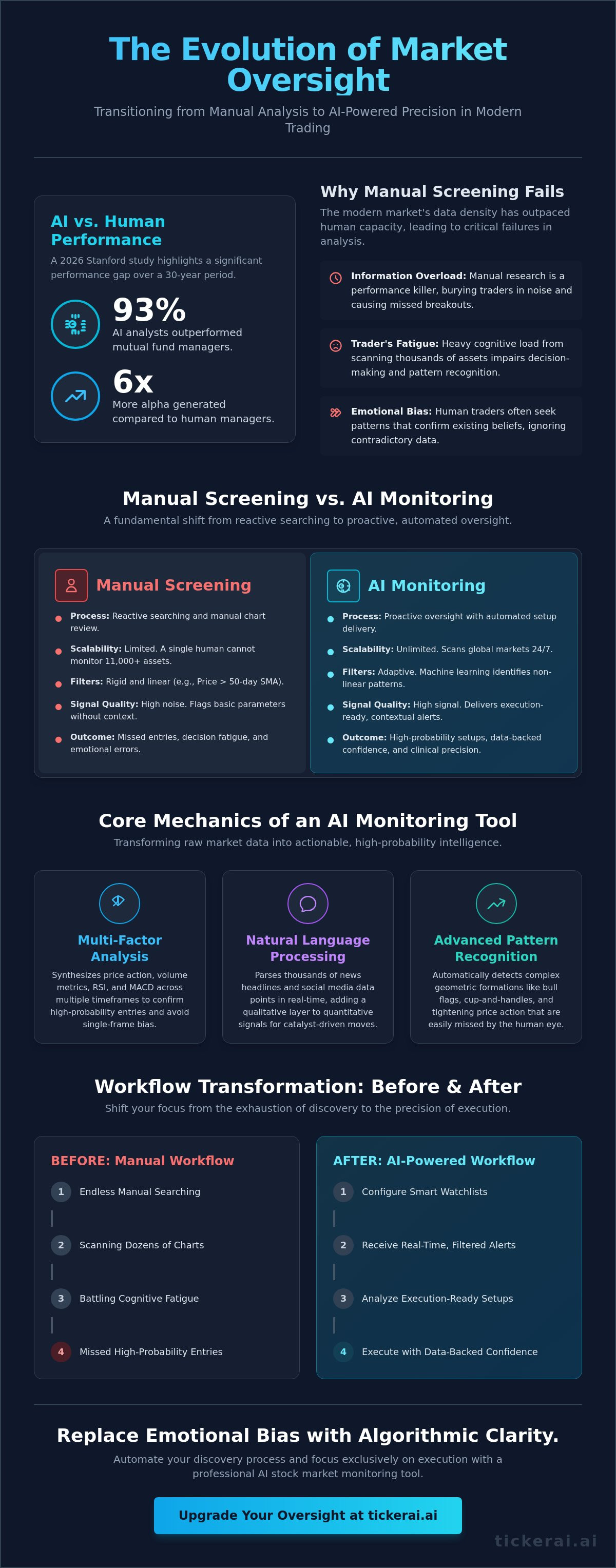
A 2026 Stanford study found that AI analysts outperformed 93% of mutual fund managers over a 30-year period, generating six times more alpha. The data is clear. Success in this environment requires more than intuition. You've likely experienced the frustration of missing a breakout because you were buried in manual research. Information overload is a performance killer. Utilizing a sophisticated AI stock market monitoring tool allows you to filter the noise and focus exclusively on execution.
We agree that the current market speed has outpaced human capacity. This guide will show you how to master the mechanics of AI-driven oversight and automate trade setup detection with clinical precision. We'll break down the transition from manual screening to high-speed intelligence. You'll learn to secure real-time alerts for high-probability setups, reduce screen time, and build data-backed confidence in every entry. It is time to replace emotional bias with calculated, algorithmic clarity.
Key Takeaways
- Identify why manual screening leads to cognitive overload in 2026 and how to transition toward data-driven oversight.
- Master the core mechanics of a professional AI stock market monitoring tool to synthesize multi-factor technical indicators with clinical precision.
- Evaluate monitoring platforms using the signal-to-noise ratio to ensure high-quality, execution-ready alerts.
- Develop a streamlined workflow by configuring smart watchlists that track high-potential sectors and specific momentum strategies.
- Automate your discovery process to replace manual chart review with real-time swing trade setups and high-probability entry points.
The Evolution of Market Oversight: Why Manual Screening Fails in 2026
The market environment in 2026 is defined by extreme data density. Mentions of "AI agent" in SEC filings surged by 6,550% year-over-year in 2025. This is not just a statistic; it's a warning for the manual trader. The sheer volume of market data points per second has reached a level where manual screening is a liability. It leads directly to "trader's fatigue," a state where heavy cognitive load impairs decision-making and leads to missed entries. Traditional static scanners contribute to this problem. They produce a wall of noise, flagging every ticker that hits a basic parameter without assessing the context of the move.
An AI stock market monitoring tool changes the math. It shifts the trader's workflow from reactive searching to proactive, automated oversight. Instead of hunting for setups, the setups are delivered to you. This transition is essential for anyone managing a professional portfolio in a high-velocity environment. It moves the focus from the exhaustion of discovery to the precision of execution.
The Limits of Human Pattern Recognition
Human pattern recognition is powerful but fragile. Visual fatigue sets in quickly during manual chart review. When you scan dozens of tickers, the risk of missing "hidden" breakout patterns increases. Your brain begins to overlook subtle indicators like volume divergence or tightening price action. Emotional bias also distorts analysis. Traders often fall into the trap of looking for patterns that fit their existing bias rather than what the data shows. Scalability is the ultimate barrier. No individual can monitor 11,000+ global assets simultaneously while maintaining clinical precision. The human brain is a decision-maker, not a data-processor.
Algorithmic Filtering vs. Basic Screening
Basic screening relies on linear filters like "Price > 50-day SMA." These are rigid. They don't adapt to changing market regimes. Machine learning identifies non-linear relationships between price, volume, and sentiment. It recognizes institutional accumulation patterns that basic scanners ignore. This is the natural evolution of Algorithmic trading. By using an AI stock market monitoring tool, you deploy a tireless scout that works 24/7. It scans global markets while you focus on strategy and execution. It provides a level of speed and clarity that manual methods simply cannot match. The result is a refined signal layer that prioritizes quality over quantity.
Core Mechanics of an AI Stock Market Monitoring Tool
An AI stock market monitoring tool is a sophisticated machine learning system engineered to scan global exchanges for predefined technical and fundamental setups. It doesn't just "pick" stocks. It monitors the market's pulse to identify execution-ready opportunities. This system synthesizes price action, volume metrics, and technical indicators simultaneously. It removes the human element of hesitation. The goal is simple: transform raw market data into actionable intelligence without the trader needing to lift a finger.
Integration of Natural Language Processing (NLP) adds a qualitative layer to this quantitative engine. It parses thousands of news headlines and social sentiment data points in real-time. This ensures that a breakout isn't just a technical fluke but is supported by fundamental catalysts. Pattern recognition algorithms detect complex geometric formations like bull flags, cup-and-handles, and momentum breakouts automatically. As professionals navigate the complexities of securities regulation in the age of AI, the emphasis remains on the technical reliability and speed of these automated scouts.
Technical Indicator Integration
Professional systems monitor RSI, MACD, and moving average crossovers across multiple timeframes simultaneously. This multi-layered approach prevents "single-frame bias" where a setup looks good on a 5-minute chart but is bearish on the daily. Algorithmic convergence is the alignment of multiple technical signals across various timeframes to confirm a high-probability entry. Volume profiles play a critical role here. They confirm AI-detected breakouts by verifying institutional participation. Without volume confirmation, a price move is just noise. The system filters for these convergences to ensure only the highest-quality signals reach your dashboard.
Real-Time Data Processing and Latency
Low-latency data feeds are the backbone of professional swing trade setups. Even a three-second delay can result in significant slippage. Professional-grade tools handle "wash trading" by filtering out artificial volume and false signals that often trap retail traders. Cloud-based processing is the current standard. It offers the computational power required to scan 11,000+ assets without the hardware bottlenecks of local machines. Speed is the ultimate professional edge. If you aren't using automated discovery tools to maintain this edge, you're competing with a handicap. Efficiency is the only path to consistency in 2026.
Evaluating Monitoring Platforms: Speed, Signal Quality, and Customization
The primary metric for any professional AI stock market monitoring tool is the signal-to-noise ratio. High-frequency environments generate thousands of data points; most of them are irrelevant. A platform's efficacy is measured by its ability to suppress false positives while highlighting high-probability setups. Precision is the baseline. If a tool delivers fifty alerts but only two meet your risk criteria, the system has failed. You need a filter, not a megaphone.
Customization is the second pillar of professional oversight. One-size-fits-all "stock picking" models often lack the granularity required for specific swing trading strategies. A professional platform must allow you to tailor alerts to your specific risk profile and timeframe. Whether you trade micro-cap momentum or large-cap mean reversion, the logic must be adjustable. Transparency is equally critical. "Explainable AI" provides the technical reasoning behind every alert. Understanding the "why" behind a signal builds the trust necessary for high-stakes execution. You shouldn't have to guess which technical indicators triggered the discovery.
Platform stability is a non-negotiable requirement. Serious market participants require 99.9% uptime and redundant data feeds. A monitoring tool that lags during peak volatility is a liability. Reliability ensures that your automated scouts are always active, even when you're away from the terminal. It's about maintaining a consistent edge without constant manual oversight.
Assessing Signal Accuracy and Timeliness
Backtesting provides a historical baseline, but real-time performance is where a tracker proves its worth. You must evaluate how the system handles "late" signals. Many inferior tools flag stocks after the momentum has already been exhausted. A professional system identifies the start of the move, not the peak. Smart watchlists help solve this by updating dynamically based on shifting market conditions. If a sector loses relative strength, the monitoring focus should shift automatically. This ensures your capital is always allocated to the highest-potential environments.
User Interface and Alert Delivery
Delivery mechanisms must match your workflow. Mobile push notifications are essential for traders on the move, while desktop dashboards offer the depth required for deep-dive analysis. Filtering capabilities allow you to refine your focus by sector, industry, or market cap. This prevents "alert fatigue" by ensuring you only see what's relevant to your current strategy. Integration with existing AI stock discovery platforms creates a seamless transition from identification to monitoring. A unified tech stack reduces friction and speeds up the "Observation-to-Action" cycle. Efficiency is the ultimate competitive advantage.
Strategic Implementation: Integrating AI Alerts into Your Trading Workflow
Implementation turns a scout into a partner. An AI stock market monitoring tool requires a structured integration plan to deliver maximum alpha. Without a clear workflow, even the best signals become background noise. Success in 2026 follows a methodical, five-step process designed for professional execution. It's about moving from passive observation to calculated action.
- Step 1: Define your core strategy. AI works best when it's looking for specific technical signatures. Decide if you are hunting for momentum breakouts, mean reversion, or institutional accumulation patterns.
- Step 2: Configure smart watchlists. Don't monitor the whole market. Use high-potential sector data to seed your monitoring engine with tickers that already show relative strength.
- Step 3: Set tiered alerts. Don't just wait for the price to hit a target. Use pre-breakout triggers to prepare your liquidity, breakout alerts to signal entry, and confirmation triggers to validate the move.
- Step 4: Execute a manual sanity check. AI identifies the technical setup; you verify the macro context. Check for upcoming earnings or unexpected news catalysts that might invalidate the technical pattern.
- Step 5: Review and refine. Analyze your performance weekly. Adjust your monitoring parameters based on which alerts led to the highest-probability outcomes.
Configuring Smart Watchlists for Swing Trading
Effective watchlists are dynamic, not static. Use an institutional-grade swing trade setup finder to identify candidates that meet your baseline criteria. The AI then automates the removal of stagnant tickers that fail to show price action over a set period. This keeps your focus on active capital. Advanced monitoring also uses clustering logic to identify stocks moving in sympathy with broader market themes. If a sector leader breaks out, your tool should automatically prioritize laggards in the same group that are showing similar technical footprints.
Managing Alert Fatigue
Information density leads to exhaustion if not managed properly. Professional traders mitigate this by setting priority levels for different technical signals. A daily breakout alert should carry more weight than a 15-minute RSI cross. The "Observation-to-Action" flow ensures you only engage when the data hits your specific requirements. An alert threshold is the specific volatility trigger required for notification. By raising this threshold, you filter out market chop and focus on high-conviction moves. Ready to streamline your execution? Access professional-grade monitoring alerts to start automating your daily routine.
TickerAI: Precision Monitoring for the Modern Portfolio
TickerAI functions as a high-speed intelligence partner for the professional trader. It effectively replaces the manual review process with a streamlined, automated engine. Manual scanning is a relic of a slower era. Professionals now rely on a sophisticated AI stock market monitoring tool to maintain oversight across thousands of tickers simultaneously. This isn't about increasing data volume. It's about increasing data quality. TickerAI prioritizes clarity, ensuring your focus remains on decision-making rather than data-gathering.
TickerAI Pro provides the smart watchlists and high-speed alerts necessary for consistent execution. Every signal is vetted with clinical precision. You receive real-time swing trade setups that are filtered for institutional-grade quality. The platform's logic is designed to suppress noise and highlight only the most viable opportunities. It acts as a tireless scout, detecting technical shifts while you manage your broader portfolio strategy. Speed and accuracy are the primary metrics of our monitoring efficacy.
- Automated Scanning: Replaces hours of manual chart review with instant, multi-factor analysis.
- Clinical Precision: Delivers swing trade setups based on rigorous technical and volume profiles.
- High-Speed Alerts: Ensures you hit entry points before the broader retail market reacts.
- Clarity Over Volume: Filters out market noise to provide execution-ready intelligence.
Automated Discovery and Detection
Momentum breakouts often occur in seconds. TickerAI identifies these shifts before they hit retail scanners. The technical logic is rooted in multi-factor analysis that combines price action, volume profiles, and relative strength. This ensures that our curated investment ideas are backed by data, not just speculation. We focus on execution-ready setups. These are not generic news updates. They are specific technical triggers that align with professional trading strategies. By automating the discovery phase, you reclaim the time needed for risk management and trade sizing.
Secure Your Professional Edge
Choosing between TickerAI Full-Access and Pro tiers depends on your specific monitoring needs. Both subscriptions offer 24/7 automated market oversight. This is critical in high-volatility environments where entry windows are narrow and fast-moving. You need a system that stays "on" even when you are "off." TickerAI provides that persistence. It monitors the global markets with the intensity required for modern algorithmic alpha. Secure your professional edge and stop competing against automated systems with manual tools. Experience TickerAI monitoring today to transform your trading workflow.
Secure Your Algorithmic Edge
The transition from manual screening to automated intelligence is no longer optional. It's a fundamental requirement for professional survival in 2026. We've analyzed how a sophisticated AI stock market monitoring tool provides the necessary oversight to detect non-linear price relationships and institutional patterns that human eyes miss. Success in this high-velocity environment depends on your ability to filter noise and prioritize high-probability setups. By integrating machine learning into your daily workflow, you reclaim your most valuable asset: cognitive bandwidth for decision-making.
Efficiency leads to consistency. TickerAI Pro delivers the clinical precision needed to dominate modern markets. You gain access to AI-driven discovery of short-term swing stock alerts and automated 24/7 market scanning. Our smart watchlists filter the market chaos, ensuring you only see execution-ready opportunities that align with your risk profile. Stop battling information overload and start executing with data-backed confidence. Upgrade to TickerAI Pro for Real-Time Market Monitoring and secure your professional edge today. The market never stops moving. Your intelligence partner shouldn't either.
Frequently Asked Questions
What is an AI stock market monitoring tool?
An AI stock market monitoring tool is an automated system that uses machine learning to scan global exchanges for predefined technical and fundamental setups. It processes thousands of data points per second to identify execution-ready opportunities that manual screening would miss. These tools act as a tireless scout, detecting price action shifts and volume surges in real-time. This allows traders to focus on decision-making rather than the exhaustion of manual research.
How does an AI monitoring tool differ from a standard stock screener?
Standard screeners rely on static, linear filters like "Price > 200 SMA," while an AI stock market monitoring tool identifies non-linear relationships and complex geometric patterns. It recognizes bull flags, cup-and-handle formations, and institutional accumulation patterns automatically. While screeners provide a snapshot of the past, AI monitoring tracks the market pulse in real-time. It filters noise to ensure that only high-probability signals reach your dashboard.
Can AI tools predict stock market breakouts with 100% accuracy?
No system can predict market movements with 100% accuracy. AI tools are designed to identify high-probability setups by analyzing historical data and current market conditions to find a statistical edge. The objective is to reduce emotional bias and provide a refined starting point for your analysis. Professional traders use these signals as a sophisticated filter, always performing a final manual sanity check before executing any position.
Is an AI monitoring subscription worth it for small-account traders?
AI monitoring is highly valuable for small-account traders because it democratizes access to institutional-grade technology. It allows individuals to monitor thousands of assets without needing a large research team. By reducing screen time and preventing missed entries on fast-moving stocks, the tool helps maximize capital efficiency. Consistency is much easier to achieve when you aren't fighting information overload manually every day.
How do I set up real-time stock alerts on my phone?
You can set up real-time alerts by configuring your strategy parameters within the platform's dashboard and enabling push notifications for the mobile app. Most professional tools offer tiered alert settings for pre-breakout, breakout, and confirmation stages. This ensures you receive critical updates directly to your device wherever you are. You can also filter these alerts by sector or market cap to prevent notification fatigue.
What are the best technical indicators for AI monitoring tools to track?
The most effective AI monitoring focuses on algorithmic convergence, which is the alignment of multiple technical signals across different timeframes. Key indicators include RSI for momentum, MACD for trend shifts, and volume profiles for institutional confirmation. Tracking moving average crossovers alongside volume surges provides the highest-quality signals. The AI stock market monitoring tool synthesizes these metrics to ensure a setup is technically robust before notifying you.
Do AI monitoring tools integrate with my brokerage account?
Many professional monitoring tools offer API integrations with major brokerage platforms to streamline the "Observation-to-Action" flow. This allows you to move from an alert to an execution screen with minimal friction. Some traders prefer using the tool as an independent signal layer to maintain a clear distinction between discovery and execution. It's best to check the specific compatibility of your chosen platform with your current broker before subscribing.
How much does a professional AI stock monitoring tool cost in 2026?
Pricing for professional AI monitoring tools in 2026 typically follows a tiered subscription model based on data latency and feature access. Basic tiers are often available for entry-level discovery, while professional and expert plans are designed for active traders who require high-speed alerts and smart watchlists. Costs reflect the computational power required for 24/7 scanning. Traders should evaluate these tiers based on their specific trading frequency and the complexity of their strategies.


