

Why are you still manually filtering balance sheets when machine learning can detect structural alpha in milliseconds? In 2026, the edge belongs to those who treat data as a raw material for algorithms rather than a manual reading list. You likely feel the weight of the 24/7 market cycle. Information overload is real. Missing an early-stage growth breakout because you were buried in noise is a professional risk you can't afford.
We agree that emotional bias and the recent rise in "AI washing" make long-term holding more complex than ever. This guide promises to help you cut through the chaos. You'll discover how to leverage AI tools for long-term investors to build a resilient, alpha-generating portfolio. We'll outline a repeatable research workflow that reduces your time on task while surfacing undervalued gems. From navigating the SEC's latest 2026 examination priorities to deploying automated market scanning, you're about to transform your approach into a clinical, high-speed intelligence operation.
Key Takeaways
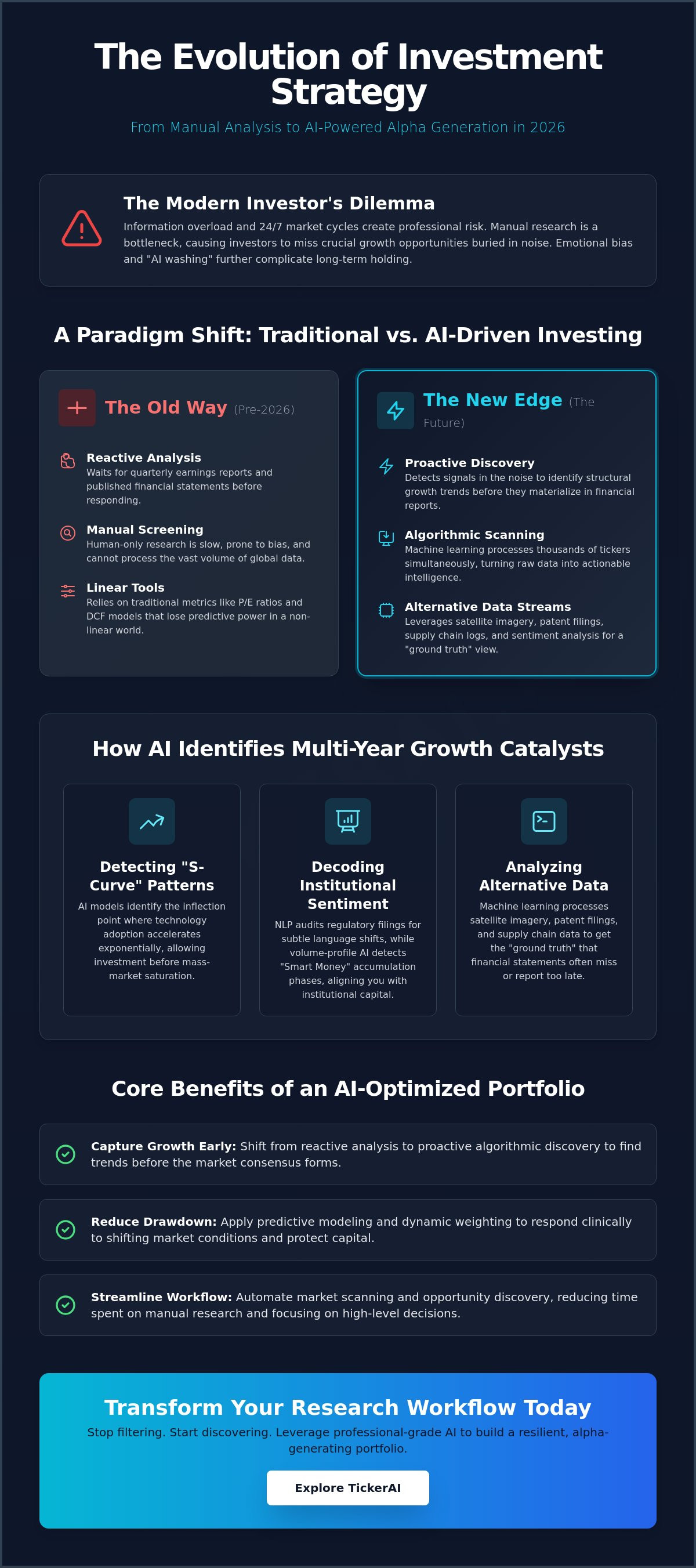
- Shift from reactive analysis to proactive algorithmic discovery to capture structural growth trends before they materialize in traditional financial statements.
- Utilize alternative data streams, including satellite imagery and patent filings, to identify multi-year catalysts that manual research often overlooks.
- Leverage professional AI tools for long-term investors to implement data-driven growth and value frameworks with clinical precision.
- Reduce portfolio drawdown by applying predictive modeling and dynamic weighting to respond to shifting market conditions in real-time.
- Streamline your research workflow using TickerAI Smart Watchlists to maintain continuous oversight of core holdings and new opportunity discovery.
The Evolution of Long-Term Investment Strategies in the AI Era
AI long-term investment strategies represent a fundamental departure from legacy stock picking. These systems use machine learning to identify structural growth trends before they ever materialize in quarterly earnings reports. Traditional fundamental analysis is reactive. It waits for data to be published and then responds. Proactive algorithmic discovery is different. It detects the signal in the noise before the market consensus forms. By mid-2026, manual stock screening has become an obsolete practice for professional-grade portfolios. The volume of global data is too vast. Human-only research is no longer a competitive strategy; it's a bottleneck. TickerAI bridges this gap. It transforms raw, chaotic data into actionable Long-Term Investment Ideas, acting as a high-speed filter for a complex environment.
From Manual Screening to Algorithmic Alpha
Traditional metrics like P/E ratios and DCF models are losing their predictive power. They are linear tools in a non-linear world. They don't account for the complex relationships found in global macro datasets or alternative data streams. To understand what is artificial intelligence in a modern financial context, you must view it as a high-dimensional pattern matcher. AI processes everything from supply chain logs to credit flows simultaneously. This is the "Quantamental" shift. It combines your human conviction with machine precision. Modern AI tools for long-term investors allow for this synthesis. They handle the heavy lifting of data processing while you focus on high-level decision-making. The result is a cleaner, data-backed thesis that ignores the emotional volatility of the retail crowd.
Why Buy-and-Hold Requires an AI Upgrade in 2026
The 10-year horizon hasn't disappeared, but the cycles within it have compressed. Market regimes shift faster than ever. A thesis that held true in 2024 might be invalidated by a structural shift by 2026. AI detects these regime changes long before they hit the headlines. It monitors for subtle deviations in institutional positioning and sector rotation. This isn't about chasing intraday moves. It's about high-tech scouting for patient capital. AI-driven long-term strategy is the clinical synthesis of real-time data speed and disciplined, patient capital. It ensures your core holdings remain viable through shifting macro environments. It alerts you the moment a structural investment story changes. By using AI tools for long-term investors, you aren't just holding a stock; you're maintaining an "always-on" intelligence operation that protects your capital from obsolescence.
How Machine Learning Identifies Multi-Year Growth Catalysts
Identifying multi-year winners requires more than a screen of historical earnings. It requires an analysis of the future. Machine learning models now excel at detecting "S-Curve" patterns. These patterns represent the lifecycle of a technology or sector, from early adoption to mass-market saturation. Professional AI tools for long-term investors prioritize the inflection point. This is the precise moment where adoption begins to accelerate exponentially. TickerAI's automated stock market analysis scales this discovery process. It scans thousands of tickers simultaneously to find these structural catalysts before they become consensus news. This proactive approach ensures you aren't just buying growth; you're buying it at the right stage of the lifecycle.
Decoding Institutional Sentiment and Positioning
Institutional positioning is a leading indicator. Retail hype is often a lagging one. Natural Language Processing (NLP) allows for a clinical audit of thousands of regulatory filings. It detects subtle language shifts in management discussion sections that suggest a change in corporate strategy or risk appetite. Volume-profile AI identifies "Smart Money" accumulation phases. This is where large blocks of shares are acquired quietly over several weeks. It's a sign of sustainable conviction rather than temporary momentum. Detecting these phases allows you to align your patient capital with institutional giants. You can ignore the noise of retail social sentiment and focus on where the capital is actually flowing.
Predicting Structural Trends with Alternative Data
Alternative data provides the "ground truth" that financial statements often miss. Machine learning processes satellite imagery of logistics hubs to gauge global trade health in real-time. It tracks patent filings to identify which companies are winning the R&D war in emerging sectors. Think solid-state batteries or localized AI hardware. These are the foundations of 2026's market leaders. AI finds correlations between these non-financial events and future stock performance. It's about identifying long-term competitive advantages before they are reflected in a P/E ratio.
Consider the 2026 energy transition. Machine learning identified a emerging leader not by its current revenue, but by its securing of critical mineral supply chains revealed through global customs data. This was a structural advantage invisible to traditional screens. By correlating non-financial events with stock performance, these models provide a high-definition view of the future. If you want to build a portfolio based on these deep-level insights, consider exploring Long-Term Investment Ideas to see how these signals translate into actionable positions. This level of precision is the new standard for professional-grade research.
Core AI-Driven Frameworks for Growth and Value Portfolios
Frameworks define your edge. Without a structured model, you're just staring at a data dump. Professional AI tools for long-term investors allow you to toggle between aggressive growth and defensive value with clinical speed. This isn't theoretical. High-end trading robots already claim win rates between 75% and 95% in shorter cycles. Your task is to apply that same algorithmic rigor to a multi-year horizon. You need a decision-making engine that filters for structural alpha while ignoring the noise of 24/7 market cycles. Integrating an AI stock screener for growth stocks into your weekly research routine ensures you never miss a shift in market leadership. It transforms a manual, error-prone process into a repeatable intelligence workflow.
The AI Growth Strategy: Detecting Early-Stage Market Leaders
Growth investing in 2026 centers on the Velocity of Innovation. AI tracks this by monitoring patent filings and R&D efficiency in real-time. You aren't looking for companies that have already peaked. You're looking for revenue acceleration and TAM expansion before they hit the mainstream radar. Machine learning models spot breakout momentum long before a stock reaches a 52-week high. They analyze non-linear data points to distinguish between sustainable growth and temporary hype. This allows you to deploy patient capital into sectors like localized AI hardware or solid-state energy before the institutional "Smart Money" completes its accumulation phase. It's about being early, not just being right.
The AI Value Strategy: Finding Hidden Gems
Value investing isn't dead; it's just been upgraded. The AI Value Framework focuses on mean reversion and asset mispricing. It uses quantitative filters to detect deep-value stocks where fundamentals are improving but the price remains suppressed. AI helps you avoid the "value trap" by analyzing long-term sector health and competitive moats. Predictive cash-flow modeling is the key here. It identifies dividend growth opportunities by simulating thousands of economic scenarios. You can find high-quality assets at a reasonable price (QARP) by letting the algorithm scan for misaligned valuation metrics. This clinical approach ensures you only buy when the data suggests a high probability of a structural rebound. You're no longer guessing at a bottom. You're executing on a statistical anomaly.
Effective portfolio management requires a hybrid approach. AI allows you to maintain a core of stable value holdings while rotating into high-potential growth catalysts. This dynamic balance is what generates long-term alpha in a fast-moving environment. Your research workflow should be a seamless transition from identification to execution, backed by a high-speed intelligence partner that never sleeps.
Managing Risk and Volatility in an AI-Optimized Portfolio
Risk management in 2026 requires more than a simple 60/40 split. The market environment has evolved. Volatility is now frequently driven by algorithmic cascades and high-speed liquidity shifts. To survive these cycles, professional AI tools for long-term investors utilize predictive modeling to identify early warning signs of market downturns. These systems scan for anomalies in credit spreads and liquidity profiles that human analysts often miss. Dynamic asset allocation is the primary defense. Instead of a static portfolio, AI adjusts your weights in real-time based on shifting risk-adjusted return forecasts. This proactive stance ensures your capital is positioned for preservation before the broader market reacts. Since 2021, the SEC has issued 92 separate AI-related comment letters to companies, highlighting the growing need for rigorous governance and risk oversight in automated systems.
Early Warning Systems and Tail Risk Protection
Tail risk is the primary threat to long-term compounding. AI mitigates this by monitoring correlation spikes between seemingly unrelated asset classes. When stocks, bonds, and commodities begin moving in lockstep, it often signals a structural liquidity crisis. Automated systems provide the necessary speed to react. Use these capabilities to protect your core positions:
- Correlation Monitoring: Detect when diversification fails due to systemic market stress.
- Stop-Loss Optimization: Adjust exit triggers based on current volatility regimes rather than arbitrary percentages.
- Real-Time Intelligence: Receive alerts the moment a structural investment thesis is threatened by macro shifts.
TickerAI provides the infrastructure for this level of oversight. By using Smart Watchlist & Alerts, you can maintain a clinical view of your portfolio's health without the emotional noise of the 24/7 news cycle.
Avoiding the Black Box Trap
Conviction is the fuel for long-term investing. You can't hold through a 20% drawdown if you don't understand the "why" behind your positions. This is why Explainable AI (XAI) is critical in 2026. XAI provides the logic and data points behind every generated idea. It moves away from "black box" algorithms that offer no transparency. You must validate AI technical analysis with human oversight to ensure the data isn't overfitted to past cycles. Algorithmic bias can lead to "AI washing" or exaggerated performance claims, a practice the SEC began actively prosecuting in 2024. Use technology to filter the noise, but maintain the final decision-making power. AI is a compass, not a self-driving car, for long-term wealth. It guides your direction while you remain in control of the destination.
Implementing AI-Generated Investment Ideas with TickerAI
Execution is the bridge between algorithmic analysis and realized alpha. In a market where structural shifts happen in real-time, your implementation strategy must be as clinical as your research. TickerAI provides the infrastructure to move from discovery to high-conviction entries without the friction of manual data entry. By integrating these specialized AI tools for long-term investors, you transform a manual process into a high-speed intelligence partner. You can transition from identifying Swing Trade Setups to building a core portfolio of Long-Term Investment Ideas with a single, unified workflow. This ensures that your patient capital is always deployed based on the most current machine learning signals.
Smart Watchlists and Alerts are the foundation of this system. They don't just track prices. They monitor the fundamental health of your core holdings 24/7. If a structural catalyst changes or a "regime shift" occurs, the system alerts you immediately. You can set custom alerts for technical breakouts that occur within a pre-validated fundamental thesis. This allows you to time your entries with precision, ensuring you aren't overpaying for growth. Leveraging the AI stock discovery platform ensures a continuous stream of new ideas, allowing you to maintain a tiered watchlist of potential leaders across high-growth sectors.
TickerAI Full-Access: The Professional Workflow
The TickerAI Full-Access subscription is designed for the serious participant who requires depth and speed. It provides Pro-tier alerts that identify institutional accumulation phases before they are reflected in retail sentiment. This level of AI Stock Opportunity Discovery allows you to diversify across high-potential sectors with confidence. The advantage is clear. While others are manually scanning 10-Ks, your automated partner is detecting anomalies across the entire market. This "always-on" scouting is essential for the busy professional who cannot afford to miss an early-stage breakout due to information overload.
Your 2026 Long-Term Roadmap
Building a resilient portfolio requires a methodical approach. Follow this three-step roadmap to integrate AI into your long-term strategy:
- Step 1: Define Scanning Parameters. Establish your risk-adjusted thresholds for revenue acceleration, TAM expansion, and institutional positioning within the TickerAI engine.
- Step 2: Build a Tiered Watchlist. Organize AI-detected growth leaders into categories based on conviction levels and sector exposure.
- Step 3: Manage with Precision. Use Smart Watchlist & Alerts to execute entries and exits. Let the data dictate your moves, not your emotions.
This structured workflow ensures transparency and logic. It moves you away from the "black box" trap and toward a data-driven future. By 2026, the professional edge isn't just about having information. It's about having the automated systems to filter, prioritize, and execute on it.
Securing Your Edge in the 2026 Market
The 2026 investment landscape rewards clinical precision over manual effort. Manual research is a bottleneck that leaves you exposed to information overload and missed structural growth. By leveraging machine learning, you transition from reactive fundamental analysis to proactive algorithmic discovery. This shift ensures your patient capital is always aligned with multi-year catalysts rather than temporary retail hype. Professional AI tools for long-term investors provide the necessary filter to surface undervalued gems while managing real-time volatility. You now have the framework to integrate predictive modeling and dynamic asset allocation into a professional-grade workflow.
It's time to stop reacting and start executing. Secure your research with real-time AI market scanning and smart watchlists designed for high-conviction portfolios. The ability to detect structural alpha before consensus forms is the only sustainable edge left in a high-speed environment. Start discovering your next long-term core holding with TickerAI Full-Access and gain access to actionable long-term investment ideas today. The technology is ready to act as your tireless intelligence partner. Build a portfolio that leads the next cycle.
Frequently Asked Questions
Can AI really predict long-term stock performance?
AI identifies high-probability outcomes by detecting non-linear patterns in structural growth data. It scans alternative data streams like patent filings and supply chain logistics to find competitive advantages before they appear in traditional earnings reports. While it doesn't predict the future with absolute certainty, it provides a statistical edge. This allows you to position capital based on multi-dimensional data correlations that manual research simply cannot process in real-time.
What is the difference between AI swing trading and AI long-term investing?
The primary difference lies in the data inputs and time horizons. AI swing trading focuses on short-term technical indicators and liquidity shifts to capture moves over days or weeks. AI long-term investing prioritizes structural trends and institutional accumulation. It uses machine learning to filter for multi-year catalysts like TAM expansion and revenue acceleration, ensuring capital is aligned with patient growth rather than temporary volatility.
Is an AI stock subscription worth it for a passive investor?
It's worth it if you want to reduce research time without sacrificing depth. Even passive investors benefit from automated market scanning to monitor the health of their core holdings. Professional AI tools for long-term investors act as an early warning system. They alert you to regime changes or structural shifts that might invalidate a "buy and hold" thesis, allowing for more informed rebalancing and risk mitigation.
How does TickerAI find long-term investment ideas?
TickerAI utilizes specialized algorithms to process alternative data and institutional sentiment at scale. It filters for specific "S-Curve" growth patterns and "Smart Money" accumulation phases across thousands of tickers simultaneously. The platform prioritizes high-conviction signals that suggest a company has secured a structural competitive advantage. This systematic approach transforms raw market noise into actionable Long-Term Investment Ideas, providing a clinical edge for the serious participant in a fast-moving environment.
What are the risks of relying solely on AI for retirement planning?
The main risks involve algorithmic bias and data overfitting. If an AI model is too focused on historical cycles, it may fail to predict unprecedented macro events. Relying solely on a "black box" without human oversight is a strategic error. You should use AI as a sophisticated compass rather than a self-driving car. Always validate algorithmic suggestions against your personal risk tolerance and broader financial goals.
How do I start using AI for my stock portfolio in 2026?
Start by defining your risk-adjusted scanning parameters within a professional intelligence platform. You don't need to be a data scientist to utilize AI tools for long-term investors effectively. Most platforms offer intuitive interfaces for building smart watchlists. Focus on a single sector to begin. Use automated alerts to monitor for technical breakouts that align with your fundamental thesis. This methodical approach ensures a streamlined transition into a high-speed research workflow.
Does AI analysis replace fundamental analysis?
No, it augments and accelerates it. AI handles the heavy lifting of data aggregation and pattern recognition, but human judgment is still required to interpret complex qualitative factors. Think of it as "Quantamental" investing. The algorithm identifies the statistical anomalies and structural trends. You provide the final conviction and strategic oversight. It replaces the manual stock screener, not the intelligent investor who understands the broader context.
Can AI help identify dividend growth stocks?
Yes, through predictive cash-flow modeling. AI simulates thousands of economic scenarios to assess a company's ability to maintain and grow its payout over a multi-year horizon. It analyzes debt-to-equity ratios and free cash flow trends with greater speed than manual spreadsheets. This allows you to find high-quality dividend payers where the market has mispriced the long-term sustainability of the yield, ensuring your income stream remains resilient.


