

What if the best stock alert is the one that helps you pause before acting? Creating a personalized stock alert system starts with a clear decision, not a flood of price notifications. Generic thresholds can miss what matters for a specific security or holding period, while constant pings make meaningful developments easier to overlook. And an alert is a prompt to review, not an automatic trade instruction.
You’re right to want alerts that match your strategy without turning every market move into a demand for attention. This guide shows you how to define alert criteria around a specific investing or trading objective, choose thresholds and events that fit your time horizon, and cut notifications that don’t support a decision.
Step by step, you’ll build a focused workflow: identify what deserves monitoring, add context to each signal, and review alerts consistently before deciding what to do. The goal is not to predict every move. It’s to surface relevant developments, reduce noise, and keep control of your decisions.
Key Takeaways
- Start creating a personalized stock alert system by defining the decision you want each alert to inform, then match signals to your time horizon.
- Compare manual research, platform notifications, and AI-assisted discovery to find an approach that fits your need for flexibility, context, and ongoing maintenance.
- Begin with a focused set of alerts and review which provide useful context, create noise, or leave important gaps.
- Track each alert’s trigger, context, and your response to refine the workflow without treating outcomes as proof of predictive accuracy.
- Use TickerAI’s AI opportunity discovery, smart watchlists, real-time alerts, and curated ideas as research inputs, then assess the evidence independently.
Why create a personalized stock alert system instead of monitoring markets constantly?
Creating a personalized stock alert system means choosing rules and signals that serve a defined objective, then using them to flag developments worth reviewing. Instead of checking every ticker repeatedly, you can monitor selected securities for conditions relevant to your research or portfolio process.
An alert is information, not a recommendation. It doesn’t decide whether to buy, sell, or hold, and it doesn’t execute a trade. You still need to assess the surrounding evidence and make your own decision. Targeted alerts can reduce repetitive monitoring, but they can’t eliminate market risk, prevent losses, or guarantee that you’ll see every relevant event.
For example, suppose a stock on your watchlist reaches a price level you’ve marked for review. The alert’s job is to prompt you to check the chart, recent company news, and your original rationale. It isn’t a signal to act automatically.
What should a stock alert help you notice?
Choose an alert type based on the question you want to investigate. Price and volume are common inputs in technical analysis, but no single indicator reliably predicts future movement. Treat each trigger as a reason to review, not a conclusion.
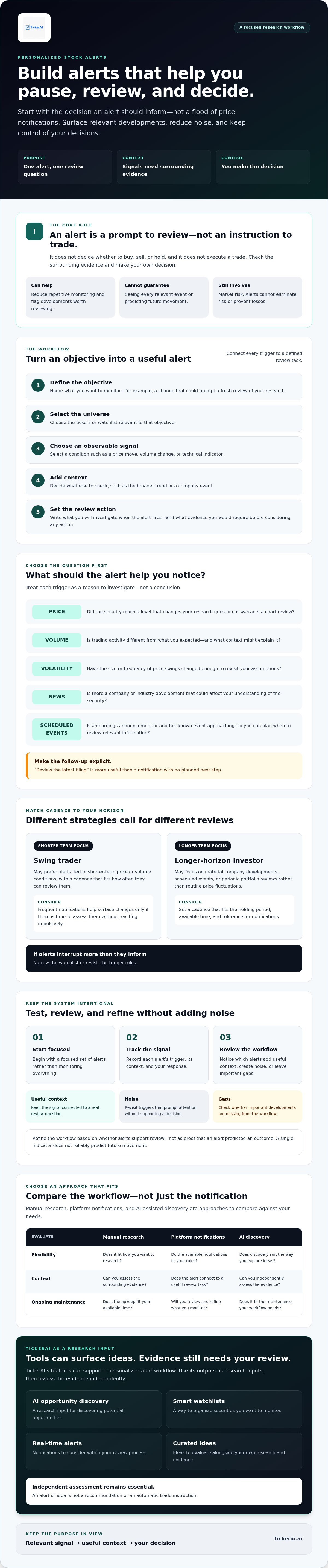
- Price: Did the security reach a level that changes your research question or warrants a chart review?
- Volume: Is trading activity different from what you expected, and what other context might explain it?
- Volatility: Has the size or frequency of price swings changed enough to revisit your assumptions?
- News: Is there a company or industry development that could affect your understanding of the security?
- Scheduled events: Is an earnings announcement or another known event approaching, so you can plan when to review relevant information?
Make the follow-up explicit. “Review the latest filing” is more useful than a notification with no planned next step.
Which investor or trader profile needs which alert cadence?
A swing trader may prefer alerts tied to shorter-term price or volume conditions, with a cadence that fits how often they can review them. More frequent notifications can help surface changes, but only if there’s time to assess them without reacting impulsively.
A longer-horizon investor may focus on material company developments, scheduled events, or periodic portfolio reviews rather than routine price fluctuations. The right cadence depends on the holding period, time available, and tolerance for notifications. If alerts interrupt more than they inform, narrow the watchlist or revisit the trigger rules. These are workflow examples, not personalized financial advice.
How to design stock alert rules around goals, signals, and context
Start with the decision an alert should inform, not with a popular indicator or an arbitrary price level. Creating a personalized stock alert system means connecting each trigger to a defined review task. Use this sequence to turn an objective into a practical rule:
- Define the objective: Specify what you want to monitor, such as a change that could prompt a fresh review of your research.
- Select the universe: Choose the tickers or watchlist relevant to that objective.
- Choose a signal: Pick an observable condition, such as a price move, volume change, or technical indicator.
- Add context: Decide what else you’ll check, such as the broader trend or a company event.
- Set the review action: State what you’ll investigate when the alert fires, and what evidence you’ll require before considering any action.
For example, a hypothetical swing-trading workflow might flag a watchlist stock when its price crosses a level selected for that strategy. The planned response could be to review the chart and trading volume, then check for relevant company news. The trigger starts an evaluation; it doesn’t settle it. For company developments, consult reliable sources and be alert to misleading claims. The SEC’s SEC Investor Alerts offer information about investment frauds and scams.
How do you translate a goal into an alert condition?
Write down the ticker universe, observation window, trigger, and follow-up before setting a rule. A threshold that makes sense for one security may be too sensitive or too broad for another. Consider the security’s historical behavior alongside your holding period: a short-term strategy may call for a different observation window than a long-term portfolio review. Define what needs confirmation, such as checking a close rather than reacting to an intraday move.
How should you combine signals without creating false precision?
Moving averages can help frame trend, the relative strength index (RSI) can describe recent momentum, and trading volume can add activity context. Combining signals may narrow what you review, but it doesn’t remove uncertainty. Indicators can produce false or late signals, especially when market conditions shift.
There’s no universal threshold. As a hypothetical example, a user might review a price condition only when volume also differs from the pattern they’re monitoring. The rule should reflect that user’s strategy and observation window, not be treated as a proven formula. For a deeper framework on assessing signal quality, read how to interpret AI stock signals. AI stock opportunity discovery can also help organize candidates for independent research; explore AI stock opportunity discovery as one possible input to that workflow.
Manual alerts, platform alerts, and AI discovery: which approach fits?
Each method solves a different monitoring problem. Manual research offers control, platform alerts watch conditions you specify, and AI-assisted discovery can help surface candidates beyond a short list you already follow. For creating a personalized stock alert system, compare how each approach handles context and upkeep, not just how quickly it sends a notification.
| Approach | Flexibility and context | Maintenance and alert volume | Best suited to |
|---|---|---|---|
| Manual research | High control; you interpret each finding directly. | Requires regular attention; volume depends on how broadly you search. | Focused research where judgment and source review matter. |
| Platform notifications | Useful for defined conditions, but a trigger may lack broader context. | Rules need review as watchlists and objectives change; volume depends on what you monitor. | Tracking a manageable set of price or volume conditions. |
| AI-assisted discovery | Can help surface and organize candidates, but findings still need verification. | Can broaden discovery; review relevance to avoid adding noise. | Expanding research beyond securities already on a watchlist. |
Screening and discovery identify what may deserve attention. They don’t verify an investment thesis, decide whether a security belongs in a portfolio, or execute an order. For a broader framework on comparing tools, see this guide to AI stock discovery platform guidance.
When are simple price or volume alerts enough?
A small set of manually selected conditions can work well when you know what you’re monitoring and why. For instance, a price alert might prompt a chart review, while a volume notification flags a change in trading activity. Fidelity outlines practical examples in its guide to how to use alerts. Keep in mind that a single-variable trigger can miss changing market context. Revisit rules when your watchlist, research question, or time horizon changes.
When can AI-assisted discovery add useful coverage?
Automated scanning can help bring potential candidates into view for further research. TickerAI offers AI-powered stock opportunity discovery, smart watchlists, and real-time alerts. These are research inputs, not verified outcomes or personal advice. Check the supporting evidence independently, and confirm which alert types and controls are currently available before relying on a platform for a specific workflow. If you want to explore this approach, consider AI stock opportunity discovery as one input to your research process.
How to test, prioritize, and refine alerts without increasing noise
Start with a limited set of alerts tied to clear review actions. Run them through a scheduled review rather than adding new triggers every time a notification feels useful. The aim of creating a personalized stock alert system is not to maximize alerts. It’s to learn which ones provide relevant information and which create distraction.
For each alert, record:
- Trigger and timestamp: What condition fired, and when?
- Market context: What was happening with the security, its trend, volume, or relevant company events?
- Your response: What did you review, and why did you keep, change, or remove the alert?
- Subsequent observation: What did you notice afterward, without treating the price outcome as proof the alert predicts future moves?
What should you record when evaluating an alert?
Keep the original condition alongside your notes, so you can distinguish the rule’s performance from your interpretation after it fires. Review alerts that triggered without useful context, as well as events you expected to notice but missed. Consider different market conditions; one quiet stretch or a handful of memorable outcomes isn’t enough to establish predictive accuracy. Use the log to explain why a rule changed, not to cherry-pick evidence for keeping it.
Look for practical failure points. Two alerts may flag the same development. A threshold may trigger repeatedly as market behavior shifts. Another alert may have no defined follow-up at all. Remove duplicates, revisit unstable conditions, and retire rules that don’t lead to a meaningful review.
How can you reduce alert fatigue while preserving useful signals?
Group alerts by objective or watchlist, then compare what each one adds. If two conditions prompt the same review, keep the one that better fits your process. Where a platform provides suitable controls, prioritize notifications by urgency or required follow-up. Don’t assume those controls are available without checking the platform’s current features.
Before acting on anything an alert surfaces, pause for a risk check. Review independent research, the original investment rationale, and how a potential position would fit your broader portfolio. Consider position sizing and the possibility that the alert is incomplete, late, or triggered by temporary noise. Notifications don’t remove market risk or make decisions for you.
If smart watchlists and real-time alerts could support your review workflow, explore TickerAI’s stock discovery and alerts as research inputs, then evaluate each signal independently.
How TickerAI can support a personalized stock alert workflow
Creating a personalized stock alert system still depends on your own objectives and review process. A platform can help organize discovery and monitoring, but it shouldn’t replace independent research or judgment. A practical workflow is simple: define what you want to monitor, organize relevant candidates, review alerts when they appear, then assess the evidence before making any investment decision.
What role can TickerAI play in alert-led research?
TickerAI offers AI-powered stock opportunity discovery, smart watchlists, and real-time alerts to support candidate discovery and monitoring. Its curated swing trade setups and long-term investment ideas serve different research horizons, so consider which type fits the process you already use. These features provide information for further research, not a decision about what to buy or sell.
Before relying on a specific alert workflow, verify which alert types, delivery options, and configuration controls are currently included in the relevant subscription tier. Don’t assume that every feature works the same way across plans, or that an alert confirms the quality of an investment idea.
What should you confirm before choosing a subscription?
TickerAI’s confirmed subscription options are Pro and Full-Access. Compare their current inclusions with your actual research needs. Check tier-specific alert features, delivery details, and any usage limitations directly before subscribing. Then consider whether the platform’s discovery and monitoring tools complement your process or add notifications you won’t review.
TickerAI does not provide personal financial advice, custom trading coaching, or brokerage execution. Its insights don’t guarantee results, and you remain responsible for independently assessing evidence and investment decisions. If the workflow and current features fit your needs, explore TickerAI and compare the available subscription options before choosing.
Build a Workflow You Can Review with Confidence
Creating a personalized stock alert system starts with a clear objective. Choose signals that fit your watchlist and time horizon, then define what you’ll review when an alert fires. Keep only notifications that support a useful research step, and revisit rules that create duplicates, noise, or no clear follow-up.
Test alerts as monitoring tools, not predictions. Check the surrounding context, verify information independently, and retain control of every portfolio decision. A disciplined review process matters more than adding more triggers.
TickerAI offers AI-powered stock opportunity discovery, smart watchlists, and real-time alerts, alongside curated swing trade setups and long-term investment ideas. These tools can support research, but they don’t provide personal financial advice or make investment decisions. Review current features and subscription options to see whether they fit your process. Explore TickerAI stock discovery and alerts, then build a workflow that keeps your attention focused and your decisions your own.
Frequently Asked Questions
How do I create a personalized stock alert system?
Start by defining what decision or research question an alert should support. Choose the securities to monitor, select a relevant signal, add context to review, and specify your follow-up action. For creating a personalized stock alert system, make thresholds fit the security’s behavior and your time horizon rather than copying generic settings. Begin with a manageable set, then review whether each alert is useful and adjust it as your objectives change.
What should I include in a stock alert?
Include the security, the condition that triggers the notification, and enough context to guide your next review. Depending on your objective, the condition might involve price, volume, volatility, news, or a scheduled company event. Define a follow-up, such as checking a chart or reviewing company information. A trigger is a prompt to investigate, not proof of a trend or a reason to trade automatically.
Are AI stock alerts reliable?
AI stock alerts can help surface information or potential opportunities, but they can’t guarantee accuracy or predict future price movements. Review how a signal was generated, check the underlying evidence, and consider market and company context before making a decision. TickerAI provides AI-powered stock opportunity discovery, smart watchlists, and real-time alerts as research tools. Its insights aren’t personal financial advice, and users remain responsible for their decisions.
Can I create stock alerts without coding?
Yes. Many investors can use alert features available through market platforms or financial tools without writing code, though available conditions and controls vary by provider. Start by checking whether a platform supports the signals you need, such as price or volume changes. You can also keep a simple written log of triggers and review actions. Confirm current features before relying on a tool for a particular workflow.
How many stock alerts should I set up?
There’s no ideal number for every investor. Start with a small set tied to distinct research questions or review actions. If several alerts flag the same development, or notifications arrive faster than you can assess them, consolidate or remove rules. Add an alert only when it fills a monitoring gap. The goal is useful coverage, not the largest possible watchlist or the most frequent notifications.
What is the difference between a stock alert and a stock recommendation?
A stock alert reports that a specified condition or development has occurred. A stock recommendation expresses a view about what someone should buy, sell, or hold. An alert alone doesn’t assess suitability, account for your circumstances, or determine what action to take. Treat it as an informational prompt. Verify relevant details and make decisions independently rather than interpreting a notification as advice or an instruction.
How often should I review and adjust my stock alerts?
Set a regular review schedule that fits your holding period and available time, and revisit rules when your objectives, watchlist, or research needs change. Check for duplicate notifications, triggers that no longer provide useful context, and missed developments your workflow should have surfaced. Keep notes on why you retain or modify each condition. Avoid drawing conclusions about predictive accuracy from a small or selectively remembered set of outcomes.


