

What if the biggest risk in a data-driven investment strategy isn’t missing a signal, but trusting one too quickly? Market indicators, research sources, backtests, and AI-generated ideas can all look persuasive. A polished result, however, doesn’t prove that the evidence is sound or that a pattern will persist.
If you’re finding it difficult to separate useful information from noise, collecting more data may not help. A better approach is to build a repeatable process for choosing evidence, checking its limits, and deciding what it does and doesn’t support.
This guide explains how to assess data quality, compare systematic, fundamental, and data-assisted approaches, and use AI discovery tools to find ideas for further research. You’ll learn how to turn evidence into a consistent workflow without treating a model, alert, or backtest as a prediction. AI-powered opportunity discovery can focus your search, but judgment remains essential when assessing risk and making decisions.
Key Takeaways
- Build a data-driven investment strategy around measurable evidence and explicit decision rules, while keeping qualitative research in view.
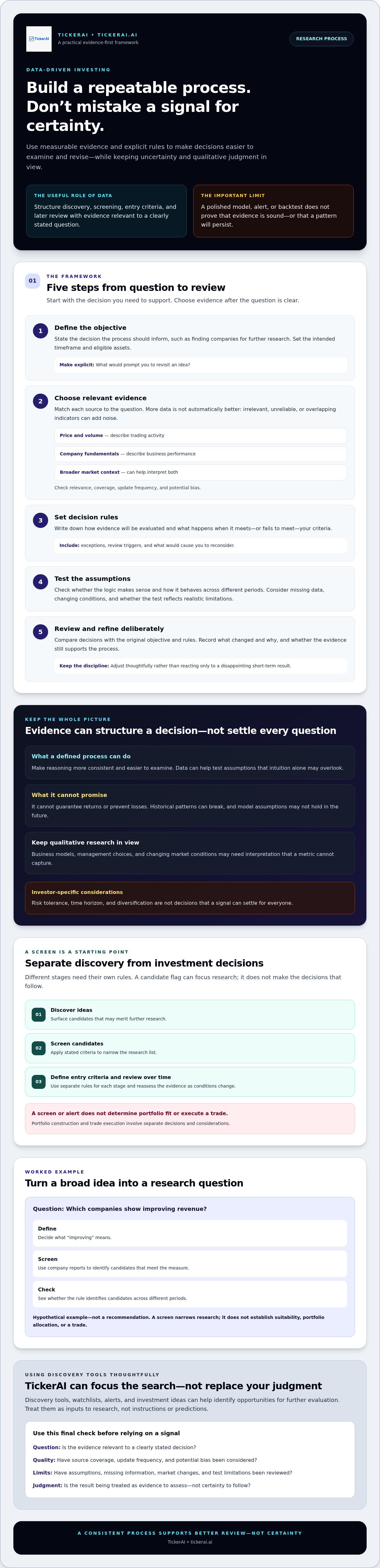
- Use five practical stages: define an objective, choose evidence, set rules, test assumptions, and review results.
- Compare systematic, fundamental, and hybrid approaches by their inputs, trade-offs, and research effort rather than assuming one fits every investor.
- Check whether a strategy’s assumptions hold across different market periods, and account for backtest limitations before drawing conclusions.
- Use TickerAI’s discovery tools, watchlists, alerts, and investment ideas to identify opportunities for further evaluation, not as a substitute for your own decisions.
What makes an investment strategy data-driven, and what does it not promise?
A data-driven investment strategy uses measurable evidence and explicit rules to inform decisions. Evidence might include price history, company financials, or other relevant information. Rules explain how that evidence is assessed and what action, if any, follows. This makes the reasoning more consistent and easier to review, but it does not remove uncertainty.
Quantitative analysis applies mathematical and statistical methods to financial information. The overview of Quantitative analysis (finance) offers useful background on the field. Data-informed decisions can help test assumptions that intuition alone may overlook. Qualitative research still matters: business models, management choices, and changing market conditions may require interpretation that a metric cannot capture.
More data isn’t automatically better. Irrelevant, unreliable, or overlapping indicators can add noise and make a weak signal look convincing. Choose evidence that relates to a clearly stated question, then consider what the data can and cannot tell you.
Which decisions can data help an investor structure?
Evidence can support distinct stages of a process: discovering ideas, screening candidates, defining entry criteria, and reviewing decisions over time. Each stage needs its own rules. A screen or alert can flag a candidate for research; it does not determine how that asset fits into a portfolio or execute a trade. Portfolio construction and trade execution involve separate decisions and considerations.
Hypothetical example, not a recommendation: An investor wants to study companies with improving revenue. They define what “improving” means, screen company reports for that measure, and check whether the rule identifies candidates across different periods. The screen narrows the research list. It does not establish that any company is suitable, or specify a portfolio allocation or trade.
Does a data-driven strategy eliminate investment risk?
No. Historical patterns can break when market conditions change, and a model may rely on assumptions that don’t hold in the future. Data quality, missing information, and the design of a test can also affect what its results appear to show.
Consistency is the benefit: applying the same defined process makes decisions easier to examine and revise. Predictable results are not. No data-driven investment strategy can guarantee returns or prevent losses. Risk tolerance, time horizon, and diversification are investor-specific considerations, not outputs that a signal can settle for everyone. Treat model results as evidence to assess, not certainty to follow.
How to build a data-driven investment strategy in five steps
Build the process in order. Start with the decision you need to support, then choose evidence that can help answer it. Adding indicators before defining the question often creates noise rather than clarity.
A data-driven investment strategy defines an objective, selects relevant evidence, sets decision rules, tests assumptions, and reviews results on a planned cadence. Use this sequence as an educational framework, not individualized financial advice.
- Define the objective. State the decision the process should inform, such as identifying companies for further research. Set the intended timeframe and eligible assets. Decide what would prompt you to revisit an idea.
- Choose evidence. Match data to the question. Price and volume data describe trading activity; company fundamentals describe business performance; broader market context can help interpret both. Check each source’s relevance, coverage, update frequency, and potential bias.
- Set rules. Write down how you will evaluate the evidence and what happens when it meets, or fails to meet, your criteria. Define exceptions and review triggers. Clear rules can reduce reactive decisions without eliminating the need for judgment.
- Test assumptions. Examine whether the logic makes sense and how it behaves across different periods. Consider missing data, changing conditions, and whether the test reflects realistic limitations. The SEC report on algorithmic trading provides context on potential benefits and risks of algorithmic methods.
- Review and refine. Compare decisions with the original objective and rules. Record what changed, why it changed, and whether the evidence still supports the process. Adjust deliberately, rather than simply reacting to a disappointing short-term result.
Start with a goal, timeframe, and decision rules
Make the objective specific enough to guide research. “Find candidates for further analysis” is more actionable than “find good stocks.” Then define the timeframe and which assets are in scope. Set conditions for reviewing an idea, such as new company information or a change in the data. Written rules create consistency; they don’t dictate a suitable choice for every investor.
Select data and set a review cadence
Check whether a dataset measures what you need, covers the assets and periods you’re studying, and updates at a useful frequency. Look for gaps or selection bias. Choose a review schedule that fits the strategy’s timeframe instead of reacting to every new data point. A research tool such as AI stock opportunity discovery can surface ideas for evaluation, while you remain responsible for checking the evidence and making decisions.
How do data-driven investment approaches compare?
Systematic, fundamental, and hybrid approaches differ in the evidence they emphasize and the role of human interpretation. They can also suit different holding periods, from shorter-term decisions to longer-term research. None is universally best. A model can organize evidence and apply rules consistently, but it can’t remove uncertainty or decide whether an opportunity fits an investor’s circumstances.
| Approach | Typical inputs | Strengths | Limitations and effort |
|---|---|---|---|
| Systematic | Defined quantitative inputs, such as price, volume, or selected financial measures | Applies explicit rules consistently and can screen many candidates | Depends on data quality and assumptions; requires rule design, testing, and monitoring |
| Fundamental | Company financials, business conditions, and relevant context | Can examine why a business may be changing, not just whether a metric moved | Requires substantial research and interpretation; conclusions may be less standardized |
| Hybrid | Quantitative screens combined with company and market research | Uses data to prioritize questions for human review | Still needs clear rules and careful judgment; can take effort to coordinate both methods |
Systematic, fundamental, or hybrid: what changes?
A systematic process evaluates specified inputs against defined conditions. It can make screening repeatable, but its output reflects the rules and data selected. Fundamental research examines a business through its financial information and operating context, with more interpretation. A hybrid process might use a screen to identify companies for closer review, then assess their business context against written criteria. In each case, investors retain responsibility for portfolio choices and execution.
How should investors judge AI-generated signals?
Treat a signal as a research prompt, not a decision. Before acting, check whether it explains the evidence behind it, the timeframe it refers to, and the conditions or limitations that could affect its meaning. Compare it with your written criteria. If the context is unclear or the signal conflicts with those criteria, pause and investigate rather than assuming the output is conclusive. For a focused walkthrough, consult How to Interpret AI Stock Signals.
A data-driven investment strategy can structure how evidence is collected and assessed. The right balance of rules and human review depends on the approach, its data demands, the intended holding period, and the investor’s decision process.
How to validate and improve your strategy without overfitting
A strong backtest is a reason to investigate a strategy, not proof that it will work in live markets. A rule can look effective because it was tuned too closely to past observations, including random patterns that may not recur. Changing market conditions, incomplete data, and selective reporting can also make results appear more robust than they are.
For a data-driven investment strategy, validation helps expose weak assumptions and clarify limitations. No single test confirms future reliability.
What can make a strategy look stronger than it is?
Overfitting happens when rules are adjusted repeatedly to match historical data. The resulting model may describe the past precisely but fail under unfamiliar conditions. Check how the data was collected, whether important information is missing, and whether the strategy was assessed across different periods rather than only the most favorable stretch. Ask whether unsuccessful tests or inconvenient results were left out.
- Review assumptions: Do the rules rely on conditions that may not persist?
- Compare periods: Does the logic remain understandable across different market environments?
- Account for limits: Does the test reflect data gaps and other practical constraints?
These checks can reveal fragility, but they can’t prove how a strategy will perform in future markets.
What should a practical review record include?
Keep a decision log. Record the original thesis, the data considered, the reason for each decision, and what you learned in later reviews. If you compare results with a benchmark, make sure it reflects a relevant market, asset type, and timeframe. A mismatched benchmark can distort the comparison.
Backtesting evaluates rules against historical data. It isn’t the same as executing trades in a live account. TickerAI supports opportunity discovery and research; it doesn’t provide brokerage execution. For more detail, see Backtesting Strategies: Using Evidence to Build Edge and Rule-Based Systems: How to Create a Trading Plan. Their titles identify useful areas to explore, while the review process remains your responsibility.
Use validation to improve clarity, not to chase a perfect historical result. To surface ideas for further research, explore AI stock opportunity discovery, then assess each idea against your own process.
Where TickerAI fits in a data-driven investment strategy
TickerAI can serve as a discovery and research input within an investor-controlled process. Its AI stock opportunity discovery, smart watchlists, real-time alerts, curated swing trade setups, and long-term investment ideas can help surface candidates to investigate. These tools aren’t a complete strategy, don’t confirm that an idea is suitable, and don’t guarantee a market outcome. Subscribers make their own investment decisions and arrange any trade execution independently.
When can stock discovery tools support the process?
Discovery tools can bring a potential candidate to your attention. The next step is to check it against criteria you established before seeing the alert. Ask whether the idea fits your intended timeframe and research scope, then examine the evidence behind it. An alert is a prompt for further review, not a substitute for company analysis, risk controls, or personal judgment.
- Check the context: What information supports the surfaced idea, and what might be missing?
- Compare with your rules: Does it meet your existing criteria, or is the signal pulling you outside them?
- Decide what comes next: Continue research, set the idea aside, or review it later according to your process.
This keeps discovery separate from decision-making. A watchlist or setup may help organize research, but it doesn’t determine portfolio fit, position size, or execution.
How should readers assess TickerAI subscription options?
TickerAI offers Pro and Full-Access subscriptions. Before choosing, verify the current differences between the tiers, then consider whether their available discovery features align with how you research and the kinds of ideas you want to investigate. Focus on fit with your workflow, not on assuming that more signals mean better decisions. TickerAI supports research and discovery; it doesn’t provide personal financial advice or brokerage execution.
A practical next step is to review the available features and compare them with your research habits and goals. Explore TickerAI stock opportunity discovery as a potential input to your process, then apply your own criteria before making decisions.
Turn better evidence into a repeatable process
A practical data-driven investment strategy starts with a clear objective, relevant evidence, and rules you can review. Systematic, fundamental, and hybrid approaches each offer different ways to organize research, but none removes uncertainty. Test assumptions across different periods, watch for overfitting, and treat historical results and AI signals as inputs, not guarantees.
The strongest process is one you can explain and reassess. Keep a record of why an idea met your criteria, what evidence informed the decision, and what might cause you to review it. Let data focus your attention while retaining responsibility for decisions and execution.
TickerAI can support the discovery stage with AI-powered stock opportunity discovery, smart watchlists and real-time alerts, curated swing trade setups, and long-term investment ideas. Consider whether these tools fit your research habits, and verify the current differences between Full-Access and Pro before choosing a subscription.
Explore TickerAI stock opportunity discovery as an input to your research. Build your process thoughtfully, stay curious, and keep your decisions grounded in evidence.
Frequently Asked Questions
What is a data-driven investment strategy?
A data-driven investment strategy uses measurable information and defined criteria to inform investment decisions. Inputs may include market prices, trading activity, company information, or other relevant evidence. The process specifies what data matters, how to interpret it, and when to review an idea. For example, an investor might screen companies using a chosen financial measure, then research candidates that meet the criteria. Data supports judgment, but it can’t guarantee results.
How do I create a data-driven investment strategy?
Start by defining the decision you want to support, your timeframe, and the assets you’ll consider. Select data that relates to your objective, then write rules for evaluating ideas and deciding when to review them. Examine how those rules behave across different conditions and revisit your assumptions as needed. Documenting the process makes it easier to assess decisions consistently, but it doesn’t remove market uncertainty or replace your judgment.
Can AI help with investment decisions?
AI can help organize information, identify patterns, and surface opportunities for further research. Its output depends on the data, model, and context, so an insight can be incomplete or incorrect. Treat AI as an analytical input, not an autonomous decision-maker. Before acting on a signal, check what evidence supports it, whether it fits your criteria, and what limitations may affect its interpretation. Make decisions through a process you understand.
Is a data-driven investment strategy better than fundamental analysis?
Neither approach is universally better. Data-driven methods can apply consistent rules to measurable inputs, while fundamental analysis examines a company’s business, financial information, and context. Some investors combine them, using data to identify candidates and fundamental research to investigate them further. Compare approaches by how well their inputs and effort fit your objectives, timeframe, risk tolerance, and ability to follow the process. No approach label guarantees better performance.
What data should investors use to evaluate stocks?
Choose data based on the decision you’re trying to make. Price and volume history can help examine market activity; company financial information can support business analysis; broader market context may help interpret both. Check whether each source is relevant, current, sufficiently complete, and interpreted consistently. Before adding an indicator to a screen, ask what specific question it answers. More inputs can add complexity without improving decision quality.
Does backtesting prove an investment strategy will work?
No. Backtesting shows how defined rules would have behaved against historical data, but the result depends on the data and assumptions used. Rules tuned too closely to past observations may not hold under different market conditions. Review how the test was designed, consider data limitations, and examine results across different periods. Treat a backtest as one research tool, not proof of future performance or a promise of investment results.
Can TickerAI execute trades or provide personal investment advice?
No. TickerAI provides AI-powered stock opportunity discovery through its subscription tiers, with smart watchlists, real-time alerts, curated swing trade setups, and long-term investment ideas. It doesn’t provide personal financial advice, custom trading coaching, or brokerage execution. Evaluate any surfaced idea against your own criteria and research. Subscribers make their own investment decisions and arrange execution independently. Check the current differences between Full-Access and Pro before selecting a tier.


