

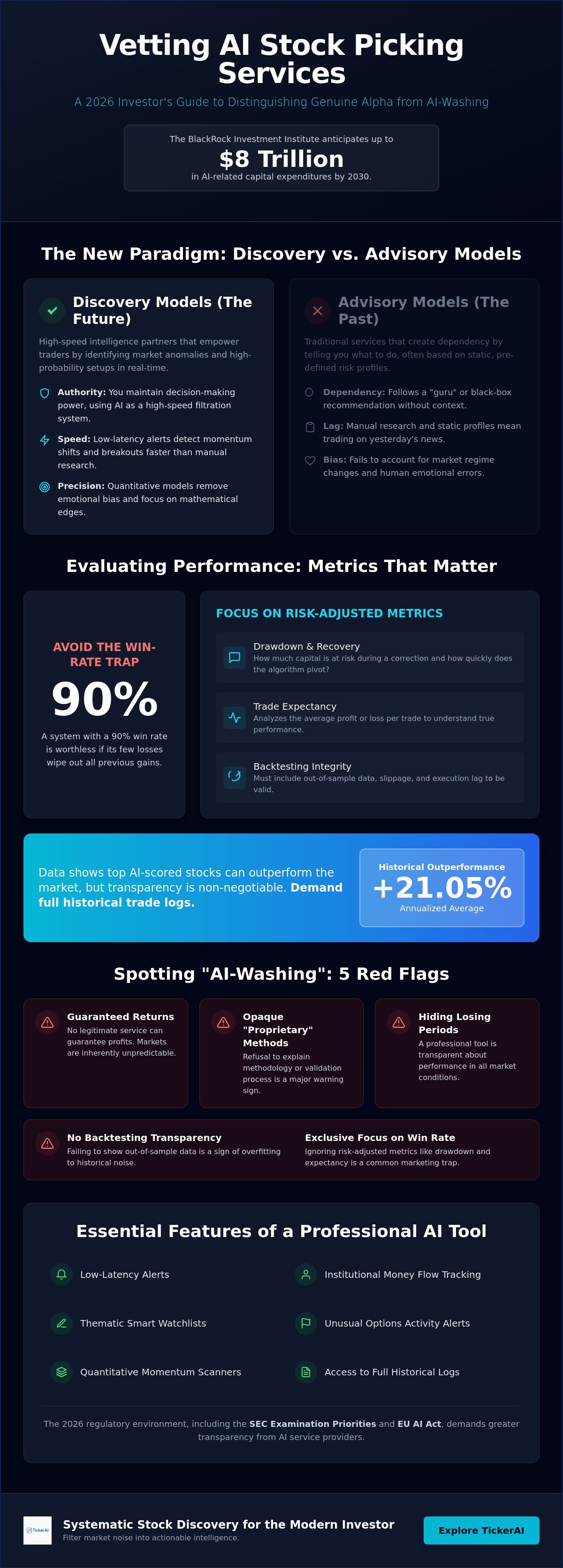
The BlackRock Investment Institute anticipates up to $8 trillion in AI-related capital expenditures through 2030. This massive capital shift has triggered an epidemic of "AI-washing" across financial products. When you're evaluating an AI stock picking service, the challenge isn't a lack of data. It's the verification of algorithmic logic. You must distinguish between genuine machine learning and simple marketing wrappers. Most professionals feel the crushing weight of 24/7 global markets. Manual research lag often means missing critical momentum breakouts before they peak.
You've likely grown skeptical of black-box promises that lack transparency. This guide provides a clinical methodology for vetting AI-driven discovery tools to extract genuine alpha. We'll deliver a repeatable framework for identifying high-potential swing trade setups automatically. We'll also examine the 2026 regulatory environment, including SEC examination priorities and the latest transparency requirements of the EU AI Act. You'll gain the precision required to filter market noise into actionable intelligence and data-driven confidence.
Key Takeaways
- Shift from traditional human-led advisory to automated discovery models that scan for market anomalies in real time.
- Prioritize risk-adjusted metrics like drawdown and recovery periods when evaluating an AI stock picking service to avoid the "win rate" trap.
- Demand professional-grade features such as low-latency alerts and thematic smart watchlists that categorize setups by timeframe.
- Detect "AI-washing" by identifying red flags like guaranteed returns or opaque, unexplainable "proprietary" methodologies.
- Align your trading frequency with the appropriate research tier to systematically capture algorithmic alpha through automated scanning.
What is an AI Stock Picking Service in 2026?
In 2026, an AI stock picking service is a platform using machine learning to scan global markets for anomalies and setups. It isn't a passive tool. It's a high-speed intelligence partner. Evaluating an AI stock picking service in 2026 requires understanding the shift from static data to dynamic discovery. While a traditional Robo-advisor manages portfolios based on static risk profiles, modern AI discovery tools hunt for volatility and momentum. They detect patterns in terabytes of data that no human analyst could process.
The industry has transitioned from "advisory" models to "discovery" models. Advisory services often create dependency; they tell you what to do. Discovery tools empower you. They provide the data points so you can execute. Relying on manual automated stock market analysis is no longer viable. The lag between data generation and human interpretation is too wide. In the 2026 market, alpha decays in minutes, not days. If you aren't using algorithmic scanning, you're trading on yesterday's news.
The Evolution of Market Intelligence
Market intelligence has evolved from basic stock screeners to predictive neural networks. Old screeners looked for simple price-to-earnings ratios. 2026 AI identifies "hidden" catalysts before retail sentiment peaks. It monitors institutional money flow in real time. It spots unusual options activity and dark pool prints. These systems don't just report what happened; they detect the structural shifts that precede a breakout. They act as proactive scouts in a chaotic environment.
This level of intelligence requires robust data pipelines; many modern fintech platforms explore Wealthreader's bank access API to integrate real-time banking data into their discovery engines.
Discovery vs. Advisory: Knowing the Difference
When you are evaluating an AI stock picking service, you must distinguish between Large Language Models (LLMs) and quantitative momentum scanners. LLMs excel at summarizing earnings calls. They are narrative generators. Quantitative scanners are different. They process raw price action and volume data to find mathematical edges. Professional traders prioritize the latter to maintain a technical advantage.
AI stock discovery is a high-speed filtration system for market noise.
- Authority: You maintain decision-making power rather than following a "guru."
- Speed: Low-latency alerts beat manual research every time.
- Precision: Quantitative models remove the emotional bias that leads to "revenge trading."
Professional traders use these tools to scale their intelligence. They don't want a "black box" telling them to buy. They want a scout that identifies high-probability setups across thousands of tickers simultaneously. This is the baseline for professional participation in the current market cycle. It's about efficiency, not guesswork.
Key Metrics for Evaluating AI Performance
Raw percentage gains are the most common trap for novice investors. When you are evaluating an AI stock picking service, a high win rate often masks poor risk management. A system with a 90% success rate is worthless if its few losses wipe out all previous gains. You must look at the expectancy of every alert. This requires analyzing drawdown and recovery periods. How much of your capital is at risk during a correction? How quickly does the algorithm pivot when the market regime changes? Transparency is non-negotiable. Demand access to full historical trade discovery logs to verify that the alpha isn't just a result of survivorship bias.
Professional discovery models aim for consistent outperformance. For instance, data shows that US-listed stocks with the highest AI scores on platforms like Danelfin have historically outperformed the market by an average of +21.05% on an annualized basis. However, these numbers mean nothing without context. You need to see how the service performed during high-volatility events or liquidity crunches. If the service hides its losing periods, it's a marketing tool, not a professional resource.
Backtesting Integrity and Data Leakage
Overfitting is a silent killer in algorithmic trading. It happens when a model is so fine-tuned to historical noise that it fails in live markets. You need to see out-of-sample testing results. This means the AI was tested on data it had never seen before. Backtesting must account for slippage and execution lag to be valid. Without these variables, the results are just theoretical fantasies. SEC Chair Gary Gensler highlighted the risks of algorithmic bias and the need for accurate representations of AI capabilities in a recent MIT Sloan interview with SEC Chair. If a service can't explain its validation process, it isn't professional grade.
Risk-Adjusted Returns (Sharpe & Sortino Ratios)
Move beyond raw gains. Evaluate performance through the Sharpe and Sortino ratios. These metrics penalize volatility. They tell you if the returns are worth the emotional and financial stress. A systematic approach requires consistent position sizing on every alert. Don't just compare performance to the S&P 500. Compare it to sector-specific benchmarks. If an AI focuses on tech, it should beat the Nasdaq 100, not just the broader market. Capturing this level of precision is easier when accessing professional discovery tools that prioritize data transparency over hype. You need a tool that treats your capital with the same clinical precision you use to trade.
Essential Features of a Professional AI Discovery Tool
A professional discovery tool must function as a high-speed intelligence partner. Evaluating an AI stock picking service requires a focus on workflow integration rather than just raw picks. It isn't enough to provide a ticker symbol. You need context, entry zones, and catalyst identification. Prioritize low-latency execution in your vetting process. If an alert arrives five minutes after the breakout, the alpha is gone. Late data is dead data. You need clinical precision in real-time to maintain a competitive edge.
Professional traders often integrate these signals with specialized swing trade setup finders to validate technical levels. This multi-layered approach ensures that algorithmic discovery is backed by structural price action. According to FINRA's guide to AI in the securities industry, the complexity of these models requires robust supervision and clear operational frameworks. You aren't looking for a toy; you're looking for a systematic advantage that scales with your trading volume.
The Utility of Smart Watchlists
Smart watchlists must adapt to sector rotations automatically. AI-driven lists scan for institutional money flow and categorize opportunities into tactical buckets. This allows you to separate long-term investment ideas from high-velocity swing trades. Anomaly detection is the core value here. It identifies early-stage breakouts by detecting volume spikes or price deviations before they hit the scanners of retail participants. Static lists are liabilities in a fast-moving market.
Alert Quality and Signal-to-Noise Ratio
Alert quality is defined by the signal-to-noise ratio. Analysis paralysis is a real risk when a service sends fifty notifications a day. A professional tool filters out low-conviction signals. Every alert must include actionable data: specific entry zones, stop-loss suggestions, and the underlying logic for the discovery. Multi-channel delivery is essential. Whether you're at your desk or on the move, real-time push notifications ensure you don't miss momentum shifts. Efficiency is the priority.
When you're evaluating an AI stock picking service, look for a platform that prioritizes the quality of information over the quantity of alerts. The goal is to spend less time scanning and more time executing. A high-quality tool acts as a tireless scout, filtering thousands of tickers to present only the most viable setups. This allows you to focus on decision-making while the algorithm handles the data-heavy lifting of market monitoring.
Spotting "AI-Washing": Red Flags and Scams
"AI-washing" isn't just a marketing buzzword; it's a systemic risk in the 2026 financial landscape. As capital floods into algorithmic tools, many services simply repackage basic technical indicators as "advanced neural networks." Evaluating an AI stock picking service requires a cynical eye for hyperbole. The most dangerous red flag is the promise of guaranteed returns. Professional markets are probabilistic, not deterministic. Any platform claiming a "guaranteed" monthly percentage is likely a Ponzi scheme or a high-risk gamble masked as technology. The SEC's 2026 examination priorities specifically target firms that overstate their AI capabilities; firms can face enforcement action for making unsupported performance claims.
Methodological transparency is another critical factor. "Proprietary" should never serve as a synonym for "unexplainable." If a service can't describe the data inputs or the logic behind a signal, you're gambling on a black box. You should also watch for selective reporting, commonly known as cherry-picking. Scams often highlight a single 500% winner while scrubbing the ten 20% losers from their public logs. This creates a distorted reality that ignores the necessity of drawdown management. If the service doesn't provide a full, unedited history of every discovery, it lacks the integrity required for professional use.
The "Black Box" vs. Explainable AI (XAI)
Demand to know the "Why" behind every alert. A signal without a rationale is unactionable for a professional participant. Relying on 100% automated execution without oversight is a recipe for catastrophic failure, especially during market regime shifts where historical correlations break down. Explainable AI is the bridge between algorithmic discovery and human confidence. It provides the technical justification required to size your positions correctly. You need to see the correlation between the AI's discovery and the underlying market mechanics to trust the output.
Vetting the Subscription Model
Avoid "churn and burn" services that prioritize aggressive social media marketing over technical infrastructure. These platforms often lack a transparent pricing structure or a trial period. High-tier services offer more than just picks; they provide community and professional support to help you refine your systematic workflow. Evaluate the cost-to-value ratio based on your portfolio size. If the subscription fee requires a massive monthly return just to break even, the math doesn't work for your capital base. For traders seeking transparency over hype, accessing a verified AI stock discovery platform is the only way to ensure your data is grounded in quantitative reality. Don't let marketing fluff dictate your risk exposure.
Regulatory compliance is also a major 2026 benchmark. The Colorado AI Act and the second phase of the EU AI Act now require transparency for high-risk AI systems. If a service refuses to provide basic disclosures about its security risk management or measures to prevent algorithmic discrimination, it likely won't survive the next regulatory cycle. Stick to platforms that treat compliance as a feature, not an obstacle.
TickerAI: Systematic Stock Discovery for the Modern Investor
TickerAI delivers algorithmic alpha by processing massive datasets with clinical precision. It doesn't just scan; it filters. The platform evaluates over 10,000 tickers to identify the highest-conviction setups in real time. This systematic approach is essential for evaluating an AI stock picking service in a market where NVIDIA reports 62% revenue growth and Broadcom's AI backlog hits $73 billion. You don't need more data. You need better filters. TickerAI acts as a high-speed intelligence partner, ensuring you aren't trading on stale information or retail sentiment that has already peaked.
TickerAI offers two distinct subscription tiers to match your specific needs. The TickerAI Pro Subscription is designed for active swing traders who require high-velocity alerts and intraday setups. For those who need institutional-grade discovery and deeper analytical layers, the TickerAI Full‑Access Subscription provides a comprehensive intelligence suite. Matching your research tier to your trading frequency is the first step in building a sustainable edge. When you're finished evaluating an AI stock picking service and move to implementation, TickerAI provides the clinical framework for execution.
Actionable Market Intelligence
TickerAI identifies momentum breakouts before they hit mainstream news cycles. It focuses on the "Inference Era," where value shifts from hardware to the profitable application of AI. The platform's real-time alerts ensure you capture opportunities as they materialize. It's a tool for both long-term investment ideas and short-term tactical trades. Smart watchlists allow you to maintain a disciplined trading plan by categorizing opportunities by theme and timeframe. You spend less time searching and more time executing. This efficiency is critical as the BlackRock Investment Institute anticipates up to $8 trillion in AI-related capital expenditures through 2030.
Building Your Edge with TickerAI
Systematic discovery is the only way to separate algorithmic alpha from market noise. TickerAI is the preferred AI stock discovery platform for professionals who value logic over hype. It acts as a tireless scout, scanning the horizon while you focus on high-level decision making. It prioritizes "Vertical AI" models trained for specific financial market mechanics. This specialized focus provides a depth of expertise that general-purpose models lack. Don't let manual research lag dictate your returns or force you to miss the next sector rotation.
Join TickerAI today and discover your next trade setup
Executing with Algorithmic Precision
The 2026 market doesn't reward hesitation. Success now depends on your ability to filter noise and detect institutional money flow before it reaches retail saturation. When you're evaluating an AI stock picking service, your focus must remain on systematic methodology and risk-adjusted performance. High win rates are meaningless without clear drawdown data and explainable logic. You need a tool that functions as a tireless scout; one that prioritizes data integrity over marketing hype.
Professional traders have moved beyond simple screeners. They now utilize discovery platforms to maintain a clinical edge in a high-speed environment. By focusing on smart watchlists and low-latency alerts, you reclaim your time and focus on high-level execution. Don't let manual research lag compromise your capital. It's time to integrate high-speed intelligence into your daily workflow to stay ahead of momentum shifts.
Access Professional AI Stock Discovery with TickerAI and leverage real-time algorithmic alerts, curated swing trade setups, and smart thematic watchlists. Secure your technical advantage and trade with data-driven confidence today.
Frequently Asked Questions
Is an AI stock picking service better than a human advisor?
AI and human advisors serve different strategic functions. AI excels at high-speed data processing and anomaly detection across thousands of tickers simultaneously. Human advisors typically focus on holistic financial planning and personal goals. For active market discovery and technical setups, algorithmic tools offer a speed and scale advantage that manual research cannot match. It's about efficiency versus broad strategy.
How much does a professional AI stock discovery service cost in 2026?
Market rates for professional AI discovery tools vary based on data depth and latency requirements. Industry benchmarks show premium tiers often fall between $30 and $150 per month. High-frequency tools with real-time alerts command higher premiums. Always compare the cost-to-value ratio against your portfolio size and trading frequency to ensure the subscription remains a viable overhead for your capital base.
Can I use AI stock alerts for long-term investing or only day trading?
AI stock discovery is applicable across multiple timeframes. While many associate algorithmic alerts with high-speed swing trading, professional platforms also generate long-term investment ideas based on structural catalysts and institutional accumulation. You can filter setups to match your specific horizon. Smart watchlists allow you to categorize these opportunities into tactical short-term buckets or strategic long-term holdings effectively.
What happens if the AI stock picking service is wrong?
No algorithm is infallible; risk management remains the user's responsibility. AI identifies probabilistic setups, not guaranteed outcomes. When evaluating an AI stock picking service, you must ensure it provides specific entry zones and stop-loss suggestions to mitigate downside. A systematic approach requires consistent position sizing on every alert. This ensures a single incorrect signal doesn't compromise your entire capital base.
How do I know if an AI stock alert is legitimate or just a pump and dump?
Legitimacy is found in explainable data and volume verification. Professional AI alerts are based on technical indicators and institutional money flow rather than social media hype. Verify if the signal aligns with a structural breakout or a fundamental catalyst. If an alert lacks a transparent "Why" or targets low-liquidity micro-caps with "guaranteed" returns, it's likely a pump and dump scheme.
Do I need technical trading knowledge to use an AI stock service?
A baseline level of industry knowledge is required to execute effectively. While the AI handles the complex data-heavy lifting of scanning and filtering, you must understand market mechanics and risk management. Professional tools provide the setups, but the user must maintain decision-making authority. It's a partnership between algorithmic discovery and human judgment rather than a "set and forget" solution.
Is TickerAI suitable for beginners or only professional traders?
TickerAI is designed for serious participants who value efficiency and clinical precision. While the interface is accessible, the underlying logic is rooted in professional-grade quantitative analysis. Beginners can use the platform to learn systematic discovery, but the service is optimized for those who treat trading as a disciplined professional activity. It filters noise for anyone who values their time and intelligence.
What is the difference between an AI screener and an AI discovery platform?
Screeners are reactive; discovery platforms are proactive. A traditional screener filters stocks based on static parameters you set manually. An AI discovery platform uses machine learning to identify anomalies and setups automatically. When evaluating an AI stock picking service, look for this predictive edge. Discovery platforms act as a tireless scout, detecting institutional shifts before they hit standard retail scanners.


