

Most traders are still manually scanning charts while the market's 2026 architecture has already moved toward total algorithmic dominance. Relying on manual labor in a high-frequency environment is a recipe for missing momentum breakouts and suffering from analysis paralysis. By automating stock market research, you transform from a reactive participant into a precision-guided strategist. It's the only way to filter 10,000+ tickers into a curated watchlist in seconds without the noise of social media or conflicting news cycles.
We know the weight of information overload. You've likely seen momentum trades vanish while you were still verifying technical indicators. This guide provides a multi-step framework to replace manual scanning with high-speed AI discovery and clinical precision. We'll detail a repeatable, data-driven investment workflow that delivers real-time alerts for swing trade setups. You'll learn to build a high-speed intelligence filter that executes the grunt work of discovery while you focus on execution. It is time to stop chasing the tape and start anticipating it.
Key Takeaways
- Replace the manual grind with a systematic signal detection engine designed for the high-speed 2026 market environment.
- Master the technical parameters for automating stock market research to identify high-probability swing trade setups as they happen.
- Utilize AI-powered sentiment analysis and thematic filtering to isolate institutional-grade opportunities from retail noise.
- Verify trade viability using automated backtesting and catalyst event analysis to ensure clinical precision before execution.
- Streamline your intelligence workflow by integrating real-time alerts and smart watchlists directly into your professional trading terminal.
The Shift from Manual Scanning to Automated Discovery
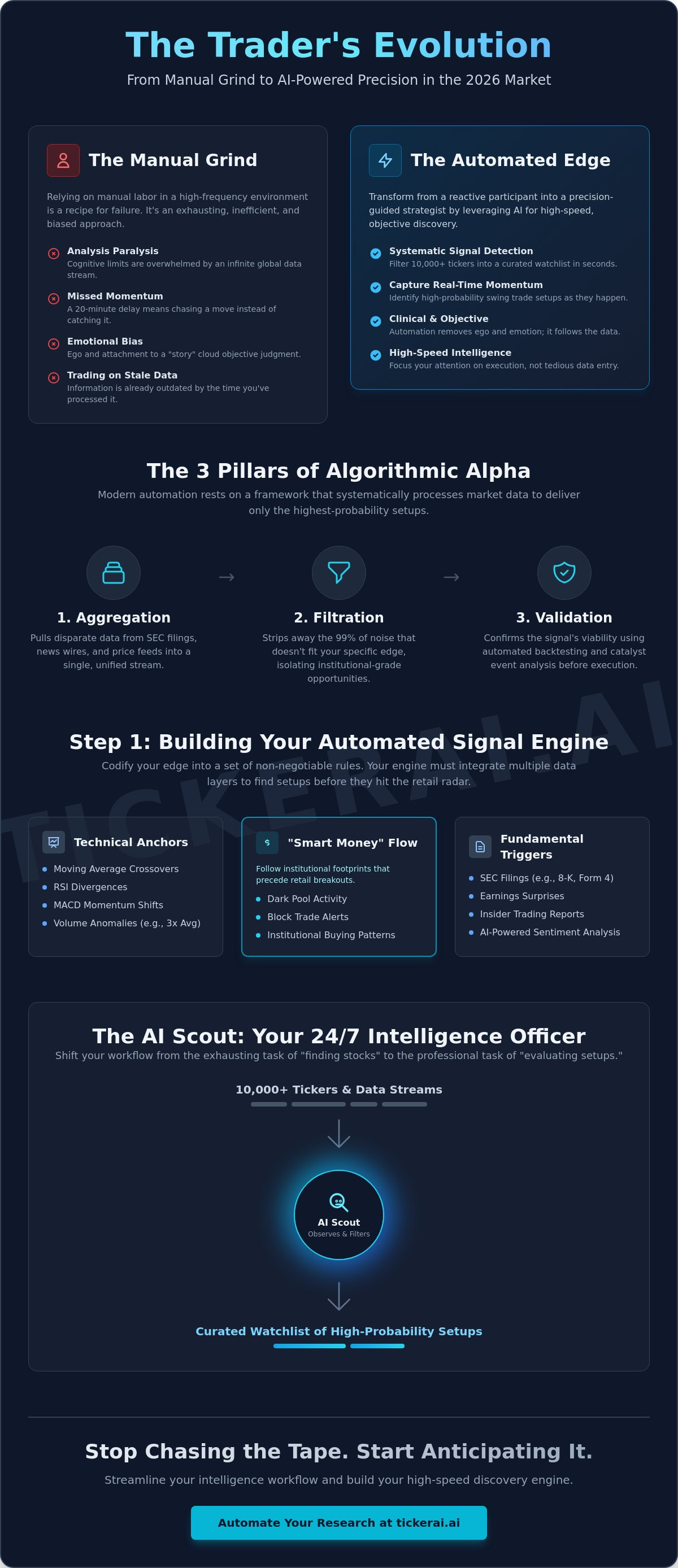
Automating stock market research is no longer a luxury for institutional desks; it's a survival requirement for any serious participant. In 2020, you could win by being the hardest worker in the room, spending hours clicking through tickers on a static watchlist. By 2026, that manual grind has become a liability. The market now rewards "algorithmic alpha." This isn't just about speed. It's about the systematic ingestion of data and the immediate detection of signals that the human eye simply cannot process in real time.
The evolution of Algorithmic Trading has expanded beyond execution into the pre-trade research phase. Modern automation rests on three pillars: aggregation, filtration, and validation. Aggregation pulls disparate data from SEC filings, news wires, and price feeds into a single stream. Filtration strips away the 99% of noise that doesn't fit your specific edge. Validation confirms the signal against historical data and upcoming catalysts. This framework ensures you're only looking at the highest-probability setups. Speed is the primary differentiator. If you aren't automating stock market research, you're trading on stale information.
Why Manual Research Fails in High-Volatility Markets
Human cognitive limits are fixed, but the global data stream is infinite. Trying to track every sector rotation or volume spike manually results in "stale data." In swing trading, a 20-minute delay is often the difference between a high-probability entry and chasing a move that's already extended. Emotional bias also creeps into manual analysis. You might hold onto a "story" because you spent three hours researching it. Automation removes the ego. It looks at the numbers, detects the anomaly, and moves on without hesitation. It's clinical. It's objective.
The Role of the AI Scout in Your Portfolio
Think of AI as a proactive scout that never sleeps. It scans 10,000+ symbols simultaneously, looking for the exact technical or fundamental criteria you've defined. This shift allows you to move from the exhausting task of "finding stocks" to the professional task of "evaluating setups." This creates an Observation-to-Action flow. The system observes a volume anomaly or a specific momentum breakout; you decide if the risk-reward profile fits your mandate. This systematic approach to automating stock market research ensures your attention is always focused on execution rather than data entry. It transforms your workflow into a high-speed intelligence operation.
Step 1: Building Your Automated Signal Detection Engine
Building an automated signal detection engine is the first step in moving from manual intuition to systematic execution. You must codify your edge into a set of non-negotiable rules. When automating stock market research, your engine acts as a 24/7 filter. It identifies volume anomalies and price breakouts before they appear on retail radars. This requires more than simple price alerts. It demands the integration of fundamental triggers. SEC filings, earnings surprises, and insider trading reports must feed into a unified scan. By doing so, you create a comprehensive view of a ticker’s health before a single candle forms. This multi-layered approach ensures you aren't just chasing price, but following the conviction of the underlying data.
Defining Your Search Parameters
Select technical anchors that provide high-probability signals. Moving average crossovers, RSI divergences, and MACD momentum shifts are foundational. However, professional 2026 workflows require tracking "Smart Money" flow. Institutional buying patterns often precede retail breakouts by days. You should monitor dark pool activity and block trade alerts to see where the largest players are positioning. An algorithmic signal is a data-driven trigger for deeper investigation. By setting these parameters, you ensure your "Agentic" scanners operate autonomously across multiple timeframes. These scanners don't just wait for a price hit. They monitor the complex relationship between volume, price action, and sentiment simultaneously. This creates a tireless assistant that flags setups while they are still nascent.
Real-Time vs. Batch Scanning
Real-time alerts are critical for capturing intraday volatility. If a stock hits a 52-week high on 3x average volume, you need to know in milliseconds. High-speed discovery is the hallmark of the modern professional. Conversely, end-of-day batch processing is superior for long-term investment ideas. It allows for a holistic view of market breadth without the noise of the trading session. The Shift to Automated Trading highlights how speed impacts market structure and liquidity. Reducing latency in your alert delivery is vital to maintain a competitive edge. For those looking to streamline this process, exploring professional AI stock opportunity discovery tools can provide a significant head start over manual logic building. This ensures your workflow remains agile and your automating stock market research efforts result in actionable intelligence.
Step 2: Intelligent Filtering and Thematic Organization
Scanning 10,000 tickers is a hollow victory if you're buried under 500 low-conviction alerts. The second phase of automating stock market research focuses on extraction over accumulation. You must move beyond static lists that require manual sorting. Smart watchlists act as dynamic, self-governing containers. They categorize opportunities into thematic baskets like AI infrastructure, biotech catalysts, or energy transitions. This organization allows you to track sector rotation with clinical precision. You aren't just looking for an isolated stock; you're identifying where institutional capital is flowing. This thematic approach ensures your research remains focused on the highest-velocity segments of the market.
Priority should never be chronological. In a high-speed environment, the most recent alert isn't always the most relevant. Professional workflows utilize 'Signal Strength' scores to dictate focus. These scores aggregate technical confluence, volume profiles, and fundamental triggers into a single numerical value. This ensures your attention remains on high-conviction setups rather than the latest social media buzz. It creates a logical Observation-to-Action flow. The system detects the anomaly. The filtering engine scores it. You evaluate the execution. This hierarchy is the only way to manage the 2026 data stream without succumbing to analysis paralysis.
Creating Dynamic Smart Watchlists
Static watchlists are a relic of the 2020 manual grind. Modern smart watchlists update automatically based on technical criteria like relative strength or moving average proximity. By using automated stock market analysis, you can scale your research capacity without increasing your screen time. If a ticker no longer meets your momentum threshold, it's purged. If a new symbol breaks out on high volume, it's added. This keeps your focus on active opportunities and provides a clear view of market breadth. Linking these watchlists to specific sectors allows for rapid rotation analysis during volatile sessions.
Sentiment Analysis: Quantifying the Market's Mood
Sentiment is the most volatile variable in the 2026 market. AI-powered sentiment analysis allows you to distinguish between retail hype and institutional conviction. Natural Language Processing (NLP) can scan thousands of earnings call transcripts and news wires in seconds. It detects subtle shifts in executive tone or hidden context that manual reading would miss. TickerAI filters 90% of market noise to focus on actionable data. This clinical approach ensures you're trading on data, not headlines. It's about quantifying the market's mood with mathematical precision, allowing you to sidestep emotional traps and focus on institutional-grade setups.
Step 3: Validating High-Probability Setups with Data
Discovery is the scout; validation is the judge. Once you've used automating stock market research to build a curated watchlist, you must subject those tickers to rigorous data validation. Clinical precision requires executing automated backtesting to verify the historical win rate of a specific setup. You aren't looking for a "feeling" about a stock. You're looking for a statistical edge. Cross-referencing technical signals with institutional "Smart Money" flow provides the necessary confirmation. If the tape shows a breakout but dark pool data indicates distribution, the signal is likely a trap. Reviewing curated swing trade setups allows you to compare your automated findings against professional-grade intelligence for a final layer of objective validation.
Validation also requires a deep look at institutional conviction. High-speed discovery tools can flag a volume spike, but only validation tells you if that volume is sustainable. By analyzing the synergy between technical breakouts and fundamental catalysts, you ensure your entries are timed with precision. This data-driven approach removes the guesswork from your workflow. It transforms your research from a series of guesses into a repeatable, high-probability execution model. You're no longer just finding stocks; you're verifying alpha.
The Backtesting Framework
Historical validation is non-negotiable for professional traders. It prevents you from trading ghosts. Professional workflows use backtesting to identify "regime changes" where old strategies no longer apply. A setup that thrived in a low-rate environment might fail in the high-frequency volatility of 2026. Using an AI stock discovery platform allows you to find algorithmic alpha by testing millions of data permutations in minutes. It's about understanding the statistical expectancy of your current strategy before committing a single dollar of capital.
Catalyst Tracking and Event-Driven Research
High-probability entries often align with specific, predictable events. Automating the tracking of your calendar for earnings, FDA approvals, and SEC filings ensures you're never blindsided by volatility. AI detects "anomaly movements" preceding major news announcements by scanning for unusual options activity or pre-market volume spikes. This synergy between technical breakouts and fundamental catalysts is the gold standard for 2026. When automating stock market research, your system should flag these catalysts as part of the total validation score. It differentiates a random price fluctuation from a high-conviction, event-driven move with institutional backing.
Implementing TickerAI for Professional-Grade Discovery
Execution is the final frontier of a professional workflow. Once your signal detection and filtering engines are active, you need a central intelligence hub to bridge the gap between data and action. Integrating TickerAI's real-time alerts into your existing trading terminal completes the process of automating stock market research. This integration ensures that high-conviction setups aren't buried in your inbox but appear exactly where you execute. Discipline is maintained through the rule-based output of the AI scout. By trusting the data-driven triggers, you remove the emotional hesitation that often leads to missed entries. Focus on capital allocation. Let the machine handle the discovery.
Efficiency is a competitive advantage in the 2026 equity market. Utilizing curated swing trade setups can reduce your manual research time by up to 90%. This allows you to scale your portfolio without a linear increase in screen time. You aren't just buying a tool; you're acquiring a high-speed intelligence partner that filters 10,000+ tickers with clinical precision. It creates a seamless transition from observation to action, ensuring your capital is always deployed in the highest-probability environments. Just as AI streamlines market research, it can also optimize business operations by identifying unnecessary software costs; click here to see how LicenseIQ helps companies recover wasted spend on Microsoft 365 licenses.
TickerAI Pro vs. Full-Access: Selecting Your Tier
Selecting the right tier depends on your specific research volume and investment horizon. The TickerAI Pro subscription is designed for active swing traders who require real-time alerts and smart watchlists for intraday or multi-day momentum plays. If your focus is on long-term investment ideas and advanced discovery tools, the TickerAI Full-Access subscription provides deeper fundamental analysis and institutional-grade insights. To maximize ROI, apply these insights consistently. Consistent workflow application is the only way to turn raw data into a sustainable edge. Don't jump between strategies. Trust the system.
The Daily Workflow: From Alert to Execution
A professional day starts before the opening bell. Your morning routine should focus on reviewing automated scans and identifying early sector rotation. This sets the stage for the session. During the day, monitor real-time alerts for momentum plays that align with your pre-validated criteria. React only to the signals your engine produces. The evening is for refinement and journaling. Review your outcomes. Adjust your scanner parameters to match evolving market conditions. This iterative process is the hallmark of automating stock market research in a high-frequency world. Start your AI-powered discovery with TickerAI today.
Mastering the Algorithmic Alpha of 2026
The transition from manual scanning to a systematic intelligence filter is the only way to navigate the high-frequency volatility of the modern market. By automating stock market research, you move beyond the exhaustion of information overload. You replace intuition with clinical precision. You've learned to build a signal detection engine, organize discoveries into thematic baskets, and validate setups with historical data. This repeatable workflow ensures that your capital is always aligned with institutional momentum. It's no longer about who works the longest hours. It's about who possesses the most efficient filtering system.
It's time to stop chasing the tape and start anticipating it with professional-grade tools. Discover high-potential swing trade setups with TickerAI and leverage AI-powered smart watchlists and real-time market alerts. Our curated setups provide the data-driven edge required to filter 10,000+ tickers into actionable opportunities in seconds. The market rewards the prepared and the efficient. Build your high-speed intelligence partner today and trade with the confidence of a professional strategist.
Frequently Asked Questions
Is automating stock market research suitable for beginners?
Automating stock market research is accessible to beginners who possess a foundational understanding of market mechanics. While the technology handles the grunt work of data ingestion, you must still define your risk parameters and strategic goals. It's a tool for scaling intelligence. It's not a substitute for learning how equity markets function.
How does AI-powered research differ from traditional stock screening?
Traditional screening relies on static filters like P/E ratios or simple price targets. AI-powered research is dynamic and multi-layered. It ingests unstructured data like news sentiment and institutional flow in real time. This allows for signal detection that adapts to changing market regimes rather than relying on rigid, historical parameters that often fail in high-volatility environments.
Can AI-driven alerts predict market crashes or black swan events?
AI-driven alerts detect anomalies and volatility spikes that often precede market shifts, but they cannot predict black swan events. These events are unpredictable by definition. Instead, automating stock market research focuses on providing real-time data. This allows you to react with clinical speed when volatility enters the system, protecting your capital through rapid observation and action.
What is the difference between TickerAI Pro and Full-Access tiers?
The TickerAI Pro Subscription is optimized for active swing traders who require real-time alerts and smart watchlists. It's built for speed and intraday momentum. The TickerAI Full-Access Subscription provides a broader scope. It includes deep-dive long-term investment ideas and advanced discovery tools for investors managing complex, multi-horizon portfolios.
Does TickerAI execute trades on my behalf?
TickerAI does not execute trades on your behalf. We are a high-speed intelligence partner focused on discovery and signal detection. You maintain full control over your brokerage execution services and final decision-making. Our role is to filter the noise so you can focus on professional execution and portfolio management.
How reliable are the swing trade setups generated by AI?
The swing trade setups generated by our AI are built on high-probability technical and fundamental confluence. Reliability is rooted in data-driven logic rather than speculation. We recommend cross-referencing these setups with your own backtesting framework. This ensures they align with your specific risk mandate and the current market regime.
Do I need coding knowledge to automate my research in 2026?
You don't need coding knowledge to automate your research in 2026. Modern platforms utilize no-code interfaces and natural language processing to build complex scanners. The focus has shifted from writing scripts to defining logical parameters—similar to how enterprises explore voice agents to automate complex workflows. You act as the strategist while the machine handles the algorithmic processing.
How does TickerAI handle SEC filings and fundamental data?
TickerAI utilizes Natural Language Processing to scan SEC filings and earnings transcripts the moment they hit the wires. It detects keywords, sentiment shifts, and fundamental anomalies that manual analysis would miss. This ensures your fundamental research is as fast and precise as your technical signal detection, providing a comprehensive view of every ticker.


