

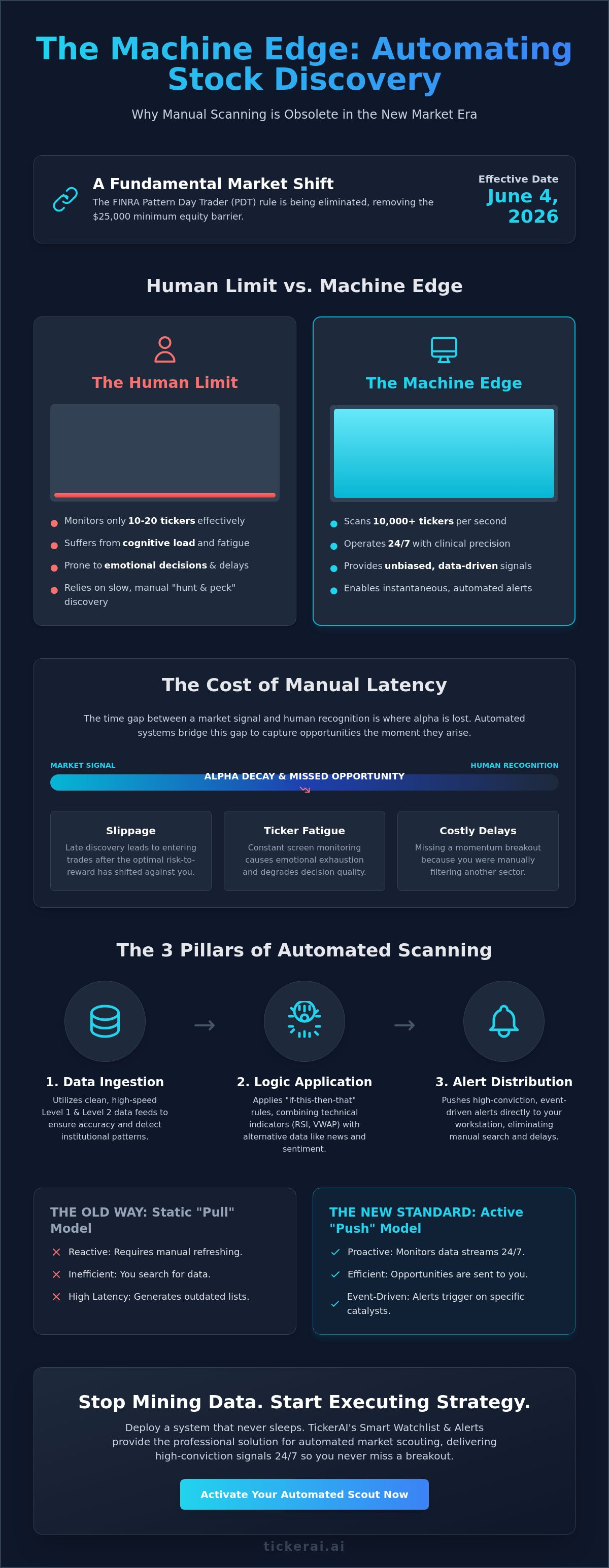
The $25,000 minimum equity requirement for frequent day trading is officially a relic of the past. As of June 4, 2026, the elimination of the FINRA Pattern Day Trader rule has fundamentally changed the barrier to entry for retail participants. However, increased accessibility brings a new challenge: extreme information overload. If you're still manually sifting through thousands of global tickers, you're already behind the curve. Learning how to automate stock market scanning is no longer a luxury. It's a requirement for those who want to avoid the emotional fatigue of constant screen monitoring and the costly delays of manual discovery.
You've likely felt the frustration of watching a momentum breakout happen without you because you were busy filtering another sector. We agree that the manual grind is unsustainable in this high-speed environment. This guide will show you how to master the transition from manual screening to automated discovery to capture market alpha with clinical precision. We'll examine the logic behind building a streamlined workflow that delivers high-conviction alerts 24/7. Stop mining data. Start executing strategy. Deploy a system that never sleeps.
Key Takeaways
- Transition from the human limit to the machine edge by deploying algorithms that scan thousands of tickers per second for clinical precision.
- Learn how to automate stock market scanning through a structured three-pillar system of data ingestion, logic application, and alert distribution.
- Evaluate the trade-offs between high-speed no-code AI deployment and the granular control of custom algorithmic scripting.
- Build a reliable opportunity discovery workflow by defining specific alpha criteria and filtering noise through sector and volume parameters.
- Implement a 24/7 monitoring system using TickerAI Smart Watchlist & Alerts to capture momentum breakouts without manual delays.
The Evolution of Market Intelligence: Why Manual Scanning is Obsolete in 2026
Automated stock market scanning is the systematic use of algorithms to filter global assets based on predefined logic. It replaces the archaic, manual "hunt and peck" method with computational speed. In the 2026 market environment, high-frequency shifts are the norm. Sub-second detection is no longer a luxury for hedge funds. It's a baseline requirement for any serious participant. Modern automation isn't about replacing your intuition. It's about deploying a system that handles Opportunity Discovery with surgical accuracy while you focus on execution.
The disparity between human capability and machine efficiency has reached a breaking point. A disciplined trader can realistically monitor 10 to 20 tickers before cognitive load degrades their performance. Machines provide the "Machine Edge," capable of scanning 10,000+ tickers per second across multiple global exchanges. This shift is rooted in the broader advancement of algorithmic trading, where speed is the primary currency. If you aren't leveraging these tools, you're effectively competing against a supercomputer with a magnifying glass.
The Cost of Manual Latency
Manual screening is a primary source of slippage. When you discover a setup three minutes late, the risk-to-reward ratio has already shifted against you. Ticker fatigue is another silent performance killer. Staring at screens for hours leads to emotional exhaustion and poor decision quality. Manual Latency is the time-gap between a market signal and human recognition. In a world where price action moves in milliseconds, this gap is where alpha goes to die. Learning how to automate stock market scanning allows you to bridge this gap, ensuring that you're alerted the moment your criteria are met, not when it's convenient for your schedule.
From Passive Screeners to Active Scouts
The old way of scanning relied on static filters. You would input a few parameters, hit "refresh," and pull a list of results. This "pull" model is reactive and inefficient. The 2026 standard has shifted to active, event-driven scouts. These systems don't wait for you to ask; they monitor the tape 24/7 and "push" high-conviction alerts directly to your workstation.
- Static Filters: Require manual refreshing and constant user input.
- Dynamic Scanners: Operate on real-time data streams to detect anomalies as they occur.
- Event-Driven Logic: Triggers alerts based on specific technical or fundamental catalysts.
By moving to an active scouting model, you transform your workflow from data mining to strategy management. You don't search for the market. You let the market come to you through a refined, automated filter. This transition is essential for capturing momentum breakouts before the rest of the retail crowd even realizes a move is underway.
Core Mechanics: How Automated Scanners Process Market Data
Understanding how to automate stock market scanning requires a look under the hood of the modern data pipeline. It is not a single tool. It is a three-stage process: Data Ingestion, Logic Application, and Alert Distribution. If any stage fails, the entire system collapses into noise. You need a pipeline that moves data from the exchange to your execution platform without friction.
Data ingestion is the first hurdle. High-quality scanners rely on "Clean Data" feeds to ensure accuracy. Level 1 data provides the basic bid, ask, and volume metrics. Level 2 data goes deeper, showing the full order book and market depth. In 2026, relying solely on Level 1 is a strategic liability. Professionals need the granularity of Level 2 to detect institutional accumulation patterns before they hit the tape. Logic application then takes this raw data and applies "if-this-then-that" rules. Common technical indicators like RSI, MACD, and VWAP serve as the primary filters, but they are just the beginning.
Modern scanning has evolved beyond simple price action. It now integrates alternative data. This includes real-time news flow and sentiment analysis from social platforms. By combining these feeds, you create a multi-dimensional view of market opportunity. Adhering to FINRA guidance on algorithmic trading is critical here. It ensures that your automated logic includes proper risk controls and supervision to prevent market disruption.
Data Ingestion and API Connectivity
Your scanner is only as good as its connection. API connectivity allows the system to pull real-time price action directly from exchange servers. Delayed data is useless for intraday setups. It leads to significant slippage and missed entries. Building a robust foundation for automated stock market analysis requires high-bandwidth APIs that can handle thousands of concurrent data streams. This infrastructure ensures your scanner sees the market exactly as it exists, not as it was ten seconds ago.
Logic Layers: Technical vs. Fundamental Filters
The most effective scanners use multi-factor logic. They don't just look for a technical breakout. They look for a technical breakout occurring on high relative volume with a fundamental catalyst, such as an earnings beat or a major analyst upgrade. This layered approach drastically reduces false positives. Machine learning models now refine these logic layers over time by analyzing past trade outcomes to optimize entry parameters. Capturing these complex setups manually is a physical impossibility. A streamlined solution like TickerAI automates this entire stack, delivering high-conviction alerts directly to your dashboard.
Choosing Your Architecture: No-Code AI vs. Custom Algorithmic Scanners
Selecting the right architecture is the most critical decision when determining how to automate stock market scanning. Your choice dictates your speed of deployment, the complexity of your logic, and your ongoing maintenance requirements. In the 2026 market, the trade-off between "off-the-shelf" speed and "custom-built" control has shifted. No-code platforms have matured, offering professional-grade depth without the need for manual syntax. Conversely, custom scripting remains the gold standard for traders running niche, proprietary strategies that require total control over every logic gate.
No-code platforms prioritize rapid execution. They allow you to deploy sophisticated scanners in minutes rather than weeks. The limitation is often the platform's specific UI constraints. Custom scripting using Python or PineScript removes these boundaries entirely. You can integrate obscure technical indicators or proprietary math. However, this control comes at a price. You aren't just a trader; you become a systems administrator. Determining the ROI of your time is essential. Building a custom scanner requires hundreds of engineering hours. For most professionals, utilizing a dedicated AI stock discovery platform is more profitable than managing a private code base.
The Rise of Agentic AI Scanning
The 2026 meta is defined by the AI-agentic model. These systems allow you to describe a setup in plain English. An agent then translates that description into actionable scanning parameters. You might command: "Find tickers with a 5% gap up on 3x average volume with a bullish MACD crossover." The AI understands the intent and builds the logic immediately. These agents also utilize "Smart Filters" that adapt to market volatility. When the VIX spikes, the scanner automatically adjusts its threshold for "high volume," reducing noise without manual recalibration. This level of dynamic adjustment was previously only available to institutional quant desks.
Maintenance and Reliability
The "Broken Pipe" problem is the primary risk of custom setups. An API update or a server outage can silently kill your scanning logic. If your system goes down during a peak volatility event, you lose your machine edge. Professional platforms mitigate this through redundant data feeds and 24/7 server monitoring. They offer higher uptime for critical market alerts. When you learn how to automate stock market scanning through a professional partner, you're paying for reliability. You outsource the engineering friction so you can focus exclusively on strategy execution and risk management.
- No-Code AI: High speed, adaptive filters, zero maintenance.
- Custom Scripting: Total logic control, high maintenance, proprietary flexibility.
- Agentic AI: Natural language interface, dynamic parameter adjustment.
Implementation Guide: 5 Steps to Building an Automated Opportunity Discovery Workflow
Deploying an automated scout requires a methodical framework. You aren't just looking for price movement. You're hunting for specific structural anomalies. Learning how to automate stock market scanning allows you to maintain decision control while outsourcing the exhausting "scouting" phase to high-speed algorithms. Follow this five-step protocol to build a reliable discovery engine.
- Step 1: Define the Alpha Criteria. Identify the specific market anomaly you intend to exploit. Are you hunting for post-earnings announcement drift, or are you looking for mean-reversion setups in oversold large caps? Precision starts with a clear thesis.
- Step 2: Select the Asset Universe. Noise reduction is essential. Filter your scan by average daily volume, sector, or market capitalization. Eliminating illiquid tickers prevents your system from triggering alerts on un-tradable spreads.
- Step 3: Configure the Trigger Logic. Set precise technical and fundamental crossovers. This is where you translate your strategy into code or no-code logic gates. Ensure the triggers are objective and measurable.
- Step 4: Establish the Alert Pipeline. Connect your scanner to high-speed delivery channels. Use Webhooks, SMS, or Email for immediate notification. The goal is to move from detection to recognition in sub-second intervals.
- Step 5: Iterate and Refine. Automation is not "set and forget." Use historical backtesting to prune indicators that produce frequent false breakouts. Refine your parameters based on actual performance data.
Defining High-Conviction Triggers
Basic filters like "Price > SMA200" are too broad for professional discovery. They produce a flood of low-quality results. High-conviction triggers rely on confluence. This means looking for momentum clusters where multiple indicators align simultaneously. For example, a breakout is more reliable when it occurs on 3x relative volume with a bullish RSI divergence. By requiring confluence, your automated system acts as a sophisticated filter, only surfacing setups with a high statistical probability of success.
Managing the Alert Flow
Alert fatigue is the primary enemy of the automated trader. If your system pings your phone every 60 seconds, you will eventually ignore it. Effective management requires prioritization. Set thresholds that only trigger alerts for the highest-conviction setups. You can integrate these high-priority alerts into a professional swing trade setup finder workflow. This ensures that when an alert arrives, it is actionable and significant. Ready to deploy your scout? Access TickerAI Pro to start building your high-precision alert pipeline today.
TickerAI: The Professional Solution for Automated Market Scouting
Implementation is the foundation. Execution is the differentiator. TickerAI acts as your tireless, high-tech assistant; it scans and detects while you focus on decision-making. It's the definitive answer for professionals determining how to automate stock market scanning without the overhead of custom coding or the latency of retail tools. The platform operates 24/7. It ensures that no market anomaly goes unnoticed, regardless of the time zone or asset class. This is clinical precision in action. You aren't just using a tool; you're deploying a proactive scout that prioritizes your time.
Eliminating the Discovery Gap
The Smart Watchlist & Alerts feature utilizes a proactive "push" model of intelligence. It monitors the tape for specific technical clusters and fundamental catalysts. When a ticker enters your criteria, the system triggers an immediate alert. This removes the psychological toll of Ticker Fatigue. You don't need to stare at a monitor for eight hours. The system stays "on" so you can stay focused. It filters thousands of global tickers to deliver only high-conviction ideas that meet professional criteria. This eliminates the discovery gap. You capture momentum before the retail crowd even identifies the trend. By the time a manual trader opens their screener, the TickerAI user has already evaluated the setup and calculated their risk.
Strategic Advantage in the 2026 Market
TickerAI Pro Subscription and TickerAI Full‑Access Subscription tiers provide a bridge to institutional-grade discovery. You gain access to curated Swing Trade Setups. These are AI-detected opportunities refined through the multi-factor logic discussed in previous sections. These aren't generic signals. They are data-driven insights designed for serious participants. The logic layers adapt to market volatility in real-time. This ensures your filters remain effective even during extreme VIX spikes.
In the 2026 market, data-driven insights are the only way to remain competitive. Algorithmic participants dominate the tape. Manual traders face a structural disadvantage that leads to inevitable slippage. TickerAI levels the playing field. It provides the speed and precision required to capture market alpha with surgical accuracy. It is the sophisticated filter for a chaotic environment. Stop mining data. Start executing strategy. Upgrade your discovery with TickerAI Full-Access.
Deploying Your Automated Scout: The Path to Algorithmic Alpha
Manual screening is a legacy process. It cannot survive the volatility of the 2026 market. You've seen the transition from human limits to the machine edge. Mastering how to automate stock market scanning is the only way to eliminate the discovery gap. It allows you to capture momentum with clinical precision. Whether you deploy agentic AI or layered custom logic, the objective is clear. Stop mining data. Start executing strategy.
TickerAI delivers the professional-grade market discovery required to compete against institutional participants. It provides AI-powered real-time alerts and curated swing trade setups. This is a tireless intelligence partner. It operates 24/7 while you focus on risk management. You have the framework. You have the logic. Now, you need the engine. The machine edge is finally within your reach. Take control of your workflow and let the setups come to you.
Start Discovering High-Potential Setups with TickerAI
Frequently Asked Questions
Can I automate stock scanning without knowing how to code?
Yes, you can automate stock scanning without coding knowledge. Modern "no-code" platforms use natural language processing to translate your strategy into algorithmic logic. This allows you to focus on strategy refinement rather than syntax debugging. It is a shift toward agentic scanning where you describe a setup in plain English and the system builds the trigger logic instantly. Learning how to automate stock market scanning has never been more accessible for non-technical traders.
What is the difference between a stock screener and an automated scanner?
A screener is a static tool that requires manual refreshing to pull a list of results. An automated scanner is a dynamic scout that monitors real-time data streams to push alerts the moment criteria are met. This distinction is critical for capturing momentum breakouts before the window closes. Understanding how to automate stock market scanning involves moving from these reactive searches to proactive, event-driven detection that operates 24/7.
How do I reduce false signals in my automated stock alerts?
Reduce noise by requiring confluence between technical indicators and fundamental catalysts. Don't just alert on a simple price breakout. Require high relative volume and a bullish news sentiment score to confirm the move. Layering these filters prevents your system from triggering on minor fluctuations. Backtesting your logic helps you prune indicators that produce frequent false positives in specific market environments, ensuring only high-conviction ideas reach your dashboard.
Is automated market scanning legal for retail traders?
Yes, automated market scanning is entirely legal for retail traders. Regulatory bodies like the SEC and FINRA focus on the supervision and disclosure of these tools rather than banning their use. You remain responsible for the outcomes and must ensure your logic avoids market manipulation or disruptive trading patterns. Professional participants must adhere to existing securities laws while leveraging these high-speed intelligence partners to filter a chaotic environment.
What are the best data sources for real-time stock scanning in 2026?
Direct exchange feeds via high-bandwidth APIs are the gold standard for accuracy. In 2026, Level 2 market data is essential for seeing the full order book and detecting institutional positioning. Delayed data feeds are insufficient for professional-grade discovery and lead to significant execution slippage. High-speed data ingestion ensures your scanner sees the market exactly as it exists in real-time, providing the necessary edge for sub-second detection.
How much does it cost to set up a professional automated scanning system?
Costs vary based on the level of data granularity and automation complexity. Professional no-code platforms often range from $40 to $130 per month, while premium tiers with AI-driven signals can reach $250 or more. You must also account for API data fees if building a custom system. View these costs as a strategic investment in speed and the elimination of manual latency. High-quality discovery tools pay for themselves by capturing alpha that manual methods miss.


