

A stock watchlist is not a collection of symbols you hope will move. It is a brutal filtering mechanism designed to eliminate 99% of market noise. Most participants fail because they lack a systematic process, leading to analysis paralysis and missed entries. Learning how to build a stock watchlist with professional-grade precision is the only way to maintain an edge in the 2026 environment. As retail investors now command 20% of market volume, the competition for high-quality setups has never been more intense.
You understand that trading on emotion is a liability. This article promises to replace that uncertainty with a data-driven framework for identifying high-alpha setups using systematic, AI-enhanced strategies. We will break down the transition from manual scanning to automated discovery. You will learn to establish clear entry triggers and a streamlined daily workflow that prepares you for every market open. By the end of this guide, your watchlist will function as a high-speed intelligence partner rather than a static list of tickers.
Key Takeaways
- Transform your approach from passive monitoring to a proactive filtering system that excludes 99% of market noise.
- Master how to build a stock watchlist using a modular structure that separates core sector leaders from high-impact catalyst opportunities.
- Integrate AI-driven discovery to detect institutional "Smart Money" footprints and real-time anomalies before breakouts occur.
- Apply a rigorous "If-Then" framework to map critical price levels and establish entry triggers before the opening bell.
- Maintain peak efficiency with a 10-minute nightly routine focused on the "One In, One Out" rule to prevent information overload.
The Strategic Purpose of a Stock Watchlist: Signal vs. Noise
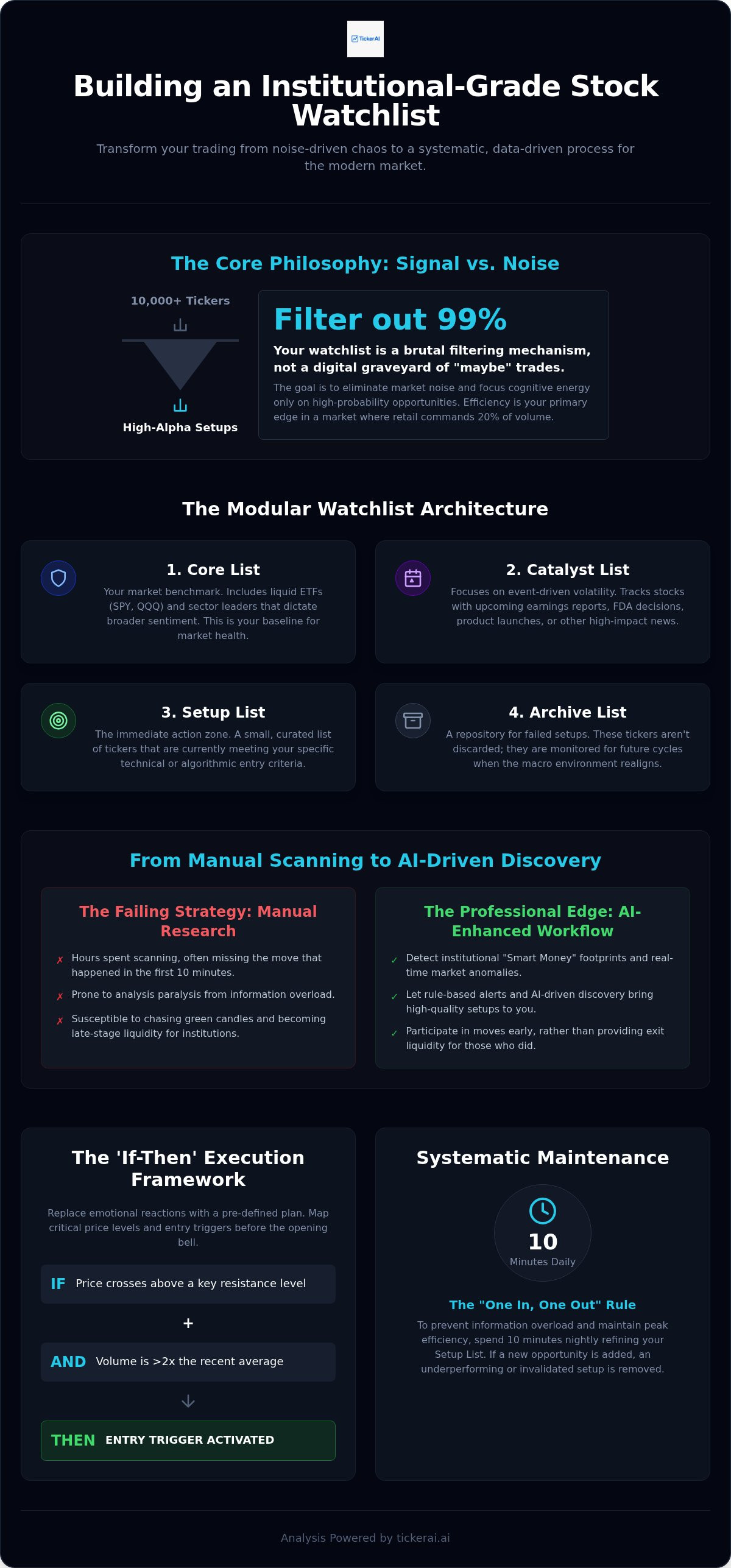
A professional stock watchlist is not a static list of tickers you find interesting. It is a dynamic filter designed for systematic discovery. Most retail traders treat their watchlists like a digital graveyard for stocks they might trade "someday." This approach creates clutter. It leads to the psychological trap of chasing green candles during market hours because you haven't defined what belongs on your screen. To understand how to build a stock watchlist that actually generates profit, you must adopt a "Brutal Filter" philosophy. Efficiency is your primary edge. You must exclude 99% of available tickers immediately to focus on the high-alpha setups that remain.
Moving from static tracking to action-oriented monitoring requires a shift in mindset. Your watchlist is a tool for execution; it prioritizes information so you don't have to. While Fundamental Analysis Explained provides the baseline for evaluating a company's intrinsic health, your watchlist acts as the tactical layer that determines when that health translates into a tradable move. It replaces emotional reactions with a pre-defined plan. If a ticker doesn't trigger a specific alert, it doesn't earn your attention.
Defining Your Liquidity and Volatility Floor
Volume is the first non-negotiable filter. For active traders, liquidity is the difference between a clean exit and devastating slippage. You must set a minimum Average Daily Volume (ADV) to ensure you can enter and exit positions without moving the market against yourself. High-volume environments provide the "clean" price action required for technical indicators to function reliably. Filtering by market cap further aligns the list with your risk profile. Large-cap stocks offer stability and institutional support, while mid-caps often provide the volatility necessary for significant swing trade returns. Choose your floor based on your ability to absorb price swings.
The Cost of Manual Research in 2026
Manual scanning is a failing strategy in a market where retail investors now command 20% of total equity trading volume. The math of missed opportunities is simple: if you spend three hours scanning 500 charts, you've already missed the breakout that occurred in the first ten minutes. Scaling your intelligence requires a transition to automated stock market analysis to detect anomalies in real-time. Information overload in 2026 high-frequency trading is the systemic failure of human cognitive processing to filter 10,000+ real-time data points into a single actionable decision. By the time you find a setup manually, the "Smart Money" has already positioned itself. Automation ensures you are a participant in the move, not a late-stage liquidity provider for institutional exits. Mastering how to build a stock watchlist in this era means letting the data come to you through rule-based alerts and AI-driven discovery.
The Anatomy of an Institutional-Grade Watchlist
An institutional-grade watchlist is a modular architecture, not a singular file. Professionals segment their universe into functional categories to maintain speed and clarity. Understanding how to build a stock watchlist requires moving beyond simple tracking to a tiered system of Core, Catalyst, Setup, and Archive lists. This structure ensures that your focus remains on high-probability outcomes rather than a cluttered screen of "maybe" trades.
The Core List serves as your market benchmark. It includes liquid ETFs like SPY and QQQ, alongside sector leaders that dictate broader sentiment. The Catalyst List focuses on event-driven volatility; think earnings reports, FDA decisions, or product launches. The Setup List is your immediate action zone, containing tickers currently hitting technical or algorithmic triggers. Finally, the Archive acts as a repository for failed setups. These tickers aren't discarded; they are monitored for future cycles when the macro environment aligns. This tiered approach turns a list of stocks into a prioritized workflow.
Thematic Organization and Sector Rotation
Institutional capital moves in waves across specific industries. Grouping tickers by themes such as AI, Energy, or Biotech allows you to spot sector rotation before it becomes obvious on a daily chart. By using finding thematic investment opportunities with AI, you can identify where smart money is accumulating in real-time. This proactive approach ensures you aren't chasing a move that has already matured. Instead, you are positioned in the leading names of the next dominant theme as capital shifts from laggards to leaders.
Integrating the Economic Calendar
A technical chart is irrelevant without context. A perfect bull flag can be decimated by a poorly timed earnings release or a sudden Fed announcement. You must filter for "Quiet Weeks" to avoid volatility traps that disrupt standard technical patterns. For example, knowing the SEC fee rate for securities transactions was adjusted to $20.60 per million in April 2026 is a minor detail, but missing an earnings date is a terminal error. Automating calendar alerts is the only way to prevent these blindside events from affecting your portfolio. To streamline this process, many professionals rely on Smart Watchlist & Alerts to sync event data directly with their technical triggers. By mastering how to build a stock watchlist that accounts for both price and time, you eliminate the variables that lead to unforced trading errors.
Integrating AI-Driven Discovery into Your Workflow
Manual scanning is an obsolete strategy in the 2026 market. The sheer volume of data makes it impossible for a human to track 10,000+ tickers across multiple timeframes effectively. Learning how to build a stock watchlist today requires a shift from active scanning to passive discovery. This means letting the data come to you. AI-driven systems now identify institutional "Smart Money" footprints by detecting volume anomalies and dark pool activity before the price breakout occurs. By the time a stock appears on a standard retail scanner, the institutional entry is often already complete.
Algorithmic discovery removes the "Human Bias" that plagues traditional ticker selection. Traders often become attached to specific names or sectors based on past winners, leading to missed opportunities elsewhere. AI filters real-time sentiment and SEC filings to update your lists dynamically. If a company's fundamentals shift or a significant insider trade is filed, the system reacts instantly. This ensures your watchlist remains a high-velocity tool for execution rather than a collection of legacy biases.
Leveraging Smart Watchlists for Real-Time Alerts
A "Smart Watchlist" is a self-populating environment. It does not wait for manual input; it adds and removes tickers based on your pre-defined technical and fundamental criteria. To maximize efficiency, you must set action-oriented stock alerts that trigger only on high-conviction setups. There is a critical difference between a basic price alert and a momentum breakout signal. A price alert tells you where the stock is; a momentum signal tells you what the stock is doing. High-alpha setups require the latter to ensure you are entering during a period of active institutional participation.
Removing Emotion with Systematic Discovery
Emotion is the primary cause of retail underperformance. Automated discovery prevents the psychological traps of FOMO and "revenge watching" by enforcing a rule-based entry system. When you understand how to build a stock watchlist that relies on objective data, you no longer feel the need to chase parabolic moves. Following a using AI to remove emotion from trading framework ensures that every ticker on your screen has earned its place through technical merit. In the high-speed environment of 2026, algorithmic discipline beats human willpower because machines do not hesitate, doubt, or hope; they simply execute when the pre-defined conditions are met.
The 'If-Then' Framework: Turning Tickers into Trades
A watchlist without an execution plan is just a list of missed opportunities. To bridge the gap between observation and profit, you must apply a rigorous "If-Then" framework to every ticker on your screen. Mastering how to build a stock watchlist involves pre-defining your reaction to market movement before the first candle of the day forms. This systematic approach ensures that you are an active participant in high-probability setups rather than a reactive observer of price action.
The "If-Then" logic follows five critical steps to transform a ticker into a trade:
- Step 1: Identify the high-level thesis. Determine if the setup is a mean reversion play or a trend following breakout.
- Step 2: Map critical price levels. Identify support, resistance, or the Volume Weighted Average Price (VWAP) as your base of operations.
- Step 3: Define the trigger. This is the specific event, such as a volume spike or RSI divergence, that confirms institutional participation.
- Step 4: Establish an invalidation point. Set your stop loss before entry to protect your capital.
- Step 5: Set take profit targets. Use historical volatility data to ensure your exits are rooted in probability rather than emotion.
Developing Rule-Based Entry Triggers
Watching a stock is a passive trap. Specific trigger conditions are the only way to ensure consistency across your trades. By combining technical levels with AI-powered sentiment shifts, you create a multi-dimensional confirmation system. This eliminates "B-Tier" distractions that often look like setups but lack the necessary momentum for a swing trade. A checklist for "A+ Setups" should require alignment between price action, volume, and algorithmic signals. If the criteria aren't met, the trade doesn't exist. To automate this level of precision, professional traders utilize Smart Watchlist & Alerts to receive notifications only when their exact "If-Then" conditions are satisfied.
Risk Management Within the Watchlist
Risk management is not an afterthought; it is built into the watchlist itself. You must calculate position size based on the predefined stop level for each ticker before the market opens. With the new intraday margin standards effective as of June 4, 2026, understanding your capital requirements is more critical than ever. Monitoring correlation risk is equally vital. If your entire list consists of 100% Tech stocks, you aren't diversified; you are leveraged on a single sector. Every entry also requires a post-mortem. Linking your watchlist to a trade journal allows for a post-trade analysis that refines your "If-Then" logic over time. This ensures that your process for how to build a stock watchlist evolves with the market.
Systematic Maintenance: The 10-Minute Nightly Routine
A professional watchlist is a living document. It requires constant pruning to remain an effective decision-making tool. Mastering how to build a stock watchlist is only half the battle; the other half is maintaining its integrity through a systematic nightly routine. This ten-minute process ensures you start every trading session with a lean, high-conviction list of setups rather than a digital graveyard of expired ideas.
Focus is a finite resource. Adopting the "One In, One Out" rule prevents your list from bloating into an unmanageable mess. If a new high-alpha setup is added, a lower-probability ticker must be removed. This forces you to constantly rank your opportunities and keep only the strongest candidates on your primary screen. High-velocity trading in 2026 demands this level of clinical precision to avoid the analysis paralysis mentioned earlier in this guide.
Purging the "Dead Wood" is the most critical part of maintenance. If a ticker was added for a specific catalyst or technical trigger that failed to materialize within the expected window, it must be deleted immediately. Keeping stagnant stocks on your screen creates mental friction and distracts from active signals. Review the AI-generated alerts from the day's session to find tomorrow's leaders. These anomalies often highlight institutional accumulation before it becomes obvious to the broader market. Finally, ensure you are syncing your watchlist across all devices for seamless execution when the opening bell rings.
Evaluating Your Discovery Source
Your routine is only as good as the data feeding it. You must determine if your current process is finding genuine trades or just providing noise. When how to build a stock watchlist becomes a burden, it usually indicates a failure in your primary data source. Use a structured framework for evaluating an AI stock picking service to ensure your inputs align with your risk profile. Backtesting your watchlist's historical performance is essential. If your filtered tickers aren't hitting their triggers or reaching take-profit targets, your discovery criteria require immediate adjustment.
Next Steps: From Watchlist to Execution
The transition from research to execution must be frictionless. Once your nightly routine is complete, your role shifts from an analyst to an executor. Your "If-Then" plans are set, your levels are mapped, and your alerts are active. TickerAI automates this discovery-to-alert pipeline, ensuring that the heavy lifting of market scanning happens in the background while you focus on high-level decision-making. By integrating AI-driven short-term swing stock alerts into your workflow, you remove the emotional burden of manual tracking. Start your systematic research journey today by refining your filters and letting technology power your discovery process.
Command Your Market Workflow with Scalable Intelligence
The 2026 market doesn't reward manual effort; it rewards systematic efficiency. Mastering how to build a stock watchlist is the foundational step in evolving from a reactive participant to a disciplined professional. You've learned to replace static tracking with a tiered architecture of Core and Catalyst lists. This ensures every ticker on your screen earns its place through objective data rather than emotional bias. By applying a rigid "If-Then" framework, you eliminate the hesitation that leads to missed breakouts and costly entries.
Success now depends on your ability to filter 10,000+ data points into a handful of high-conviction setups. This is where automated discovery becomes your primary edge. Transitioning to a workflow powered by AI-driven real-time market alerts and automated anomaly detection allows you to focus solely on execution. Stop chasing market noise and start identifying professional-grade swing trade setups with clinical precision.
Discover high-alpha setups with TickerAI's Smart Watchlists and leverage the power of high-speed intelligence to streamline your daily routine. It's time to take control of your process and trade with the confidence of a systematic expert. Your edge is ready.
Frequently Asked Questions
How many stocks should be on a professional watchlist?
A professional watchlist should contain 10 to 20 active tickers to maintain peak focus. Institutional traders avoid list bloat because cognitive load increases with every added symbol. If your list exceeds 20 names, you're likely tracking market noise rather than high-conviction setups. Use a "One In, One Out" rule to ensure only the highest-alpha opportunities remain on your primary screen.
What is the best free tool to build a stock watchlist in 2026?
TradingView remains the industry standard for free technical charting and manual list management. For basic AI-driven analytics, free tiers of platforms like Zen Ratings provide a starting point for retail investors. While these tools are useful for beginners, learning how to build a stock watchlist that generates consistent edge eventually requires moving from manual charting to professional automated discovery engines.
How often should I update my stock watchlist?
Update your watchlist nightly during a dedicated 10-minute routine. You must remove any tickers that failed to trigger their "If-Then" conditions during the day's session. Stagnant stocks are "dead wood" that distract from emerging leaders. Perform a deeper thematic review every weekend to align your list with current sector rotation and upcoming high-impact economic catalysts.
Can AI build a stock watchlist for me automatically?
Yes, AI-driven systems now build and maintain smart watchlists automatically based on your pre-defined risk parameters. TickerAI utilizes automated market scanning to detect institutional footprints and dark pool activity in real-time. This technology populates your list with tickers hitting high-conviction triggers. It eliminates the need for manual scanning and allows you to focus purely on the decision-making process.
What are the most important technical indicators for a watchlist?
Average Daily Volume (ADV) and Relative Strength are the most critical filters for any systematic list. You must ensure sufficient liquidity to avoid slippage during exits. Tactical triggers like VWAP and RSI divergence provide the necessary entry points. Combining these technical levels with AI-powered sentiment shifts creates a multi-dimensional confirmation that manual indicators cannot match in the 2026 market.
Should I include ETFs in my stock watchlist?
Including liquid ETFs like SPY and QQQ is mandatory for institutional-grade monitoring. These assets serve as benchmarks for market sentiment and broad sector health. If you are tracking individual tech stocks, monitoring the XLK or equivalent sector ETF provides the necessary context for rotation. ETFs act as the "Signal" that confirms whether individual price action is idiosyncratic or market-driven.
How do I filter out penny stocks from my watchlist?
Filter out penny stocks by setting a minimum price floor of $5 and a market capitalization of at least $300 million. Low-priced stocks often lack the institutional sponsorship required for clean technical setups. By enforcing these non-negotiable liquidity filters, you protect your capital from the volatility traps and low-liquidity environments typical of micro-cap tickers and highly speculative assets.
What is the difference between a watchlist and a portfolio?
A watchlist is a scouting tool for discovery and potential setups where no capital is yet deployed. In contrast, a portfolio consists of active positions where your capital is currently at risk. Learning how to build a stock watchlist focuses on identifying future opportunities. Portfolio management focuses on risk mitigation and exit execution. The watchlist is your intelligence partner; the portfolio is your balance sheet.


