Your brain is biologically hardwired to sabotage your P&L through cognitive biases that no amount of willpower can override. Whether it's the impulse to chase late-stage momentum or the paralysis that sets in during high volatility, human instinct is often the greatest risk to a portfolio. Using AI to remove emotion from trading isn't just a technical upgrade; it's a necessary evolution for anyone tired of losing money to revenge trades or FOMO. You've likely felt the frustration of an impulsive exit or a missed entry, but these aren't character flaws. They're the result of trying to process a chaotic environment with an analog mind.
This guide will show you how to leverage AI-driven discovery to neutralize these biological biases and implement a repeatable, data-led workflow. In a market where AI-driven algorithms now account for roughly 70% of US trades, manual discipline is no longer enough. We'll explore how automated market scanning and smart watchlists provide the structural discipline needed for consistent execution regardless of market noise. You'll learn to move beyond the stress and trade with the clinical precision of a professional intelligence partner.
Key Takeaways
- Understand how biological "fight or flight" responses hijack decision-making and why willpower alone isn't enough to combat market volatility.
- Discover the technical advantages of using AI to remove emotion from trading by replacing manual searches with high-probability, clinical filtering.
- Transition from reactive "screen staring" to proactive execution using rule-based alerts that enforce objective entry and exit points.
- Build a modular, repeatable trading workflow that prioritizes data-backed setups over narrative-driven impulses and FOMO.
- Learn to leverage automated discovery tools to maintain consistent discipline and neutralize the destructive cycle of fear and greed.
The Psychology of Trading in 2026: Why Willpower is Not Enough
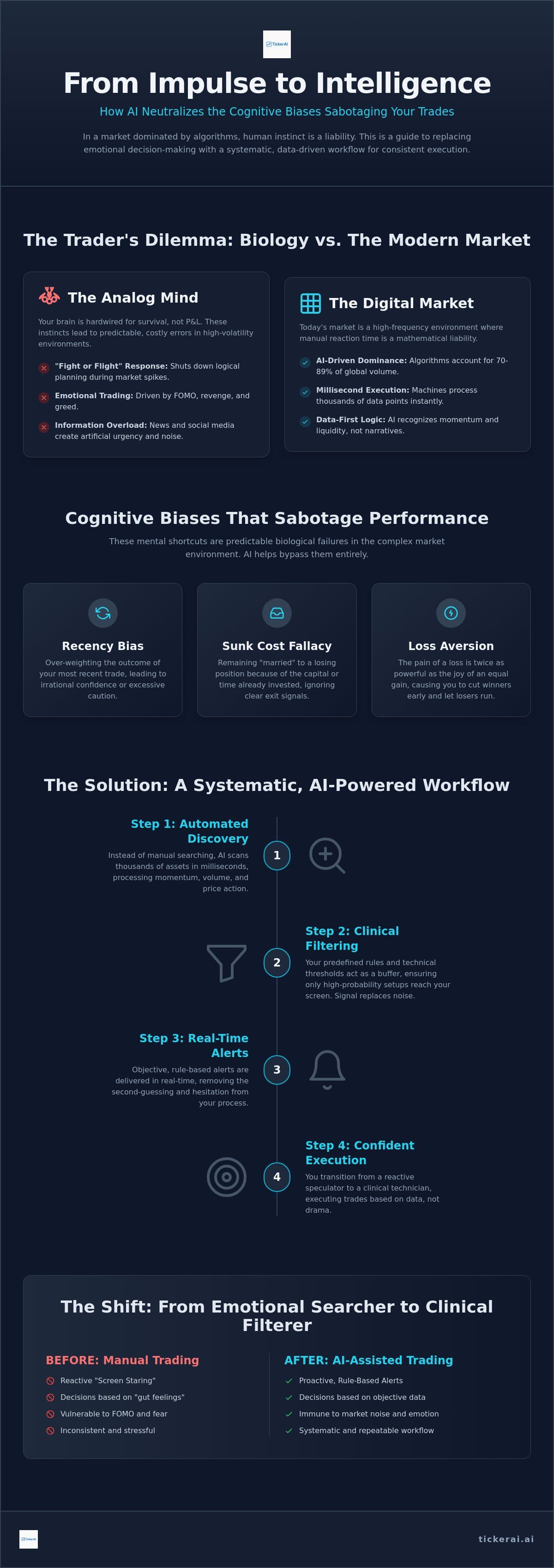
Human biology hasn't evolved as fast as financial markets. When volatility spikes, the amygdala triggers a "fight or flight" response. This process effectively shuts down the prefrontal cortex, the brain's center for logical planning and risk assessment. In a market where Algorithmic trading accounts for approximately 70% to 89% of global volume, a manual trader's reaction time is a mathematical liability. You aren't just competing against other participants; you're fighting your own nervous system.
Emotional trading isn't a lack of character; it's a predictable biological failure. FOMO forces you to chase momentum long after the smart money has exited. Loss aversion makes you hold onto sinking assets in the hope of a "bounce" that the data doesn't support. Using AI to remove emotion from trading isn't an optional luxury in 2026. It's a requirement for survival. By delegating discovery and monitoring to a machine, you bypass the cognitive traps that lead to revenge trades and analysis paralysis. You move from being a reactive victim of the tape to a clinical observer of the data.
Cognitive Biases That Sabotage Performance
Biases are mental shortcuts that fail in complex environments. Recency bias is particularly dangerous because it causes you to over-weight your most recent trade, leading to irrational overconfidence or excessive caution. The sunk cost fallacy is another profit-killer. It keeps you "married" to a position because of the time or capital already invested, even when technical indicators have clearly signaled a trend reversal. Loss aversion describes the psychological reality where the pain of a loss is twice as powerful as the joy of an equivalent gain, frequently causing traders to tighten winners too early and let losers run too long.
The Information Overload Paradox
The 24/7 news cycle and social media sentiment create a state of permanent artificial urgency. This environment makes every headline feel like a "signal" when it's usually just "noise." When you're flooded with data, your brain defaults to impulsive execution to resolve the tension of uncertainty. Filtering is the first step in emotional regulation. If you can't filter the data before it reaches your screen, you can't control your reaction to it. Systematic thinking requires moving away from discretionary "gut feelings" and toward a clinical, data-first approach.
How AI-Driven Discovery Replaces Intuition with Clinical Precision
Willpower is a finite resource. Relying on it to maintain discipline during a market rout is a losing strategy. The shift toward using AI to remove emotion from trading begins by redefining your role from a "searcher" to a "filterer." Instead of manually scanning charts until fatigue sets in, you leverage algorithms to process thousands of data points in milliseconds. This transition ensures that your entries are based on objective criteria rather than a compelling narrative. AI doesn't care about a stock's story or the charisma of its founder; it only recognizes data-driven momentum and liquidity clusters. Navigating AI In Trading requires understanding that these tools are designed to enforce the logic you've already defined, acting as a buffer between market volatility and your execution finger.
Professional grade tools avoid the "black box" trap. You should understand the technical parameters triggering your alerts to maintain full confidence in the system. This transparency is central to automated stock market analysis, where the goal is to scale your intelligence, not replace it. By setting specific technical thresholds, you create a clinical research environment that prioritizes signal over noise.
The Role of Algorithmic Signals
Algorithms quantify what traders used to call "gut feelings." By synthesizing momentum, volume, and price action into a single actionable alert, you remove the second-guessing phase of execution. These systems detect subtle anomalies, such as hidden institutional accumulation or sudden volatility shifts, that the human eye misses due to fatigue or cognitive bias. You stop saying "I think this will move" and start acknowledging "The system has detected a movement." This shift in language reflects a shift in mindset: from speculator to technician.
Smart Watchlists as Psychological Guardrails
Random trading is the byproduct of a lack of structure. Smart watchlists act as guardrails, keeping you focused on specific sectors or setups that align with your risk profile. Using finding thematic investment opportunities with AI ensures that your capital is only deployed in high-probability environments that match your strategy. Pre-validation is the final step. If a ticker hasn't passed the AI's rigorous filter, it doesn't belong on your screen. This level of discipline is easily maintained when you utilize a professional AI stock discovery subscription to handle the heavy lifting.
Neutralizing the 'Fear and Greed' Cycle with Real-Time Alerts
Staring at a candle for six hours doesn't improve your edge. It actually erodes it. The "screen stare" is a primary driver of anxiety, leading to premature exits or hesitant entries. By using AI to remove emotion from trading, you delegate the observation phase to a system that doesn't suffer from fatigue. Real-time alerts act as a clinical trigger. They notify you only when your specific criteria are met, effectively shortening the gap between data and execution. This "set and forget" approach allows you to trust your swing trade setup finder to do the heavy lifting while you focus on high-level strategy.
Professional trading requires acknowledging that AI's influence on market dynamics has made speed and objectivity paramount. Even with advanced filtering, false positives occur. A systematic trader doesn't lose faith when a signal fails; they recognize it as a statistical variance. The goal isn't a 100% win rate. It's a consistent, emotionless execution of a proven edge. When you stop second-guessing every alert, you neutralize the greed that keeps you in a position too long and the fear that keeps you from entering a valid setup.
Bypassing FOMO (Fear Of Missing Out)
Chasing a vertical stock is a symptom of a discovery failure. If you're chasing, you weren't there for the breakout. Real-time alerts ensure you are proactive vs reactive, positioning you at the start of a move rather than the end. AI-driven timing removes the need for "market intuition" by identifying volume clusters and price breakouts the moment they materialize. You don't have to guess if a move is real. The data has already confirmed it. This removes the "hope" phase of trading, which is where most emotional errors occur.
Managing Loss Aversion with Data
Loss aversion thrives in a scarcity mindset. When you believe opportunities are rare, you hold onto losers too long. A continuous "Discovery" feed shifts this perspective to one of abundance. Seeing a steady stream of new setups reduces the psychological weight of any single trade. By interpreting AI stock alerts for entry and exit points, you establish a logical exit strategy before the trade even begins. This pre-determined plan protects your capital from the emotional urge to "wait and see." You trade the data, not the dollar amount.
Implementing a Systematic Workflow: From Discovery to Execution
Discipline isn't a state of mind. It's a protocol. Transitioning from discretionary impulses to a structured system requires a modular approach that prioritizes data at every stage. By using AI to remove emotion from trading, you transform your daily routine into a repeatable, clinical operation. This workflow moves through five distinct phases to ensure every trade is backed by technical logic rather than hope or anxiety.
- Step 1: Define Your Parameters. Establish your universe. Filter by sector, market cap, and specific volatility tolerance to ensure you only see assets that fit your strategy.
- Step 2: Delegate the Search. Use an AI stock discovery platform to scan thousands of tickers in real-time. Let the machine identify the setups while you focus on risk management.
- Step 3: Pre-set Risk-Reward Ratios. Determine your exit points before the trade is live. Use algorithmic signals to find objective support and resistance levels.
- Step 4: Execute on High-Confidence Alerts. Only pull the trigger when an alert matches your pre-defined smart watchlist criteria. If it doesn't fit the system, ignore it.
- Step 5: Review Performance. Understand the importance of a trading journal to track your hits and misses. Use this data to refine your AI's filtering logic for future cycles.
Setting Systematic Stop-Losses and Profit Targets
Mental stops are a fantasy. During high-emotion events, the urge to "give a position more room" is almost impossible to resist. Objective risk management requires pre-defined exits based on technical indicators like ATR (Average True Range) or AI-suggested levels. This "hands-off" approach to trade management ensures that your capital is protected by logic, not your ability to stay calm under pressure. You set the rules; the system enforces them. This shift is the cornerstone of using AI to remove emotion from trading effectively.
Refining the Discovery Feed
Market regimes are not static. A discovery feed that works during a bull market will generate noise during a bear cycle. Your clinical intelligence must evolve with the tape. Adjust your filters to prioritize liquidity during downturns or momentum during expansions. Avoid the trap of over-optimization, where rules become so strict they ignore market reality. A successful feedback loop uses historical performance data to fine-tune your parameters without losing sight of the broader trend. To start building your systematic protocol, explore TickerAI subscriptions for professional-grade discovery.
TickerAI: Your Clinical Partner in Emotionless Market Discovery
TickerAI functions as the clinical intelligence layer that filters market chaos into actionable data. Systematic discipline requires more than just a set of rules; it requires a framework that prevents those rules from being ignored. TickerAI's Full-Access and Pro tiers provide a ready-made research environment tailored for this exact purpose. By using AI to remove emotion from trading, the platform strips away the influence of social media hype and artificial urgency. You transition from a state of emotional reaction to one of professional execution. Real-time alerts serve as objective triggers, notifying you of setups that meet your rigorous criteria. Your capital is only deployed in high-probability environments. Smart Watchlists keep your focus on data-validated themes, preventing the random trading that erodes long-term performance.
The TickerAI Discovery Engine
The engine operates as a tireless proactive scout. It scans the entire market for swing trade setups and long-term ideas without the interference of human bias. You can customize these filters to align with your specific risk profile and volatility tolerance. Fine-tuning these parameters ensures the system only alerts you to opportunities that fit your established strategy. It identifies liquidity clusters and technical anomalies that the human eye, clouded by fatigue, would likely miss. You stop speculating on what might happen. You start executing on what is currently occurring in the data. This level of automated discovery is the ultimate edge for retail traders in the 2026 market.
Achieving Trading Discipline with TickerAI
Manual research is a primary source of cognitive load. When you are overwhelmed by information, your decision-making quality drops. TickerAI reduces this burden by handling the scanning and monitoring phases of the workflow. Gaining psychological breathing room is essential for using AI to remove emotion from trading over the long term. Using institutional-grade discovery tools gives you the confidence to trust the process, even during periods of high volatility. You aren't just following a bot. You are supervising a sophisticated intelligence partner. This partnership allows you to maintain a clinical mindset while the market fluctuates. The system handles the detection; you handle the decision.
Maintaining this clinical discipline in your professional life often creates the space to focus on what truly matters outside of the markets. If you're looking for a way to use technology to enhance your personal connections rather than just your P&L, you can learn more about Say it with a Song "The Fastest Most Meaningful Gift In The World" and discover how AI can turn your most cherished memories into custom musical keepsakes.
Upgrade to TickerAI Pro and start trading with clinical precision.
Mastering the Clinical Edge
Mastering the clinical edge requires a fundamental shift in how you process market information. Manual willpower cannot compete with the algorithmic systems that now account for 70% to 89% of global trading volume. Using AI to remove emotion from trading replaces biological liabilities with a repeatable, data-led protocol. You move from reactive anxiety to proactive execution. TickerAI facilitates this transition through institutional-grade market scanning and curated swing trade setups. By delegating the discovery phase to a tireless intelligence partner, you ensure that every entry is backed by technical validation. This approach neutralizes the scarcity mindset and protects your capital from the destructive cycle of fear and greed. Real-time AI-driven alerts provide the objective triggers necessary for consistent performance. Stop letting impulse dictate your P&L. It's time to leverage a framework that prioritizes logic over instinct. Discover high-potential movements without the emotional noise; Join TickerAI today. Professional execution is now a standard, not a luxury.
Frequently Asked Questions
Can AI really remove all emotion from my trading?
AI provides a clinical buffer by automating the detection phase of your workflow. It doesn't eliminate your pulse, but it prevents that pulse from dictating your execution. By using AI to remove emotion from trading, you shift your focus from searching to verifying. This transition protects your prefrontal cortex from the fight or flight responses triggered by sudden market volatility.
Do I need to be a programmer to use AI for stock discovery?
You don't need coding skills to access institutional-grade discovery tools. Professional platforms provide intuitive interfaces for setting technical parameters like market cap, volume, and momentum thresholds. The complex algorithmic processing happens in the background. You act as the supervisor of the intelligence, not the developer of the code.
How do AI alerts help with FOMO?
FOMO is a symptom of poor discovery. If you're chasing a move, you missed the initial entry signal. Real-time alerts notify you the millisecond a ticker meets your specific criteria. This allows you to anticipate movements rather than reacting to them after they've already trended. You trade the breakout, not the exhaustion.
What is the difference between automated discovery and automated execution?
Discovery identifies high-probability setups through automated market scanning. Execution is the actual placement of orders via a broker. Automated discovery allows you to filter thousands of tickers while retaining final decision-making power. It removes search fatigue without relinquishing the control necessary for complex risk management.
How do I know if an AI stock signal is reliable?
Reliability is found in confluence and historical win rates. No single signal is a guarantee of profit. You should verify AI alerts against your own technical framework and risk-reward requirements. Professional systems prioritize data-driven momentum and liquidity, providing a higher probability starting point than manual intuition.
Can I use AI to help with risk management?
AI is essential for establishing objective exit points. Using AI to remove emotion from trading allows you to calculate stop-losses based on Average True Range (ATR) or historical volatility levels. This eliminates the mental stop fallacy where traders move exits during a loss. Pre-calculating these levels ensures your risk is capped by math, not your emotional tolerance.
What happens if the AI makes a mistake?
You manage AI errors through strict position sizing and statistical expectation. False positives are a natural part of any data-driven model. A professional workflow doesn't panic when a signal fails; it simply executes the pre-defined exit. Consistency in the process is more important than the result of a single trade.
How do I integrate AI alerts into my existing trading plan?
Treat the AI as your proactive scout. Instead of starting your day by scanning the entire market, start by reviewing the alerts generated by your discovery engine. Only move assets to your active watchlist if they pass the AI's clinical filter. This integration ensures your execution is limited to high-confidence setups that align with your strategy.
Beyond trading, the same logic of leveraging AI and automation is fundamental for modern business growth. For entrepreneurs looking to scale their digital operations, blog.entourageinsider.com offers a comprehensive playbook on using these tools to build smarter businesses.


