

Most traders treat AI like a magic button. Professionals treat it like a high-speed scout. With the global AI market projected to reach up to $900 billion in 2026, the differentiator isn't having access to the tech; it's having the discipline to filter it. You've likely experienced the analysis paralysis that comes from too many data points or the sting of a missed exit due to emotional hesitation. It's a common friction point in a market that moves at the speed of light, leaving even experienced participants with inconsistent results despite their "good" tools.
Learning how to use AI stock signals in a trading plan is the only way to bridge the gap between raw intelligence and consistent profitability. This article provides the architecture of a professional trading plan that seamlessly integrates AI signals for discovery without sacrificing human oversight. We'll deliver a clear, one-page template for your daily workflow and a professional risk management structure. You'll gain the confidence to know exactly which signals to take and which to ignore, transforming your process into a clinical, high-speed execution system.
Key Takeaways
- Define the critical bridge between raw algorithmic data and human capital to eliminate emotional decision-making and analysis paralysis.
- Master how to use AI stock signals in a trading plan by distinguishing between a high-probability discovery and a confirmed trade setup.
- Implement a professional risk management structure using the 1% Rule to ensure capital preservation in high-speed, volatile markets.
- Adopt a 3-point execution checklist that filters automated alerts into a repeatable, one-page daily trading workflow.
- Leverage historical performance data to refine your strategy and scale your edge using advanced discovery subscriptions.
What is a Systematic Trading Plan in the Age of AI?
A trading plan is your operational constitution. It's a written set of rules governing every second of your market participation. It defines your edge and dictates your limits. Without one, you aren't trading; you're gambling on noise. By 2026, the primary challenge has shifted from finding data to processing it. Systematic trading provides the necessary framework to handle this information density by replacing subjective intuition with objective logic. Your modern plan must bridge the gap between raw AI data and your human capital. It acts as a sophisticated filter, determining which high-speed signals deserve your liquidity and which should be ignored. Developing a strategy for how to use AI stock signals in a trading plan is the only way to survive the current data saturation.
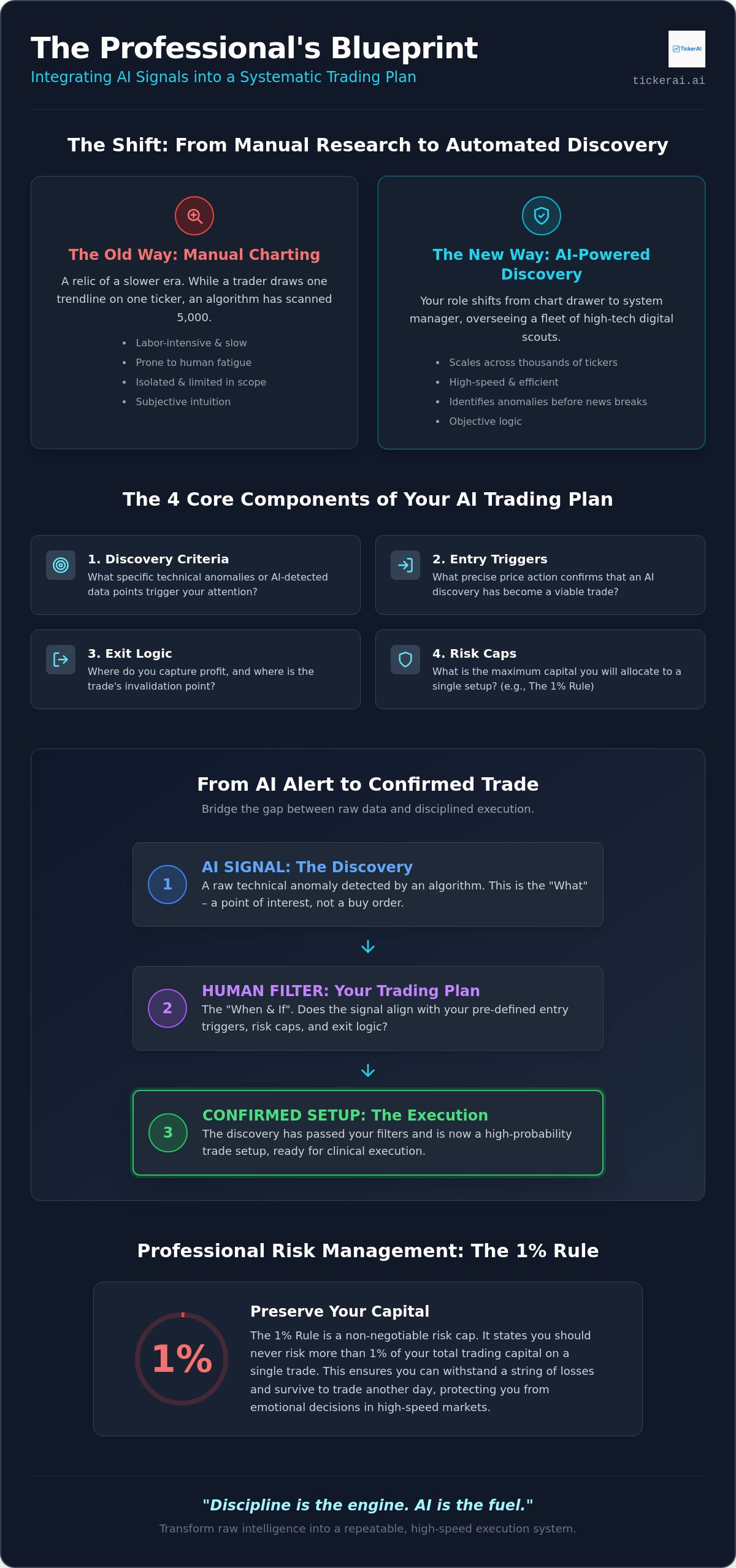
Every professional plan requires four core components to remain functional:
- Discovery criteria: What specific technical anomalies or data points trigger your attention?
- Entry triggers: What precise price action confirms that a discovery has become a trade?
- Exit logic: Where do you capture profit, and where is the invalidation point?
- Risk caps: What is the maximum capital allocated to a single setup?
Manual charting alone is no longer a viable competitive edge. While a retail trader draws a single trendline on one ticker, an algorithm has scanned 5,000 setups. Efficiency is the new alpha.
The Shift from Manual Research to Automated Discovery
Manual scanning is a relic of a slower era. It's labor-intensive and prone to human fatigue. Professionals now rely on automated stock market analysis to scale their intelligence across thousands of tickers simultaneously. This technology identifies momentum breakouts and technical anomalies hours or days before they become mainstream news. Your role has fundamentally shifted. You are no longer a "chart drawer" hunting for patterns in isolation. You are a system manager overseeing a fleet of high-tech digital scouts. Mastery of how to use AI stock signals in a trading plan involves treating these alerts as raw material for your pre-defined execution logic.
Why Discipline Outperforms Intelligence
Brilliant analysts often struggle as traders because they lack a framework for execution. Raw intelligence cannot overcome the biological "gut feeling" that leads to FOMO or hesitation. A rule-based plan creates a repeatable feedback loop that allows for clinical performance reviews. It removes the cognitive load of decision-making during fast-moving market hours. When a high-conviction alert hits your dashboard, you don't debate the merits of the trade. You consult your pre-written matrix. This transition from "thinker" to "executor" provides the psychological relief necessary for long-term survival. Discipline is the engine. AI is the fuel.
The Discovery Layer: Integrating AI Stock Signals into Your Strategy
The most common mistake in algorithmic trading is conflating a discovery with a trade setup. A discovery is a raw technical anomaly detected by a scout. A setup is a discovery that aligns perfectly with your specific risk and entry rules. Understanding how to use AI stock signals in a trading plan requires a modular approach where the technology acts as a high-speed filter. It scans thousands of data points to find the "what," but your plan dictates the "when" and "if." Integrating these alerts into your daily workflow is the cornerstone of how to use AI stock signals in a trading plan effectively.
Organization is the antidote to information overload. Professionals use smart watchlists to categorize AI-detected anomalies by theme, sector, or volatility profile. This prevents the "scattergun" approach to execution. You must learn to interpret AI stock signals based on your primary timeframe; a swing alert is noise for a day trader, just as a scalp signal is irrelevant for a long-term investor. Filter for action-oriented alerts that provide specific price levels rather than generic market news. Following structured guidelines, such as the NIST AI Risk Management Framework, ensures that your automated discovery process remains reliable, accountable, and aligned with professional standards.
Defining Your Search Parameters
Precision starts with your search settings. Focus your AI scout on specific sectors or themes, such as high-growth technology or undervalued small-caps. Set your "noise floor" by deciding which alert types fit your lifestyle. If you cannot monitor charts during market hours, ignore intraday momentum alerts in favor of daily swing setups. For those looking to optimize this workflow, a TickerAI Pro Subscription provides the granular filtering needed to curate a high-conviction universe of stocks without manual effort.
The Validation Step: Human Oversight of AI Logic
Never execute a trade based on an alert in isolation. Cross-reference AI discoveries with key technical levels, such as major support and resistance zones or volume profiles. Check for upcoming catalysts like earnings reports or regulatory decisions that the AI has flagged as high-probability volatility events. Signal validation is the process of confirming an AI alert meets your pre-defined entry criteria. This human oversight ensures that you only deploy capital when the machine's data and your plan's logic intersect.
Risk Management Parameters: Protecting Capital in a High-Speed Market
AI is a high-speed scout, not a protective shield. The most dangerous misconception in modern markets is that algorithmic accuracy removes the need for traditional stop-losses. It doesn't. Even the most sophisticated signals can fail when macroeconomic shifts override technical patterns. Markets remain chaotic. Following FINRA guidance on algorithmic trading strategies is essential for maintaining control over automated systems. Professional risk management ensures that a single failed discovery doesn't compromise your entire portfolio. Mastering how to use AI stock signals in a trading plan requires a clinical approach to capital preservation that prioritizes survival over raw gains.
Execution starts with the "1% Rule." Never risk more than 1% of your total account equity on a single trade. If your account is $50,000, your maximum loss (R) is $500. You must calculate your position size based on the distance between your entry and your stop-loss. Don't trade based on a "feeling" about the signal's strength. Every setup must maintain a minimum 2:1 Reward-to-Risk ratio. If the potential profit isn't at least 2R, the trade is mathematically inefficient and should be discarded. This discipline is the only way to ensure your edge remains profitable over a large sample of trades.
AI-detected breakouts often come with intense volatility. These setups require wider "breathing room" than standard consolidation plays. If you tighten your stops too much, you'll be stopped out by noise before the move materializes. Understanding how to use AI stock signals in a trading plan means adjusting your risk parameters to match the specific volatility profile of the alert. High-volatility tickers demand smaller position sizes to keep your total "R" constant.
The Hard Rules of Exit Logic
- Stop-loss placement: Use ATR (Average True Range) to set technical stops. This ensures your exit is based on market mechanics rather than arbitrary price levels.
- Take-profit targets: Scale out of winners. Sell 50% of your position at 1R to lock in gains and move your stop to break even. This turns a "good" trade into a "risk-free" trade.
- The Time Stop: Implement a hard exit if the AI-predicted movement hasn't started within a specific number of candles. Stagnant capital is dead capital.
Managing Correlation and Over-Exposure
Avoid the "Sector Trap." If your AI scout delivers five signals in the semiconductor space, don't take all of them. You're effectively taking one massive, over-leveraged trade on a single industry. Limit your exposure to a maximum of two signals per sector. Set a hard cap on the number of open swing trade setups at any given time. Finally, establish a "Circuit Breaker." This is a daily loss limit. If you lose 3% of your account in one session, shut down your trading desk. The market will be there tomorrow; you might not be if you chase losses.
The Step-by-Step Execution Template: From Alert to Exit
A plan without a sequence is just a list of ideas. Professional execution requires a rigid workflow that moves from discovery to liquidation without hesitation. This is the operational phase of how to use AI stock signals in a trading plan. You aren't just reacting to alerts. You are processing them through a pre-defined filter. Precision in timing and order entry separates the hobbyist from the professional. If you lack a repeatable sequence, your results will remain random despite the quality of your data.
Pre-market preparation begins with a review of your smart watchlist. Overnight alerts provide the initial universe of candidates. By the time the opening bell rings, you should already have your price targets and stop-losses calculated. Use limit orders exclusively to ensure price precision. Market orders are for the undisciplined; they invite slippage and erode your edge. This methodical approach ensures that you only enter the market on your terms, never the market's terms.
The 3-Point Signal Validation Checklist
Every alert must pass this clinical matrix before capital is deployed. If a signal fails even one point, ignore it. No exceptions.
- Thematic Alignment: Does the signal align with the current sector rotation? Professionals focus on finding thematic investment opportunities with AI to ensure they are trading with the wind at their back.
- Structural Math: Is the reward-to-risk ratio at least 2:1 based on the current chart structure? We already established that trades under 2R are mathematically inefficient.
- Catalyst Confirmation: Is there a clear catalyst supporting the move? Look for volume spikes, breakout patterns, or earnings-related momentum that the AI has identified as high-probability.
Daily Routine for the Professional Swing Trader
Success is a result of a disciplined schedule. Consistency in your routine leads to consistency in your equity curve.
- 08:30: Scan alerts for institutional money flow. This is the time to identify where the "big money" is moving before the retail crowd wakes up.
- 09:30 - 10:30: The "Golden Hour." This is your primary window for executing high-conviction setups discovered during the pre-market scan.
- 16:00: The post-market review. Log all trades and note any emotional deviations from the plan. Did you chase a price? Did you hesitate on an entry?
The 16:00 review is non-negotiable. Your journal is the most important document you own. It reveals the gap between your plan and your actions. To streamline your discovery process and focus purely on execution, subscribe to TickerAI Full-Access and receive real-time alerts designed for professional workflows.
Scaling Your Edge: Leveraging TickerAI for Systematic Growth
Scaling is a process of refinement, not just expansion. You don't grow by taking more trades; you grow by increasing the quality and size of your high-conviction setups. This requires using historical win proofs to validate your logic. If the data shows your plan performs best in high-volatility environments, you must lean into those specific signals. Conversely, if your win rate drops during sideways consolidation, your plan needs a filter to sit on hands during low-range days. This is the advanced stage of how to use AI stock signals in a trading plan. It turns raw data into a personalized performance metric. Professionals maintain a constant feedback loop, reviewing AI performance monthly to adjust parameters as market regimes shift. Your plan is a living document. It must evolve alongside market volatility to remain effective; similarly, maintaining a structured approach to personal legacy through Aiker Wills and Trusts ensures your assets are protected with the same professional rigor.
Choosing the Right Research Tier
Your data requirements must match your execution speed. Using a tool that is too fast or too slow for your lifestyle leads to friction and missed exits. Match your subscription to your plan's required data frequency to maintain a clean decision-making environment.
- TickerAI Full-Access Subscription: This tier is optimized for active traders who require real-time momentum alerts. It's the primary tool for those capturing short-term price inefficiencies and swing trade setups.
- TickerAI Pro Subscription: This is engineered for professionals building complex, AI long-term investment strategies. It provides the deeper market discovery and thematic analysis needed for institutional-grade portfolio management.
Building Long-Term Algorithmic Alpha
Alpha in 2026 is the result of combining institutional-grade AI discovery with rigid, human-led risk management. The technology provides the speed, but your plan provides the stability. As AI models become more sophisticated, the "noise floor" in the market will continue to rise. Staying ahead of the curve requires an approach rooted in innovative pragmatism. You don't use technology for its own sake; you use it for the tangible advantages of time-saving and clarity. By treating AI as your tireless high-tech assistant, you free up your mental capital for high-level decision-making. This synergy is the foundation of a modern trading business. Start building your systematic edge with TickerAI today.
Executing Your 2026 Systematic Advantage
Success in the current market regime isn't about working harder; it's about processing information more efficiently. You've seen how a rigid architecture transforms raw data into actionable intelligence. By prioritizing how to use AI stock signals in a trading plan, you move beyond the reactive "gut feeling" that ruins retail portfolios. You now have the framework to filter high-speed anomalies through a clinical 3-point validation matrix. This ensures your capital is only deployed when machine discovery and human logic intersect at high-probability levels. Discipline remains your greatest asset while AI remains your most tireless scout.
Professional growth requires institutional-grade tools to maintain your competitive edge. You can now access AI-powered discovery for technology and growth sectors, real-time smart watchlists, and algorithmic alerts previously reserved for the floor. This is your opportunity to eliminate analysis paralysis and focus entirely on execution precision. Discover high-potential swing trade setups with TickerAI Full-Access and secure the data frequency your plan demands. The market moves fast, but with the right system, you'll always be positioned to capture the next breakout. Start your professional evolution today.
Frequently Asked Questions
Is a trading plan really necessary if the AI is already scanning the market?
A trading plan is absolutely essential because it provides the execution logic that AI lacks. While algorithms excel at scanning thousands of tickers for anomalies, they don't account for your specific risk tolerance or capital constraints. Without a plan, you are simply reacting to alerts. This reactive behavior leads to over-trading and inconsistent results. A written plan ensures that every AI discovery is filtered through your pre-defined entry and exit rules.
How much capital do I need to start using AI stock signals in my plan?
Capital requirements depend on your chosen strategy and the 1% risk rule. To effectively implement how to use AI stock signals in a trading plan, you need enough liquidity to withstand the stop-loss distances of volatile breakouts. Many professional swing traders suggest a minimum of $5,000 to $10,000 to ensure proper position sizing. Smaller accounts risk over-exposure by taking signals that require wider breathing room than their equity allows.
Can I use AI signals for day trading, or are they better for swing trades?
AI signals are effective for both day trading and swing trading, provided you match the signal frequency to your plan. Day traders require real-time, low-latency alerts to capture intraday momentum. Swing traders benefit from higher-conviction daily setups that allow for institutional money flow analysis. The key is consistency. You must decide which timeframe fits your lifestyle and ignore signals that fall outside those parameters to avoid cognitive overload.
How do I handle a situation where the AI signal contradicts my own technical analysis?
Defer to your pre-defined validation checklist whenever a contradiction occurs. If the AI detects a breakout but your technical analysis shows a major resistance level immediately overhead, the trade lacks confluence. No confluence means no entry. Professional trading isn't about being right against the machine. It's about taking setups where multiple data points align. When in doubt, staying in cash is a valid professional position.
What is the most common mistake traders make when integrating AI into their plan?
The most frequent error is treating AI discoveries as guaranteed trades rather than raw data. Many traders skip the validation step and execute orders immediately upon receiving an alert. This bypasses the critical risk management layer of your trading plan. Successful participants understand how to use AI stock signals in a trading plan as a starting point for research, not a replacement for a 3-point execution checklist.
How often should I update the rules in my trading plan?
Review your plan's performance metrics monthly, but only update the core rules quarterly. Changing your strategy every week prevents you from gathering a statistically significant sample size of trades. Use your monthly feedback loop to identify emotional deviations or technical slippage. If a specific market regime, such as extreme low volatility, renders a rule ineffective, adjust it during your quarterly deep-dive review to maintain your edge.
Is TickerAI a brokerage, or do I need a separate account to execute trades?
TickerAI is an intelligence and discovery platform, not a brokerage. It provides the high-speed scout services and smart watchlists needed to find opportunities. You must execute your trades through a separate, regulated brokerage account. This distinction is vital. TickerAI focuses on providing institutional-grade data and alerts while you maintain full control over your order execution and capital management at your chosen broker.
Can AI help me manage the emotional side of trading?
AI assists emotional management by removing the stress of manual scanning and providing objective data points. When the hunt for stocks is automated, you spend less mental energy on discovery and more on disciplined execution. Having a pre-validated signal removes the gut feeling that often leads to FOMO or hesitation. It replaces uncertainty with a clinical, rule-based workflow that keeps you grounded during high-volatility sessions.


