

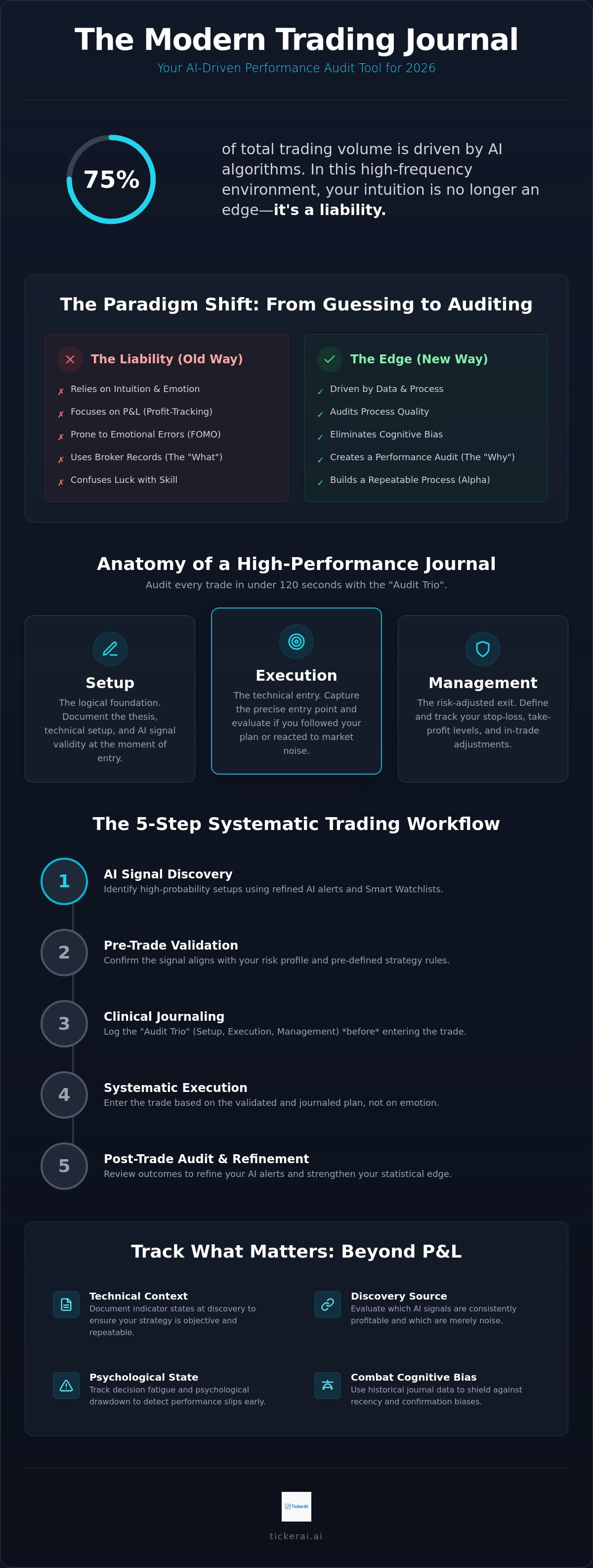
In a market where AI algorithms drive up to 75% of total trading volume, your intuition is no longer a competitive advantage. It's a liability. The importance of a trading journal in 2026 has shifted from a simple record of past trades to a high-speed intelligence partner. You need a clinical audit of your discovery-to-execution workflow. Without one, you're just guessing in a high-frequency environment.
You've likely felt the frustration of chasing AI signals only to realize they didn't fit your specific risk profile. It's common to repeat emotional entry errors like FOMO when the market moves at this pace. This guide will show you how to transform raw trade data into a systematic performance-audit tool that validates your AI-driven discovery process. We'll explore a repeatable framework to identify your most profitable signals; provide objective proof of your edge; and strip away the emotional decision-making that erodes your capital. You'll learn to move from reactive trading to proactive, data-driven execution.
Key Takeaways
- Shift from profit-tracking to process-auditing by learning to differentiate between simple broker records and the underlying logic of your AI-driven trades.
- Recognize the strategic importance of a trading journal as a feedback loop for AI signals, allowing you to filter high-probability setups from market noise with clinical precision.
- Master the "Technical Context" field to document indicator states at the exact moment of discovery, ensuring your strategy remains objective and repeatable.
- Adopt a structured five-step workflow to eliminate emotional entry errors like FOMO and provide verifiable proof of your statistical edge.
- Streamline your TickerAI discovery process by using journaled data to refine your Smart Watchlists and optimize your alert parameters for maximum efficiency.
The Strategic Necessity of a Trading Journal in 2026
The modern trading journal is no longer a diary for emotional venting. It is a clinical performance-audit tool. In the 2026 high-frequency environment, the importance of a trading journal lies in its ability to separate execution skill from market noise. A broker record tells you what happened: the fill price, the timestamp, and the size. It is a post-mortem of a completed event. A journal tells you why it happened. It captures the thesis, the technical setup, and the validity of the signal at the moment of entry. Without this context, you are trading in the dark.
Understanding the importance of a trading journal is the difference between a retail hobbyist and a professional participant. Systematic traders require a structured feedback loop to survive the volatility of 2026. Markets move too fast for manual recollection. You cannot rely on memory to identify if your recent wins were the result of "Alpha" or simply "Luck." Luck is a statistical outlier; Alpha is a repeatable process. By documenting every trade, you build a proprietary database that proves your edge. This audit process is the only way to refine a strategy in real-time without risking catastrophic capital erosion.
Beyond the Broker Statement: Tracking the Intangibles
P&L is a lagging indicator. It tells you the result of a decision made minutes or hours ago, but it hides the dangerous habits that led there. You can make money on a bad trade through sheer variance, but that habit will eventually destroy your capital. The psychological principle of self-monitoring is critical here. By tracking "Psychological Drawdown" and decision-making fatigue, you detect when your performance is slipping before the losses hit your account. You must also track your "Discovery Source" to evaluate which third-party signals are consistently profitable and which are merely noise.
The Feedback Loop: Turning Data into Strategy Refinement
Your journal serves as the "Black Box" for your investment process. When an AI alert triggers, the journal records your logic for interpreting AI stock alerts for entry and exit points. Did you follow the signal's parameters, or did you front-run the entry due to FOMO? Data-driven journaling transitions you from reactive chasing to proactive anticipation. You stop asking what the market is doing. Instead, you start knowing exactly what you will do when specific conditions are met. This refinement turns raw data into a scalable, professional strategy.
Auditing the Alpha: Why Process-Tracking Trumps Profit-Tracking
Process-oriented trading is the hallmark of the 2026 professional. While retail participants obsess over daily P&L fluctuations, elite traders focus on the quality of their decisions. The importance of a trading journal lies in its ability to quantify that quality. If you make $5,000 on a trade where you broke every rule, you haven't won; you've just reinforced a catastrophic habit. Conversely, a loss taken within the parameters of a proven system is a successful execution. You must audit the logic, not just the bankroll.
Many traders claim they don't have time for detailed logs. This is a fallacy of efficiency. By focusing on high-impact metrics rather than narrative prose, you can complete an audit in under 120 seconds. A professional audit requires the "Audit Trio" for every position:
- Setup. The logical foundation.
- Execution. The technical entry.
- Management. The risk-adjusted exit.
This structured post-mortem eliminates FOMO by forcing you to justify every entry against your pre-defined rules. It turns a chaotic market into a series of clinical data points. Professional traders use these insights to refine their Smart Watchlist & Alerts, ensuring they only deploy capital on high-probability setups.
Eliminating Cognitive Bias with Objective Data
Recency bias is a silent portfolio killer. It leads traders to abandon winning systems after a brief period of standard variance. Your journal acts as a shield, providing the historical win-rate data needed to stay the course during a drawdown. It also exposes confirmation bias in your thematic research. If you only record the news that supports your long bias while ignoring bearish technical divergence, your journal will reflect that imbalance. It serves as a clinical mirror, reflecting your actual behavior rather than your intentions. This objectivity is the only way to stop emotional revenge trading before it liquidates your account.
Validating Your Systematic Discovery Workflow
The speed of the 2026 market requires a seamless transition from detection to execution. You must audit the latency between an ai stock discovery platform alert and your actual entry. If your edge comes from speed, but your execution log shows a persistent 10-minute delay, your strategy is fundamentally flawed. Use your historical win-rates per theme to refine your focus. You may find that your edge is significantly higher in high-growth tech sectors than in energy. Data allows you to prune the underperforming branches of your strategy and double down on what works. This is how you transform a broad discovery process into a precision instrument for capital growth.
Anatomy of a High-Performance Journal for AI-Driven Traders
A professional journal in 2026 is a technical specification document. It goes beyond the basic fill price to capture the environment of the trade. To truly understand the importance of a trading journal, you must view it as a high-fidelity recording of market conditions. Non-negotiable data points include entry and exit prices, slippage, position sizing, and R-multiple. However, the most critical addition for the modern trader is the "Technical Context" field. This field documents the state of key indicators at the exact millisecond an AI alert triggers. Was the RSI overbought? Was there a volume-weighted average price crossover? This context transforms a static record into a dynamic learning tool.
The "Logic Field" follows. This is where you justify why a specific AI-driven discovery met your personal criteria. If an algorithm flags a setup, your journal must record the secondary confirmation that prompted your entry. Finally, the "Execution Audit" tracks plan adherence. It measures "style drift." Did you exit early due to nerves, or did you follow the systematic stop-loss? Identifying drift is the first step toward professional-grade consistency. Without an audit, you're flying blind in a high-speed market.
Quantitative vs. Qualitative Inputs
Quantitative data provides the mathematical proof of your edge. You need to track slippage to ensure your execution isn't eroding your profits. R-multiple tracking reveals the true risk-to-reward ratio of your system over time. Yet, qualitative data is equally vital. Recording market sentiment at entry and your own conviction level (on a scale of 1 to 10) helps identify psychological patterns. The "Logic Snapshot" remains the most important part of the entry log. It captures your professional thesis before the outcome is known, preventing hindsight bias from clouding your future analysis.
Tracking AI Signal Performance
The importance of a trading journal extends to auditing the source of your alerts. Categorize every trade by "Setup Type." Are you trading momentum breakouts or mean reversions? Measuring "Signal Decay" is another 2026 essential. You need to know how long an AI opportunity remained valid after the alert was issued. If the window of opportunity is shrinking, your execution speed must increase. Finally, compare alert accuracy across different market sectors. You may find your systematic approach yields higher accuracy in Tech than in Energy. This data allows you to reallocate capital to your highest-performing themes with clinical precision.
The 5-Step Workflow: How to Journal Your Systematic Trades
A systematic workflow is the only defense against the cognitive biases that plague retail traders. In the 2026 market, the importance of a trading journal is realized through the consistency of your protocol. You don't need a narrative. You need a structured sequence that captures data at the moment of peak relevance. This five-step workflow ensures that every trade contributes to your institutional-grade database, allowing you to audit your performance with clinical precision.
- Step 1: The Pre-Trade Snapshot. Document the "Why" before committing capital.
- Step 2: The Execution Log. Record the "How" of your entry.
- Step 3: The Active Management Audit. Monitor the "During" to track decision quality.
- Step 4: The Post-Mortem. Analyze the "Result" against your initial thesis.
- Step 5: The Weekly Performance Review. Implement the "Refinement" to scale your edge.
By following this sequence, you transform a chaotic series of trades into a professional-grade audit trail. You can optimize your execution with TickerAI Pro by integrating these steps into your daily routine.
Step 1 & 2: Capturing the Opportunity
Efficiency is paramount. Before hitting "Buy," write a single sentence defining your "Opportunity Logic." For example: "Momentum breakout on high relative volume following a TickerAI sector alert." This forces immediate clarity. Next, log the specific TickerAI alert timestamp to measure your reaction latency. If you're consistently entering five minutes after an alert, you're losing the best part of the move to slippage. Finally, record your "Stop Loss" and "Take Profit" targets immediately. This hard-coding of risk prevents "Target Drifting," where traders move stops in a desperate attempt to avoid a realized loss.
The Weekly Audit: Finding Your Statistical Edge
The weekly review is where raw data becomes actionable intelligence. You must calculate your "Expectancy" using the formula: (Win Rate x Avg Win) minus (Loss Rate x Avg Loss). This single number tells you if your system is a viable business or an expensive hobby. Look for "Error Clusters." You might discover you consistently lose money on Tuesday afternoons or within specific high-volatility sectors. These aren't random occurrences; they're data-driven signals to adjust your automated stock market analysis filters. If the data shows a 20% lower win rate in small-cap biotech, prune that sector from your alerts. This refinement process is how you evolve from a participant into a proactive scout with a verifiable edge.
Closing the Feedback Loop: Scaling Your Edge with TickerAI
The loop must close. TickerAI provides the signal, but your journal provides the filter. Integrating these two systems is the final step in achieving professional-grade consistency. The importance of a trading journal is most evident when it transforms from a passive record-keeper into a strategic advisor. It identifies which part of the discovery engine generates your highest-quality alpha. TickerAI acts as your high-speed discovery engine. Your journal serves as the navigation system that keeps you on course.
Smart Watchlist & Alerts are not just monitoring tools. They are the organizational framework for your journaled themes. When your audit shows a high success rate in specific sector breakouts, you move those tickers into a dedicated Smart Watchlist. This creates a high-velocity feedback loop. Technical observation leads to execution. Execution generates data. Data leads to refinement. Transitioning from a casual follower to a systematic operator requires this level of clinical precision. You stop asking if a trade will work. You start knowing the probability that it will.
Refining Your Alerts with Journal Insights
Your journal data dictates your subscription needs. If your audit reveals that your edge requires deep-dive thematic research and high-volume alerts, TickerAI Full-Access is the necessary tool. For traders focused on a tighter set of swing trade setups, TickerAI Pro provides the essential precision. Use your high-expectancy setups to customize your real-time alerts. Stop chasing every notification. Only engage when the alert matches a setup where your journal proves a 60% or higher win rate. This is how you scale position sizes with confidence. You aren't gambling on a signal; you're executing on a verified statistical probability.
The Future of Professional Trading: Discovery + Discipline
The most successful traders in 2026 are hybrids. They leverage AI intelligence for discovery and manual rigor for discipline, often supplementing their mental toolkit with an AI stoic guide to ensure logical consistency. Discovery without discipline is gambling. Discipline without discovery is stagnation. Combining TickerAI’s predictive capabilities with a clinical journaling process creates a navigation system that survives any market regime. You've seen the framework. You've understood the importance of a trading journal. Now, execute the process. Stop trading on intuition and start trading on audited data.
Audit your edge with TickerAI Full-Access
Execute with Precision: Your Data-Driven Future
Success in this era belongs to those who combine institutional-grade intelligence with personal rigor. You have the framework to eliminate FOMO and scale your highest-expectancy setups. Now, it's time to deploy these tools. Leverage AI-powered swing trade setups and real-time momentum breakout alerts to fuel your discovery engine. Organize your findings into smart watchlists for thematic discovery and let your journal validate your path to profitability. The data is waiting. Your execution starts now.
Master Systematic Discovery with TickerAI Full-Access
Frequently Asked Questions
Is a trading journal really necessary if I use AI alerts?
Yes. AI alerts provide raw discovery, but they don't account for your execution skill or risk tolerance. A journal acts as a clinical audit of the signal's validity within your specific system. It's the only way to prove you have a repeatable edge rather than a temporary streak of luck in a volatile market.
What is the best format for a trading journal in 2026?
The most effective format is a structured digital database that supports technical context snapshots. You need a system that tracks quantitative metrics like R-multiple and slippage alongside qualitative logic fields. While spreadsheets offer a baseline, professional journaling software provides the speed and integration required for high-frequency environments.
How much time should I spend journaling every day?
Dedicate approximately 15 to 20 minutes to your daily audit. The focus should be on clinical precision rather than long-form narrative. By using structured fields for your pre-trade logic and post-trade results, you can capture high-impact data without eroding the time needed for market discovery and execution.
Should I record my emotions in a professional trading log?
Record emotions as objective data points rather than subjective feelings. Use a conviction scale from 1 to 10 or specific tags for psychological triggers like FOMO or revenge trading. This approach highlights the importance of a trading journal in detecting psychological drawdown before it leads to catastrophic capital erosion.
What are the most important metrics to track in a swing trading journal?
Prioritize expectancy, R-multiple, and win rate per sector. You must also track "Signal Decay" to see how long AI alerts remain valid for your style. Auditing these metrics allows you to reallocate capital to the themes and sectors where your data proves a verifiable statistical advantage.
How do I use my journal to improve my stop-loss execution?
Audit your "Style Drift" by comparing planned stops against actual exits. If the data shows a pattern of moving stops or exiting early due to stress, you've identified a specific execution flaw. Use this objective proof to reinforce your rule-based management and eliminate emotional decision-making.
Can I automate my trading journal?
You can automate the data entry for prices, timestamps, and sizes through broker integrations. However, the qualitative "Logic Field" must remain manual. Recording the specific reason you accepted an AI signal ensures you are auditing your professional judgment, which is the core importance of a trading journal.
How often should I review my past trades?
Perform a weekly audit to identify immediate error clusters and a monthly strategic review for broader refinement. Weekly reviews catch bad habits before they become ingrained. Monthly reviews provide the data needed to adjust your AI-driven filters and optimize your position sizing for the current market regime.


