
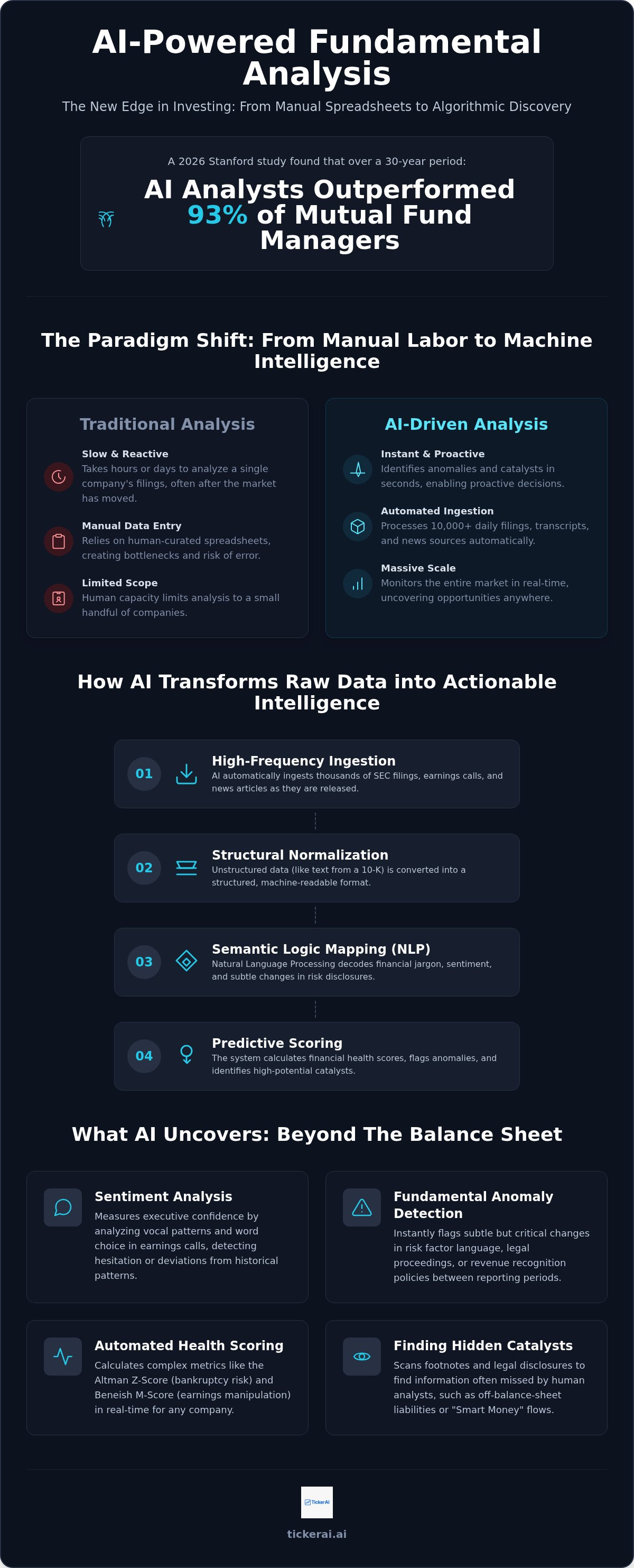
A 2026 Stanford study found that AI analysts outperformed 93% of mutual fund managers over a 30-year period. This isn't a future projection. It is the current reality of the 2026 market. You likely feel the weight of information overload every time a fresh wave of SEC filings hits the wires. Lagging behind institutional algorithms is a choice, not a necessity. By integrating AI for fundamental analysis into your workflow, you move from reactive searching to proactive discovery. It is about clinical precision, not guesswork.
We agree that emotional bias and manual data entry are the primary killers of portfolio performance. You shouldn't spend hours digging through transcripts only to miss the move. This article shows you how AI-driven fundamental analysis eliminates manual research to identify high-potential stock opportunities with institutional precision. You will learn to automate the identification of stock catalysts and reduce research time while increasing accuracy. We'll explore the shift toward agentic AI and show you how these autonomous systems provide clear, data-driven investment ideas that keep you ahead of the curve.
Key Takeaways
- Shift from static, manual research to dynamic algorithmic discovery to extract value-driving signals from unstructured data.
- Learn how Natural Language Processing decodes complex financial jargon to score fundamental data with clinical precision.
- Identify "Smart Money" flows and fundamental anomalies that traditional valuation ratios often overlook.
- Optimize your daily routine by integrating AI for fundamental analysis to filter market noise and validate high-potential catalysts.
- Leverage automated market scanning to bridge the gap between raw institutional data and individual execution.
Beyond Manual Filings: The Evolution of AI for Fundamental Analysis
Fundamental analysis used to be a slow, methodical process of reading through paper filings and manual spreadsheets. In 2026, that approach is obsolete. AI for fundamental analysis is the automated extraction of value-driving signals from unstructured data. It represents a paradigm shift from traditional static research to dynamic algorithmic discovery. Instead of analyzing a company based on a quarterly snapshot, algorithms now monitor every data point in real time. You aren't just looking at what happened; you're seeing what is happening right now.
This transition moves the investor from reactive reading to proactive signal detection. In a high-frequency market, speed is no longer just a technical advantage; it's a fundamental metric. Understanding a company's health requires processing vast amounts of information instantly. This methodology shares its roots with Quantitative Analysis in Finance, but it applies those rigorous standards to the messy world of qualitative disclosures and management commentary. It turns words into actionable data points with clinical precision.
The Death of the Spreadsheet Era
Manual data entry is a liability. In the volatile 2026 environment, relying on human-curated spreadsheets creates a bottleneck that leads to missed opportunities. Human analysts cannot compete with AI's ability to ingest and process 10,000+ daily filings across global exchanges. While a person might spend hours on a single 10-K, an AI model identifies anomalies in seconds. We've moved beyond historical data. The focus is now on predictive fundamental modeling. This allows traders to forecast earnings surprises or debt restructuring before the broad market reacts. Accuracy isn't enough anymore; you need scale to survive.
Speed as a Competitive Advantage
Institutional desks don't wait for news summaries. They use AI to process earnings calls in seconds, detecting subtle management sentiment shifts that a human ear might miss. These algorithms look for hesitation in a CEO's voice or specific word choices that deviate from historical patterns. By the time a retail investor opens the transcript, the institutions have already positioned themselves. They use these tools to front-run traditional research. To compete, you must adopt the same high-speed intelligence filters. AI fundamental analysis is a high-speed intelligence filter that identifies actionable alpha within a chaotic data stream.
How AI Processes SEC Filings and Financial Data
Processing financial documents isn't just about reading words. It's about data transformation. Modern AI for fundamental analysis follows a rigorous four-step pipeline: high-frequency ingestion, structural normalization, semantic logic mapping, and predictive scoring. This automated workflow converts raw SEC filings into structured intelligence. It identifies hidden patterns that manual review simply cannot see. By the time a human analyst highlights a paragraph, the AI has already cross-referenced it against three years of historical disclosures.
NLP: Reading Between the Lines of 10-Ks
Natural Language Processing (NLP) is the engine behind qualitative discovery. It decodes financial jargon with clinical precision. One critical application is detecting subtle shifts in risk factor language between reporting periods. If a company silently modifies its "Legal Proceedings" section, the AI flags the change immediately. It quantifies executive confidence during earnings call Q&A sessions by analyzing vocal patterns and word choice. This goes beyond what is said. It measures how it is said.
Hidden catalysts often bury themselves in footnotes and legal disclosures. AI models scan these sections to find off-balance-sheet liabilities or changes in revenue recognition. Research on Fundamental Analysis via Machine Learning confirms that these models generate more accurate earnings forecasts than traditional manual methods. They don't get tired. They don't have bad days. They just process data.
Automated Quantitative Scoring
Numbers tell a story, but only if you can read them fast enough. AI systems calculate complex health metrics like the Altman Z-Score or Beneish M-Score in real time. This allows for an instant assessment of bankruptcy risk or earnings manipulation. The system compares company performance against sector peers using live data feeds. It doesn't just look at a P/E ratio in a vacuum. It analyzes it relative to the entire industry's current volatility.
Red flags in accounting and governance are flagged automatically. If a company's cash flow doesn't match its reported revenue growth, the system triggers an alert. Integrating these qualitative sentiment scores with quantitative ratios provides a holistic view of a stock's potential. If you want to see these signals in action, you can explore AI stock opportunity discovery tools that automate this entire research pipeline. This proactive scouting identifies anomalies before price action confirms them.
Detecting Fundamental Anomalies: Beyond Ratios and Spreadsheets
Standard valuation metrics are lagging indicators. In the 2026 market, ratios like P/E or Debt-to-Equity are public knowledge, baked into the price within milliseconds of a filing. Relying on these alone provides zero edge. AI for fundamental analysis identifies the anomalies that traditional spreadsheets miss. It looks for the divergence between a company's reported health and actual market behavior. This is how you spot "Smart Money" flow before the retail crowd sees the price action confirm the trend. Clinical precision replaces historical guesswork.
The goal is to identify "Catalyst Convergence." This occurs when high-impact fundamental news meets a technical breakout point. By monitoring these intersections, you aren't just chasing a green candle. You're entering a trade because the underlying business fundamentals have reached a critical tipping point. This methodology transforms disparate data points into a clear, actionable roadmap for capital allocation.
Tracking Institutional Footprints
Institutional activity leaves a trail, but it's often hidden in the noise of high-frequency trading. AI scans 13F filings at a global scale to detect where hedge funds are quietly accumulating shares. It doesn't just look at the ticker. It analyzes the conviction behind the buy by measuring position sizing relative to the fund's historical behavior. By correlating "Dark Pool" activity with underlying fundamental strength, the system identifies high-conviction entries that are invisible to the naked eye.
Understanding these institutional movements is a core component of modern strategy. For a deeper context on how these systematic methods work, you should explore what is quantitative investing and how it applies to opportunity discovery. This proactive scouting allows you to align your portfolio with the entities that actually move the market.
Catalyst Event Discovery
True alpha is found at the intersection of news and numbers. AI monitors a diverse array of non-traditional data sources, including FDA approvals, patent filings, and new government contracts. It automates the tracking of upcoming earnings and product launches, filtering out the noise to focus on high-impact events. TickerAI detects momentum breakouts before they occur by identifying the fundamental pressure building behind a technical resistance level. This ensures you're positioned before the volatility expansion begins.
Sector rotation is also tracked through fundamental strength shifts. If the fundamental health of the semiconductor sector begins to plateau while energy starts showing aggressive margin expansion, the AI flags the rotation before it's headline news. You don't need to read every report. You only need to see the signals that matter. AI for fundamental analysis acts as your tireless scout, ensuring you never miss a sector shift or a high-conviction catalyst.
Building an AI-Driven Fundamental Research Workflow
Success in a high-speed market requires a repeatable, high-conviction process. You cannot rely on manual searches or luck. A robust daily routine utilizing AI for fundamental analysis follows a linear progression: Alerts, Smart Watchlists, and Validation. This sequence ensures you are only spending time on the top 1% of market opportunities. It moves you from a passive observer to a proactive decision-maker.
Filtering Market Noise with Intent
The market generates a massive volume of noise. Most of it is irrelevant to your P&L. To maintain an edge, you must define criteria for action-oriented fundamental alerts. These aren't just news notifications. They are logic-based triggers that fire when a specific fundamental anomaly, like a sudden divergence in cash flow and revenue, is detected. Trusting algorithmic prioritization is the only way to avoid analysis paralysis. Focus on the output, not the raw data.
Scaling this process is essential for high-volume traders. You can explore more about automated stock market analysis to understand how these systems handle global data sets without increasing your workload. By offloading the scanning to AI, you preserve your mental capital for sizing and risk management. You focus on the decision while the machine handles the discovery.
Executing Rule-Based Entries
A fundamental catalyst is only half the trade. You must align fundamental strength with technical swing trade setups to ensure timing is accurate. Systematic discipline is the bedrock of using AI for fundamental analysis effectively. It ensures that every trade is backed by data, not intuition. Use a set of fixed rules to determine your entry and exit points:
- Fundamental Trigger: AI identifies a thematic strength shift or earnings anomaly.
- Technical Confirmation: Price action breaks through a key resistance level on high volume.
- Risk Parameters: Pre-defined stop-losses and profit targets are set based on volatility, not hope.
Maintaining a trading journal is vital for refining these AI-assisted decisions. Document which signals led to the highest accuracy and adjust your rule-based systems accordingly. This feedback loop turns a tool into a personalized intelligence partner. To start building your own high-conviction lists, leverage Smart Watchlist & Alerts to bridge the gap between discovery and execution.
Scaling Market Intelligence with TickerAI Discovery
TickerAI isn't just another research tool. It's the critical bridge between institutional-grade data and individual execution. In a market where milliseconds define alpha, you need a proactive scout that never sleeps. TickerAI provides this through automated market scanning across global sectors. It delivers curated swing trade setups and long-term investment ideas, filtering out the noise that distracts the average retail trader. You move from drowning in data to executing high-conviction trades with clinical precision.
Using AI for fundamental analysis allows you to offload the heavy lifting of data ingestion. TickerAI acts as a 24/7 intelligence partner, scanning thousands of data points to find the catalysts that matter. This isn't about raw, unfiltered data. It's about curated intelligence that is ready for action. You focus on the decision-making while the platform handles the discovery. It's an innovative pragmatism that values technology for the tangible advantages it provides in time-saving and clarity.
TickerAI Full-Access vs. Pro Tiers
Choosing the right tier depends on your specific trading volume and speed requirements. The TickerAI Full-Access subscription is built for swing traders who need high-conviction setups and smart watchlists. It provides the essential logic-based filters discussed in previous sections. For those who require an even faster edge, the TickerAI Pro subscription enables advanced market scanning with priority alerts.
The Pro tier is designed for high-volume traders who need to go deeper. It offers priority real-time alerts for high-potential movements, ensuring you're the first to know when a fundamental anomaly is detected. It uses clinical precision to score every ticker against complex health metrics. While Full-Access gives you the "what," the Pro tier delivers the "why" and "when" with institutional speed. It's about having a tireless assistant that prioritizes your time and intelligence.
The Future of Individual Investing
AI is the "Great Equalizer" for retail investors in 2026. The massive gap between Wall Street's algorithms and your home office has effectively closed. By integrating AI for fundamental analysis into your daily routine, you gain the same systematic edge once reserved for billion-dollar funds. You don't need a team of analysts. You need a high-tech intelligence partner that is always "on," scanning and detecting while you focus on the final execution.
Getting started is a simple shift from manual research to automated discovery. You can gain this systematic edge today by leveraging the power of TickerAI. Join the professional participants who have already transitioned to a data-driven workflow and start identifying high-potential stock opportunities with institutional precision. The era of the manual spreadsheet is over; the era of automated alpha has arrived.
Master the 2026 Market with Algorithmic Precision
The 2026 market demands more than historical spreadsheets and manual ticker searches. You've seen how the shift from static research to dynamic discovery allows you to detect "Catalyst Convergence" before the broader market reacts. By integrating AI for fundamental analysis into your daily workflow, you eliminate the emotional bias and information overload that plague traditional stock picking. You move from a reactive observer to a proactive participant with an institutional edge.
Success now depends on filtering the noise with clinical precision. You need a tireless intelligence partner. Real-time AI alerts for market breakouts. Curated swing trade setups based on verified fundamental catalysts. Professional-grade smart watchlists bridge the gap between raw data and execution. It's time to stop lagging behind institutional algorithms and start leading.
Discover high-potential stock opportunities with TickerAI Full-Access and secure your systematic advantage in a high-frequency environment. The tools are ready. The data is live. Your next high-conviction trade is waiting for discovery.
Frequently Asked Questions
Is AI for fundamental analysis better than manual research?
AI for fundamental analysis is superior in terms of speed, scale, and objectivity. While manual research is limited by human processing time, AI ingested over 10,000 daily filings in 2026. It eliminates the emotional bias that often leads to poor stock picking. It doesn't replace the need for a final decision; it ensures that decision is based on a complete data set rather than a handful of seen reports.
Can AI replace a financial analyst for stock picking?
AI acts as a tireless intelligence partner rather than a total replacement. It excels at filtering the chaotic market environment and prioritizing actionable signals. The human analyst remains responsible for the final capital allocation and strategic validation. Think of it as a proactive scout that delivers high-conviction ideas, allowing the analyst to focus on execution and risk management.
How does TickerAI handle hallucinations in financial data?
TickerAI utilizes structural normalization and cross-referencing to ensure accuracy. Every qualitative signal is mapped against verified numerical data from live exchange feeds. This logical mapping ensures that AI-generated insights remain grounded in factual SEC disclosures. While all AI tools require professional review, these multi-step validation pipelines significantly reduce the risk of incorrect data outputs compared to generic models.
What are the best AI tools for analyzing SEC filings in 2026?
Leading platforms in 2026 include TickerAI, AlphaSense, and Seeking Alpha. TickerAI is specifically optimized for active swing traders who need to bridge the gap between fundamental data and technical execution. Other tools like AlphaSense focus more on corporate enterprise research. The best choice depends on whether you need deep-dive corporate intelligence or high-speed opportunity discovery for active trading.
Does AI for fundamental analysis work for short-term swing trading?
Yes, it is highly effective for identifying "Catalyst Convergence" in short-term setups. By detecting fundamental anomalies before price action confirms them, traders can position themselves before a momentum breakout. This proactive scouting identifies thematic strength shifts that traditional technical indicators often miss. It allows swing traders to align their entries with the underlying business reality for higher accuracy.
How much does an AI-powered stock discovery service cost?
Market pricing for AI-driven intelligence varies based on data depth and alert frequency. Most professional platforms utilize a tiered subscription model. Basic tiers usually cover essential market scanning, while advanced tiers provide priority alerts and deep-dive discovery for high-volume traders. You should choose a tier that matches your trading frequency and the level of market intelligence required for your specific strategy.
Can I use AI to track institutional buying and smart money flow?
AI scans 13F filings and Dark Pool data at a scale that is impossible for manual research. It correlates these institutional footprints with shifts in fundamental strength to identify high-conviction accumulation zones. This allows individual investors to see where hedge funds are positioning themselves before the trend becomes mainstream news. It turns institutional activity into a readable map for individual execution.
What is the difference between AI sentiment analysis and traditional fundamental analysis?
Traditional analysis relies on static ratios like P/E or Debt-to-Equity. AI sentiment analysis uses Natural Language Processing to quantify executive confidence and shifts in risk language within transcripts. It turns qualitative words into actionable data points. This provides a dynamic view of a company's health that traditional spreadsheets cannot capture. It reveals the "why" behind the numbers in real time.


