

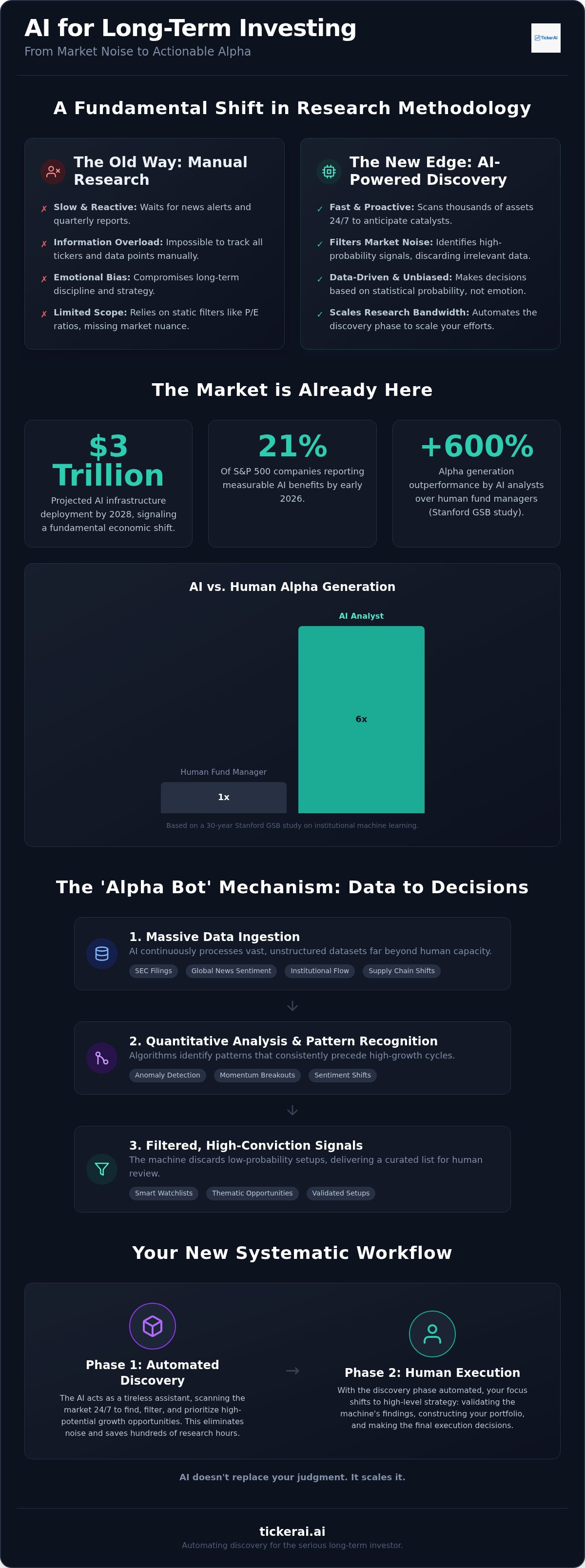
Nearly $3 trillion in AI infrastructure will be deployed by 2028. This isn't a speculative bubble. It's a fundamental shift in how sophisticated participants utilize AI for long-term investing to generate alpha. By early 2026, 21% of S&P 500 companies were already reporting measurable AI benefits. You've likely felt the weight of the 24/7 market cycle. Information overload is a constant threat. Emotional bias often compromises long-term discipline. You're watching high-growth opportunities slip by before they ever reach the mainstream.
It's time to change the methodology. This guide explores how to leverage institutional-grade filtering to identify high-potential growth and automate your discovery phase. You'll learn to scale your research bandwidth using systematic algorithmic logic. We'll break down the 2026 regulatory landscape, the mechanics of algorithmic alpha, and the specific tools required to maintain a proactive edge. This isn't about replacing human judgment. It's about deploying a tireless, high-tech assistant to filter the chaos. We'll examine how smart watchlists and systematic research transform raw data into actionable long-term positions. Stop reacting to the noise. Start executing with clinical precision.
Key Takeaways
- Transition from manual research to automated scanning to capture institutional-grade alpha and outperform traditional benchmarks.
- Discover how to leverage AI for long-term investing to identify high-potential growth opportunities before they reach mainstream market consensus.
- Utilize smart watchlists and thematic investing to organize your portfolio by specific catalysts, sectors, and emerging global trends.
- Establish a systematic, two-step workflow that automates the discovery phase and filters market noise with clinical precision.
- Deploy professional-grade discovery tools to maintain a continuous bench of high-quality ideas while focusing your energy on final execution.
The Evolution of Wealth: Defining AI for Long-Term Investing
2026 represents a structural shift in capital markets. The era of the manual spreadsheet is over. AI for long-term investing has moved from an institutional luxury to a core requirement for serious participants. It's a systematic approach to opportunity discovery. Traditional research is slow. It's reactive. You wait for a news alert or a quarterly report. By the time you process the data, the market has already priced in the move. Algorithmic scanning changes this dynamic. It transforms the investor from a reactive reader into a proactive scout. This is the tipping point where individual access to institutional-grade quants becomes a reality. You're no longer competing with the machines; you're using them to scale.
From Manual Screening to Algorithmic Discovery
Basic stock screeners are primitive. They rely on static filters like price-to-earnings ratios or dividend yields. These tools miss the nuance of modern market mechanics. AI-powered discovery utilizes anomaly detection to find what screeners overlook. It doesn't just look at numbers. It integrates price action with unstructured data. This includes global news sentiment, supply chain shifts, and macroeconomic catalysts. We're seeing the core principles of algorithmic trading adapted for long-term thematic growth. High-speed intelligence is no longer just for high-frequency firms. It's the new baseline for professional research. AI detects the signal. You execute the strategy. The goal is to move faster than the consensus.
The Core Objective: Scaling Your Research Bandwidth
Information overload is the primary enemy of the modern investor. There are too many tickers and too many data points to track manually. A systematic approach to stock investing is the only way to scale your efforts without burning out. AI doesn't sleep. It monitors thousands of assets simultaneously, 24/7. This reduces your time-to-discovery for high-potential growth stocks significantly. You don't need to manually filter through 500 earnings transcripts to find a single growth catalyst. The algorithm does it for you. It prioritizes action-oriented signals over market noise. This efficiency allows you to focus on high-level decision making and portfolio construction. It's about clinical precision. You're moving from searching for ideas to validating high-conviction setups. The discovery phase is automated. The judgment remains yours. This is how you maintain a professional edge in a fast-moving environment.
How Algorithmic Analysis Generates Alpha in Long-Term Portfolios
Stanford GSB researchers published findings from a 30-year study that redefined institutional expectations for machine learning. Their data revealed that AI analysts outperformed human fund managers by nearly 600% in alpha generation. This performance gap is a direct result of a structural shift in how data is processed and weaponized. In the framework of AI for long-term investing, alpha is the excess return generated by identifying market inefficiencies before they become common knowledge. It's the difference between following a trend and anticipating a catalyst based on statistical probability.
Reliability in AI stock predictions comes from historical win proofs rather than speculative hype. These models don't guess. They calculate. By analyzing SEC filings, global sentiment, and institutional flow, algorithms identify patterns that consistently precede high-growth cycles. This data-driven investment strategy ensures that your portfolio construction is built on verified market mechanics. The machine acts as a sophisticated filter. It discards thousands of low-probability setups to prioritize the few that meet institutional-grade criteria.
The 'Alpha Bot' Mechanism: Squeezing Earnings from Data
LLMs and quantitative models analyze SEC filings faster than any human research team. While a traditional analyst might spend an entire day reviewing a single 10-K, an algorithm parses thousands in seconds. It identifies subtle changes in financial reporting or management sentiment that signal future performance. This efficiency is critical for Using AI for Investment Research effectively. It allows you to track institutional activity and "smart money" footprints in real-time. AI detects momentum breakouts by identifying the specific convergence of volume surges and sentiment shifts before the price move is fully priced in by the retail market.
Quantitative Investing: Institutional Tools for Individuals
Quantitative investing is the process of using mathematical models to automate the discovery and execution of trades. Its primary advantage is the total removal of emotional bias. Fear and greed are the two most common reasons long-term investors fail to maintain discipline. An algorithm doesn't panic during a 5% correction. It follows the data. This technology has transitioned from exclusive hedge fund use to accessible retail platforms. To understand the mechanics, read our full breakdown of what is quantitative investing. Using a systematic discovery tool allows you to maintain a professional edge without the institutional overhead. You're no longer just an observer. You're a participant with the same intelligence capabilities as the largest desks on Wall Street.
Bridging the Gap: Thematic Investing and Smart Watchlists
Successful portfolio management requires moving away from the retail habit of chasing hot stocks. This reactive behavior often leads to buying at the peak of a hype cycle. Thematic investing offers a more disciplined alternative. It involves organizing capital around structural catalysts, specific sectors, or emerging global trends. By focusing on themes rather than isolated tickers, you build a portfolio resilient to short term volatility. AI for long-term investing facilitates this by identifying sector rotation before it becomes a mainstream headline. Algorithms detect the subtle migration of institutional capital into new themes, allowing you to position yourself ahead of the curve.
A smart watchlist serves as your professional bench. It isn't a static list of names you might buy someday. It's a dynamic, filtered group of high quality assets that meet your specific investment criteria. AI monitors these assets 24/7, waiting for the precise technical or fundamental trigger that validates an entry. This shift toward continuous discovery ensures you're always prepared for the next market cycle. You aren't searching for ideas under pressure. You're executing on a pre-validated list of opportunities.
Finding Thematic Investment Opportunities with AI
TickerAI streamlines the discovery process by filtering thousands of tickers into actionable themes. It automates the tracking of complex growth stock screening criteria, such as relative strength and revenue acceleration. This prevents high potential opportunities from falling through the cracks. For a deeper look at this methodology, explore our guide on finding thematic investment opportunities with AI. The platform acts as a scout. It prioritizes themes with the highest probability of sustained growth, allowing you to focus on capital allocation rather than manual data entry.
Filtering Market Noise with Action-Oriented Alerts
The modern investor is bombarded with news. Most of it is noise. Algorithmic signals are different. They are data driven and rule based. Configuring action oriented alerts allows you to maintain systematic discipline and avoid the pitfalls of FOMO. Academic research into AI for Low-Cost Financial Advice suggests that automated systems can provide higher quality guidance by removing human bias from the decision making process. Rule based entries ensure that you only commit capital when the data confirms your thesis. This approach transforms your research workflow into a repeatable, professional system.
Building Your Portfolio: A Step-by-Step AI-Driven Workflow
Professional wealth management requires a transition from intuition to architecture. A high-performance portfolio isn't the result of a single "great pick." It's the output of a repeatable, data-driven system. To effectively utilize AI for long-term investing, you must integrate algorithmic discovery into a structured sequence. This workflow moves you from raw market noise to high-conviction execution with clinical precision. You stop guessing and start calculating.
- Step 1: Define Investment Criteria. Establish your "ideal" asset profile. This includes specific sector preferences, volatility tolerance, and market cap requirements.
- Step 2: Initialize Automated Scanning. Deploy your AI scout to monitor the entire market. It detects hidden movements and institutional footprints that manual research inevitably ignores.
- Step 3: Leverage Smart Watchlists. Organize your discoveries. Use watchlists to track high-conviction thematic ideas until the price action aligns with your long-term thesis.
- Step 4: Validate Signals. Don't trust blindly. Use automated fundamental and technical analysis to cross-reference the AI's findings against historical data and earnings quality.
- Step 5: Execute with Discipline. Commit capital only when your rule-based plan is triggered. This ensures every entry is backed by data, not impulse.
Designing a Repeatable Investment Workflow
Success depends on routine. Integrate AI stock opportunity discovery into your daily or weekly schedule. This prevents "analysis paralysis" and ensures you're always scanning for the next growth catalyst. Use a trading journal to document why you entered a position and how the AI-generated signal performed over time. This data is invaluable for refining your filters. Backtesting an AI trading strategy is the only way to verify that your discovery criteria would have survived previous market regimes before you risk real capital.
Removing Emotion: Using AI to remove emotion from trading
Fear and greed destroy more portfolios than poor stock selection. Systematic discovery removes the "gut feeling" that leads to revenge trading or panic selling. When you rely on a clinical process, you stop reacting to headlines and start responding to data. This builds trust in the research process itself. You learn to value the system's long-term hit rate over the outcome of any single trade. To deepen your mental edge, review our guide on using AI to remove emotion from trading. Establishing this discipline is what separates the serious professional from the casual hobbyist. Start building your AI-driven portfolio with TickerAI.
TickerAI: Discovery Tools for the Serious Long-Term Investor
TickerAI isn't a brokerage. It's a high-speed intelligence partner. In a 24/7 global market, the bottleneck isn't execution; it's discovery. AI for long-term investing requires a filter that never blinks. TickerAI acts as your proactive scout. It scans thousands of tickers to prioritize institutional-grade setups while you focus on capital allocation. By automating the discovery phase, the platform removes the manual labor that often leads to missed entries. You're no longer digging through data. You're deciding on pre-vetted opportunities.
The ecosystem is built around Smart Watchlists and Real-Time Alerts. These aren't generic notifications. They are algorithmic signals triggered by specific technical and fundamental convergences. This structure ensures that your long-term bench is always populated with high-conviction ideas. You maintain a continuous stream of thematic opportunities without the burden of manual screening.
Full-Access vs. Pro: Choosing Your Research Tier
Choosing the right tier depends on your capital allocation strategy and time horizon. TickerAI Pro is designed for participants focused on high-probability swing trade setups. It prioritizes shorter-term momentum and technical breakouts. TickerAI Full-Access expands this capability to include specialized AI for long-term investing ideas. This tier is optimized for investors who require deep-dive thematic discovery and structural growth catalysts. Evaluate the TickerAI discovery platform to determine which logic matches your specific portfolio goals.
The TickerAI Edge: Why Discovery Matters More Than Execution
Modern markets are efficient. Execution is a commodity. Finding the opportunity before it's priced in is where the real alpha resides. Most investors suffer from analysis paralysis because they try to track too much. TickerAI eliminates this friction through curated ideas. It prioritizes quality over quantity. The system filters out the noise of the global news cycle to deliver action-oriented signals. This clinical precision allows you to maintain a professional research workflow without institutional overhead.
The future of individual investing in 2026 belongs to the systematic participant. You don't need a larger team. You need better intelligence. TickerAI provides the tools necessary to scale your research bandwidth and identify high-potential growth with speed and clarity. The discovery phase is now automated. The decision remains yours. Start executing with clinical precision.
Mastering the Discovery Cycle: Your Path to Systematic Alpha
The transition from manual screening to high-speed intelligence is the single most significant upgrade for a modern portfolio. By automating the discovery phase, you eliminate the friction of information overload and the danger of emotional bias. You've seen how systematic workflows and thematic watchlists transform raw data into institutional-grade setups. Leveraging AI for long-term investing ensures you're no longer reacting to headlines but responding to calculated data points. You now have the framework to maintain a proactive scout that operates 24/7, filtering the noise to prioritize high-conviction growth.
Effective wealth management in 2026 requires more than just capital; it requires superior research bandwidth. TickerAI provides the tools to bridge this gap through advanced AI anomaly detection and institutional-grade thematic discovery. You can now receive real-time actionable market alerts that align with your specific long-term thesis. It's time to move beyond the limitations of manual research and execute with clinical precision. Scale your research bandwidth with TickerAI Full-Access. Your next high-growth opportunity is already being scanned. Stay disciplined and let the data lead your execution.
Frequently Asked Questions
Is AI for long-term investing safe for retail investors?
AI for long-term investing is as safe as the strategy it supports. It isn't a guarantee of returns; it's a high-speed filtration system. By removing emotional bias and identifying institutional footprints, AI reduces the guesswork associated with retail investing. However, market risk remains a constant factor. You must verify all outputs against your own risk tolerance. Systematic discovery provides clarity, but the final decision to commit capital rests entirely with the individual participant.
How does TickerAI discover long-term investment ideas?
TickerAI utilizes advanced anomaly detection to scan the global market 24/7. It parses unstructured data, including SEC filings and sentiment shifts, to identify high-potential growth catalysts. The platform filters thousands of tickers to prioritize setups that meet institutional-grade criteria. This automated discovery phase allows you to focus on capital allocation rather than manual data entry. It acts as a proactive scout, detecting structural shifts before they become mainstream consensus.
Can AI replace my financial advisor for long-term planning?
No, AI tools like TickerAI focus on stock opportunity discovery rather than holistic financial planning. While algorithms excel at data analysis and identifying market inefficiencies, they don't account for your personal tax situation, estate planning, or specific life goals. Use AI as a high-speed intelligence partner to find ideas. Consult a licensed professional for personalized financial advisory. The platform is a research tool for serious participants, not a replacement for human fiduciary duty.
What is the difference between an AI stock alert and a traditional stock tip?
A traditional stock tip is often subjective and based on hearsay or singular observations. An AI stock alert is a data-driven signal triggered by the convergence of multiple technical and fundamental indicators. These alerts are rule-based and objective. They identify specific market mechanics, such as volume surges or sentiment shifts, that have a statistical probability of preceding price movement. This clinical approach replaces speculative hype with verifiable algorithmic logic.
Do I need technical skills to use AI stock discovery tools?
No advanced technical skills or coding knowledge are required to use the TickerAI platform. The interface is designed for professional efficiency, translating complex algorithmic processing into clear, actionable insights. You only need a baseline understanding of market mechanics to interpret the signals. The platform handles the heavy computational work, such as scanning for anomalies and tracking thematic trends, allowing you to focus your energy on final investment decisions.
How often does TickerAI update its long-term investment ideas?
TickerAI updates its data feeds in real-time to match the pace of the global market. While long-term investment ideas are based on structural catalysts, the scanning process is continuous. As new SEC filings are released or institutional flows shift, the platform adjusts its priorities. This ensures that your Smart Watchlist always reflects the most current market environment. You receive alerts the moment a high-conviction setup meets your pre-defined investment criteria.
What is the expected win rate for AI-powered long-term discovery?
TickerAI does not guarantee specific returns or win rates. Algorithmic discovery is about increasing the probability of success by identifying institutional-grade setups and removing emotional bias. Academic studies show that AI analysts can outperform human managers in alpha generation by processing data with higher precision. However, individual results depend on your execution discipline and market conditions. The tool provides the intelligence; you provide the judgment and risk management.
Can I use TickerAI to find thematic opportunities like AI or Green Energy?
Yes, TickerAI is specifically optimized for thematic discovery across sectors like AI infrastructure, green energy, and emerging technologies. The platform filters tickers based on specific catalysts and global trends, allowing you to build a portfolio around structural shifts. By utilizing Smart Watchlists, you can organize high-potential ideas into thematic groups. This proactive approach helps you identify sector rotation early, positioning your capital before a trend becomes a mainstream headline.


