

The most profitable opportunities in the London market are often invisible to those relying on lagging indicators and traditional volume lists. You've likely felt the frustration of watching a mid-cap breakout on the AIM or FTSE 250 only after the price has already peaked. Information overload from the London Stock Exchange makes it nearly impossible to filter signal from noise manually. It's a common trap. It leaves serious participants chasing yesterday's news while missing the next cycle of the best UK stocks.
This guide shifts the focus from manual observation to algorithmic execution. You'll learn how to move beyond basic screeners and identify high-alpha opportunities using systematic AI discovery. We'll outline a repeatable workflow for detecting momentum breakouts and removing emotional bias from your portfolio decisions. This process replaces guesswork with data. We'll explore how automated anomaly detection builds a smart watchlist that prioritises clinical precision over raw volume.
Key Takeaways
- Understand why traditional market cap rankings often obscure high-alpha opportunities in the London market.
- Learn to identify the best UK stocks by using algorithmic anomaly detection rather than relying on lagging broker lists.
- Evaluate the distinct risk-reward profiles of the FTSE 250 and AIM segments to find hidden momentum breakouts.
- Implement a systematic workflow that removes emotional bias and filters information overload from the London Stock Exchange.
- Transition from manual screening to real-time AI discovery to capture price movements before they are fully priced in by the market.
The UK Market in 2026: Why Traditional Lists Fail
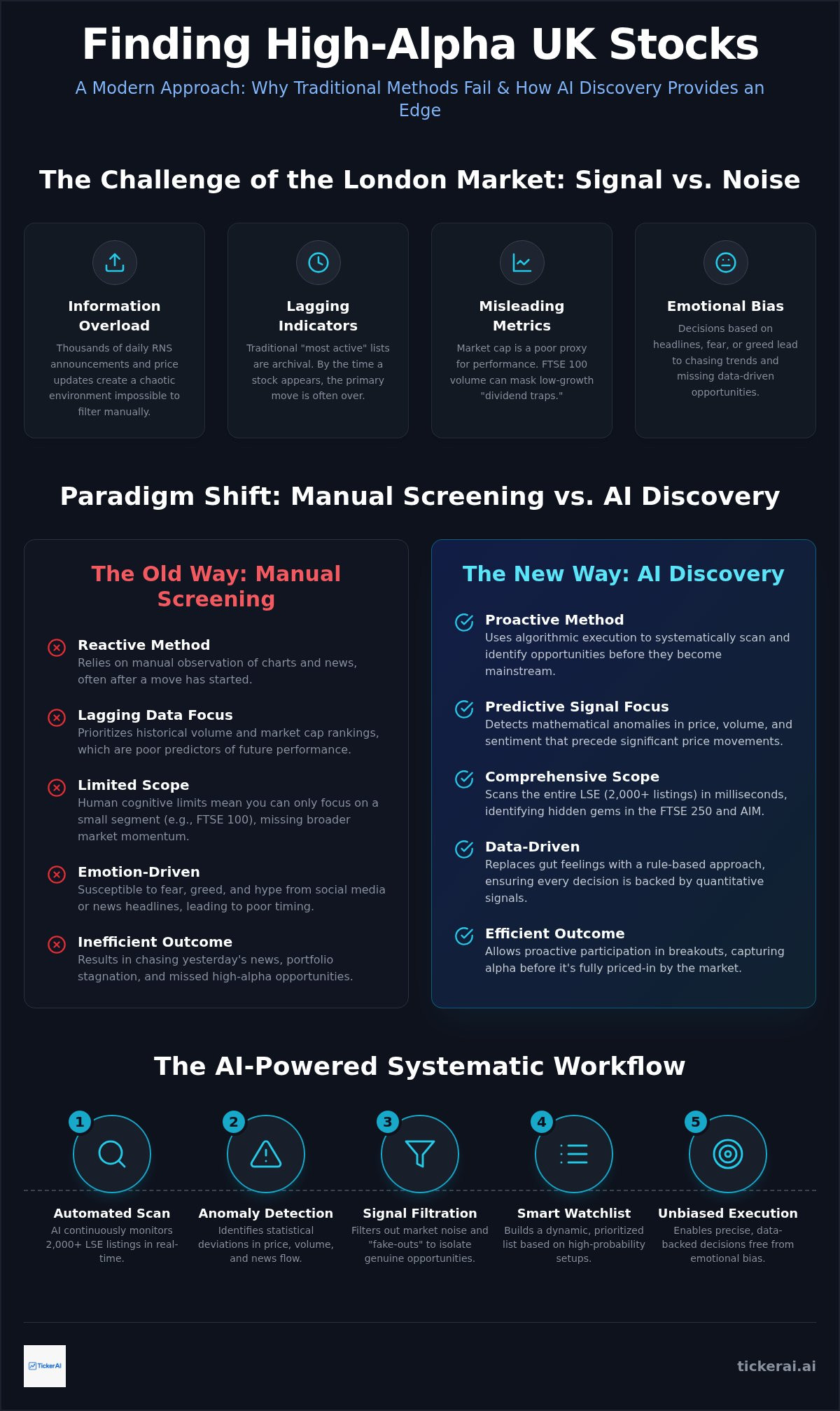
Traditional brokerage lists are archival, not predictive. They rank the London Stock Exchange by market cap or historical volume. This creates a significant lag. By the time a ticker appears on a "most active" list, the institutional entry is often finished. Retail traders are then left chasing the tail end of a move. This reactive news-chasing is the primary reason for portfolio stagnation. Identifying the best UK stocks requires looking where the capital is flowing next, not where it settled yesterday.
The information overload from the LSE is a deliberate hurdle. Thousands of RNS (Regulatory News Service) announcements and price updates create a chaotic environment. Most traders attempt to filter this manually. It fails. Human cognitive limits cannot process real-time anomalies across the FTSE 250 and AIM simultaneously. The result is missed momentum and emotional decision-making based on headlines rather than hard data. You need a filter, not just more information.
The Limitations of Market Cap Rankings
Size is a poor proxy for performance. The FTSE 100 is dominated by legacy sectors: banking, mining, and energy. These giants offer stability but frequently lack the velocity required for high-alpha returns. Many investors fall into "Dividend Traps" within the FTSE All-Share, prioritising a 6% yield while ignoring a 10% capital erosion. Institutional volume in these mega-caps masks the real opportunities. When a massive fund rebalances, it creates volume that looks like interest. It isn't. It's just maintenance. To find the best UK stocks, you must look beyond the top 20 lists that competitors like Hargreaves Lansdown promote.
The Shift Toward Systematic Discovery
Success in 2026 requires a data-driven investment strategy. Manual charting is a bottleneck that costs time and money. Systematic discovery uses algorithmic processing to detect anomalies in price action and liquidity. This is "Algorithmic Alpha". It identifies deviations before they become mainstream news. This proactive approach allows you to build a smart watchlist based on mathematical signals rather than broker recommendations. You move from being a passive observer of the LSE to a proactive participant in market movements. Efficiency is the only edge that remains in a fast-moving market.
AI vs. Manual Screening: Finding the Best UK Stocks
AI-powered stock discovery represents a paradigm shift in how participants interact with the London Stock Exchange. It isn't just a basic filter. It's a high-speed intelligence layer that processes vast datasets to find the best UK stocks before they trend on social media. Manual screening relies on human cognitive limits. You can't monitor 2,000+ listings simultaneously. AI can. It scans the entire LSE in milliseconds. It detects the subtle fingerprints of "Smart Money" flow. By the time a breakout hits the mainstream headlines, the algorithmic discovery phase is already complete.
Traditional screening is a bottleneck. It forces you to choose between depth and breadth. If you focus on the FTSE 100, you miss mid-cap momentum. If you scan the AIM, you're often overwhelmed by low-quality noise. Algorithmic processing removes this compromise. It executes a tireless scan that identifies institutional accumulation patterns in real-time. This isn't about guessing. It's about detecting specific mathematical anomalies that precede significant price movements.
Automated Anomaly Detection
AI-powered stock anomaly detection focuses on the relationship between price and volume. It identifies deviations from the norm. This process filters out market noise and "fake-outs" that often trap retail traders. In the UK equity markets, sentiment analysis adds another layer of security. It cross-references price action with news flow to ensure the signal is genuine. This clinical approach allows for rapid identification of momentum without the lag of traditional research methods.
Removing Emotional Bias
Emotional discipline is the hardest trait to master. Using AI to remove emotion from trading eliminates the urge to chase speculative tips from Reddit or Discord. It replaces gut feeling with a rule-based approach. You don't buy because you feel lucky; you buy because the data confirms a high-probability setup. This precision is vital for the best UK stocks where volatility in the AIM or FTSE 250 can be extreme. A systematic workflow ensures that every entry and exit signal is based on pre-defined parameters rather than fear or greed. For those seeking this level of discipline, exploring systematic trade setups provides a structured path to market execution.
Comparing UK Market Segments: Where the Alpha Lives
Alpha isn't distributed evenly across the London Stock Exchange. To find the best UK stocks, you must understand the structural differences between indices. The FTSE 100 provides institutional liquidity but often lacks the momentum required for significant outperformance. In contrast, the FTSE 250 represents the "sweet spot" for many systematic traders. It offers a balance of mid-cap growth and sufficient trading volume. Identifying where capital is concentrating is the first step toward discovery.
Sector rotation is a critical driver of returns in 2026. Capital is aggressively moving into UK FinTech and Energy sectors. Thematic opportunities in Green Energy and AI Infrastructure are creating localised volatility. Identifying these shifts early requires monitoring sector-wide anomalies rather than individual tickers. When capital flows into a theme, it lifts all boats. Your goal is to be in the fastest one. This requires a proactive stance that looks for capital clusters before they become obvious trends.
Blue Chips vs. Growth Stocks
The risk profile of "Value" in the UK is often a euphemism for stagnation. FTSE 100 blue chips are reliable for dividends but rarely provide the explosive growth found in the FTSE 250 or AIM. You should prioritise FTSE 100 liquidity when market volatility is extreme and capital preservation is paramount. However, for those seeking momentum, the FTSE 250 is the primary hunting ground. AI discovery tools scan these segments to identify thematic trends. This allows you to position yourself before the trend becomes a mainstream headline.
Small-Cap Discovery with AI
The AIM market is where the highest potential returns reside, but it's also where noise is loudest. Finding "hidden gems" requires detecting institutional accumulation before coverage begins. Traditional brokers often ignore small-caps until the move is already well underway. Systematic discovery looks for specific technical indicators:
- Relative strength against the broader AIM index.
- Sudden, sustained volume spikes without immediate news releases.
- Tightening price consolidation followed by a volatility breakout.
How to Build a Systematic UK Stock Watchlist
A static list of tickers is a liability. To identify the best UK stocks, you need a dynamic workflow that adapts to real-time market mechanics. Building a systematic watchlist requires a transition from manual observation to automated filtering. This process ensures you're only monitoring assets that meet specific technical and liquidity thresholds. It's about efficiency. You can't watch everything. You must watch the right things.
Follow this five-step sequence to automate your discovery:
- Step 1: Define your investment thesis. Determine if you're targeting short-term swing trade setups or long-term structural growth. Your parameters for volatility will differ significantly between the two.
- Step 2: Set algorithmic parameters for liquidity. The London market has varying depth. Establish minimum average daily volume (ADV) filters to avoid illiquidity traps, especially within the AIM segment.
- Step 3: Integrate real-time anomaly alerts. Use automated scanning to detect price-volume deviations as they happen. This removes the need for manual chart scrolling.
- Step 4: Categorise thematic ideas. Organise your smart watchlists into thematic clusters like UK Green Energy or FinTech. This helps you spot sector-wide momentum shifts instantly.
- Step 5: Review and refine. Periodically evaluate your criteria based on historical performance tracking to ensure your filters remain relevant to current market conditions.
Optimising Your Smart Watchlist
A watchlist is only as effective as your ability to act on its data. You must learn how to interpret AI stock signals specifically for UK equities. This involves distinguishing between a routine price fluctuation and a genuine institutional entry. Set "Catalyst Alerts" for LSE earnings seasons to monitor how the best UK stocks react to fundamental news. Organising your list by market cap allows you to toggle between the stability of the FTSE 100 and the high-velocity movements of the FTSE 250.
Execution and Risk Discipline
Systematic discovery is useless without clinical execution. You must establish a "No-Emotion" rule for exiting positions. Automated stop-losses are mandatory to protect capital against sudden UK market volatility. Maintaining a digital trading journal for every LSE trade allows you to audit your decisions and remove recurring biases. If you're ready to move beyond manual lists, you can start building your smart watchlist today to capture momentum before it fades.
TickerAI: Your Edge in the London Stock Exchange
TickerAI acts as an authoritative expert and proactive scout for the modern market participant. It doesn't just provide raw data; it filters, prioritises, and delivers actionable intelligence. While traditional brokers offer lagging volume lists that reflect past interest, TickerAI identifies price-volume anomalies as they occur. This speed is the difference between capturing a breakout and chasing a peak. Identifying the best UK stocks requires a tool that operates at the speed of the LSE's digital infrastructure. It's about moving faster than the FTSE volume lists. You need a system that detects institutional footprints before they become mainstream news.
The platform bridges the gap between retail limitations and institutional capabilities. It functions as a tireless, high-tech assistant that is always "on." It scans and detects while you focus on the final decision-making process. This "innovative pragmatism" ensures that technology provides a tangible advantage in time-saving and clarity. You aren't just watching the market; you're dominating it through automated filtering. This approach replaces the exhaustion of manual research with the efficiency of algorithmic discovery.
The TickerAI Discovery Mechanism
Our AI discovery mechanism scans the London Stock Exchange for momentum anomalies that manual charting consistently misses. It analyses relationships between price action and liquidity across over 2,000 listings simultaneously. This process is clinical. It identifies institutional-grade signals and converts them into curated swing trade setups. These setups provide specific parameters for entry and risk management. By using TickerAI, you access a level of precision previously reserved for professional desks. The mechanism filters out the noise of the AIM and FTSE 250, leaving only high-probability signals. This removes the information overload discussed earlier in this guide, allowing you to focus on execution rather than searching.
Getting Started with UK Alpha
Choosing the right research tier is your first step toward systematic discovery. The TickerAI Pro Subscription is designed for traders focused on high-velocity swing trade setups. It provides the essential alerts needed to capture short-term momentum. For those seeking comprehensive market intelligence, the TickerAI Full-Access Subscription offers the complete suite of discovery tools. This includes advanced smart watchlists and long-term investment ideas that align with structural UK growth themes. Both tiers provide a streamlined path to identifying the best UK stocks without the manual bottleneck.
Integrating these tools into your workflow is seamless. You start by setting up a UK-focused smart watchlist that reflects your specific investment thesis. The AI then monitors these parameters, delivering real-time alerts the moment an anomaly is detected. This systematic approach ensures you remain disciplined and data-driven. It eliminates the emotional fatigue of chasing tips. Start discovering high-potential UK stocks with TickerAI today.
Mastering the 2026 London Market
The transition from manual observation to systematic discovery is no longer optional for serious participants. Success in the current London market depends on your ability to filter signal from noise with clinical precision. You've seen why traditional market cap rankings fail to predict momentum and how algorithmic processing captures anomalies before they reach mainstream headlines. Identifying the best UK stocks requires a proactive stance that prioritises data over gut feeling and speed over speculation.
TickerAI serves as your tireless scout, offering AI-powered real-time discovery and curated swing trade setups that remove the cognitive burden of manual screening. By implementing smart watchlist automation, you can maintain a disciplined, rule-based approach to the FTSE 250 and AIM segments. It's time to replace reactive news-chasing with a structured workflow that detects institutional capital flows in real-time. Secure your competitive edge and Start Discovering UK Alpha with TickerAI today. The market moves fast; make sure your intelligence moves faster.
Frequently Asked Questions
What are the best UK stocks to buy for beginners in 2026?
Beginners should prioritise liquidity and transparency by focusing on broad-market ETFs or established FTSE 100 leaders. Building a foundation with low-volatility assets provides a safer entry point into the London market. However, identifying the best UK stocks for capital growth requires moving beyond simple name recognition. Algorithmic discovery helps beginners avoid emotional traps by highlighting assets with sustained accumulation patterns. Start with stable sectors like utilities while using discovery tools to monitor emerging momentum in mid-caps.
Is AI stock discovery better than traditional technical analysis?
AI discovery enhances technical analysis by processing data at a scale humans cannot match. While traditional analysis relies on manual charting of a few tickers, AI scans thousands of LSE listings for anomalies simultaneously. It doesn't replace indicators like RSI or MACD; it automates the detection of their most potent configurations. This systematic approach removes the bottleneck of manual screening. It allows traders to focus on execution rather than searching for setups through repetitive chart scrolling.
How do I find high-growth stocks on the AIM market?
Finding growth on the Alternative Investment Market requires filtering for volume anomalies and relative strength. Many AIM listings lack sufficient liquidity, which creates significant exit risk for the unprepared. Systematic discovery identifies the best UK stocks in this segment by detecting institutional buying before it becomes mainstream news. Look for companies with expanding margins and price action that consistently outperforms the broader AIM index. Automated alerts ensure you capture these breakouts before the price movement is fully priced in.
What is the difference between FTSE 100 and FTSE 250 for investors?
The FTSE 100 consists of the largest global companies listed in London, offering stability and dividends but often slower capital growth. The FTSE 250 contains mid-sized companies that are more focused on the domestic UK economy. For growth-oriented investors, the FTSE 250 often provides superior capital appreciation. It's the primary hunting ground for momentum breakouts. Systematic tools help you navigate the increased volatility of mid-caps while maintaining clinical risk discipline and removing emotional bias from your portfolio.
Can AI predict UK stock market crashes or corrections?
AI doesn't predict the future, but it excels at detecting systemic risk through anomaly detection. By monitoring broad market breadth and liquidity shifts, algorithms identify when capital begins to exit major indices. Sudden spikes in correlation or a sharp decline in the number of stocks hitting new highs often precede corrections. This data-driven observation allows you to adjust your exposure proactively. It replaces guesswork with a calculated assessment of market health, helping you protect your capital during downturns.
How much time does systematic stock research take with AI?
Systematic research reduces the time spent on manual screening by over 90%. Instead of spending hours analysing individual charts, you receive curated alerts based on pre-defined technical parameters. This shifts your workflow from "finding" to "evaluating." Most professional participants spend less than thirty minutes a day reviewing their smart watchlists. This efficiency allows you to maintain a high-performance portfolio while focusing on broader strategic decisions rather than repetitive data entry. It's a tool for professionals, not a hobbyist's manual task.
Are UK stocks undervalued compared to the US market in 2026?
Valuation gaps between the UK and US markets often persist due to different sector compositions. While the US is tech-heavy, the UK market is dominated by traditional sectors like finance and energy. Some analysts report that the UK trades at a lower price-to-earnings multiple than historic averages. Systematic discovery ignores these broad narratives to focus on specific price action. It finds value by identifying where capital is actually moving, regardless of international comparisons or broad macroeconomic theories.
Is TickerAI a regulated financial advisor in the UK?
TickerAI is not a financial advisor and does not provide personal investment recommendations. It's a technology platform that provides AI-powered stock opportunity discovery and systematic trading tools. All data and alerts are for informational purposes to assist your own decision-making process. We don't offer brokerage execution or custom coaching. Users should conduct their own due diligence or consult a qualified professional before making any financial commitments. It's an intelligence partner designed for the self-directed, professional participant.


