

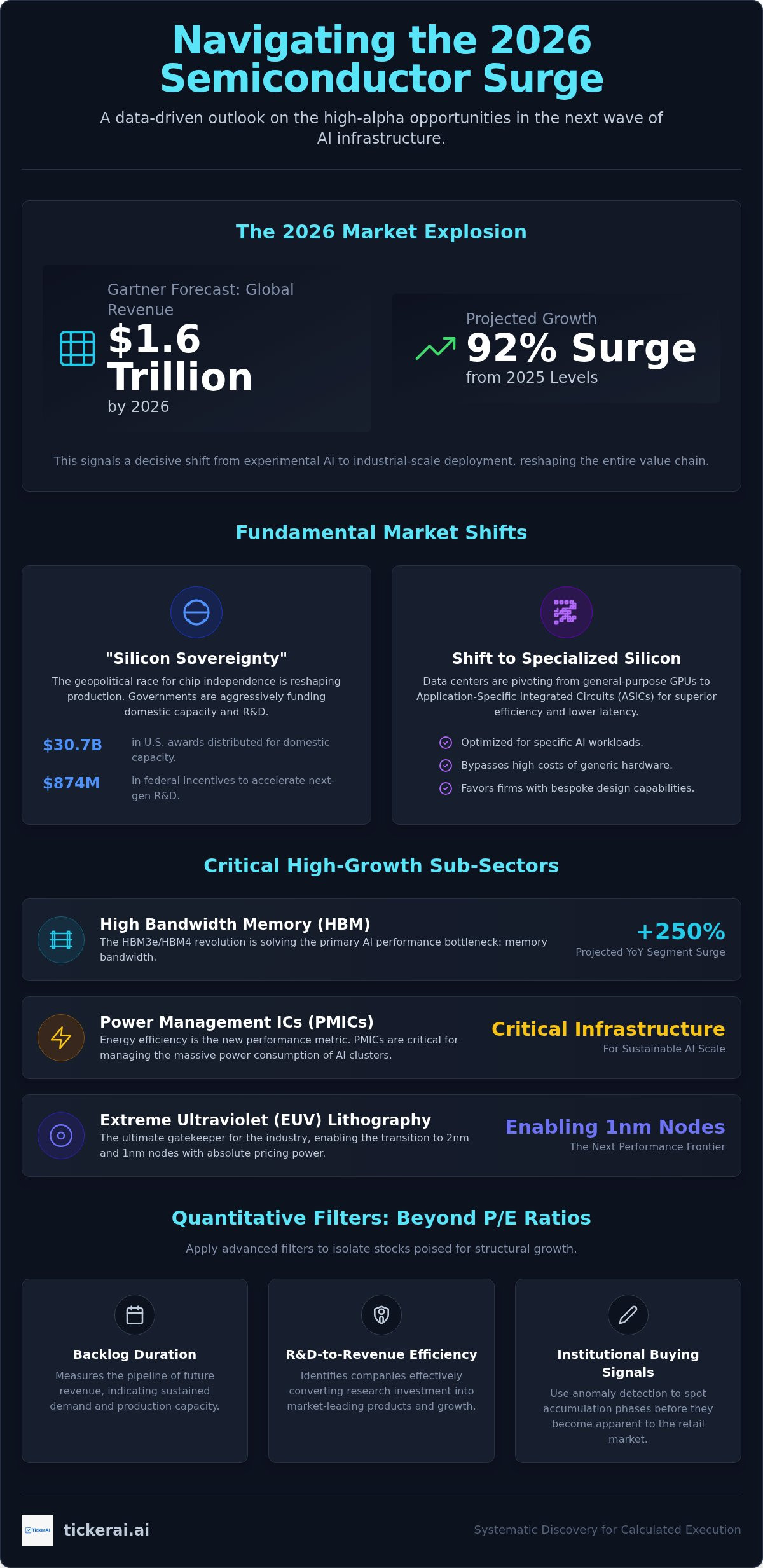
Gartner forecasts global semiconductor revenue to hit $1.6 trillion in 2026. This represents a 92% surge from 2025 levels. While the scale is massive, the risk of buying into an overextended AI bubble is equally significant. You've seen the NVIDIA-level breakouts, and you don't want to be the last one entering a crowded trade. It's a high-speed environment where information overload often leads to retail paralysis.
We've engineered this guide to solve that. By leveraging data-driven AI discovery, we identify the best semiconductor stocks positioned for high-alpha returns in 2026. We look past the standard GPU hype to find specialized foundries and power management firms currently showing institutional accumulation. Our analysis relies on clinical precision rather than emotional tips or speculative social media trends.
This guide provides a curated list of high-potential tickers and a systematic framework for evaluating chip stocks. You'll learn to spot early institutional signals and monitor the 2nm node capacity shifts that define the current market cycle. It's time to move from passive observation to calculated execution.
Key Takeaways
- Identify how "Silicon Sovereignty" and industrial-scale AI deployment are fundamentally reshaping the global semiconductor value chain in 2026.
- Pinpoint high-alpha opportunities in critical infrastructure sub-sectors, specifically High Bandwidth Memory (HBM) and energy-efficient Power Management ICs.
- Apply advanced quantitative filters like Backlog Duration and R&D-to-Revenue Efficiency to isolate the best semiconductor stocks for structural growth.
- Establish a systematic discovery workflow that uses anomaly detection to flag institutional buying signals before they reach the retail crowd.
- Leverage TickerAI Pro to automate your sector monitoring and access curated swing trade setups generated by advanced AI filters.
The 2026 Semiconductor Landscape: Why Chips Remain the Global Economic Engine
Gartner projects global semiconductor revenue to hit $1.6 trillion in 2026. This 92% increase from 2025 signals a decisive shift from experimental AI to industrial-scale deployment. In this high-stakes environment, identifying the best semiconductor stocks requires looking beyond the surface. The market is no longer just about software; it's about the physical infrastructure required to run it at scale.
The semiconductor value chain is tightening. IP providers, fabless designers, and foundries now operate under the shadow of supply chain bottlenecks for advanced packaging (CoWoS). With 2026 capacity for 2nm nodes largely booked, the market is rewarding companies that secure their production lines early. This is why "Systematic Discovery" beats "Stock Picking." It's about monitoring the flow of capital and the physical constraints of the industry rather than chasing social media hype.
Geopolitics now dictates market caps. Silicon Sovereignty is the geopolitical race for chip independence. Governments are aggressively funding domestic capacity, as seen with the $30.7 billion in U.S. awards distributed as of early 2025. For 2026, the focus has shifted to R&D, with the Department of Commerce allocating $874 million in federal incentives to accelerate next-gen development. These regional chip acts are fundamentally reshaping where and how chips are built.
The Shift Toward Specialized Silicon
General-purpose GPUs are no longer the only game in town. In 2026, data centers and edge computing environments are pivoting toward Application-Specific Integrated Circuits (ASICs). These chips are optimized for specific workloads, offering superior energy efficiency and lower latency. Custom silicon is becoming the standard for 2026 data centers, as companies seek to bypass the high costs and power demands of generic hardware. This trend favors firms that can provide bespoke design services or specialized manufacturing capabilities.
Market Sentiment and the 2026 Semi-Cycle
Institutional players are currently maneuvering through a high-volatility environment. Understanding whether a ticker is in an accumulation or distribution phase is vital for timing entries. You can learn how to interpret AI stock signals to gauge sector heat and institutional conviction. Relying on systematic monitoring helps you filter out the noise and focus on data-driven setups. In 2026, the best semiconductor stocks are found where technical indicators align with structural demand. Monitoring real-time momentum alerts ensures you don't buy at the top of a short-term cycle.
High-Growth Sub-Sectors: Identifying the Next Layer of AI Infrastructure
The 2026 semiconductor edge belongs to those who look past the GPU headlines. Identifying the best semiconductor stocks requires a granular look at the "Silicon Enablers"—the sub-sectors like High Bandwidth Memory (HBM) and advanced packaging that solve physical bottlenecks. WSTS projects the memory segment will surge by approximately 250% year-over-year in 2026. This segment alone is expected to reach over $800 billion, representing a structural reset of the entire value chain.
Beyond memory, photolithography remains the ultimate gatekeeper for the industry. The transition to 2nm and 1nm nodes is the next frontier for performance. Deloitte predicts global annual sales will reach $975 billion in 2026, driven largely by these technical leaps. Companies controlling the extreme ultraviolet (EUV) lithography space maintain absolute pricing power. They are the essential toll booths for every advanced chip produced in the coming years.
Memory and Storage: The HBM3e/HBM4 Revolution
Memory bandwidth is currently the primary constraint for AI performance. Processors are only as fast as their data access speeds. In 2026, HBM3e and HBM4 are the standard for high-end AI accelerators. Dominant players in this space are seeing historic capital expenditures to expand production capacity. Spotting momentum here requires monitoring order book expansions and pre-payment signals from major cloud service providers before they hit the mainstream news cycle.
Powering the AI Data Center
Energy efficiency is the new performance metric for the technology sector. AI clusters consume massive amounts of electricity, making power management ICs (PMICs) critical. Demand for Gallium Nitride (GaN) and Silicon Carbide (SiC) is accelerating. These materials provide the high-density power delivery required for 2026 infrastructure. Pinpointing the best semiconductor stocks in the power segment requires finding the firms that own the GaN and SiC patents and manufacturing pipelines.
Advanced packaging is the final piece of the puzzle. The rise of "Chiplets" and 3D stacking technologies allows for performance gains even as physical scaling hits limits. Lead times for CoWoS packaging remain high; 2026 capacity is already largely secured. This creates a significant moat for incumbents. You can use AI-powered stock opportunity discovery to detect which firms are winning these high-value contracts before the retail crowd catches on.
Quantitative Metrics for Semi Stocks: Beyond Revenue and P/E Ratios
Traditional valuation models often fail in high-growth tech cycles. Static P/E ratios don't capture the structural shift of the 2026 AI infra-cycle. To identify the best semiconductor stocks, professionals focus on R&D-to-Revenue Efficiency. This metric measures the ROI of innovation. R&D efficiency is a 2026 leading indicator because it quantifies how effectively a firm converts engineering spend into market-dominant IP. High efficiency suggests a sustainable competitive advantage in the race for 1nm and 2nm dominance.
Operating margins in the Fab-Lite era remain a critical focus. By outsourcing heavy manufacturing to specialized foundries, designers can maintain higher margins while focusing on high-value IP development. This lean structure often leads to superior returns on invested capital. It allows companies to scale without the massive overhead of maintaining their own fabrication plants.
Backlog duration serves as a leading indicator of future revenue certainty. In an era where advanced node capacity is largely booked through 2026, a growing backlog confirms demand resilience. Conversely, inventory-to-sales ratios help traders spot the end of a supply glut. High inventory levels relative to sales often precede margin compression; a normalization phase usually triggers institutional accumulation. Monitoring these shifts in real-time is essential for timing entries.
Systematic Valuation Frameworks
Standard discounted cash flow models struggle with the non-linear growth of AI hardware. You can explore what is quantitative investing to understand how systematic discovery filters for high-alpha chip stocks. In capital-intensive industries, Free Cash Flow per Share is the ultimate truth. It accounts for the massive capital expenditures required to maintain foundry leads while highlighting which firms are actually generating cash for shareholders.
Tracking Institutional Accumulation
Retail investors often buy at the top of a breakout. Institutional players move earlier in "Dark Pools" to avoid slippage and hide their footprints. AI-powered discovery scans for these unusual volume signatures across the technology sector. Identifying these patterns allows for early detection of institutional buying before the retail crowd enters. This proactive monitoring helps you find the best semiconductor stocks before they become mainstream consensus picks. It's about following the smart money, not the social media sentiment.
The Discovery Workflow: Spotting Momentum Before the Retail Crowd
The 2026 market moves at a pace that renders manual research obsolete. Success isn't about guessing which ticker will "moon" on social media. It's about a repeatable, data-driven process that identifies structural shifts before they become mainstream news. Identifying the best semiconductor stocks requires a shift from reactive trading to proactive discovery. This workflow prioritizes leading indicators like institutional volume and geopolitical catalysts over lagging earnings reports.
Thematic filtering is the first step. You can't treat the entire sector as a monolith. A specialized foundry has a different risk profile than an EDA software provider. Once you've categorized the market, you must deploy anomaly detection to flag unusual price and volume action. These signatures often represent institutional accumulation in "Dark Pools" that retail filters miss. Finally, map these signals against 2026 catalysts, such as the December 31, 2026, construction deadline for CHIPS Act tax credit eligibility. Firms breaking ground before this cutoff secure a 35% investment tax credit, providing a massive tailwind for future margins.
Filtering Noise with Smart Watchlists
Structure your semiconductor watchlist by functional role: Foundry, Fabless, and Equipment providers. This allows you to see which part of the value chain is leading the current cycle. If equipment providers are breaking out while designers lag, it suggests a capacity expansion phase is underway. Automating the monitoring of these momentum breakouts ensures you're alerted the moment a sector theme gains traction. For a deeper look at optimizing this process, refer to finding thematic investment opportunities with AI to streamline your discovery pipeline.
Detecting Anomaly Signals
A high-conviction AI signal in the semiconductor space combines price appreciation with significant volume expansion and an institutional footprint. Retail chasing is characterized by high volatility on low relative volume; institutional accumulation is steady, calculated, and persistent. In 2026, real-time alerts for market catalysts—like the November 1, 2026, concept paper deadline for federal R&D incentives—are vital. These dates create binary outcomes that drive massive volatility. You need to know which firms are positioned to win these awards before the announcements hit the wire.
Risk profiling is the final guardrail. Algorithmic volatility signals help you set stops that account for the sector's inherent "beta" without getting shaken out by noise. It's about maintaining clinical precision in a chaotic environment. To start automating your deep-sector research, leverage AI Stock Opportunity Discovery to find setups that fit your specific risk parameters.
Automating Your Semiconductor Search with TickerAI
Manual screening is a liability in a high-speed market. In a sector where 2026 lead times for advanced packaging are already locked, waiting for a news report is too slow. TickerAI functions as a tireless scout. It filters the noise to identify the best semiconductor stocks before they hit the retail radar. By organizing the market into "Smart Watchlists," the platform tracks the specific 2026 Silicon Enablers that define the current cycle. This allows you to focus on decision-making rather than data entry.
The volatility of 2026 requires more than just price alerts. You need context-aware discovery. TickerAI Pro provides real-time "Swing Trade Setups" that align with the technical indicators and institutional footprints discussed in previous sections. It moves from high-level value propositions to specific, actionable steps. This isn't about passive observation; it's about clinical execution. Automation ensures that you never miss a structural shift because you were offline.
Full-Access vs. Pro: Scaling Your Research
Professional traders use automated scanning to reclaim over 20 hours of research time each week. Manual ticker-by-ticker analysis is inefficient. TickerAI Pro prioritizes "Action-Oriented Alerts" over generic market news. These alerts focus on the quantitative metrics that matter, such as sudden shifts in backlog duration or R&D efficiency spikes. If you aren't sure which tier fits your workflow, see this guide on evaluating an AI stock picking service for tier selection guidance. It helps you scale your research without increasing your workload.
The TickerAI Edge: Data-Driven Discipline
Emotional bias is the primary cause of retail losses. When semiconductor stocks begin "mooning," the FOMO factor often leads to buying at the peak of a distribution phase. AI removes this variable. It maintains a grounded, data-driven approach that ignores social media sentiment in favor of algorithmic processing. Systematic discovery becomes a daily routine. It ensures you are monitoring the best semiconductor stocks with a proactive mindset. This level of discipline is what separates professional participants from casual hobbyists. You gain a high-speed intelligence partner that is always "on."
Join TickerAI to discover the next semiconductor breakout today.
Capitalizing on the 2026 Semiconductor Expansion
The transition from experimental AI to industrial-scale deployment is driving a $1.6 trillion market. Success in this environment requires moving beyond surface-level hype. You've seen why you must identify the structural enablers like High Bandwidth Memory and advanced packaging. We've established why R&D efficiency and backlog duration are the definitive leading indicators for 2026 performance. Relying on lagging data or social media sentiment isn't a viable strategy in this high-beta sector.
To consistently find the best semiconductor stocks, you need a high-speed intelligence partner. TickerAI provides institutional-grade market scanning and real-time sector anomaly detection. You get curated tech-sector swing trade setups designed to remove emotional bias and FOMO from your daily workflow. It's about replacing manual effort with clinical precision. You focus on decision-making while the AI handles the discovery. The next structural breakout is already being detected by our filters.
Access AI-Powered Semiconductor Discovery with TickerAI and secure your edge in the 2026 cycle. Position yourself before the retail crowd catches the next momentum signal.
Frequently Asked Questions
What are the best semiconductor stocks to buy for long-term growth in 2026?
The best semiconductor stocks for long-term growth in 2026 are those controlling the 2nm frontier and high-bandwidth memory pipelines. Look for firms with secured capacity for 2027 and beyond. Companies focused on custom ASICs and power management for industrial-scale AI data centers show the most resilient structural growth. Focus on specialized foundries and IP providers that enable the entire hardware ecosystem. These firms maintain high pricing power during supply bottlenecks.
Is the semiconductor industry still a good investment after the AI boom?
Yes, the sector has transitioned from an experimental phase to industrial-scale deployment. Gartner forecasts a 92% revenue increase in 2026, reaching $1.6 trillion. This isn't a temporary spike; it's a structural reset of global infrastructure. The "boom" has evolved into a multi-year infra-cycle. Investors should shift focus from broad AI hype to specific sub-sectors like advanced packaging and power efficiency to find sustainable returns. The market now rewards tangible production capacity over speculative software promises.
How does TickerAI discover semiconductor swing trade setups?
TickerAI utilizes automated market scanning to detect unusual volume and price action signatures. It specifically monitors "Dark Pool" activity and institutional accumulation patterns that retail filters often miss. By filtering the technology sector through algorithmic anomaly detection, the platform identifies high-conviction setups before they reach mainstream awareness. This systematic discovery process removes emotional bias and FOMO. It provides action-oriented alerts for professional traders seeking short-term momentum in the volatile semiconductor space.
What is the difference between fabless and foundry semiconductor stocks?
Fabless companies focus exclusively on chip design and IP development, outsourcing the actual manufacturing to external partners. Foundries own and operate the physical fabrication plants where chips are produced. Fabless firms often maintain higher margins and lower overhead. Foundries require massive capital expenditures but control the physical supply chain. In 2026, the best semiconductor stocks are often found where these two models intersect through long-term capacity agreements. This ensures design firms have guaranteed access to advanced 2nm nodes.
Can AI predict the next semiconductor breakout?
AI doesn't predict the future; it calculates probabilities based on real-time data flows. By detecting institutional footprints and unusual accumulation in the technology sector, AI-driven discovery flags high-probability breakouts before the retail crowd enters. It monitors leading indicators like R&D-to-revenue efficiency and backlog duration. This proactive approach identifies momentum shifts based on technical indicators rather than speculative social media trends. It functions as a tireless assistant that filters noise to find calculated entry points.
How much risk is involved in trading semiconductor stocks in 2026?
Semiconductor trading involves significant "beta" and geopolitical risk. Supply chain bottlenecks for advanced nodes and shifting regional chip acts create high volatility. To manage this, professionals use algorithmic volatility signals to set precise stops. Diversifying across sub-sectors like memory, logic, and equipment helps mitigate specific foundry risks. Success requires a disciplined, data-driven framework to navigate the rapid price swings characteristic of the current technology market cycle. Risk is inevitable, but systematic monitoring makes it manageable.
What are the key catalysts for chip stocks this year?
Key catalysts include the December 31, 2026, construction deadline for CHIPS Act tax credits and the transition to 2nm mass production. Federal R&D incentives and letters of intent for federal funding also drive sector momentum. Monitoring these dates is essential for timing entries. Additionally, the shift toward custom ASICs and the expansion of HBM4 capacity serve as structural catalysts. These events create binary outcomes that drive massive volatility and opportunity for prepared traders.


