

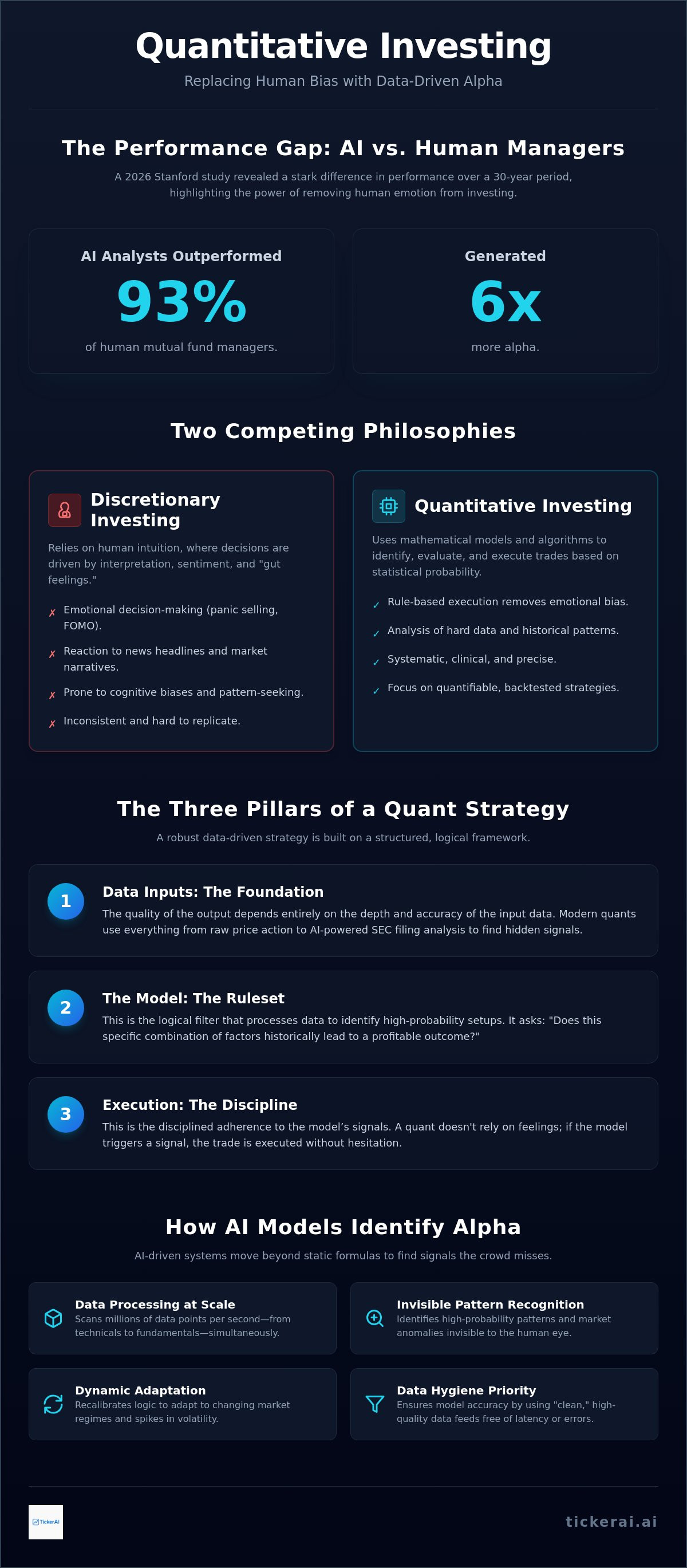
A 2026 Stanford study revealed that AI analysts outperformed 93% of mutual fund managers over a 30-year period, generating six times more alpha. This performance gap isn't a coincidence. It's the direct result of removing human bias from the execution loop. You've likely felt the sting of emotional decision-making or the paralysis caused by an endless stream of conflicting financial news. To compete in this environment, you must define what is quantitative investing and how it utilizes mathematical models to replace inconsistent manual analysis with clinical precision.
You want to stop chasing hype and start following hard data. This guide provides the blueprint to master the principles of data-driven investing. We'll show you how AI-powered quantitative models identify market alpha for individual traders, acting as a tireless scout in a chaotic market. We will break down the systematic 'Quant' framework, identify the specific tools that automate discovery, and help you shift your strategy from reactive guessing to automated, high-speed intelligence gathering.
Key Takeaways
- Define what is quantitative investing as a shift from speculative guessing to rule-based execution through backtested mathematical models.
- Understand how AI-driven models process millions of data points per second to identify high-probability patterns and market anomalies invisible to manual analysis.
- Explore core systematic strategies, including Factor Investing and Momentum Discovery, to isolate consistent drivers of market returns.
- Leverage AI to automate the "scout" phase of trading, eliminating information overload and emotional bias from your decision-making process.
- Learn to bridge the gap between institutional theory and retail execution using TickerAI Pro for curated, data-backed swing trade setups.
The Definition of Quantitative Investing: Math Over Myth
Investing is often treated as a game of intuition. Quantitative investing proves otherwise. To understand what is quantitative investing, you must view the market as a series of data points rather than a narrative of news headlines. It's a systematic approach that uses mathematical models and algorithms to identify, evaluate, and execute trades. Every decision is based on statistical probability rather than a "gut feeling."
The core philosophy is simple: if an investment thesis cannot be quantified and backtested, it's a guess. It's not a strategy. Discretionary investing relies on human intuition, where news sentiment or a CEO's charisma drives the final decision. In contrast, a quantitative approach filters out the noise. By July 2026, the necessity of this shift is undeniable. Trillions of dollars are managed through systematic strategies globally. High-frequency algorithms now account for a massive share of daily trading volume on major exchanges. Manual traders who rely on "vibes" are competing against machines that never sleep and never panic.
The Shift from Intuition to Evidence
Human brains are poorly evolved for 24/7 global market volatility. We're biologically hardwired to seek patterns where none exist and to prioritize short-term survival over long-term statistical edges. This leads to emotional decision-making, such as panic selling during a dip or chasing a parabolic move too late. In a professional quantitative fund environment, these biases are intentionally engineered out of the process.
The goal is the pursuit of "Alpha." In a quantitative framework, Alpha is the statistically significant edge that generates returns above a benchmark. Achieving this requires moving beyond surface-level charts. Systematic Discovery is the automated identification of market anomalies. This concept is increasingly relevant in alternative markets; for example, Land Invest Corp applies data-driven methodologies to identify and acquire high-potential residential vacant land, bringing institutional-level precision to land investment strategies.
The Three Pillars of a Quant Strategy
Building a data-driven strategy requires a structured workflow. It's not just about having a computer; it's about the logic that governs it. A robust quant strategy rests on three specific pillars:
- Data Inputs: This is the foundation. Modern quants use everything from raw price action to AI-powered SEC filing analysis to find hidden signals. The quality of your output depends entirely on the depth of the data you feed the system.
- The Model: This is the ruleset. It processes the data through a logical filter to identify high-probability setups. It asks: "Does this specific combination of factors historically lead to a profitable outcome?"
- Execution: This is the disciplined adherence to the model’s signals. A quant doesn't wait to see if they "feel" good about a trade. If the model triggers a signal, the trade is executed.
By following this framework, you remove the heavy emotional lifting. You transition from a reactive participant to a proactive observer of market mechanics. The focus shifts from wondering what might happen to executing what the data suggests is most likely to occur.
The Mechanics: How Quantitative Models Identify Alpha
Modern models ignore the single-chart perspective. They scan millions of data points per second. This speed allows for the identification of patterns that are invisible to the naked eye. To truly grasp what is quantitative investing, you must understand the engine behind it. It's a transition from static, linear formulas to dynamic, AI-driven detection. The goal is simple: find the signal before the crowd reacts.
Data hygiene is the first priority. High-quality feeds serve as the foundation. If the input is corrupted by latency or inaccuracies, the output is useless. Quants prioritize "clean" data to ensure their models aren't chasing ghosts. This clinical approach separates professional systems from amateur attempts. Static formulas were the standard for decades. They looked for fixed conditions, like a simple moving average crossover. Today's models adapt to changing market regimes. When volatility spikes, the model recalibrates. This ensures the logic remains relevant even as market conditions shift.
Data Processing at Scale
Analyzing technical indicators, fundamental ratios, and alternative data simultaneously is now a baseline requirement. In 2026, the technological barrier between institutional desks and retail traders has finally collapsed. Individual participants can now utilize AI-powered stock anomaly detection to find hidden momentum before it hits the mainstream news cycle. This scale filters the noise. Retail traders often succumb to social media FOMO. Quantitative systems do the opposite. They identify the quiet footprints of institutional accumulation. They see the volume precedes the price move.
Algorithmic Signal Generation
Raw data is meaningless without a filter. Algorithmic signal generation converts this data into actionable "Buy" or "Watch" alerts based on rigorous historical probability. It's vital to distinguish between a signal and a prediction. A prediction implies certainty. A signal represents a high-probability event based on historical patterns. Professional traders don't need to be right 100% of the time. They need a statistically significant edge that plays out over hundreds of trades.
This approach to systematic investing focuses on high-conviction signals. It ignores the high-frequency noise that often leads to overtrading and capital erosion. By focusing on these refined outputs, you can automate your market scanning and focus strictly on execution. The model handles the discovery. You handle the decision. This division of labor is how professionals maintain consistency in a volatile environment.
Core Quantitative Strategies: Factor, Momentum, and Arbitrage
Models are only as effective as the logic that powers them. To master what is quantitative investing, you must identify the specific strategies that professional quants use to extract Alpha from the noise. These aren't vague theories. They're mathematical frameworks designed to exploit repeatable market behaviors. By 2026, these strategies have evolved from simple formulas into complex, multi-layered systems.
- Factor Investing: Isolating specific drivers of return. This includes Value, Size, Quality, and Volatility. Quants don't just buy "cheap" stocks; they buy stocks that meet a rigorous mathematical definition of value.
- Momentum Discovery: Identifying securities with existing price strength. The goal is to find assets statistically likely to continue their current trajectory based on volume and velocity.
- Statistical Arbitrage: Exploiting temporary price discrepancies. This involves identifying related securities that have diverged from their historical price relationship and betting on their eventual convergence.
- Risk Parity: Allocating capital based on risk contribution. Traditional portfolios allocate by dollar amounts. Risk parity ensures that no single asset class or factor dominates the portfolio's total volatility.
Momentum and Trend Discovery
AI identifies the tipping point where a trend becomes statistically significant. It doesn't guess. It calculates. Traditional technical analysis often fails because it misses the underlying liquidity shifts. By integrating AI for swing trading, you can catch mid-term moves that manual charting misses. There's a critical difference between chasing a pump and riding a quantitative trend. Chasing is reactive. Riding a trend is a proactive execution of a high-probability signal. You aren't hoping for a move; you're participating in a statistically validated momentum cycle.
Factor Investing: Beyond the P/E Ratio
Traditional fundamental metrics are often lagging indicators. A low P/E ratio doesn't guarantee value; it might just signal a dying business. Professional quants use multi-factor models to increase signal reliability. They look for "confluence." If a stock shows high quality, low volatility, and positive "Smart Money" flow, the conviction increases. In 2026, tracking institutional footprints through volume-weighted analysis acts as a leading quantitative factor. It reveals where the largest participants are positioning before the price reflects the change. This systematic approach ensures you're following the data, not the narrative.
The AI Revolution: Democratizing Systematic Research
2026 is the "Year of the Retail Quant." High-performance cloud computing has finally leveled the playing field between institutional desks and individual participants. Historically, understanding what is quantitative investing required a PhD and a massive server room. Today, AI discovery engines provide that same firepower to anyone with an internet connection. This democratization shifts the focus from the labor of finding data to the precision of executing insights.
Automating the "Scout" phase is the most significant leap forward for modern traders. Manual market scanning is a legacy process. It's slow, prone to fatigue, and limited by human bandwidth. AI acts as a tireless assistant, scanning 8,000+ global stocks to identify the five that actually matter. This eliminates analysis paralysis. You no longer need to spend four hours a night staring at charts. The systematic filter does the heavy lifting, delivering actionable ideas directly to your dashboard. We're also seeing a shift from "black box" algorithms to transparent, data-driven insights. Modern systems don't just give you a signal; they show you the underlying factors driving the recommendation.
Machine Learning and Anomaly Detection
AI models don't just follow static rules; they learn from market cycles. Machine learning allows these systems to adjust signal sensitivity as market regimes shift from high volatility to low-growth periods. This is crucial for spotting "Outliers." These are stocks behaving differently than their peers, often signaling a massive move before it occurs. AI identifies institutional accumulation by detecting subtle volume and price deviations long before they appear on standard news terminals. This proactive detection is the difference between catching a breakout and being the liquidity for someone else's exit.
Automating the Research Workflow
The transition from manual chart scanning to real-time algorithmic alerts is a necessity for survival in 2026. Smart watchlists now organize thematic opportunities automatically. If a specific sector sees a sudden influx of quantitative momentum, the system alerts you instantly. Speed-to-insight is the only metric that matters in a high-frequency environment. TickerAI’s automated scanning provides this exact advantage, filtering the noise so you can focus strictly on trade management. You can access institutional-grade AI discovery tools today to stop guessing your entries and start following the data.
By integrating these automated workflows, you remove the emotional burden of discovery. You aren't hunting for trades; the trades are being delivered to you based on rigorous, backtested criteria. This efficiency allows you to scale your strategy without increasing your screen time. It's a clinical, professional approach that prioritizes capital preservation and statistical consistency over the "big win" narrative that traps most retail participants.
Implementing a Quantitative Workflow with TickerAI
Transitioning from theoretical knowledge to market execution requires a robust infrastructure. Understanding what is quantitative investing is only the first step. The second is deploying an institutional-grade workflow that replaces manual labor with automated intelligence. TickerAI acts as the bridge between complex quant theory and retail execution. It provides the tools necessary to move from a "gambler" mindset to a systematic investor through real-time alerts and data-backed insights.
The TickerAI Pro Subscription offers curated swing trade setups built on rigorous, systematic rules. These setups aren't based on social media sentiment or financial news hype. They're the result of continuous algorithmic scanning across global data. By utilizing Smart Watchlists, you can track thematic movements without manual effort. If a specific factor like momentum or low volatility begins to outperform, the system detects the shift and updates your watchlist automatically. This ensures you're always positioned where the data shows the highest probability of success.
Real-Time Alerts and Smart Discovery
Success in a fast-moving environment depends on speed-to-insight. You must set up filters that match your specific risk profile and timeframe to avoid information overload. TickerAI allows you to interpret signals within a broader market context, providing a sense of "calculated urgency." When an alert triggers, it's not a call to panic. It's a signal that the mathematical conditions for a high-probability trade have been met. This precision allows you to act with confidence while others are still analyzing lagging indicators.
Evidence-Based Investing for the Modern Trader
A systematic approach is the ultimate cure for FOMO and emotional trading. When you follow a model, you remove the "hope" factor from your portfolio. Professional traders build a repeatable routine: Scan, Filter, Execute, and Review. TickerAI automates the first two steps, allowing you to focus your mental energy on execution and performance review. This discipline is what separates consistent performers from those who churn their accounts chasing the next big win. You aren't guessing what the market might do; you're executing what the data suggests is already happening.
Stop relying on intuition in a market dominated by machines. Transition to a clinical, data-driven strategy that prioritizes capital preservation and statistical edges. Start your systematic discovery journey with TickerAI Full-Access today.
Master the Systematic Edge
The era of manual stock picking is over. To compete in 2026, you must internalize what is quantitative investing and deploy it as a clinical shield against emotional bias. We have explored how mathematical models identify Alpha, the mechanics of momentum discovery, and the democratization of institutional-grade research through AI. You now have the framework to replace guesswork with data-backed execution. This shift ensures your capital is allocated based on probability rather than news sentiment.
Stop losing time to information overload. Upgrade to TickerAI Pro for institutional-grade stock discovery alerts. Access real-time AI alerts for momentum breakouts and curated swing trade setups based on rigorous algorithmic logic. Let the system handle the automated filtering of 8,000+ stocks while you focus on high-conviction decision-making. The tools for professional-grade discovery are at your fingertips. Your shift toward a systematic, evidence-based approach starts now. Follow the data to find your edge.
Frequently Asked Questions
What is the difference between quantitative and fundamental investing?
Fundamental investing focuses on qualitative factors such as management quality, brand value, and industry narratives. Quantitative investing relies strictly on mathematical models and historical data to identify trades. One is subjective; the other is systematic. By defining what is quantitative investing as a rule-based framework, you eliminate the emotional bias that often plagues fundamental analysis. It's a shift from reading narratives to calculating probabilities.
Do I need to be a programmer to use quantitative investing strategies?
You don't need to be a coder to succeed in 2026. Cloud-based AI engines now handle the technical heavy lifting previously reserved for PhDs. Platforms like TickerAI provide the discovery infrastructure, allowing you to focus on strategy selection and risk management. You provide the logic; the software provides the execution. The barrier to entry has shifted from programming skills to analytical intelligence and disciplined execution.
Is quantitative investing better than technical analysis?
Quantitative investing is a more rigorous evolution of technical analysis. Traditional technical analysis often relies on subjective chart patterns that two traders might interpret differently. Quantitative strategies require every signal to be backtested and statistically validated before a trade is placed. This removes the guesswork from charting. It's about finding repeatable anomalies rather than drawing lines on a screen and hoping for a breakout.
Can quantitative investing beat the market consistently?
No strategy beats the market every single day. However, a systematic approach provides a consistent statistical edge over hundreds of trades. By removing emotional decision-making, quants avoid the large drawdown events that typically ruin manual traders. Consistency comes from high-probability signals and disciplined risk management. You aren't looking for a "perfect" prediction; you're looking for a repeatable edge that plays out over time.
What is a 'quant' in the context of stock market trading?
A "quant" is a quantitative analyst who uses mathematical models to guide investment decisions. Historically, these professionals were restricted to major hedge funds and institutional desks. In 2026, the term also applies to retail traders who use systematic discovery tools to replace intuition. A quant prioritizes data hygiene and rules-based execution over market news, social media hype, and unverified sentiment.
How has AI changed quantitative investing in 2026?
AI has democratized access to institutional-grade scanning and unstructured data analysis. In 2026, machine learning models adjust to market volatility in real-time, identifying institutional footprints before they hit the tape. This speed-to-insight allows retail participants to compete on the same level as professional desks. AI understands what is quantitative investing in the context of shifting market regimes, ensuring your filters remain relevant as volatility spikes.
What are the risks of relying solely on quantitative models?
The primary risks include model drift and data latency. A model that works in a bull market may fail when market regimes shift or volatility spikes unexpectedly. Relying solely on a "black box" without human oversight can lead to capital erosion during black swan events. Success requires monitoring the model's performance and ensuring the underlying data remains clean. Human judgment is still required to oversee the system.
How much capital do I need to start quantitative investing?
Capital requirements depend on your brokerage and specific strategy. The cost of entry for quantitative research has dropped significantly due to cloud computing. You can start with a standard retail account and use AI-powered discovery tools to identify swing trade setups. Focus on the quality of the signal rather than the size of the initial deposit. Scalability is a core benefit of systematic trading once you validate your edge.


