

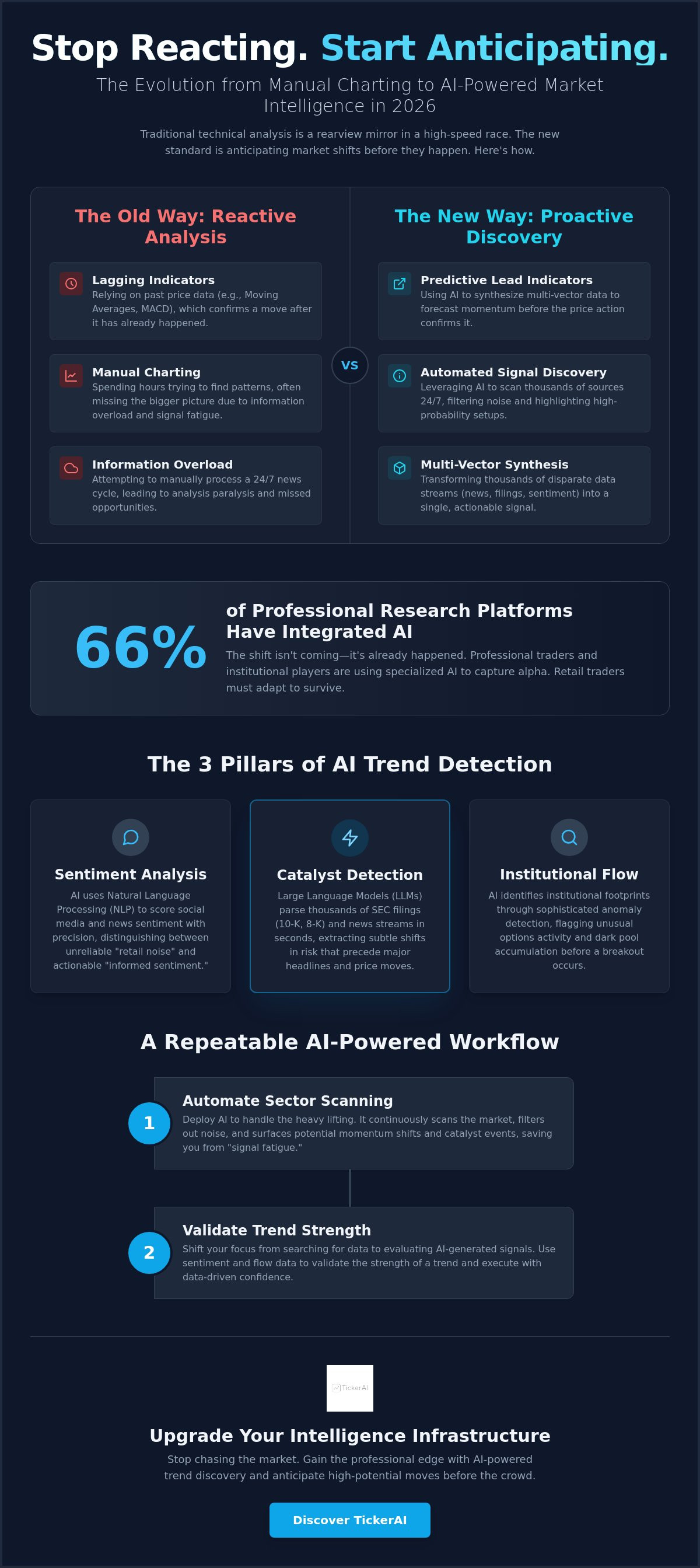
Traditional technical analysis has become a rearview mirror in a high-speed race. While retail traders still squint at lagging indicators, 66% of professional research platforms have already integrated specialized AI for market trend analysis to capture alpha before it hits the tape. You're likely drowning in a 24/7 news cycle that produces more noise than signal. It's a common pain. Information overload makes it nearly impossible to quantify emotional market sentiment or spot momentum shifts in real time.
This guide changes that. You'll master the transition from manual charting to a repeatable, automated discovery workflow. We'll show you how to identify high-potential market movements before the crowd reacts. You'll gain the tools to replace guesswork with data-driven confidence in your swing trade setups. We'll explore the shift toward specialized intelligence tools and the specific algorithmic frameworks used by elite participants in 2026. It's time to stop reacting to the market and start anticipating it.
Key Takeaways
- Replace lagging technical indicators with multi-vector synthesis to capture alpha in high-frequency, algorithmic environments.
- Master the use of AI for market trend analysis to transform thousands of disparate SEC filings and news streams into actionable momentum signals.
- Implement a repeatable two-step workflow that automates sector scanning and utilizes sentiment data to validate trend strength.
- Evaluate discovery tools based on signal transparency and processing speed to maintain data-driven confidence in every trade setup.
- Shift from reactive monitoring to proactive execution by identifying high-potential momentum shifts before they are priced in by the broader market.
The Evolution of Market Trend Analysis: Why Manual Tracking Fails in 2026
The market landscape of 2026 has rendered manual observation obsolete. Institutional players dominate via algorithmic trading, executing thousands of orders before a human can refresh a browser. Traditional technical analysis, once a staple of the retail trader, now serves as a roadmap for liquidity hunting by high-frequency systems. Manual trend tracking in a 24/7 global news cycle isn't just inefficient; it's a structural liability. You can't process a central bank leak, a geopolitical shift, and a corporate earnings beat simultaneously. AI for market trend analysis has transitioned from a luxury to a baseline requirement for survival.
Reliance on lagging indicators creates a dangerous delay. By the time a moving average crossover appears, the smart money has already moved to the next sector. 2026 markets demand predictive lead indicators. These systems synthesize multi-vector data to forecast momentum before the price action confirms it on a standard candle chart. Information overload is the primary enemy. It leads to analysis paralysis, where traders hesitate while the window of opportunity closes. Moving from manual tracking to algorithmic discovery isn't about working harder; it's about upgrading your intelligence infrastructure.
The Limitations of Traditional Charting
Standard support and resistance levels are no longer reliable barriers. Institutional algorithms identify these retail clusters and trigger stop-loss hunts to generate liquidity. Standard RSI and MACD settings fail in 2026's momentum-driven phases, often staying "overbought" for weeks during AI-fueled rallies. Chart lag is the temporal gap between a market event occurring and its visual representation on a price graph, a delay that costs modern swing traders their entry edge. If you're waiting for a breakout to be "confirmed" by a 14-day average, you're already too late.
The Information Overload Crisis
The volume of financial data is staggering. With 88% of organizations worldwide using AI in at least one function by 2025, the speed of data generation has accelerated exponentially into 2026. This operational shift is mirrored in manufacturing, where specialized production management software for garment industry is now essential for streamlining complex workflows. Monitoring multiple sectors manually is a recipe for burnout. The psychological toll is measurable. Traders face "signal fatigue" from constant, unprioritized alerts. Success now requires a shift in focus. You must move from "searching for data" to "evaluating signals." Utilizing AI for market trend analysis allows you to filter the noise and focus on high-probability execution while the machine handles the heavy lifting of multi-sector scanning.
The Pillars of AI-Powered Trend Detection: Sentiment, Catalysts, and Flow
Effective AI for market trend analysis requires more than a single data stream. It demands a multi-vector synthesis of disparate data points. Price action is merely the final output of deeper market mechanics. The real discovery happens in the layers beneath: sentiment, catalysts, and flow. By 2026, Large Language Models (LLMs) have evolved to parse thousands of SEC filings, including complex 10-K and 8-K reports, in mere seconds. They extract subtle shifts in management tone or risk disclosures that human analysts inevitably miss. This multi-vector approach to AI for market trend analysis ensures that no single signal is viewed in isolation.
Anticipation is the goal. Utilizing AI for tracking stock catalyst events allows professionals to position themselves before the news cycle accelerates. This isn't about reacting to a headline. It's about identifying the structural shifts that precede the headline. Smart money doesn't leave a trail on the surface. It leaves anomalies in the flow. AI detects these institutional footprints through sophisticated anomaly detection, flagging unusual options activity or dark pool accumulation before the breakout occurs. These pillars provide the data-driven confidence needed to execute in volatile environments.
Sentiment Analysis Tools for Stocks: Quantifying the Crowd
Natural Language Processing (NLP) scores social media and news sentiment with clinical precision. In 2026, the key is distinguishing between "retail noise" and "informed sentiment." Retail noise signals trend exhaustion. Informed sentiment, found in niche trade journals, indicates structural moves. High sentiment scores correlate with trend reversals at extreme levels. It's a contrarian signal that AI quantifies in real-time to prevent entering trades at the peak.
Technical Anomaly Detection
Breakouts rarely happen without warning. AI spots unusual volume patterns signaling institutional positioning. This is effective in small-cap sectors where "hidden" trends develop away from the mainstream. Scaling this research requires automated stock market analysis to scan thousands of tickers simultaneously. The machine prioritizes signals. You execute trades. Professionals use these tools to build a smart watchlist that updates based on real-time shifts.
Evaluating AI Trend Analysis Tools: Speed vs. Signal Accuracy
Speed without accuracy is a structural liability. In the high-stakes environment of 2026, the primary challenge of AI for market trend analysis is the trade-off between processing velocity and signal reliability. Low-latency data is useless if it triggers a cascade of false positives. Many "black box" algorithms promise high returns but offer zero transparency regarding their underlying logic. This creates unacceptable risk for professional participants. You need to know if a signal is based on a fundamental SEC filing shift or a temporary social media spike. Historical win proofs and performance transparency are non-negotiable. Without them, you're relying on a developer's marketing claim rather than a data-backed strategy.
When selecting an AI stock discovery platform, prioritize transparency over hype. If a platform can't explain its methodology, it shouldn't manage your capital. Transparency allows you to adjust your risk management based on the strength of the underlying data. It's the difference between gambling on a black box and executing a calculated strategy. High-speed intelligence must be paired with clinical precision to be effective in 2026's volatile sectors.
Signal-to-Noise Ratio: The Ultimate Metric
Actionable trend alerts must be distinguished from common market volatility. Algorithmic alpha isn't just about finding trades; it's about avoiding traps. While AI for market trend analysis handles the heavy lifting of multi-vector data synthesis, human oversight remains vital. You validate the AI-generated swing trade setups against broader macro contexts. This synergy ensures that every execution is grounded in reality. The machine finds the momentum. You determine the conviction.
Integration and Accessibility
A professional tool can't be tethered to a single desk. Real-time alerts must flow across multiple devices to ensure you never miss a momentum shift. Smart watchlists are essential for organizing thematic trend opportunities, allowing you to categorize tickers by sector or catalyst type. Your choice between a TickerAI Pro Subscription and a TickerAI Full-Access Subscription should depend on your research intensity. The Pro tier provides core discovery tools, while Full-Access delivers the deep-dive intelligence required for institutional-grade execution.
Building a Repeatable Workflow with AI for Market Trend Analysis
Efficiency in 2026 requires a structured routine. You can't rely on sporadic gut feelings in a market where 88% of organizations have integrated AI into their operations. A professional workflow for AI for market trend analysis moves through four distinct phases: scanning, filtering, calibration, and execution. This sequence ensures that every ticker on your radar has survived a rigorous, data-driven vetting process. It transforms a chaotic news cycle into a streamlined pipeline of opportunity.
- Step 1: Automated Scanning. Set your parameters. Define your sectors, liquidity requirements, and market cap ranges. The machine scans the entire universe of equities to find candidates that match these structural criteria.
- Step 2: Signal Filtering. Validate the momentum. Use sentiment scores and catalyst data to ensure a price move is backed by substance. This step removes "fake-outs" and low-conviction noise.
- Step 3: Risk Calibration. Use AI-detected volatility metrics to set your stops and targets. If the algorithm detects high institutional churn, your stop-loss must be wider to avoid being "hunted."
- Step 4: Execution. Move from discovery to a brokerage-ready decision. Your plan is set. The data is clear. You execute with clinical precision.
Success is a byproduct of repetition. By automating the discovery phase, you free your cognitive energy for high-level decision-making. You stop being a researcher and start being a manager of probability. Get started by building your first automated market watchlist today.
From Discovery to Watchlist
Transitioning an AI alert into a structured trading plan is critical. Don't just buy the ticker; define the entry, the exit, and the thesis. Journaling these AI-driven trades allows for long-term refinement. It helps you identify which sectors or catalyst types yield the highest win rates for your specific style. A rules-based discovery process is the only cure for FOMO. If the machine doesn't flag it, you don't trade it. Discipline is automated.
Managing Momentum Breakouts
Identifying the "sweet spot" of a trend is an art backed by data. You want to enter after the initial signal but before the retail crowd reaches peak exhaustion. AI detects early warning signs of trend reversals by monitoring shifts in sentiment and volume decay. Process discovery beats hot stock chasing because it relies on a repeatable framework rather than fleeting luck. This systematic approach ensures you capture the meat of the move while the crowd is still reading yesterday's news.
TickerAI: The Professional Standard for Automated Market Intelligence
TickerAI serves as the definitive filter for 2026's market chaos. In an environment defined by algorithmic dominance, the platform transforms raw data into actionable intelligence with clinical precision. It's not a general-purpose research tool. It's a specialized engine built for AI for market trend analysis. TickerAI moves beyond the limitations of manual charting. It provides a structural advantage by synthesizing multi-vector data points into high-conviction signals. You receive curated swing trade setups and smart watchlist updates that match professional execution standards. This transition from manual tracking to algorithmic discovery is the only way to maintain a competitive edge.
The methodology behind TickerAI’s discovery tiers is built on transparency and speed. The TickerAI Pro Subscription delivers core AI stock opportunity discovery. It's designed for participants who need high-velocity alerts on momentum shifts and sector rotations. For those requiring institutional-grade depth, the TickerAI Full-Access Subscription provides advanced quantitative filters and long-term investment ideas. Both tiers utilize the same high-speed engine to detect momentum signals before the broader market reacts. You get the signal before the crowd drives the price to exhaustion. It's about leading the tape rather than chasing it.
Proactive Scouting vs. Reactive Analysis
TickerAI acts as a tireless assistant that's always "on." While you focus on high-level decision-making, the machine scans thousands of tickers 24/7. It identifies the institutional footprints and catalyst events we've analyzed throughout this guide. Curated swing trade setups replace the need for manual, error-prone chart hunting. You aren't just using a tool. You're joining a community of systematic investors who prioritize efficiency and data-driven confidence. Reactive analysis is a liability in 2026. Proactive scouting is the solution.
Future-Proofing Your Investment Strategy
AI isn't a luxury in the 2026 market. It's the baseline for survival. With 86% of organizations increasing their AI budgets this year, the speed of information has outpaced human cognition. Utilizing AI for market trend analysis provides the scalability needed to manage diverse portfolios without increasing your workload. Automated research allows you to identify long-term investment ideas and momentum shifts with clinical objectivity. It's time to stop reacting to the news cycle and start anticipating it. Get started with TickerAI to automate your market discovery today.
Master the Algorithmic Edge in 2026
The window for manual market observation has closed. Success in 2026 requires a transition from reactive charting to proactive, multi-vector synthesis. You've seen how integrating AI for market trend analysis into a repeatable workflow eliminates the liability of information overload. Prioritize signal accuracy. Transform chaotic news cycles into structured opportunities. Stop chasing laggards. Identify momentum before the crowd reacts. This is the new baseline for professional participation.
The tools of institutional players are now within your reach. You don't need more data; you need better prioritization. Clinical precision in sentiment tracking and catalyst detection provides the data-driven confidence required for high-stakes execution. Moving from "searching" to "evaluating" ensures your cognitive energy is spent on decisions rather than discovery. Take the final step toward professional-grade market intelligence today.
Discover High-Potential Momentum Breakouts with TickerAI. Leverage real-time algorithmic alerts, curated swing trade setups, and advanced sentiment and catalyst tracking to secure your trading edge. Your path to systematic, data-driven profit starts here.
Frequently Asked Questions
How accurate are AI sentiment analysis tools for stocks in 2026?
AI sentiment analysis in 2026 uses advanced Natural Language Processing to score global news and social data with clinical precision. These tools distinguish between retail noise and informed institutional sentiment. While no system is flawless, they provide a statistical edge by quantifying the emotional extremes that precede trend reversals. Professionals use these scores to validate technical signals before committing capital.
Do I need technical coding skills to use AI for market trend analysis?
No technical coding skills are required to leverage AI for market trend analysis. Professional platforms provide discovery tools through intuitive interfaces. The complex algorithmic processing and data synthesis happen on the backend, allowing you to focus on decision-making. You simply set your sector and market cap parameters to receive actionable, brokerage-ready intelligence without writing a single line of code.
Can AI trend analysis predict market crashes before they happen?
AI doesn't predict the future; it identifies structural anomalies and sentiment decay that often precede significant pullbacks. By monitoring unusual volume patterns and dark pool activity, AI detects institutional distribution before the price action breaks. These early warning signs allow you to calibrate risk and tighten stop-losses before a broader market correction accelerates. It's about risk management, not fortune-telling.
What is the difference between a simple stock screener and an AI discovery tool?
A standard screener uses static, lagging filters like P/E ratios or simple moving averages. An AI discovery tool performs a multi-vector synthesis of real-time data, including SEC filings and catalyst events. It adapts to changing market conditions rather than relying on fixed rules. This allows for the detection of emerging momentum shifts that static, manual screeners inevitably miss.
How does TickerAI handle "false signals" in volatile market conditions?
TickerAI mitigates false signals through multi-layer validation. The system requires convergence between sentiment scores, catalyst data, and volume flow before issuing a high-conviction alert. In high-volatility environments, the algorithm tightens its parameters to prioritize signal quality over quantity. This filtering process protects your capital by ensuring that only setups with high statistical probability reach your watchlist.
Is AI for market trend analysis suitable for long-term investors or just day traders?
AI for market trend analysis serves both short-term swing traders and long-term investors. While traders use it for momentum setups, long-term investors leverage the technology to identify secular trends and macro shifts. The ability to scan thousands of SEC filings in seconds allows for the early discovery of long-term investment ideas based on fundamental catalysts that the broader market hasn't yet priced in.
How much does a professional AI stock alert subscription cost in 2026?
Subscription costs for professional AI market intelligence vary based on the depth of research and the speed of signal delivery. Most high-speed platforms offer tiered pricing to match different research intensities. Professional tiers typically focus on real-time alerts and advanced quantitative filters, while entry-level options provide core discovery tools. You should evaluate tiers based on your specific need for data transparency and execution speed.
Can I integrate AI trend signals into my existing trading journal?
Yes, integrating AI signals into your trading journal is a critical step for long-term refinement. Professional discovery tools provide structured alerts that include entry points, catalyst types, and sentiment scores. This data allows you to track the performance of specific algorithmic theses over time. Reviewing these trades helps you identify which momentum patterns yield the highest win rates for your specific execution style.


