
What if your execution speed was measured in microseconds rather than minutes? Institutional algorithms don't wait for news tickers to update. They utilize AI for tracking stock catalyst events to quantify data at the source, positioning before the retail crowd even sees a headline. If you're still manually scanning feeds, you're competing against a machine that never sleeps and processes filings in real-time. It's an exhausting reality for any serious participant in today's fast-moving environment.
You likely feel the weight of information overload from 24/7 news cycles and the constant fear of missing key filings or earnings nuances. This guide provides a clinical look at how AI-driven market intelligence identifies high-impact catalysts before they move the needle on price. We'll preview a repeatable workflow for event-driven trading, focusing on early detection of M&A, earnings surprises, and leadership changes. By the end of this resource, you'll have a roadmap to reduce research time and achieve the precision required for professional-grade swing setups.
Key Takeaways
- Quantify the historical probability of catalyst success to shift from reactive news consumption to proactive execution.
- Utilize NLP-driven AI for tracking stock catalyst events to extract actionable signals from complex SEC filings and dense earnings transcripts in real-time.
- Isolate high-alpha opportunities within M&A, corporate actions, and earnings surprises through automated sentiment analysis and data mapping.
- Establish a streamlined trading workflow using smart watchlists and trigger-based alerts to minimize research time and eliminate information overload.
- Leverage TickerAI Pro and Full-Access subscriptions to scale discovery and secure a speed advantage over traditional institutional algorithms.
The Catalyst Conundrum: Why Manual Event Tracking Fails in 2026
The market in 2026 operates at a scale that renders manual observation obsolete. Information velocity has breached the limits of human cognition. Traders attempting to track catalysts via traditional news feeds are effectively looking at a rear-view mirror. By the time a headline hits a retail ticker, institutional algorithms have already parsed the source data and executed. The price action you see is the result, not the opportunity. Implementing AI for tracking stock catalyst events is the only way to maintain a competitive posture.
Manual event tracking is a high-cost endeavor. It forces an impossible choice between breadth and depth. You can monitor a wide range of tickers superficially or a few tickers intensely. Both paths lead to missed alpha. Analysis paralysis occurs when traders spend critical minutes evaluating SEC filings that an AI could analyze in microseconds. Distinguishing between structural shifts and routine corporate noise is no longer a manual task. It's a computational one. If you're manually scrolling through EDGAR, you've already lost the lead.
The Speed of Information vs. Execution
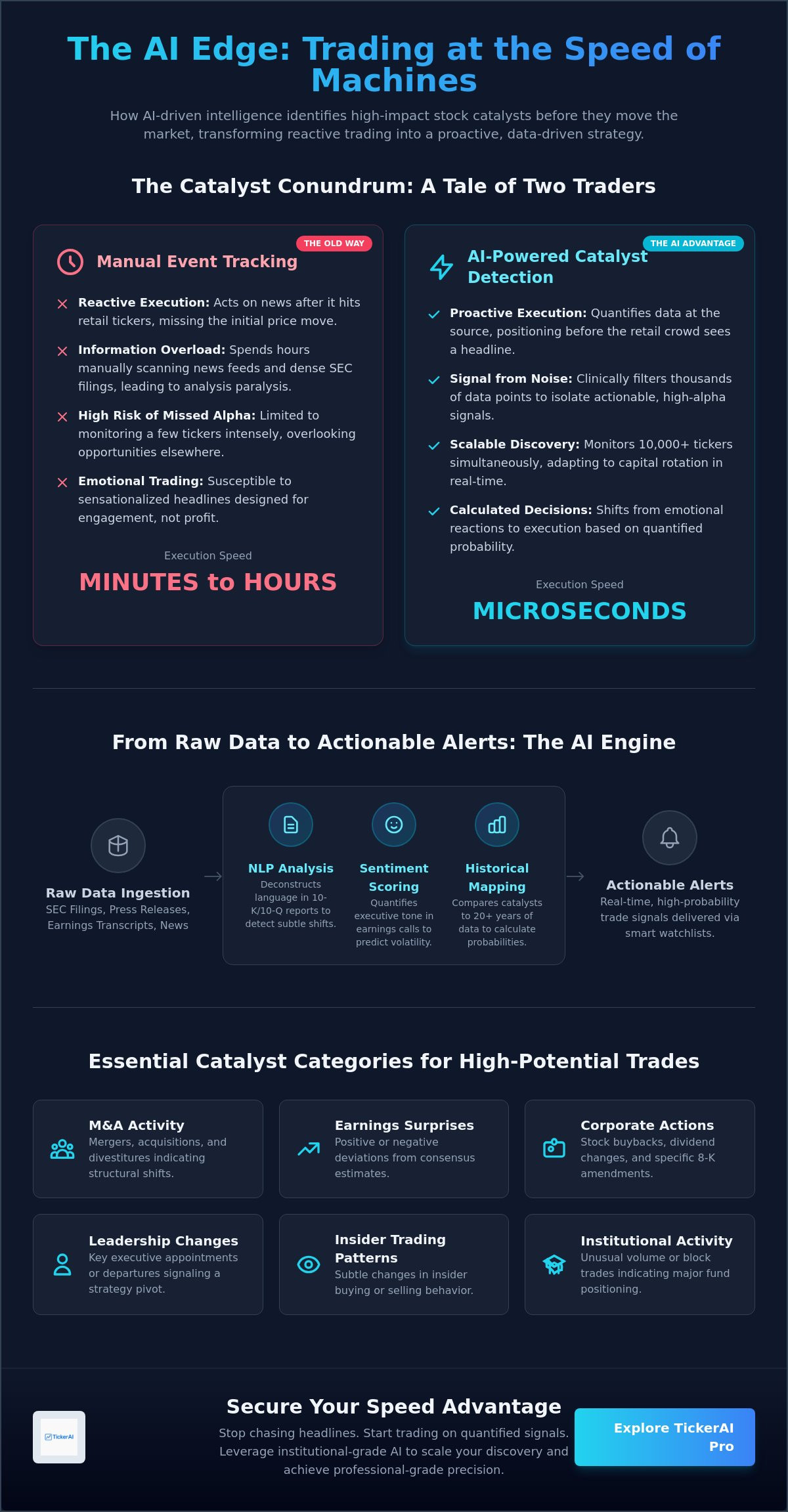
In a high-frequency environment, milliseconds determine the success of event-driven investing strategies. Manual watchlists are static and fragile. They cannot adapt to the rapid rotation of capital across a universe of 10,000+ tickers. When a catalyst occurs, the window for entry is incredibly narrow. Institutional players treat public news as an exit signal. They've already positioned based on the raw data. To compete, you need a system that detects the catalyst at the source. Waiting for the "breaking news" alert is a strategy for the last decade.
Filtering Signal from Noise
Daily market data points are nearly infinite. Most headlines are designed for engagement, not for profit. Traders often fall into the psychological trap of emotional trading, reacting to sensationalized news that lacks structural significance. This is where AI for tracking stock catalyst events becomes essential. It acts as a clinical filter for a chaotic environment.
Automated systems identify the "hidden" filings that the general market overlooks. This includes specific 8-K amendments, subtle changes in insider trading patterns, or nuances in subsidiary divestitures. While the crowd reacts to the loudest headline, the professional stays focused on the data that actually moves the needle. Automated scanning ensures that you don't miss the signal while everyone else is distracted by the noise. It turns overwhelming data into a calculated, actionable advantage.
How AI Decodes Stock Market Catalysts: From Raw Data to Actionable Alerts
Raw financial data is a liability unless you possess the computational power to process it in real-time. Modern AI for tracking stock catalyst events functions as a high-speed analytical engine, converting thousands of pages of legalese into precise trade signals. It doesn't just scrape information; it interprets context. This technological shift allows traders to move from reactive news consumption to proactive execution based on quantified data points.
NLP and Sentiment Analysis of SEC Filings
Natural Language Processing (NLP) serves as the core of this operation. It doesn't just read SEC filings; it deconstructs them. AI detects subtle linguistic shifts in 10-K and 10-Q reports that human analysts often overlook. A change in the frequency of "risk" qualifiers or a pivot in how management describes "liquidity" can signal a structural change months before it hits the price chart. This level of clinical precision reduces the time required to vet a ticker from hours to seconds.
Sentiment analysis quantifies the tone of earnings calls and press releases. It assigns a numerical value to executive confidence, allowing you to compare management's delivery against historical benchmarks. High-negative sentiment scores often precede post-earnings price volatility, providing a clear signal for risk management. Linguistic pattern recognition automates fundamental research by scanning for specific trigger phrases, ensuring that your focus remains on high-alpha decision-making rather than manual data entry.
Historical Event Mapping and Probability
Historical event mapping adds a layer of statistical probability to every alert. By comparing current filings to 20+ years of market data, AI calculates the expected move for specific catalysts. It identifies repeatable patterns in M&A announcements, clinical trial results, or spinoffs. Integrating automated stock market analysis into your workflow transforms raw information into a probability-based execution plan. This shift from intuition to data-driven logic is the foundation of institutional success.
Anomaly detection is the final piece of the puzzle. AI monitors unusual activity, such as sudden spikes in specific filing types or abnormal sentiment shifts across a sector, before a formal announcement occurs. This proactive scouting identifies opportunities in the pre-catalyst phase. Utilizing intelligent algorithms in forecast trading provides the clarity needed to act while others are still processing the headline. If your objective is to lead the market, you must leverage automated discovery tools that operate at the speed of the 2026 industry. You're no longer guessing; you're executing based on a validated historical footprint.
Essential Catalyst Categories for High-Potential Swing Trades
Not all market events are created equal. High-alpha swing trading requires a hierarchy of catalysts based on their historical volatility and liquidity profiles. Deploying AI for tracking stock catalyst events enables traders to filter the noise and focus on structural shifts that force price discovery. By categorizing events into distinct buckets, you can apply specific execution strategies tailored to the expected move.
Earnings surprises remain the primary engine for short-term volatility. However, the reported EPS is rarely the whole story. AI analyzes the delta between the "whisper number"—the unofficial expectation of the trading community—and the official results. When a company beats both the consensus and the whisper number while raising guidance, it creates a "beat and raise" scenario that often leads to multi-day momentum runs. Regulatory approvals, particularly FDA decisions or legal settlements, represent binary outcomes where AI sentiment analysis of previous court transcripts can provide a statistical edge.
- Capital Allocation: Aggressive share buybacks and dividend hikes signal management’s confidence in future cash flows.
- Regulatory Shifts: Legal resolutions or patent wins that remove long-term overhangs from a stock's valuation.
- Financial Milestones: Large-scale contract wins that significantly alter a company's revenue trajectory.
Corporate Actions and Leadership Shifts
CEO changes and leadership rotations are frequently overlooked as institutional rebalancing events. When a high-profile executive departs, funds often pause or adjust their positions, creating short-term liquidity gaps. AI monitors these shifts in real-time, identifying when a leadership change is perceived as a "turnaround" signal versus a "red flag." Similarly, spin-offs allow for value discovery by forcing the market to price a previously obscured asset. AI-detected institutional buying patterns often telegraph M&A rumors weeks before an official 8-K filing hits the wire, allowing proactive traders to position early.
Financial Milestones and Contracts
Surprise contract wins are often telegraphed in niche industry publications or localized news sources before they reach mainstream financial media. AI for tracking stock catalyst events scans these disparate data points to identify growth-sector companies securing major partnerships. Tracking stocks with institutional buying during quiet periods—the weeks between earnings reports—reveals where "smart money" is accumulating shares. This accumulation often precedes a public financial milestone, providing a clear entry signal for those with the right intelligence tools. You aren't just watching the news; you're monitoring the capital flows that precede it.
Building a Catalyst-Driven Trading Workflow with AI Tools
Integrating AI for tracking stock catalyst events into a daily routine requires a structured, methodical pipeline. Data without a framework is just noise. To secure a speed advantage in the 2026 market, you must move from passive observation to an active, trigger-based workflow. This process transforms raw market intelligence into a repeatable execution strategy. Efficiency is the priority. Precision is the goal.
A professional workflow follows a logical sequence: Configuration, Monitoring, Verification, and Execution. You start by defining your thematic parameters. You then let the intelligence partner handle the heavy lifting of scanning. When a signal is generated, you validate it against the price chart. Finally, you execute within a pre-defined risk envelope. This discipline prevents emotional interference and ensures every trade is backed by quantified probability.
Setting Smart Watchlists for Pre-Event Momentum
Success begins with curation. You cannot monitor the entire market effectively. Use your intelligence tool to organize tickers by upcoming catalyst dates. Focus on high-conviction windows such as earnings weeks, scheduled FDA decision dates, or anticipated regulatory filings. Filtering for "high-conviction" setups ensures your cognitive capital is spent only on the most tradeable events. By utilizing a swing trade setup finder, you can narrow a universe of 10,000+ tickers down to a manageable list of prime candidates. Observation leads to focus. Focus leads to alpha.
- Step 1: Configure watchlists based on thematic catalysts (e.g., AI infrastructure, biotech trials).
- Step 2: Set real-time alerts for specific sentiment score thresholds (e.g., Sentiment > 0.75).
- Step 3: Cross-reference AI alerts with technical indicators like VWAP or volume profile.
- Step 4: Deploy capital only when the catalyst signal aligns with price action confirmation.
Risk Management: Timing the Entry and Exit
Catalyst-driven trades are inherently volatile. Strict stop-loss discipline is non-negotiable. Use AI-calculated volatility targets to set your profit-taking levels and risk parameters. If the intelligence tool detects a sudden sentiment reversal, you must be prepared to exit immediately, regardless of the initial thesis. This proactive stance helps you avoid the "buy the rumor, sell the news" trap. Real-time data provides the exit signal before the retail crowd realizes the momentum has shifted. You are trading the data, not the headline. To implement this high-speed workflow today, start your TickerAI trial and automate your catalyst discovery.
TickerAI: Scaling Your Catalyst Discovery with Algorithmic Intelligence
Scaling a trading operation requires more than just faster data feeds. It requires a sophisticated filter that can distinguish between a routine press release and a structural market shift. TickerAI automates the discovery of high-potential catalyst events by applying clinical precision to a chaotic data environment. Instead of reacting to headlines, you're executing on quantified signals. This transition from manual research to algorithmic intelligence is the only way to maintain a competitive lead in the 2026 market.
The platform functions as a tireless assistant. It scans thousands of data points simultaneously, ensuring no filing or earnings nuance goes unnoticed. By utilizing AI for tracking stock catalyst events, TickerAI removes the cognitive bottleneck of manual observation. You focus on decision-making while the algorithm handles the heavy lifting of discovery and prioritization. It's a system designed for professionals who value time as much as capital.
TickerAI Pro vs. Full-Access: Which Catalyst Tracker Fits Your Strategy?
Choosing the right tier depends on your execution frequency and the depth of data required for your strategy. TickerAI Pro is built for the serious participant who needs high-quality swing trade setups and smart watchlist alerts. It provides a streamlined feed of AI-detected catalysts, allowing you to identify opportunities quickly without getting bogged down in raw data. It's about efficiency and speed.
TickerAI Full-Access offers a deeper level of institutional-grade intelligence. This tier provides maximum discovery depth, including advanced sentiment mapping and comprehensive historical event comparisons. Full-Access users gain a more granular view of market mechanics, which is essential for those managing larger portfolios or complex event-driven strategies. Both tiers prioritize actionability, but Full-Access provides the comprehensive transparency needed for high-conviction, large-scale positioning.
Real-Time Alerts and Smart Discovery
Volume is the enemy of clarity. TickerAI avoids the "firehose" approach of traditional tickers by delivering "calculated" opportunities. Every alert is filtered for relevance and potential impact. The platform acts as a proactive scout, scanning for anomalies and shifts in institutional accumulation before the general market catches on. It doesn't just tell you what happened; it tells you what matters.
Successful trading often involves bridging different time horizons. Integrating AI tools for long-term investors with short-term catalyst tracking creates a holistic market view. You can identify which short-term catalysts align with long-term structural trends, increasing the probability of a successful trade. This multi-layered approach ensures that your strategy is both agile and grounded in fundamental data. Don't let manual research limit your alpha. Optimize your catalyst tracking with TickerAI Full-Access and secure your speed advantage today.
Secure Your Speed Advantage in the 2026 Market
The era of manual event tracking has officially ended. To remain a serious participant in today's environment, you must shift from a reactive posture to a proactive, data-driven execution strategy. This guide has detailed how high-precision tools like NLP and sentiment analysis transform raw SEC filings into actionable trade signals. You've seen that the true edge in 2026 isn't just about finding the news; it's about quantifying its historical probability before institutional algorithms move the needle on price.
Implementing AI for tracking stock catalyst events allows you to bypass information overload and focus exclusively on structural shifts that force price discovery. By automating the discovery of M&A activity, earnings nuances, and leadership changes, you reclaim your most valuable asset: time. You're no longer guessing; you're executing based on a validated analytical footprint.
Now is the time to optimize your workflow with institutional-grade intelligence. Discover Market-Moving Catalysts with TickerAI Full-Access to leverage AI-driven short-term swing stock alerts, real-time anomaly detection, and curated smart watchlists. Take control of the market chaos and start executing with clinical precision today. Your next high-conviction setup is already being decoded by the system.
Frequently Asked Questions
How does AI track stock catalysts faster than news outlets?
AI bypasses the human editorial process by scanning raw data sources like the EDGAR database and company press rooms in real-time. While a journalist takes minutes to draft a headline, an algorithm parses the text and identifies structural changes in microseconds. This speed advantage allows you to position before the news reaches mainstream retail tickers. You are reacting to the source data, not the reporting.
Can AI predict the outcome of an earnings report before it is released?
AI doesn't possess non-public information, but it calculates the probability of an earnings surprise by analyzing sentiment shifts in previous executive transcripts and tracking whisper numbers. It maps historical data against current supply chain indicators to identify directional bias. You're trading a statistical probability rather than a blind guess. This data-driven approach removes the emotional uncertainty of earnings season.
What is the best AI tool for tracking SEC filings in real-time?
TickerAI is the premier resource for tracking SEC filings with clinical precision. The platform utilizes Natural Language Processing to decode 8-K, 10-K, and 10-Q documents the moment they hit the wire. It prioritizes actionability, ensuring you only receive alerts for filings that represent structural market-moving events rather than routine administrative updates. It's a tool built for professionals who value high-speed intelligence.
Is catalyst trading with AI suitable for beginners or only professionals?
AI for tracking stock catalyst events is accessible to all participants, but it rewards a professional mindset. While the technology simplifies complex data, users still need a disciplined risk management framework to succeed. Beginners benefit from the automated discovery of setups, while professionals use the advanced sentiment mapping to scale their existing strategies. It bridges the gap between retail and institutional capabilities.
How do I filter out market noise when using an AI stock alert service?
Effective noise reduction requires setting specific alert thresholds based on your strategy's parameters. You should configure your service to trigger only when a catalyst meets high-conviction criteria, such as a sentiment score above 0.75 or an abnormal volume spike. This selective monitoring ensures your attention is focused on high-alpha opportunities rather than routine headline churn. Precision is the priority in a chaotic environment.
What are the most profitable stock catalysts to track with AI in 2026?
Mergers and acquisitions, FDA drug approvals, and "beat and raise" earnings scenarios remain the highest-alpha catalysts in 2026. AI is particularly effective at detecting pre-announcement institutional accumulation in these categories. Tracking these structural events provides the volatility necessary for successful swing trade setups and price discovery. You are focusing on events that force the market to reprice an asset.
Does TickerAI provide specific entry and exit points for catalyst trades?
TickerAI provides high-conviction swing trade setups and real-time alerts that signal the start of a catalyst event. While the platform identifies the opportunity and calculates volatility targets, you are responsible for final brokerage execution. It acts as a proactive scout that tells you when to pay attention and when the data suggests a trend reversal. It provides the logic; you provide the execution.
How reliable are AI-generated sentiment scores for stock trading?
Sentiment scores are highly reliable indicators of management's confidence and market expectations. When integrated with technical analysis, AI for tracking stock catalyst events provides a quantified edge that intuition cannot match. Reliability increases when you cross-reference scores against historical price reactions to similar linguistic patterns. It's a clinical way to measure the "tone" of the market before the price reflects it.


