

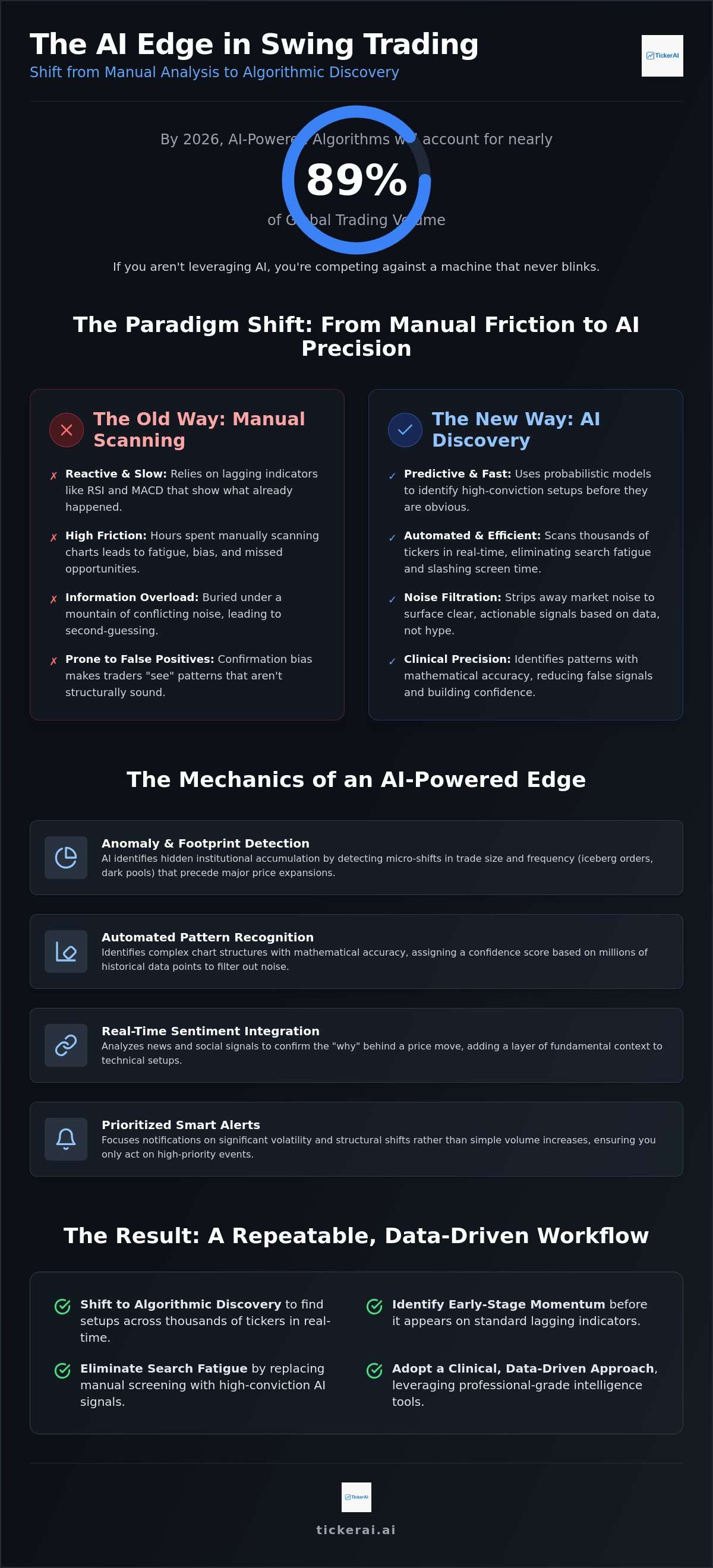
AI-powered algorithms now account for nearly 89% of global trading volume in 2026. If you aren't leveraging AI for swing trading, you're competing against a machine that never blinks. Most traders still spend hours manually scanning charts, only to miss the move or second-guess a clear technical setup. It's a high-friction approach that leads to information overload and exhausted decision-making. You know the frustration of staring at a screen for half a day, only to realize your best idea was buried under a mountain of conflicting noise.
This guide changes that dynamic. We’ll show you how to master the mechanics of algorithmic discovery to find high-probability setups without the search fatigue. You’ll gain a repeatable, automated workflow that builds confidence in your entry points and slashes your screen time. We’ll explore how to filter market noise, prioritize high-speed intelligence, and turn your trading process into a streamlined, professional operation.
Key Takeaways
- Shift from manual scanning to algorithmic discovery. Use machine learning to detect technical and fundamental anomalies across thousands of tickers in real-time.
- Identify early-stage momentum breakouts and hidden institutional accumulation before they register on standard lagging indicators like RSI or MACD.
- Eliminate search fatigue by replacing binary "if/then" screeners with probabilistic AI for swing trading to prioritize high-conviction setups.
- Establish a repeatable, automated workflow. Define your specific edge and configure smart watchlists to filter for your precise criteria without constant monitoring.
- Adopt a clinical, data-driven approach to the markets. Leverage high-speed intelligence tools designed for professional precision rather than retail hype.
What is AI for Swing Trading? Defining Algorithmic Discovery
AI for swing trading isn't about handing your keys to a robot and hoping for the best. It's the application of machine learning to solve the most significant hurdle in the modern market: information density. In 2026, the professional edge has shifted from simple stock picking to advanced search optimization—a methodology also used by AI-driven performance agencies like RANE Digital to maximize visibility. The goal is no longer just finding a stock that might go up; it's about filtering thousands of tickers in seconds to identify specific technical and fundamental anomalies that suggest a high-probability move is imminent.
We distinguish between automated execution and automated discovery. While many platforms focus on "AI Robots" that trade for you, TickerAI prioritizes the discovery phase. This approach aligns with Algorithmic trading principles but keeps the trader in the driver's seat. It's about using technology to surface high-conviction momentum breakouts while stripping away the market noise that leads to emotional second-guessing. You get the clinical precision of a machine with the strategic oversight of a human.
The Shift from Manual Scanning to AI Discovery
Manual chart reading is inherently limited. Human traders suffer from fatigue, cognitive bias, and a physical inability to monitor more than a handful of setups at once. You might catch a breakout on one ticker while missing a much stronger move on another simply because you weren't looking at the right screen. AI removes these constraints. It processes multi-dimensional data, including price action, volume clusters, and real-time sentiment, simultaneously across the entire market. Professional traders are rapidly adopting these hybrid workflows because they allow for greater scale without a proportional increase in stress or screen time.
Key Components of a Modern AI Trading Tool
Effective AI for swing trading requires a sophisticated infrastructure. It isn't enough to just scan for price; the tool must understand context. Modern systems utilize pattern recognition engines that identify "fractal" setups, which are movements that mirror historical high-alpha events. Key components include:
- Real-time scanning: Constant monitoring of the tape for institutional accumulation patterns.
- Sentiment integration: Analyzing news and social signals to confirm the "why" behind a price move.
- Smart Alerts: Notifications that prioritize volatility and structural shifts over simple volume increases.
By focusing on these elements, traders can transition from reactive searching to proactive execution. The machine finds the signal; you trade the setup. This clinical approach ensures that your energy is spent on risk management rather than the exhausting hunt for opportunities.
The Mechanics of AI-Powered Technical Analysis
Standard indicators like RSI or MACD are reactive. They describe what happened, not what is likely to occur. AI for swing trading identifies momentum breakouts by analyzing non-linear relationships between price, volume, and volatility. Recent research on AI-powered trading suggests that reinforcement learning models can adapt to changing market regimes faster than any static formula. These models don't just look at a single data point; they assess the probability of a breakout based on historical success rates in similar environments. This predictive capability allows traders to position themselves before the retail crowd sees the signal.
A critical component of this process is AI-powered stock anomaly detection. This technology identifies hidden institutional accumulation. Large players often hide their entries through iceberg orders or dark pool activity. AI detects the micro-shifts in trade size and frequency that precede a major price expansion. Instead of waiting for a moving average crossover, you're alerted when the "footprint" of big money becomes visible. This is discovery at a level manual scanning cannot reach.
Automated Pattern Recognition
AI brings clinical precision to chart analysis. It identifies complex structures like cup and handle or head and shoulders patterns with mathematical accuracy. Humans often see what they want to see due to confirmation bias. AI doesn't. It measures the depth, duration, and volume profile of a pattern against millions of historical data points to assign a confidence score. By evaluating structural integrity through multi-dimensional geometry, AI filters out noise and drastically reduces false positives in pattern recognition. Professional traders use these scores to prioritize their capital on only the highest-conviction setups.
Quantifying Market Sentiment and Catalysts
Technicals don't exist in a vacuum. Swing trades often require a fundamental catalyst to sustain a move. Natural language processing (NLP) models scan news feeds, social media, and AI for quantitative stock analysis of SEC filings to validate technical setups. If a stock is flagging near a multi-year high, the AI checks for bullish sentiment shifts or specific keyword clusters in recent 10-K or 8-K reports. This ensures the technical breakout is supported by an underlying narrative.
This synergy creates a high-conviction environment. You aren't just trading a line on a chart; you're trading a data-backed anomaly. For those looking to streamline this discovery process, TickerAI Pro provides these clinical setups in a modular, actionable format. The result is a workflow where the machine handles the heavy lifting of validation, leaving you to focus on risk-to-reward ratios and execution.
AI Discovery vs. Traditional Screeners: Choosing Your Edge
Traditional screeners operate on rigid "if/then" logic. If a stock crosses a moving average, it appears on the list. This binary approach often produces hundreds of results, leading to the search fatigue problem. In a professional environment, receiving 500 results is as counterproductive as receiving zero. You're still forced to manually scan each chart to find the actual edge. AI for swing trading solves this by moving from static filtering to probabilistic discovery. It doesn't just find stocks that meet a criteria; it ranks them based on historical win rates and current market volatility.
The distinction lies in the quality of the output. A legacy screener provides a raw list. AI provides a prioritized watchlist. By weighting variables such as relative strength, volume acceleration, and institutional footprints, AI identifies which setups are statistically more likely to follow through. This clinical prioritization saves hours of manual labor and reduces the emotional drain of analysis paralysis. It's the difference between having a phone book and having a direct line to a qualified lead.
Static Filters vs. Dynamic Intelligence
Fixed filters like a price-to-earnings ratio fail in fast-moving swing environments. They are too slow to capture thematic rotations or sudden sentiment shifts. AI recognizes thematic opportunities, such as a cluster of stocks in a specific sub-sector breaking out simultaneously. The methodology used in a modern swing trade setup finder involves dynamic intelligence that adapts to the current market regime. It understands that a high-conviction setup in a bull market looks different than one in a volatile sideways range.
Scalability: Scanning the Global Market in Milliseconds
Small-cap discovery often happens in the corners of the market where the crowd hasn't arrived yet. AI enables traders to scan the global market in milliseconds, identifying international market gaps and pre-market anomalies. This 24/7 scanning capability ensures you never miss a gap-up or a late-day reversal. By automating the filtering process, you can scale your strategy across multiple asset classes without increasing your workload. Professional discovery tools represent a strategic investment. Free charting software provides the canvas, but AI provides the map.
Building a Repeatable Swing Trading Workflow with AI
A professional workflow turns chaotic market data into a structured execution plan. AI for swing trading is most effective when it follows a rigorous, five-step sequence. This process removes the search fatigue and emotional friction that plague manual traders. By automating the discovery and validation phases, you can focus entirely on risk-to-reward ratios and capital allocation.
- Step 1: Define Your Edge. Determine if your strategy centers on momentum, mean reversion, or catalyst-based trading. AI is a multiplier, not a replacement for a core thesis.
- Step 2: Configure Smart Watchlists. Set up real-time alerts that filter for your specific criteria. These lists should update dynamically as market conditions shift.
- Step 3: Clinical Validation. Use AI-generated data points to verify the technical setup. Check for the institutional footprints and volume anomalies discussed earlier.
- Step 4: Risk Management. Set stop-losses and profit targets based on AI-calculated volatility metrics. Use ATR-based stops or standard deviation levels to ensure your exit points are statistically sound.
- Step 5: Execution and Review. Log every trade. Journal the accuracy of the AI signals to refine your filters for future market regimes.
Configuring Your AI Discovery Engine
Success starts with your discovery parameters. Smart Watchlists are the foundation of a modern workflow. They don't just track price; they monitor the health of a trend in real-time. You should prioritize action-oriented alerts that require immediate attention over generic price updates. Over-filtering is the #1 mistake in AI discovery because it creates a sterile environment where high-probability outliers are accidentally discarded. Keep your initial scan broad enough to capture the outliers, then use clinical validation to narrow the field.
From Discovery to Execution
Transitioning from a signal to a position requires a zero-emotion approach. Use AI-driven statistics to justify your position sizing. If the machine identifies a setup with a high historical win rate and low current volatility, you may choose to increase your exposure. Integrating these signals into your existing brokerage platform ensures that you act on the data without hesitation. To begin building your automated workflow, access TickerAI's Smart Watchlist and Alerts to see these steps in action. This systematic approach ensures that every trade is backed by data, not just a feeling about a chart.
Consistency is the byproduct of a repeatable process. When you use AI for swing trading, you're building a feedback loop that improves with every market cycle. The machine handles the tireless scanning; you provide the strategic oversight. This partnership allows for a scalable trading operation that doesn't require 12 hours of screen time per day.
TickerAI: Precision Discovery for Professional Swing Traders
TickerAI isn't a signal service built on social media hype. It's a high-speed intelligence partner designed for clinical precision. While other platforms promise automated riches through "bots," TickerAI focuses on the discovery phase. This ensures that you find high-probability swing trade setups without the exhaustion of manual scanning. It's about providing the raw, data-driven intelligence required to execute with confidence. Every alert is a product of algorithmic verification. No noise. No fluff. Just actionable data.
The platform offers two primary tiers to match your trading intensity. The TickerAI Pro Subscription is built for the active participant who requires constant market monitoring. It provides the essential tools for daily discovery and real-time alerts. For those seeking the highest level of market coverage, the TickerAI Full‑Access Subscription unlocks the complete suite of Smart Watchlist & Alerts and institutional-grade discovery engines. Both tiers prioritize speed and accuracy, ensuring you're never late to a momentum shift.
Institutional-Grade Tools for the Individual Trader
Professional swing traders require transparency. TickerAI delivers curated setups generated by machine learning models that analyze thousands of data points simultaneously. You get the "why" behind every alert. We don't offer personal financial advisory or custom coaching. Our focus remains on pure market intelligence. This ensures that the data stays objective and the discovery process remains clinical. You receive institutional-grade AI for swing trading that was once reserved for hedge fund desks. By accessing these curated setups, you bypass the learning curve of building your own algorithms while maintaining full control over your execution.
Securing Your 2026 Trading Edge
The primary ROI of TickerAI is time. Manual chart scanning is a low-leverage activity. If you spend four hours a day looking for setups, you're losing 20 hours a week of strategic decision-making time. TickerAI reduces that scanning time to minutes. It acts as a proactive scout, filtering the noise to present only the most relevant opportunities. This allows you to focus on position sizing and risk management rather than the hunt.
Joining TickerAI connects you with a community of data-driven, proactive traders who value efficiency over speculation. You aren't just buying a tool; you're adopting a professional workflow. The market moves fast. Your discovery process must move faster. Stop guessing and start discovering with algorithmic precision.
Discover your next swing trade setup with TickerAI
Optimize Your Strategy for the 2026 Market
The transition from manual chart scanning to algorithmic discovery is no longer a luxury; it's a professional requirement. By integrating AI for swing trading into your daily workflow, you replace search fatigue with clinical precision. We've explored how probabilistic discovery identifies institutional footprints and momentum anomalies before they become obvious to the retail crowd. You now have the framework to build a repeatable, data-driven process that prioritizes your time and capital over exhaustive manual labor.
Professional success in 2026 depends entirely on the quality of your market intelligence. Stop fighting information overload and start leveraging a high-speed partner that filters the noise on your behalf. Secure your competitive edge with institutional-grade anomaly detection, real-time AI-driven stock alerts, and curated swing trade setups designed for immediate execution. This clinical approach ensures you focus on decision-making rather than the hunt.
Start your AI-driven discovery with TickerAI Full-Access
The market doesn't wait for manual analysis to catch up. Take the proactive step today to streamline your discovery engine and trade with calculated, data-backed confidence.
Frequently Asked Questions
Is AI for swing trading suitable for beginners?
AI for swing trading is highly suitable for beginners who possess a baseline understanding of market mechanics. It eliminates the steep learning curve associated with manual chart scanning by surfacing verified setups automatically. While the technology handles the discovery, beginners must still apply their own risk management and position-sizing rules to the intelligence provided.
How does AI detect momentum breakouts before they happen?
AI detects momentum by identifying non-linear anomalies in volume and price action. Unlike traditional indicators that lag the market, machine learning models analyze institutional footprints and order flow clusters in real-time. This allows the system to recognize the structural setup before the price expansion occurs, providing a high degree of statistical probability.
Can TickerAI integrate with my existing brokerage?
TickerAI is a discovery and intelligence platform rather than a brokerage execution service. You receive high-conviction alerts and curated setups through the platform, which you then execute on your preferred brokerage. This separation ensures the intelligence remains objective and focused entirely on finding market alpha without conflict of interest.
What is the difference between an AI trading bot and an AI discovery tool?
An AI trading bot handles automated execution—for instance, unCoded allows those who prefer self-hosted, non-custodial solutions to explore Profit-Sharing Licensing—while an AI discovery tool focuses on identifying opportunities. TickerAI is an intelligence partner that filters the market to find high-probability setups. This distinction is critical for professionals who want to maintain strategic control over their capital while using technology to handle the heavy lifting of scanning.
How reliable are AI stock predictions in a volatile market?
Reliability in volatile markets is often higher with AI because it adapts to changing regimes in real-time. Manual strategies frequently fail when market conditions shift suddenly. AI models use dynamic intelligence to recognize these structural changes, prioritizing setups that align with the current volatility profile rather than relying on static historical averages.
Do I need to know how to code to use AI for swing trading?
No coding knowledge is required to use modern AI trading tools. TickerAI provides a streamlined interface with Smart Watchlists and real-time alerts ready for immediate use. The platform handles the complex algorithmic processing in the background, allowing you to focus on strategic decision-making and execution instead of syntax.
How much time does an AI tool actually save a swing trader?
AI tools typically save professional traders 15 to 20 hours per week. By automating the scanning of thousands of tickers across global markets, the tool eliminates the need for manual chart flipping. This massive reduction in search fatigue allows you to reallocate your time toward high-leverage activities like risk assessment and portfolio optimization.
Is paying for a stock alert subscription worth it in 2026?
A subscription is a strategic investment in 2026. Given that nearly 89% of global trading volume is now algorithmic, manual traders are at a severe speed disadvantage. Subscribing to AI for swing trading ensures you are alerted to high-conviction setups as they form, providing the necessary edge to compete in a high-speed environment.


