

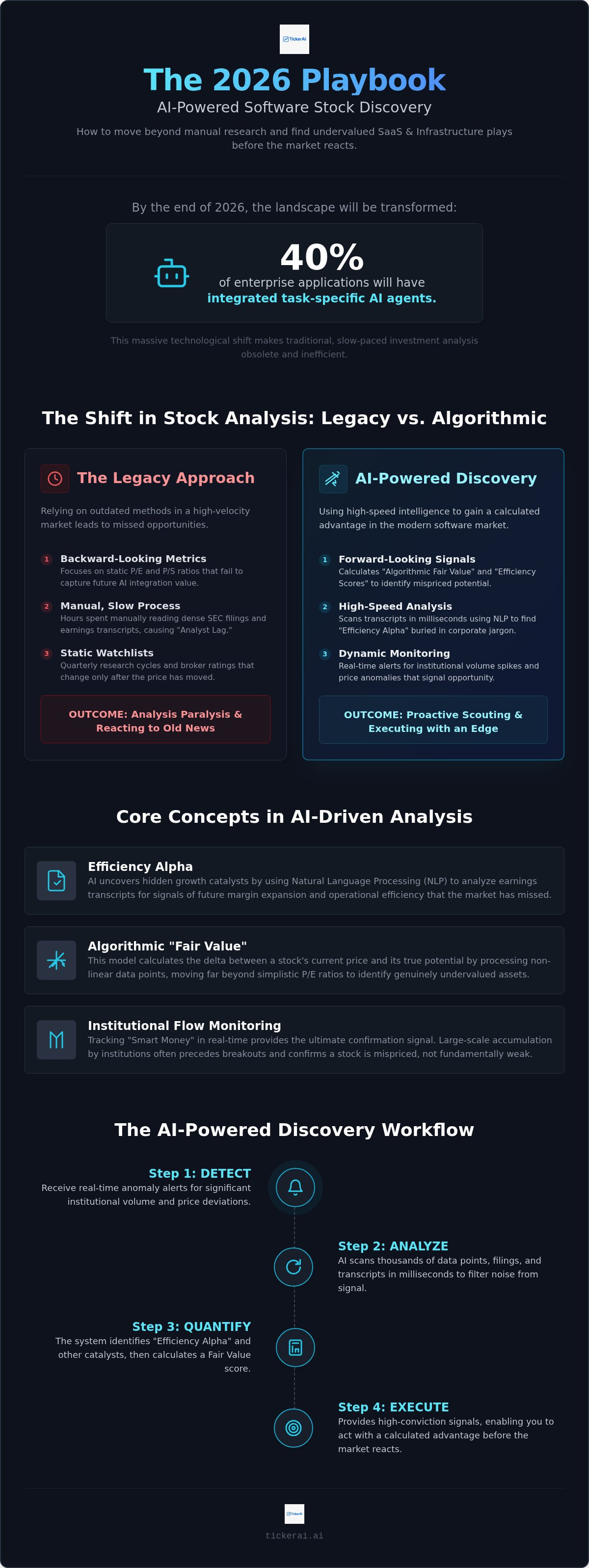
By the end of 2026, 40% of enterprise applications will have integrated task-specific AI agents. Despite this massive shift, the average retail investor is still distracted by the 24/7 tech news cycle. You've likely felt the frustration of missing a high-velocity software breakout because you couldn't distinguish between empty AI hype and genuine SaaS value. It's a common pain point in a market that moves faster than human analysis can track.
This guide changes that. You'll discover how to utilize specialized AI to find undervalued software stocks by filtering through market noise and quantifying hidden growth catalysts. We're moving beyond trailing multiples to focus on algorithmic detection of efficiency anomalies. You'll learn a repeatable workflow for tech discovery that identifies mispriced infrastructure plays before the broader market reacts. We will also examine how to monitor institutional money flow in real-time. This isn't about chasing the crowd; it's about using high-speed intelligence to secure a calculated advantage. Let's look at the mechanics of algorithmic discovery.
Key Takeaways
- Understand why traditional P/E ratios fail to capture value in 2026 and how algorithmic "Fair Value" identifies the delta between price and potential.
- Leverage advanced AI to find undervalued software stocks by using Natural Language Processing to extract "Efficiency Alpha" from complex earnings transcripts.
- Transition from the standard Rule of 40 to AI-detected Efficiency Scores to pinpoint hidden growth within the SaaS and infrastructure sectors.
- Establish a high-speed discovery workflow that utilizes real-time anomaly alerts for institutional volume and price deviations.
- Use TickerAI Pro to automate your software scouting and filter through market noise with clinical precision.
The Software Sector in 2026: Why Manual Research Fails to Spot Value
Software valuations in 2026 shift in seconds. Manual research can't keep pace with the high-velocity repricing common in the SaaS sector. Traditional screens focusing on P/E or P/S ratios often miss the massive "Platform Shift" value generated when a company moves to an AI-first architecture. These backward-looking metrics fail to account for the rapid integration of task-specific AI agents. By the time a human analyst identifies a trend, the entry point has often closed.
To stay ahead, professionals use AI to find undervalued software stocks before the broader market catches on. Relying on static data leads to analysis paralysis. There are thousands of SaaS tickers, each generating a constant stream of signals. Sifting through them manually is an exercise in futility. You need forward-looking signals that quantify hidden growth catalysts in real-time. It's about detecting the delta between market perception and algorithmic reality.
The Information Overload Challenge
The sheer volume of data in the tech sector is staggering. Every day, hundreds of SEC filings and earnings transcripts are released. Market noise frequently obscures genuine software value plays. If you miss a breakout by just 48 hours, you're often buying at the top of a momentum spike. Manual reading of transcripts takes hours. AI scans them in milliseconds to find "Efficiency Alpha" buried in technical jargon. This efficiency allows you to filter out the hype and focus on companies with actual infrastructure advantages.
Why Static Lists are Obsolete
Quarterly research cycles are a relic of the past. The "Analyst Lag" problem is real. Brokerage ratings often change only after the price action has already occurred. Software volatility requires a dynamic approach. Static watchlists don't account for intraday institutional accumulation or sudden sentiment shifts. Waiting for a 4-star rating to confirm a trade usually means you've missed the meat of the move. You need a system that updates as fast as the ticker tape.
Transitioning to automated stock market analysis allows you to scale your intelligence. Instead of waiting for a quarterly report, you receive alerts based on live algorithmic scanning. This proactive scouting identifies anomalies that manual screens simply cannot detect. Speed isn't just an advantage; it's a requirement for survival in the 2026 software market. It's the difference between reacting to news and executing on a setup before the news even hits the wire. Use AI to find undervalued software stocks by focusing on real-time data flow rather than stagnant spreadsheets.
Beyond P/E Ratios: How AI Quantifies 'Undervalued' in SaaS
AI-driven undervaluation isn't a simple low P/E score. It's the calculated delta between an algorithmic "Fair Value" and the current market price. Traditional metrics fail in SaaS because they ignore the velocity of revenue recognition and RPO (Remaining Performance Obligations). Advanced models use AI to find undervalued software stocks by processing non-linear data points that human screens overlook. This includes identifying when the market has overreacted to temporary churn spikes or misunderstood a platform shift. It creates a clinical view of a company’s trajectory based on data, not sentiment.
NLP and Sentiment Analysis in Tech
Natural Language Processing (NLP) provides a lens into "Efficiency Alpha." Algorithms scan earnings transcripts for specific product-led growth (PLG) catalysts that suggest future margin expansion. These tools quantify management confidence against market skepticism with high precision. By analyzing linguistic patterns in 10-K filings, NLP detects subtle sentiment shifts that signal a pivot long before it reflects in the balance sheet. It looks for the specific language of "agentic AI" adoption and infrastructure scaling. This process filters through the noise to find high-conviction signals in a sea of corporate jargon. It effectively prioritizes actionable data over PR fluff.
Institutional Flow as a Value Signal
Tracking "Smart Money" is critical for identifying value floors in mid-cap software. Large-scale accumulation in cybersecurity and cloud stocks often precedes a massive breakout. Institutional footprints are the ultimate confirmation that a stock is genuinely mispriced rather than just falling. TickerAI monitors these movements in real-time, providing AI-powered discovery for swing trades and long-term setups. This visibility into block trades and dark pool activity removes the guesswork from bottom-fishing. When institutions buy aggressively into a declining price, it signals a high-conviction floor. You want to follow the money, not the headlines.
Anomaly detection plays a vital role in spotting oversold conditions. When a software ticker deviates significantly from its historical correlation with the broader sector, it creates an opportunity. AI detects these deviations instantly. It separates broad market panic from company-specific weakness. This allows you to capitalize on temporary liquidity vacuums where high-quality SaaS assets are sold indiscriminately. It's about finding the "Efficiency Score" that the market hasn't priced in yet. These anomalies often present the most profitable entry points on high-velocity software breakouts. You identify the mispricing. You execute. You ignore the noise.
Key Metrics for AI-Driven Software Discovery
The traditional Rule of 40 is no longer sufficient for high-conviction tech investing. In 2026, software investors require a more granular "Efficiency Score" detected by algorithmic models. This score doesn't just look at growth and margins. It evaluates how effectively a company utilizes its compute resources and AI infrastructure to drive top-line revenue. Professionals use AI to find undervalued software stocks by identifying companies where this efficiency is trending upward before it hits the quarterly reports. Trailing metrics are historical artifacts. AI-projected forward growth is the real currency of the current market.
Net Retention Rate (NRR) remains a core pillar, but the focus has shifted toward NRR anomalies. An AI model might flag a company with a temporarily low NRR if the Remaining Performance Obligations (RPO) are surging. RPO acts as a predictive value indicator, representing contracted revenue that hasn't been recognized yet. When RPO grows significantly faster than current revenue, it suggests a massive growth catalyst is waiting in the wings. AI identifies these discrepancies, spotting "hidden" growth that manual screens miss. This data-driven approach removes the guesswork from SaaS valuation and provides a clinical look at future performance.
Efficiency Metrics for the AI Era
Headcount is no longer the primary driver of software scaling. Algorithmic discovery now prioritizes revenue per employee anomalies. If a company's revenue increases while its headcount remains flat or decreases, it's a clear signal of successful AI agent integration. You must distinguish between "AI Hype" and actual "AI Revenue." Hype is found in press releases. Revenue is found in the expansion of core SaaS features that customers actually pay for. AI filters through marketing fluff to find companies successfully integrating generative features into their core product architecture. This process identifies the true winners of the platform shift.
The 2026 Software Valuation Framework
Traditional SaaS multiples often fail to account for the pivot toward AI-first engineering. Companies stuck in the legacy "seat-based" licensing model are frequently overvalued, while those adopting usage-based AI models are often mispriced. Small-cap software presents the highest AI-detected alpha. These smaller tickers often have the agility to pivot faster than legacy giants but lack the analyst coverage to correct their price quickly. Using an AI stock discovery platform allows you to identify these valuation gaps in real-time. It's a clinical method for using AI to find undervalued software stocks within the mid and small-cap sectors. You aren't just looking for cheap stocks. You're looking for efficiency leaders that the market hasn't recognized yet.
Building a Real-Time Discovery Workflow: From Anomaly to Execution
Static lists are obsolete. Success in 2026 requires a repeatable, systematic workflow. You must use AI to find undervalued software stocks by moving beyond manual screening into a high-speed discovery loop. This process begins with technical configuration and ends with emotionless execution. It transforms raw data into actionable intelligence without the cognitive lag of human analysis.
- Step 1: Configure AI filters specifically for the Software and IT Services sectors to narrow the universe to high-growth targets.
- Step 2: Establish "Anomaly Alerts" for volume and price deviations. These signals often precede major institutional accumulation.
- Step 3: Utilize Smart Watchlists to categorize candidates by theme, such as Cybersecurity or AI Infrastructure.
- Step 4: Verify technical setups using automated chart pattern recognition to ensure the price action supports the fundamental value signal.
- Step 5: Execute based on a pre-defined, rule-based system. This eliminates the emotional bias that leads to hesitation during high-velocity software breakouts.
Setting Up Smart Watchlists
Organization is the key to managing information overload. Categorize your discoveries into specific buckets like Vertical SaaS, DevOps, or Cloud Infrastructure. This allows you to monitor thematic rotation within the broader tech market. When capital flows from infrastructure to applications, your watchlists will flag the shift instantly. Utilizing TickerAI Full-Access enables you to manage these multiple discovery themes simultaneously. It acts as a tireless scout, ensuring you don't miss a sector rotation while focusing on individual tickers.
Interpreting AI Stock Signals
Not all signals are created equal. You must distinguish between a "Value Signal," which highlights a fundamental mispricing, and a "Momentum Signal," which indicates price velocity. A value signal tells you what is cheap; a momentum signal tells you when it's moving. TickerAI alerts help you catch the start of a trend by identifying the precise moment an anomaly turns into an actionable setup. For a deeper dive into the mechanics, read the professional guide on how to interpret AI stock signals.
A clinical workflow removes the guesswork from a chaotic market. Start your discovery process today by accessing AI-powered discovery for swing trades and long-term software investments. Focus on the data. Execute with precision. Ignore the noise.
TickerAI: Automating Software Stock Opportunity Discovery
TickerAI functions as a tireless scout in a market that never sleeps. Our algorithms are specifically engineered to detect software mispricing by scanning thousands of data points across the SaaS landscape. By identifying the delta between algorithmic "Fair Value" and current market price, the platform allows you to use AI to find undervalued software stocks with institutional precision. This removes the subjective bias and emotional hesitation that often paralyze retail investors during high-velocity moves. You aren't just guessing on a dip; you're executing on a calculated anomaly detected by clinical logic.
The TickerAI Pro subscription is built for this level of intensity. It provides high-frequency alerts that capture software anomalies as they occur, ensuring you have the data before the "Analyst Lag" discussed earlier takes effect. This is the institutional-grade tool for the modern retail investor. It levels the playing field by providing the same algorithmic depth once reserved for high-frequency hedge funds. You focus on the final decision. TickerAI handles the exhaustive search.
Actionable Swing Trade Setups
Detecting a breakout before the crowd requires a synthesis of fundamental value and technical momentum. TickerAI identifies the "Golden Cross" where a stock’s Efficiency Score aligns with a positive price deviation. In 2026, our models have flagged multiple software breakouts where AI-detected RPO surges preceded significant price moves within 48 hours. TickerAI focuses on automated discovery and technical detection rather than providing personal financial advisory. It delivers the raw, high-speed intelligence you need to execute high-conviction setups with confidence. You see the footprint of institutional accumulation before it becomes a headline.
The TickerAI Edge in 2026
Automated market scanning is no longer optional. It's the only way to remain competitive in a sector where 40% of enterprise applications are already AI-augmented. Manual research is a liability in this environment. There is a powerful synergy between our long-term investment ideas and short-term swing trade setups. You can maintain a core portfolio of high-efficiency SaaS while capitalizing on tactical mispricing opportunities identified by our "Anomaly Alerts."
TickerAI acts as a sophisticated filter for a chaotic environment. It prioritizes the most impactful data, allowing you to focus on execution rather than data entry. This is "innovative pragmatism" in action. It values technology for the specific, tangible advantages it provides in terms of time-saving and clarity. Stop chasing the news cycle and start leading the tape with a high-speed intelligence partner. Start discovering undervalued software stocks with TickerAI and secure your algorithmic alpha today.
Securing Your Algorithmic Edge in the Software Market
The software sector's velocity in 2026 demands a departure from manual screening. You've seen how traditional P/E ratios fail to capture the value of AI-first platform shifts. High-speed discovery now requires analyzing non-linear signals like RPO surges and NLP-detected sentiment shifts. By leveraging AI to find undervalued software stocks, you transition from a reactive observer to a proactive participant. This systematic approach filters out market noise and prioritizes hidden growth catalysts before they become consensus.
TickerAI serves as your proactive market scout. It delivers real-time algorithmic scanning to pinpoint actionable setups while the rest of the market is still reading yesterday's news. We focus on providing a systematic, data-driven alpha that removes human bias from your workflow. High-velocity software breakouts wait for no one. Join TickerAI to Discover Undervalued Software Stocks Today. The future of tech discovery is automated. Position yourself ahead of the curve and execute with clinical precision.
Frequently Asked Questions
How does AI determine if a software stock is undervalued?
AI calculates the delta between the current market price and an algorithmic "Fair Value" derived from non-linear datasets. It processes variables like revenue recognition velocity, Remaining Performance Obligations (RPO), and compute resource efficiency. By using AI to find undervalued software stocks, you bypass the limitations of static P/E ratios. The system identifies when the market misinterprets temporary churn or infrastructure costs, revealing a clinical view of the company’s true trajectory.
Can AI find undervalued small-cap software stocks before they trend?
AI identifies small-cap opportunities by detecting subtle shifts in fundamental data and dark pool activity before they hit mainstream headlines. These smaller companies often lack extensive analyst coverage, creating significant valuation gaps. Algorithmic scanning flags anomalies in volume and price action that suggest early accumulation. This allows you to secure entry points on high-growth SaaS plays before the broader market recognizes the breakout potential and price moves higher.
Is AI stock discovery better than manual fundamental analysis for tech?
AI discovery is superior for the tech sector due to the sheer velocity of data and repricing. Manual analysis cannot process thousands of SEC filings and earnings transcripts in real-time. Algorithms remove human bias and the cognitive lag associated with traditional research cycles. While fundamental analysis provides a snapshot, AI offers a dynamic, continuous stream of intelligence that matches the 24/7 nature of the 2026 software market. It's about speed and scale.
What are the best AI metrics for evaluating SaaS companies in 2026?
The most effective metrics include AI-detected Efficiency Scores, revenue per employee anomalies, and RPO growth rates. Traditional metrics like the Rule of 40 are now augmented with data on how effectively a company integrates task-specific AI agents. You should also monitor Net Retention Rate (NRR) anomalies. These indicators provide a more accurate forecast of margin expansion than trailing earnings, helping you use AI to find undervalued software stocks with higher precision.
How often does TickerAI update its software stock alerts?
TickerAI updates its software alerts in real-time to match the high-speed nature of the industry. The platform continuously scans market movements and data releases, providing instant notifications for "Anomaly Alerts" and swing trade setups. This ensures you receive actionable intelligence the moment a mispricing is detected. Unlike quarterly analyst reports, these alerts provide a dynamic view of the market, allowing for precise execution during high-velocity price deviations and sudden sentiment shifts.
Do I need technical trading knowledge to use an AI stock finder?
You don't need to be a professional quantitative analyst, but a baseline understanding of market mechanics is helpful. The platform is designed to be practically accessible while maintaining technologically advanced capabilities. It filters and prioritizes complex data into clear, actionable signals. TickerAI acts as a high-tech assistant, handling the exhaustive scanning and detection so you can focus on the final decision-making. It's a tool for serious participants who value efficiency.
What is the difference between a value trap and an undervalued software stock?
A value trap appears cheap based on trailing multiples but lacks growth catalysts or faces structural decline. An undervalued software stock has a significant delta between its price and its algorithmic "Fair Value" due to temporary market noise. AI distinguishes between the two by quantifying "Efficiency Alpha" and forward-looking growth indicators like surging RPO. It separates broad market panic from company-specific weakness, ensuring you avoid stagnant assets and focus on quality.
How does TickerAI track institutional buying in the software sector?
TickerAI monitors institutional footprints by analyzing block trades, dark pool activity, and significant volume deviations. These movements often signal a high-conviction value floor before a major breakout occurs. The platform tracks "Smart Money" accumulation in sectors like cybersecurity and cloud infrastructure in real-time. This visibility allows retail investors to follow institutional money flow, providing a calculated advantage and confirming that a stock is genuinely mispriced rather than just declining in value.


