
The most capable AI investing tools aren’t automatically the right fit; the best choice depends on what you need help doing. AI can summarise investment reports, scan sources faster, and help analyse historical data for potential risks. Treat its output as a starting point for research, not a final investment decision.
It’s easy to assume one tool can handle stock research, portfolio decisions, and risk management equally well. In practice, AI investing tools vary in what they analyse and how their outputs fit your process. This guide compares options by investing goal, explains where AI can help and where its limits matter, and shows how to match a tool to your research needs and risk tolerance.
Key Takeaways
- Match a tool to the task you need help with, such as screening stocks, monitoring a watchlist, or reviewing portfolio risk.
- Use AI summaries and stock signals to focus your research, then examine the reasoning and source information behind them.
- Compare how each option handles diversification and risk instead of relying on a single score or signal.
- Check AI-generated information against trusted sources, especially when it may be outdated or lacks real-time market data.
- Choose tools that support your investing goals and decision process, while keeping your own judgment in control.
AI-supported stock research and selection
AI can summarize reports, scan information sources, and organize stock signals for further review. Use its output to guide your research, not replace it.
There is no single best AI research tool for every U.S. investor in 2026. Choose by research coverage, explanation quality, data freshness, and whether you need analysis, portfolio automation, or brokerage features.
AI Investment Research Tools
An AI research tool can summarize company reports, compare fundamentals, and surface stocks for closer analysis. Unlike a robo-advisor, it may focus on research rather than portfolio allocation; unlike a traditional broker, it may prioritize automated screening over account execution. Examine how each tool generates scores, what information it analyses, and whether its explanations point to evidence you can assess.
For fundamental research, ask the tool to extract revenue trends, business risks, and management commentary from a filing. Then compare those points with the original document. AI can speed up that first pass, but a summary is a research aid, not a complete investment thesis.
AI Tools, Robo-Advisors, and Brokers
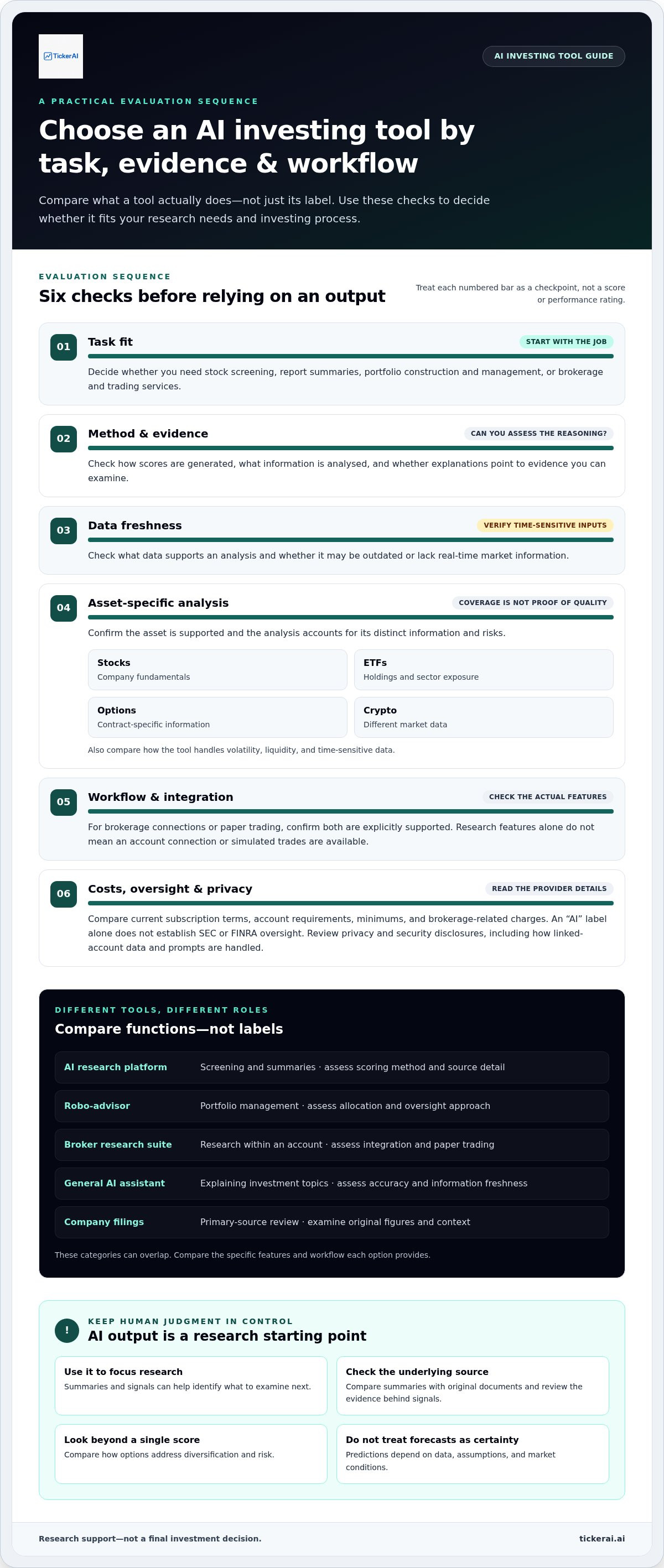
AI investing tools can screen securities or summarize documents. Robo-advisors generally focus on portfolio construction and ongoing management, while traditional brokers provide account and trading services alongside research features. These categories can overlap, so compare actual functions rather than labels.
For brokerage connections and paper trading, review the platform’s feature list for both capabilities before linking an account. A research function alone doesn’t mean a tool connects to a U.S. brokerage or supports simulated trades. Compare account integration, paper-trading access, and whether trades require a separate brokerage workflow.
Stock, ETF, Options, and Crypto Analysis
Analysis varies by tool and asset type. A stock research platform may evaluate company fundamentals, while ETF analysis may emphasize holdings and sector exposure. Options require contract-specific information, and crypto research involves different market data. Check supported assets and the data behind each analysis before relying on an output.
Broad coverage doesn’t prove analytical quality. Compare how the tool handles volatility, liquidity, time-sensitive data, and each asset type’s distinct risks. Use its results to identify questions for further research, not as a buy or sell instruction.
Criteria table: Compare each option by the task it supports, the evidence it shows, and the workflow it requires.
| Option | Primary use | What to assess | Distinctive role |
|---|---|---|---|
| AI research platform | Screening and summaries | Scoring method and source detail | Research support |
| Robo-advisor | Portfolio management | Allocation and oversight approach | Portfolio-focused |
| Broker research suite | Research within an account | Integration and paper trading | Brokerage-linked |
| General AI assistant | Explaining investment topics | Accuracy and information freshness | Flexible prompts |
| Company filings | Primary-source review | Original figures and context | Direct documentation |
Costs and minimum deposits: Tools differ in subscription terms, account requirements, and brokerage-related charges. Compare each provider’s current pricing and minimums, and distinguish research access from account or trading costs.
Regulation: An AI label alone doesn’t establish SEC or FINRA oversight. Distinguish a research feature from brokerage services or financial advice, and identify the provider and activity involved before drawing conclusions about oversight.
Beginner workflow: Start with one research question, choose a supported asset, review the AI’s method, and compare its summary with source documents. Record what would change your view before acting. To assess data protection, review the tool’s privacy and security disclosures, especially how it handles linked-account data and prompts.
Choose the option that fits your research task, data needs, and desired level of portfolio or brokerage integration.
AI investing benefits and limitations
AI investment predictions have no universal accuracy rate; recommendations depend on their data, assumptions, and market conditions. No investment tool can predict the next market crash with 100% accuracy, so use its analysis to inform decisions, not dictate action.
AI Investing Benefits
AI can process historical investment data and organize complex market information into clearer language. For example, it can help compare a company’s reported risks with price movements or flag patterns for further investigation. That speed is useful when markets produce more information than you can review manually. The benefit is faster analysis, not certainty about what comes next.
Use an AI tool to make a specific research task more efficient. Ask it to summarize a company’s recent results, list the assumptions behind a forecast, or identify which market data supports a signal. Then review the underlying information before deciding whether it matters to your strategy.
Historical analysis can also show how a strategy behaved under past conditions. A backtest, for example, may show how a set of rules responded to earlier market declines. That evidence helps you examine the strategy’s behavior, but it doesn’t establish that the same rules will perform similarly in a different market environment.
Limits of AI Market Predictions
AI forecasts use patterns and inputs to estimate possible outcomes. AI forecasts can offer estimates, but unexpected market events can make outcomes hard to anticipate. A model trained on historical data may not account for a surprise earnings announcement, a geopolitical shock, or a rapid change in investor behavior. Its result depends on the data and assumptions used; it isn’t a certain market call.
No reliable accuracy percentage applies to every prediction or portfolio recommendation. A forecast might describe a possible price direction, while a portfolio recommendation also depends on holdings, objectives, and risk exposure. Compare the recommendation’s assumptions with your own plan before acting.
Data quality matters. Some AI tools rely on outdated training information or lack real-time market data, which can produce stale or inaccurate answers. Check the timestamp and source behind a market claim. If a tool presents a current price or event without a clear data basis, don’t treat it as live market intelligence.
Claims of a sure thing or guaranteed fast returns are red flags. AI investing tools don’t guarantee success, and historical patterns can’t eliminate investment risk. Separate analysis from action: identify the signal, inspect its evidence, consider what could invalidate it, then decide whether it fits your strategy.
Use AI to sharpen research, not outsource judgment. For a focused starting point, explore AI-supported stock opportunity research and assess each signal against your own criteria.
AI-driven portfolio diversification and risk management
AI can help map portfolio exposures by grouping holdings around shared patterns, sectors, or market drivers. That view can reveal concentration hidden by a list of ticker symbols. For example, separate companies may still depend on the same industry or economic trend. Use the analysis to spot overlap, then decide whether it conflicts with your diversification plan.
Start with your holdings and the risk question you want answered. Ask the tool to group positions by sector, asset type, or sensitivity to a market factor. Review how it categorized each holding. If a company appears in the wrong group, correct the input or interpretation before acting on the summary.
Diversification involves more than counting investments. A portfolio containing several technology companies may still have substantial exposure to one sector. AI can surface patterns across holdings and help you compare them with other areas. It can’t make that exposure disappear; any portfolio change involves trade-offs that depend on your goals.
Use AI to Examine Portfolio Risk
Historical data can help AI identify risks and show how holdings behaved under past conditions. For example, an investor could compare how different positions responded during a previous market decline. That analysis describes past behavior, not future performance. Treat it as a prompt to examine assumptions, not an answer about what the portfolio will do next.
Risk signals are most useful when tied to a specific decision. Ask whether the concern is concentration, volatility, or exposure to a shared market driver. Then inspect the holdings and data behind the signal. A broad label such as “high risk” offers little direction unless the tool explains which portfolio features produced it.
Use this review sequence to make the output practical:
- List the holdings and confirm the information is current.
- Group positions by sector, asset type, or shared exposure.
- Identify concentrations and question any unexpected classification.
- Compare the findings with your objectives before changing allocations.
Your time horizon and tolerance for loss shape how portfolio risks matter. The same concentration may call for different responses from investors with different objectives. AI can organize exposures, but it can’t decide which trade-off suits you. Set your criteria first, then use the analysis to assess whether your holdings align.
Finally, separate risk detection from prediction. AI may analyse historical investment data to identify risks, but it can’t predict future investment performance. Sudden events can also push markets beyond patterns found in past data. Use the tool to prepare focused questions and review possible portfolio vulnerabilities, then make decisions in light of your full strategy.
AI transparency and human oversight
Reliable investment analysis needs traceable inputs, clear reasoning, and human review before action. Treat each AI output as a claim to inspect, whether it concerns earnings, valuation, or portfolio exposure.
Start by asking what information produced the result. If a tool flags a company after its earnings report, identify the figures and statements behind the signal. Separate reported facts from the model’s interpretation. A useful explanation links its conclusion to evidence, such as lower revenue, changing costs, or revised guidance, rather than offering an unexplained score.
The UK Financial Conduct Authority publishes investor guidance on AI research, warns about hallucinations, and advises checking answers against trusted sources. Apply that discipline to generated summaries: compare a claim about earnings with the original company report or investor communication. If the source doesn’t support the summary, discard the claim and reassess the analysis.
Transparency also means understanding the model’s method. A stock score might combine price movement, financial metrics, and news sentiment, inputs that can differ in timing and reliability. Before using the score, learn what it measures, which inputs influence it, and whether the tool distinguishes current market data from older material. An opaque score offers little basis for a sound decision.
Keep human oversight active at every decision point. AI can organize information, but you set the objective and weigh the trade-offs. For example, if a model identifies a company as attractive while its latest filing shows a risk you consider material, investigate the conflict instead of following the ranking automatically. The disagreement is a prompt for deeper research.
Use a repeatable review process for every material recommendation:
- Identify the claim. Write down what the tool says, such as “earnings growth is accelerating.”
- Trace the evidence. Find the relevant company report, market data, or other cited input.
- Test the context. Check whether the analysis reflects the period and business factors you care about.
- Decide independently. Compare the evidence with your investment plan before taking action.
Reviewing results can improve how you use AI. Record which claims held up, which relied on outdated information, and which missed important context. Over time, that log can help you spot recurring errors, refine prompts, and distinguish useful analysis from confident but unsupported language. Keep your final decision tied to evidence and your strategy, not the model’s tone.
Choosing tools based on investing goals
Start with the decision you need help with, not the tool’s AI label. A long-term investor reviewing company fundamentals needs different functions from an active trader scanning short-term setups. Define the task first, then compare data coverage, explanation quality, and how the output fits your existing process.
For long-term research, prioritize tools that organize company information around business performance, earnings, and material risks. A useful output helps you frame questions about revenue drivers or changing costs and trace conclusions to sources. If your main goal is maintaining a portfolio, focus instead on holdings, asset allocation, and sector exposure.
An active investor may value screening speed and alerts that surface price or news activity. This workflow differs from portfolio planning: it prioritizes timely signals, while long-term analysis emphasizes business context. Choose based on the decisions you actually make. A tool that generates frequent signals adds noise if you review investments only during scheduled portfolio checks.
Let risk tolerance shape your selection criteria, not just your final allocation. If a sharp decline would disrupt your plan, prioritize tools that make concentration and volatility easier to review. If you can tolerate larger short-term swings, focus on whether the research supports your strategy. In either case, choose a tool that explains its inputs rather than hiding them behind a single score.
Use this decision guide to compare options:
- Set the goal. Choose stock discovery, long-term research, portfolio review, or active monitoring.
- Specify the output. Decide whether you need summaries, screens, alerts, or exposure analysis.
- Assess evidence. Look for traceable sources, clear methods, and relevant data freshness.
- Fit the workflow. Check whether the tool supports your review habits without adding unnecessary steps.
- Define your boundary. Decide which findings require your own review or discussion with an advisor.
Then test the tool against a real decision. For example, ask it to compare two companies you already understand. Check whether it identifies the same business drivers, raises a useful new question, and explains its reasoning. This practical test reveals more than a feature list because it shows how the analysis fits your research process.
Keep the final choice tied to purpose. A stock screener won’t replace portfolio oversight, and an allocation dashboard won’t necessarily support active stock selection. Choose the narrowest set of functions that answers your recurring questions. Explore stock research options to connect your research workflow with your investing goals.
TickerAI: AI Stock Opportunity Discovery
TickerAI helps investors discover stock opportunities through AI Stock Opportunity Discovery. Use it as a focused starting point for market research when you want to spend less time sorting signals manually. Its Swing Trade Setups support short-term idea discovery, while Long-Term Investment Ideas suit a longer research horizon. Smart Watchlist & Alerts help organize the tickers you want to monitor.
Match the offering to your workflow: explore swing setups for active market research, or long-term ideas when evaluating potential investments over a longer horizon. Treat generated ideas as prompts for your own analysis. Review the evidence and decide whether an opportunity fits your goals and risk tolerance.
Visit TickerAI to explore its stock research offerings.
Make your next research step deliberate
Set a clear objective before adding another signal to your workflow. Decide what evidence would change your view, how much uncertainty you can accept, and when you’ll review the result. That discipline keeps technology tied to a decision instead of letting activity become the goal.
AI investing tools can support a consistent research process, but your criteria should lead. TickerAI offers AI Stock Opportunity Discovery, Swing Trade Setups, and Smart Watchlist & Alerts to help investors surface ideas and monitor selected tickers. Use these capabilities as inputs to your own research and judgment.
If you’re ready to align your research workflow with your investing goals, contact TickerAI to discuss your investing goals. Start with a focused question, evaluate the information carefully, and build a process you can use with confidence.
Frequently Asked Questions
What Is AI Investing?
AI investing uses software to process market information and support research or portfolio decisions. For example, a system might sort company earnings data, summarize a filing, or flag unusual price activity for review. You still decide what matters and whether to act. Treat AI as an analysis layer in your investing process, not a guarantee of returns or a substitute for understanding the assets you own.
Can AI help me identify risks in an investment?
Yes. AI can scan historical data or company information for patterns that may point to risk. For example, you could ask it to identify changes in a company’s costs or highlight shared sector exposure across your holdings. Use the result to form specific follow-up questions. Compare findings with original documents and your investment goals before changing a position or allocation.
Can I automate alerts for market-moving changes?
Yes, if a platform supports watchlists and alerts. You can add selected tickers and set notifications for events or conditions the tool offers, such as price movements or company updates. TickerAI offers Smart Watchlist & Alerts for monitoring selected stocks. Treat an alert as a prompt to review the underlying event, not an instruction to trade immediately.
Can I use AI to get rich quickly?
No tool can promise quick wealth through investing, and claims of guaranteed fast returns are red flags. AI may help organize research or surface ideas, but it can’t remove the possibility of loss. Before acting on a high-return claim, identify the strategy, its risks, and the supporting evidence. Avoid decisions based only on persuasive language or projected outcomes.
Can I use AI to predict market crashes?
AI can analyze historical data for conditions associated with past market stress, but it can’t reliably call every crash in advance. No investment tool can predict the next stock market crash with 100% accuracy. Sudden events may also disrupt patterns in historical data. Use warning signals to review your exposure and contingency plan, not as proof that a crash will happen or won’t happen.
Is AI Good at Picking Stocks?
AI can rank or flag stocks using selected data, but a ranking doesn’t prove a stock suits your strategy. For example, a screen may surface a company with strong recent momentum while overlooking a business risk that matters to you. Inspect the reasons behind each result, compare them with primary company information, and decide whether the idea fits your objectives and risk tolerance.
What are AI investing tools and how do they work?
AI investing tools are software that applies algorithms to financial information and produces outputs such as summaries, screens, or alerts. You might request a comparison of two companies, and the tool will organize relevant points from the information available to it. Results depend on its data and method. Review the evidence behind an output, especially when it informs an investment decision.
What are the risks and limitations of using AI for investing?
AI may produce inaccurate answers, rely on outdated material, or lack current market data. A polished explanation can still contain errors, and AI can’t foresee sudden events or guarantee investment success. For example, a summary might miss context in a company announcement. Compare important claims with trusted sources, avoid sharing sensitive account information in prompts, and keep final decisions tied to your own plan.


