

Manual chart review is a liability in a 2026 market that moves at the speed of light. You've likely felt the frustration of staring at screens for hours, only to realize that information overload has paralyzed your decision-making. It's a common trap. Many traders spend the vast majority of their time on research and very little on actual execution. This inefficiency leads to missed breakout opportunities and emotional bias that compromises your edge. You aren't just fighting the charts; you're fighting the clock.
This guide changes that dynamic. You'll discover how to leverage a professional AI tool for technical analysis automation to eliminate manual charting entirely. We'll show you how advanced scanning identifies high-probability swing trade setups with clinical precision while you focus on risk management. We're moving beyond simple alerts. You'll learn to build a smart watchlist that acts as a proactive scout, filtering the noise of 24/7 markets into actionable intelligence. It's time to replace manual fatigue with automated discovery and professional-grade efficiency.
Key Takeaways
- Eliminate the latency of manual chart reviews by offloading high-volume market scanning to agentic AI discovery engines.
- Transition from lagging indicators to multi-vector pattern recognition by leveraging a professional AI tool for technical analysis automation.
- Prioritize discovery-focused platforms over execution-only tools to maximize your leverage in identifying high-probability swing trade setups.
- Integrate automated filters and smart watchlists into your trading plan to remove emotional bias and maintain a consistent research rhythm.
- Scale your market intelligence using proactive scouts that monitor 24/7 volatility with clinical precision and zero cognitive fatigue.
Scaling Market Intelligence: Why Manual Charting Fails in 2026
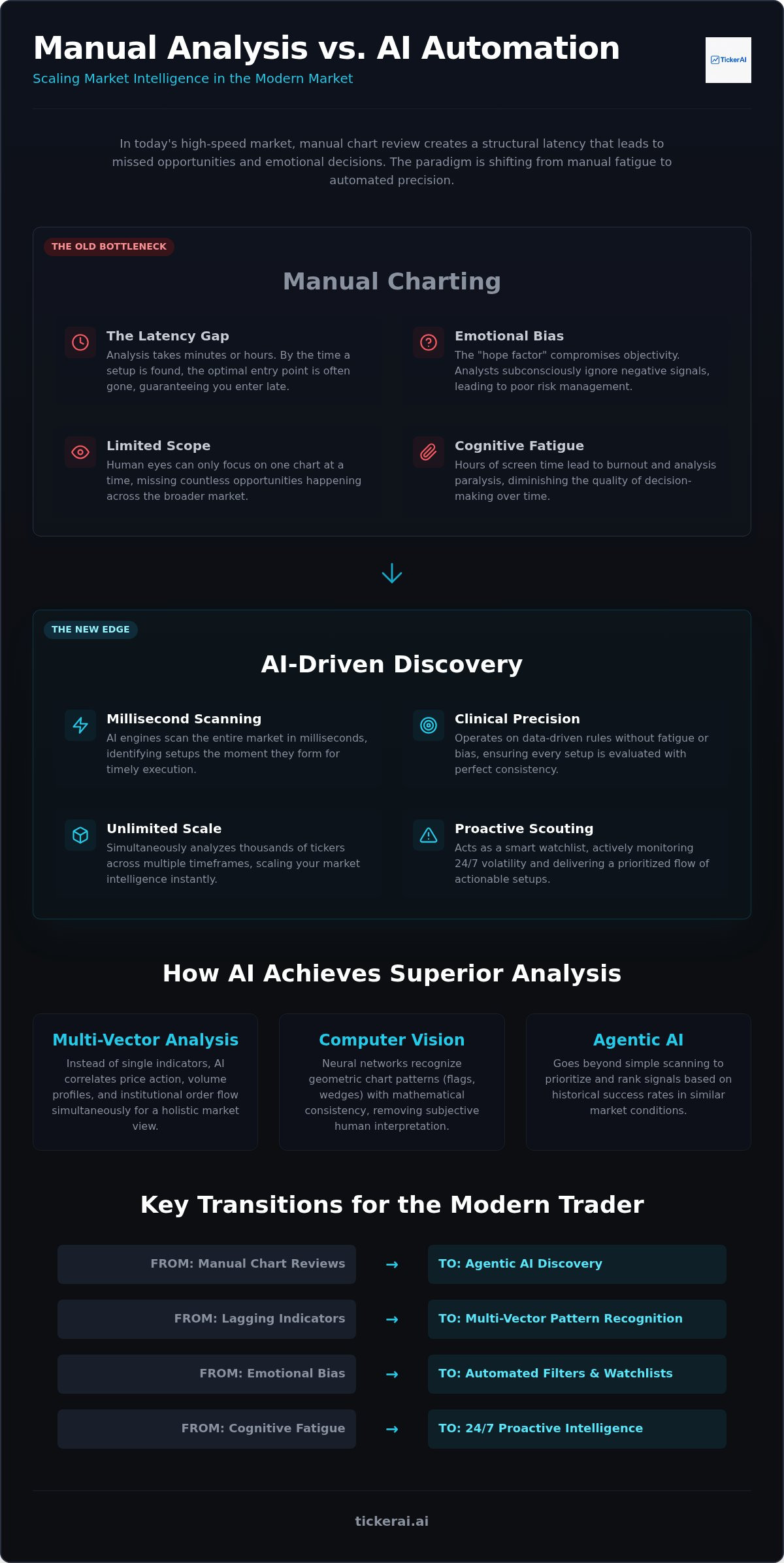
In the 2026 market, volatility isn't just a metric; it's a constant state of play. Manual chart reviews are fundamentally incapable of keeping pace with high-frequency institutional flows. While you're drawing a trendline on a single ticker, the market has already moved across forty others. This creates a structural latency that guarantees you're always entering late. To stay competitive, you must shift from being a manual observer to a high-speed intelligence operator. This is where automated stock market analysis becomes the primary driver of your research scale.
The Latency Gap in Manual Analysis
Institutions operate on microsecond execution. Retail traders relying on manual screening operate on a delay of minutes or even hours. Human eyes simply cannot process thousands of data points across multiple timeframes simultaneously. By the time a human analyst detects a breakout, the high-probability entry point is often gone. The time-cost is immense. Spending four hours a night on chart reviews is a low-leverage activity that yields diminishing returns. An Automated trading system or discovery engine removes this bottleneck by scanning the entire market in milliseconds. This ensures you see the setup the moment it forms, not after the price has already extended.
Eliminating Emotional Bias Through Automation
Manual charting invites the "hope" factor. You want a setup to work, so you subconsciously ignore bearish signals on a chart you've spent an hour analyzing. This subjective interpretation is the root of most trading losses. An AI tool for technical analysis automation operates with clinical precision. It doesn't get tired, and it doesn't have a bias toward a specific ticker. It applies rule-based discovery to every setup. You receive a data-driven notification based on multi-vector analysis, not a gut feeling. This removes the cognitive load of second-guessing your own research. It replaces analysis paralysis with a streamlined flow of actionable setups.
Moving from a "chart-watcher" to a "strategy-manager" mindset is the ultimate goal. You shouldn't be the one finding the patterns; you should be the one deciding which patterns are worth the risk. Automation handles the detection, allowing you to focus on capital allocation and risk management. This systematic approach is the only way to scale your intelligence without burning out in a 24/7 market environment. You're no longer fighting the data; you're directing the intelligence.
The Mechanics of AI-Driven Technical Analysis Automation
AI technical analysis automation is the deployment of machine learning models to detect market patterns and anomalies without human intervention. It represents a paradigm shift from traditional scanners. Legacy tools rely on "if-then" logic. Modern AI uses neural networks to understand context. This technology doesn't just look for a price point; it analyzes the environment surrounding that price. It's the difference between a static filter and an active intelligence agent. A professional AI tool for technical analysis automation acts as a proactive scout, filtering noise into prioritized setups.
The core of this mechanics lies in multi-vector analysis. Instead of looking at a single RSI or MACD crossover, the system correlates price action, volume profiles, and institutional order flow simultaneously. This holistic view identifies high-probability setups that manual reviews often miss. Agentic AI takes this a step further. It doesn't just scan the market; it prioritizes signals based on their historical success rates in similar volatility regimes. It manages the discovery process so you can manage the capital.
Computer Vision and Pattern Recognition
Neural networks have revolutionized how systems "see" financial charts. AI doesn't just calculate numbers; it recognizes geometric signatures. Whether it's a head-and-shoulders, a bull flag, or a complex wedge formation, the AI identifies these structures with mathematical consistency. Human analysts are prone to "seeing what they want to see." AI removes this subjectivity. It detects the pattern's validity by comparing current price structures against millions of historical data points. This shift from hard-coded rules to neural recognition has significantly increased detection accuracy, ensuring that micro-breakouts are captured before the retail crowd reacts.
Algorithmic Signal Processing
High-speed automation thrives on signal processing at scale. It integrates volume profiles with price action to spot institutional accumulation before the price reflects it. AI identifies momentum breakouts before they occur by correlating accelerating volume with specific volatility compression signatures. This allows traders to position themselves during the "quiet" phase of a move. By monitoring the order book for "smart money" footprints, these systems detect large-block transactions that signal institutional intent. If you want to stop chasing moves and start anticipating them, integrating AI stock opportunity discovery into your workflow is the most efficient path forward. It turns raw market data into a clinical, actionable roadmap for every trading session.
Evaluating Automation Tools: Discovery Engines vs. Execution Platforms
Professional traders understand a fundamental truth: finding the trade is more valuable than placing it. The market is saturated with execution platforms that automate order entry. While these tools save seconds at the terminal, they don't solve the primary problem of identifying where to deploy capital. Discovery engines represent a higher level of leverage. By using a specialized AI tool for technical analysis automation, you focus your energy on high-probability setups rather than manual labor. Execution is a commodity; discovery is your edge.
Choosing the right technology requires a clear distinction between these two functions. If your tool doesn't actively prioritize opportunities, it's just a digital filing cabinet. A true discovery engine acts as a proactive filter, scanning thousands of tickers to present only the most viable swing trade setups. This allows you to scale your intelligence without increasing your screen time. It's about quality of information over quantity of data. You need a partner that scouts the horizon while you make the final executive decisions.
Scanning vs. Curated Discovery
Generic scanners often suffer from a low signal to noise ratio. They alert you to every RSI crossover or moving average touch, regardless of the broader market context. This leads to analysis paralysis. AI-driven discovery is different. It utilizes curated filters to ensure every alert meets strict liquidity and momentum criteria. Professional traders value clinical precision over volume. Receiving three high-conviction alerts is infinitely better than sifting through fifty mediocre ones. Less is more when the "less" is mathematically validated for institutional-grade potential. This curated approach ensures your cognitive energy is reserved for high-leverage decision-making.
Key Features for Technical Automation
Certain features are non-negotiable for serious participants when evaluating an AI tool for technical analysis automation. Real-time alert latency is the first priority. In a 2026 environment, a five-minute delay is an eternity. You need systems that scan and report in milliseconds. Second, look for Smart Watchlist functionality. This shouldn't be a static list; it should be a central hub that organizes research by theme, sector, or volatility regime. This keeps your research organized and actionable. Finally, the tool should offer curated swing trade setups that are ready for immediate review. TickerAI Pro and TickerAI Full-Access are designed specifically for this discovery-first workflow, providing the depth of intelligence needed to outpace generic scanners. These tools don't just provide data; they provide clarity.
Building a Systematic Workflow: Integrating AI into Your Trading Plan
Integrating an AI tool for technical analysis automation into your routine isn't about surrendering control. It's about optimizing your decision-making funnel. A systematic workflow ensures that every trade you take is the result of a high-leverage process rather than a random reaction to price movement. You start by setting the parameters. You end by managing the capital. Everything in between is a calculated, data-driven sequence.
Configuring Your Alert Pipeline
Start by defining your edge. If you're a swing trader, your filters should focus on daily volatility compression and relative strength. Don't scan the entire market; filter for sector-specific momentum to find where the institutional money is flowing. This prevents notification fatigue. You want a pipeline that delivers curated setups, not a firehose of raw data. Professional efficiency depends on the quality of your inputs. By optimizing your notification frequency, you avoid the burnout associated with 24/7 market monitoring.
Once your pipeline is active, you must master how to interpret AI stock signals to differentiate between a standard move and a high-probability breakout. AI provides the discovery, but you provide the secondary validation. Look for confluence. If the AI detects a bull flag, check for volume profile support or a key moving average bounce. This dual-layer approach combines algorithmic speed with human discretion to ensure clinical precision in every entry.
The Observation-to-Action Flow
The transition from alert to entry must be seamless. When you receive a notification, perform an immediate technical check to confirm the setup's integrity against your primary plan. Don't guess on position sizing. Use AI-calculated risk levels to determine exactly how much capital to allocate based on current volatility and stop-loss distance. The optimal workflow for a trader using an AI-driven discovery tool is a rapid, three-stage cycle of automated detection, manual technical validation, and systematic risk-adjusted execution.
Finally, use smart watchlists to track thematic momentum over days or weeks. This allows you to monitor how specific sectors react to market shifts without re-scanning manually. It turns your research into a living, breathing asset that evolves with the tape. If you're ready to build this system, start discovering swing trade setups with the precision of a professional intelligence partner. Your trading plan deserves the speed and clarity of a modern AI tool for technical analysis automation.
TickerAI: Precision Opportunity Discovery for Professional Traders
TickerAI isn't a generalist scanner. It's a specialized AI tool for technical analysis automation engineered for participants who prioritize discovery over raw execution. While other platforms focus on building complex models from scratch, TickerAI provides an immediate, high-speed intelligence layer. It filters the noise of 24/7 markets into curated, actionable intelligence. This allows you to scale your research without sacrificing the clinical precision required for institutional-grade trading. You focus on the decision; the AI focuses on the detection.
The platform offers two primary tiers designed for distinct professional needs. The TickerAI Pro Subscription delivers advanced discovery features for the high-frequency swing trader who requires constant monitoring of volatility. For those seeking the complete suite of automated market scanning, the TickerAI Full-Access Subscription provides the ultimate hub for opportunity detection. Both tiers leverage real-time alerts that detect breakouts before they move, ensuring you're positioned ahead of the retail crowd. It's about seeing the tape before it prints the move.
Actionable Swing Trade Setups
TickerAI filters thousands of symbols per second to deliver curated ideas that meet specific liquidity and momentum thresholds. The system's momentum detection logic identifies the "quiet" phase of a move, allowing for entries before parabolic extensions. For example, during recent sector rotations into overlooked mid-cap energy names, TickerAI's automated scanning detected institutional volume shifts days before they hit mainstream financial headlines. This proactive scouting turns Smart Watchlists into a dynamic hub for organized research. You aren't just watching stocks; you're tracking thematic momentum as it builds.
The TickerAI Edge: Data Over Emotion
The primary benefit of this automation is the removal of the human "hope" factor. TickerAI provides continuous market monitoring while you sleep, scanning global indices for anomalies and setups. Beyond short-term volatility, the platform delivers long-term investment ideas derived from deep quantitative analysis. This ensures your portfolio remains balanced between immediate swing setups and structural growth opportunities. It's a tireless, high-tech assistant that prioritizes your time and intelligence. You don't need to be at your desk to have your scout in the field.
Professional trading in 2026 demands a shift from manual labor to strategic management. You can access the TickerAI discovery platform here to integrate these advanced capabilities into your daily routine. By offloading the grunt work of technical analysis to a dedicated AI tool for technical analysis automation, you reclaim your cognitive energy for high-stakes decision-making. Discovery is the edge; TickerAI is the engine that drives it.
Scale Your Edge with Automated Discovery
Manual charting is no longer a viable path for serious participants in the 2026 market. The transition from manual observation to systematic strategy management is essential for maintaining a professional edge. By integrating a high-speed AI tool for technical analysis automation, you remove the cognitive fatigue of constant market monitoring and replace it with clinical, data-driven precision. This shift allows you to focus on high-leverage capital allocation while your proactive scout identifies institutional-grade swing trade setups in real-time.
You've seen how discovery engines provide more leverage than simple execution platforms. Building a systematic workflow ensures that every entry is backed by multi-vector analysis and rule-based validation. The future of trading isn't about increasing your screen time; it's about deploying smarter intelligence to filter the noise. Efficiency is the ultimate currency in a 24/7 environment. Don't let latency dictate your performance when automated intelligence is available.
Ready to dominate the tape? Join TickerAI Full-Access for Automated Stock Discovery and leverage real-time momentum alerts, curated swing trade setups, and our advanced quantitative discovery engine. Your next high-potential trade is forming right now. Make sure you're the one to see it first.
Frequently Asked Questions
Can an AI tool completely replace manual technical analysis?
AI acts as a force multiplier rather than a total replacement. It eliminates the grunt work of scanning thousands of charts. An AI tool for technical analysis automation handles high-volume detection across multiple timeframes with clinical precision. This removes human latency and emotional bias from the research phase. However, the final decision on capital allocation remains with the human operator. It's a partnership where technology scouts and the professional executes.
How accurate are AI-automated chart pattern recognition tools?
Accuracy has improved significantly through neural network training. Unlike human eyes, which often see what they want to see, AI uses geometric signatures and multi-vector analysis. It compares current structures against millions of historical data points. This mathematical consistency reduces false positives. It ensures that setups like bull flags or wedges meet strict validity criteria before an alert is triggered, providing a more reliable foundation for your trades.
Do I need coding skills to use an AI tool for technical analysis automation?
Coding skills are not required for modern discovery platforms. Professional tools like TickerAI provide a no-code interface for setting specific parameters. You select your criteria, such as volatility compression or relative strength, through a streamlined dashboard. The complex algorithmic processing happens in the background. This allows you to focus on strategy management rather than script writing. It's built for professional traders who value speed over programming.
What is the difference between an AI scanner and an AI discovery engine?
Scanners are reactive and often create a high noise-to-signal ratio. They alert you to every simple indicator crossover regardless of context. An AI discovery engine is proactive and agentic. It prioritizes setups based on historical probability and current market regimes. It filters thousands of tickers into a handful of actionable swing trade setups. It's the difference between a raw data feed and refined, prioritized market intelligence.
How does AI detect institutional smart money flow in charts?
AI identifies institutional footprints by correlating volume profiles with price action anomalies. It monitors the order book for large-block transactions and aggressive buying pressure that precedes a breakout. These smart money signatures are often too subtle for manual detection. By identifying these accumulation phases early, the AI allows you to position yourself before the retail crowd reacts. This provides a clear advantage in timing your entries during the quiet phase.
Is TickerAI suitable for long-term investors or just day traders?
TickerAI serves both demographics but specializes in high-probability swing trade setups. While day traders utilize real-time momentum alerts, long-term investors benefit from our quantitative discovery engine. This engine identifies structural growth trends and long-term investment ideas based on data-driven insights. The Smart Watchlist functionality allows all users to track thematic momentum across different timeframes with clinical precision. It's a versatile tool for any serious market participant.
What technical indicators does TickerAI use for its automated alerts?
TickerAI utilizes a multi-vector approach rather than relying on a single indicator. Its automated alerts correlate RSI, MACD, and moving averages with volume profile and volatility compression signatures. This holistic view ensures that a signal isn't just a mathematical fluke. Every alert is a product of comprehensive algorithmic processing. It represents a high-conviction technical setup validated across multiple analytical dimensions to ensure maximum clarity before you take action.
Can I integrate AI alerts with my existing brokerage platform?
TickerAI is a discovery-first platform focused on identifying high-probability opportunities. We don't offer brokerage execution services. However, our real-time market alerts are designed to be immediately actionable. You receive the intelligence, perform your final technical validation, and then execute the trade through your preferred broker. This separation ensures that you maintain full control over your capital while benefiting from institutional-grade market scanning and proactive detection.


