
What good is an alert if the catalyst is already priced in by the time you see it? Automated catalyst-driven trade alerts can cut down on manual scanning of headlines and market activity, but speed alone doesn’t make a signal actionable. Context matters: what happened, how the stock responded, and whether the potential setup fits your risk plan.
Tracking earnings, company announcements, and other market-moving events can pull focus from evaluating a trade. Alerts can help surface potential opportunities, but a notification without a clear review process may leave you with more questions than answers. Treat an alert as a prompt to investigate, not an instruction to buy or sell.
This guide explains how catalyst-driven alerts work and how to assess an event, its price context, and risk before making a decision. You’ll also learn how to build a consistent review workflow and how research tools such as TickerAI’s smart watchlists, real-time alerts, and curated swing trade setups can support stock discovery. The aim is a faster, more structured way to identify and evaluate opportunities, without confusing automated discovery with trade execution or replacing your judgment.
Key Takeaways
- Separate the market event from price or volume behavior that may help confirm a potential setup.
- Understand how automated catalyst-driven trade alerts organize event information without determining whether a trade is actionable.
- Use a consistent review checklist to assess whether a catalyst is new, material, and relevant before considering risk.
- Distinguish research notifications from trade recommendations and broker-executed orders.
- Use TickerAI watchlists, alerts, and curated ideas to support stock discovery while keeping decisions in your hands.
What Are Automated Catalyst-Driven Trade Alerts, and What Do They Flag?
An earnings release lands. A company revises its outlook. A regulator announces a decision. Each event may change how investors assess a company, its sector, or its prospects. A catalyst-driven alert connects an event like these with a stock being monitored, bringing a potentially relevant development into view.
An event catalyst is information that may shift market expectations; a trade alert is a notification that connects the event to a security for further review. The alert can help organize discovery, but it doesn’t establish whether a trade is suitable or whether the market has already responded.
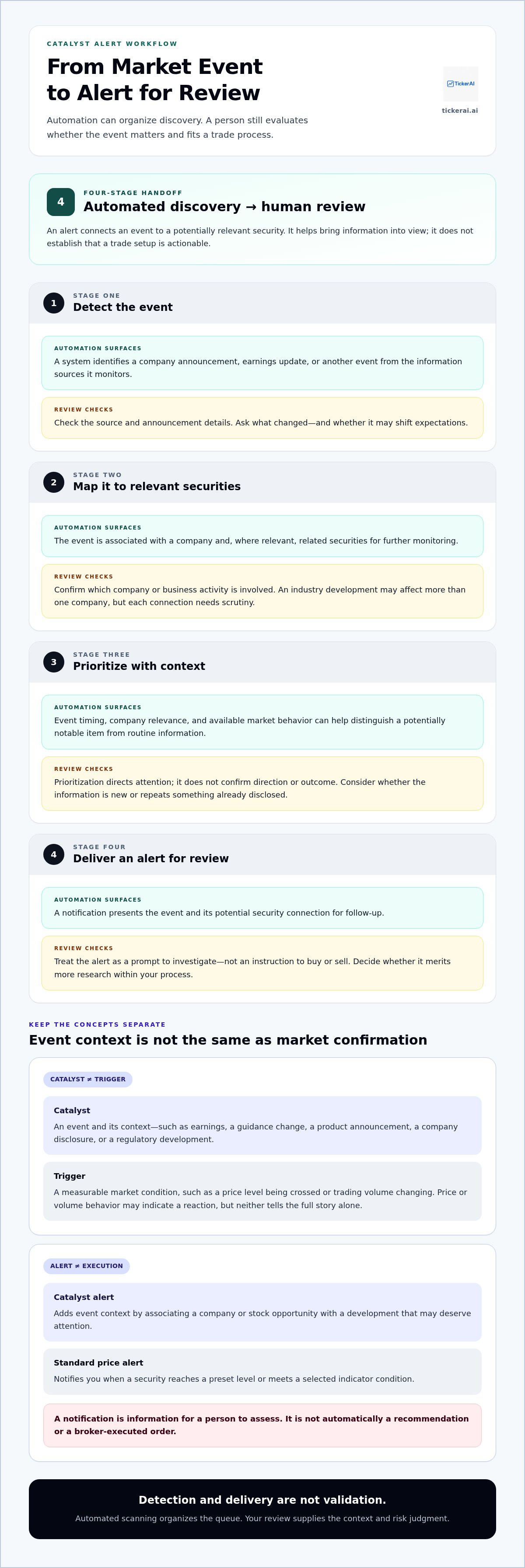
Keep catalysts separate from triggers. A catalyst is the event and its context. A trigger is a measurable market condition, such as a price level being crossed or trading volume changing. Price or volume behavior may indicate that the market is reacting, but neither tells the full story on its own. Automated catalyst-driven trade alerts are most useful when they make the connection between an event and a stock clear enough to investigate.
Which market events can act as catalysts?
Common event categories include earnings results, guidance changes, product announcements, company disclosures, and regulatory developments. These events may alter expectations about revenue, costs, competition, operations, or a company’s ability to bring a product to market. The relevant question isn’t just “What happened?” It’s “Why might this matter to this security?”
A single event can affect companies in different ways. A new product announcement could be an opportunity for the company launching it, while competitors may face different questions. A regulatory decision can affect one business directly and have broader implications for others in its sector. The direction and scale of a market response can’t be determined by the event label alone.
That’s why an alert is a starting point. Check the source and details of the announcement, identify which company or business activity it concerns, and consider what expectations it might change. The same headline can mean different things depending on the company’s circumstances and the information already available to the market.
What makes a catalyst alert different from a standard price alert?
A standard price alert notifies you when a security reaches a preset level or meets a selected indicator condition. It answers a narrow question: did a market threshold get crossed? A catalyst alert adds event context by associating a company or stock opportunity with a development that may deserve attention. That context can help you prioritize follow-up research.
Automation can mean different things. An Automated trading system may refer to technology used in trading processes, including systems that execute orders. An alert, by contrast, can simply deliver information for a person to assess. A notification is not automatically a recommendation or an order.
To evaluate a signal rather than react to its label, examine the event, the security, and market behavior together. For a broader framework on assessing generated signals, see this guide to interpreting AI stock signals.
How Automated Catalyst-Driven Trade Alerts Turn Events into Setups
A useful alert workflow does more than collect headlines. It organizes research by linking an event to potentially relevant securities, adding context, and sending a notification for review. That process can reduce manual scanning, but it doesn’t prove a trade setup is actionable. The alert is a handoff from automated discovery to your own analysis.
The workflow detects an event, maps it to potentially relevant securities, prioritizes it with context, then sends an alert for human review. Each stage has a distinct purpose:
- Detect the event. A system identifies a company announcement, earnings update, or other event from the information sources it monitors.
- Identify relevant securities. The event is associated with a company and, where relevant, related securities for further monitoring. An industry development may draw attention to more than one company, but each connection needs scrutiny.
- Assess and prioritize context. Event timing, company relevance, and available market behavior can help distinguish a potentially notable item from routine information. Prioritization directs attention; it doesn’t confirm direction or outcome.
- Deliver the alert. A notification presents the item for review. You can then check the event and decide whether it merits more research within your process.
This sequence matters because detection and delivery aren’t the same as validation. A system may surface an event quickly but lack context that affects its importance, such as whether the announcement changes expectations or repeats information already disclosed. Automated scanning organizes the queue; it doesn’t remove uncertainty from the analysis.
How does an event become a watchlist alert?
An event may bring a company or related security into a monitoring workflow when the information appears relevant to a stock being tracked. Timing matters: a new disclosure may warrant attention, while an older development may already be reflected in the share price. Company context matters too. The same type of announcement can have different implications for different businesses. A detected event is a reason to review, not proof that a trade setup exists.
For example, a product announcement could prompt research into the company issuing it and competitors that may be affected. The alert is useful only if those securities are genuinely connected to the event and the development is material to your research question. Treat the watchlist association as a lead to verify, not a conclusion based on an event label.
Where do price, volume, and timeframe conditions fit?
Market behavior can add another layer to event-based research. You might examine whether price has moved, volume has changed, and the reaction fits the timeframe you’re evaluating. These conditions can help filter what deserves closer attention. But combining filters doesn’t eliminate false signals, establish causation, or guarantee that a move will continue. For broader context on how automated scanning can organize market information, see this guide to automated stock market analysis.
To support ongoing discovery, TickerAI offers smart watchlists, real-time alerts, and curated swing trade setups as research inputs. Explore TickerAI stock opportunity discovery to structure your monitoring, while keeping event verification and trade decisions in your hands.
Catalyst Alerts vs. Trading Bots: What Automation Does, and Does Not, Do
“Automated” can describe very different functions. One tool monitors market events and sends a notification. Another analyzes information and presents a trade idea. A trading bot can go further by submitting orders through a brokerage connection. These are separate stages, not interchangeable labels.
The key distinction is control. An alert informs you that something may merit review. It doesn’t tell you to buy or sell, and it doesn’t place an order. More automation can reduce repetitive scanning, but it can also create noise if every notification is treated as important. Clear review rules keep discovery separate from decision-making.
| Automation level | What it does | What it doesn’t establish |
|---|---|---|
| Event monitoring | Surfaces a market or company development for attention. | Whether the event matters to a specific strategy. |
| Research alert | Connects an event or stock opportunity with a notification to review. | Whether to buy, sell, or hold. |
| Trade recommendation | Presents a proposed action or setup for consideration. | Whether it fits every investor’s goals, timeframe, or risk tolerance. |
| Broker-executed order | Sends an instruction to a brokerage to place a trade. | Whether the resulting position is appropriate or will perform as expected. |
Can an alert tell you whether to buy or sell?
No. The same catalyst can support different interpretations depending on your timeframe, existing position, and approach to risk. A short-term trader might focus on immediate price action; a longer-term investor may assess how the event affects a company’s outlook. Neither perspective follows automatically from an alert.
Curated setup information can organize research, but it isn’t individualized financial advice. Treat each notification as an input: verify the source, consider what may already be reflected in the price, and decide whether further analysis fits your process. No alert guarantees a result or serves as a definitive trade instruction.
When does automation help, and when can it mislead?
Automation can make routine monitoring more consistent and leave more time to evaluate the information that surfaces. But a system may flag stale or duplicated information, produce false positives, or draw attention to a catalyst the market has already priced in. More notifications aren’t necessarily more useful.
Set review rules before alerts arrive. Confirm the event and its timing, assess its relevance to the security, then consider price behavior and risk before making a decision. If a signal doesn’t pass those checks, it may not deserve further attention.
TickerAI supports AI-powered stock opportunity discovery through smart watchlists, real-time alerts, curated swing trade setups, and long-term investment ideas. These are research inputs, not personal financial advice or brokerage execution. The platform helps surface opportunities; you remain responsible for evaluating them and deciding what, if anything, to do.
How to Review an Automated Catalyst Alert Before Acting
An alert can focus your attention, but a repeatable review process determines what happens next. Before treating one of these automated catalyst-driven trade alerts as a potential setup, assess the event, the security, the market’s response, and your own risk rules. If key details are unclear, pause rather than fill the gaps with assumptions.
Use this checklist in order:
- Confirm the event. Locate the original announcement or a credible report. Check that the alert describes it accurately, and separate confirmed details from interpretation or speculation.
- Assess timing and novelty. Note when the event occurred and whether the information is genuinely new. Consider whether it was announced earlier, anticipated by the market, or followed by other developments.
- Test relevance and materiality. Ask how the event could affect this specific company. A headline may sound important but have little direct bearing on the security or the question you’re researching.
- Inspect market behavior. Review recent price and volume activity over a timeframe that matches your approach. A move after an announcement may coincide with the event, but that alone doesn’t prove the event caused it.
- Define risk before a decision. Write down the thesis, what would invalidate it, the intended holding period, and the level of risk you’re prepared to accept. If you can’t state these clearly, the alert needs more work.
What should you verify when an alert arrives?
Start with the source and timestamp, then compare the alert’s summary with the original information. Check which company or business activity is affected and what additional facts might change your first interpretation. For instance, a company announcement may seem material until you find that the market had already been discussing the same development. Separate observation from inference: record what the company stated, what the stock did, and what remains uncertain.
Price and volume can show how the security has behaved, not why. Treat them as evidence to investigate, not proof of a catalyst’s impact. This distinction helps prevent a compelling headline from becoming a conclusion before you’ve checked the supporting details.
How can you turn alert review into a repeatable process?
Use the same relevance criteria, time horizon, and risk questions for each alert. Log the event, source, timestamp, initial thesis, invalidation conditions, and decision, including a decision to take no action. Later, revisit the entry to assess whether you followed your process and what information mattered. Judge the quality of the review, not just whether an individual outcome was a winner or loser.
A rule-based trading plan can help keep decisions consistent. For structured stock discovery and alerts to review within your own process, explore TickerAI’s research tools.
How TickerAI Supports Catalyst-Driven Stock Discovery
Market events raise questions to investigate. TickerAI is an AI-powered stock opportunity discovery platform that helps organize research with smart watchlists and real-time alerts. These tools support ongoing monitoring by bringing stock opportunities into view, so you can decide what merits closer analysis.
The role is discovery, not execution. TickerAI doesn’t provide personal financial advice or place brokerage orders. Its alerts and curated ideas are research inputs, not instructions or promises of an outcome. You remain in control of how you verify information, assess risk, and make decisions.
How do TickerAI alerts fit into a research workflow?
Use a watchlist to keep relevant stocks within your monitoring routine, then treat alerts as prompts to revisit the context. If a company announcement or other catalyst draws your attention to a security, check the underlying information and consider how it relates to your research. Don’t assume an alert confirms that the event is new, material, or likely to move the share price.
Curated swing trade setups can surface ideas for further analysis, while long-term investment ideas provide another research input. Each is a starting point, not a tailored recommendation. Assess the information against your own timeframe, thesis, and risk criteria before deciding whether to continue researching or set the idea aside.
This makes automated catalyst-driven trade alerts part of a broader discovery process, rather than a shortcut to execution. For a wider view of how algorithmic tools can support opportunity research, explore this guide to AI stock discovery platform tools.
A practical workflow might look like this:
- Monitor: Use smart watchlists to keep selected stocks on your research radar.
- Review: Treat a real-time alert or curated setup as a cue to investigate its context.
- Evaluate: Apply your own thesis, timeframe, and risk process before making a decision.
The value is structure and less manual scanning, not certainty. Alerts can help focus attention, but they can’t determine whether an opportunity fits your objectives or whether a market reaction will continue.
Which TickerAI subscription path fits your research needs?
TickerAI offers Pro and Full-Access subscription tiers for its stock discovery platform. Consider how you want to incorporate discovery, watchlists, and alerts into your research routine, then review the membership options to find the access path that suits your needs.
To explore the available tiers and support your stock research workflow, explore TickerAI memberships.
Make Your Next Alert Part of a Clearer Process
Turn your review checklist into a routine. Decide what makes an event relevant to your strategy, what evidence you need before considering a setup, and which conditions would change your view. Apply the same standards across opportunities. Consistency keeps automated catalyst-driven trade alerts in their proper role: a way to focus research, not a substitute for judgment.
Build that process around the opportunities you want to monitor. TickerAI brings AI-powered stock discovery together with smart watchlists, real-time alerts, curated swing trade setups, and long-term investment ideas, giving you research inputs to evaluate within your own decision framework.
Explore TickerAI stock discovery and alert memberships to create a more focused starting point for your market research. Verify the signal and let a disciplined process guide what you do next.
Frequently Asked Questions
What are automated catalyst-driven trade alerts?
Automated catalyst-driven trade alerts are notifications that connect a market event with a stock opportunity for research. For example, an earnings announcement could prompt a closer look at a company on your watchlist. The alert doesn’t tell you whether the news is favorable or predict how investors will respond. Use it to identify what to investigate, then check the original information and decide whether the idea meets your own criteria.
How do catalyst-driven stock alerts work?
They use selected event or market criteria to flag information associated with securities and notify users when those criteria are met. For instance, a company update might surface because the stock is on a monitored list or matches a system’s screening conditions. What appears depends on the system’s inputs and rules. Treat the notification as a research lead, not a broker order or guaranteed trade recommendation.
Can automated catalyst alerts predict whether a stock will rise?
No. An alert can identify a development, but it can’t establish a stock’s future direction. Investors may have anticipated the news, interpret its implications differently, or respond to another factor at the same time. If a stock jumps after an announcement, that timing alone doesn’t show the move will continue. Review what changed, what the market may already expect, and what evidence would alter your view.
What is the difference between a trading alert and a trading bot?
A trading alert delivers information or reports that a specified condition has occurred; you decide what to do with it. A trading bot follows programmed rules to automate actions, which may include submitting orders through a brokerage connection. Before relying on any tool, identify what it automates: monitoring, research notifications, suggested actions, or order placement. Those functions involve different levels of user control.
How can I reduce false positives from catalyst-driven alerts?
Reduce low-value alerts by narrowing what qualifies for review. For example, exclude duplicate headlines, require a clear connection between the event and the company, and set a timeframe for deciding whether the information is still relevant. Keep a record of alerts you dismiss and why. Review it periodically to see whether your filters are screening out noise or repeatedly missing developments you intended to track.
Do catalyst-driven trade alerts replace my own research?
No. Alerts can direct your attention, but you still need to examine the information and decide whether it supports a coherent thesis. Before considering any action, write down what you know, what you’re assuming, and what remains uncertain. TickerAI supports stock discovery and research; it doesn’t provide personalized financial advice or execute brokerage trades.
How should I respond when a catalyst alert arrives?
Pause long enough to determine whether the alert changes a decision you were already considering. Verify the event, then compare the new information with your existing thesis and rules. Record your reasoning, including why you choose not to act. For example, if the announcement doesn’t affect the company’s core business or falls outside your planned timeframe, dismissing it may be the most disciplined response.


