

Your first swing trade shouldn’t be your first test of a strategy. If charts, indicators, and conflicting trade ideas make it hard to know where to begin, focus first on building a repeatable process. Learning how to get started in swing trading means defining your setup, entry, exit, and risk rules before committing meaningful capital.
It’s reasonable to be cautious about losses while you’re learning. A plan can’t remove market risk, including overnight price gaps, but practising with consistent rules can help you assess decisions without treating every signal as an instruction to trade. The goal is a clear workflow, not a shortcut to guaranteed results.
This guide walks through the fundamentals: choosing a strategy to study, setting entry and exit criteria, managing risk, and reviewing practice trades. It also explains how research tools, including AI-powered opportunity discovery, curated swing-trade setups, watchlists, and alerts from TickerAI, can help surface ideas for further analysis. These are inputs to your research, not decisions made for you. You remain responsible for evaluating each setup and deciding whether it fits your plan.
Key Takeaways
- Learn how to get started in swing trading with a clear sequence: understand market basics, select a setup, define rules, practise, and review.
- Compare swing trading with day trading and longer-term investing by considering holding periods and the monitoring each approach requires.
- Rehearse entries and exits with paper trading, and assess how position sizing and exit plans fit your risk limits.
- Use screeners, watchlists, and alerts to find candidates, then check each one against your own written criteria.
- Recognize the difference between a research signal and a trade decision. Tools can surface ideas, but they can’t confirm a setup or guarantee an outcome.
What Is Swing Trading, and What Does a Beginner Need to Know First?
Swing traders seek to capture price moves that develop over several days or weeks. They look for a defined setup, decide in advance what would support or invalidate it, then manage the position as the market changes. The objective isn’t to predict every move. It’s to apply a consistent process and evaluate its results over time.
That distinction matters because a chart pattern, indicator, or research alert is only a possible signal. It can help focus attention, but it can’t confirm what the market will do next or guarantee a return. A trade can lose money, even when the reasoning and rules are sound. Before exploring how to get started in swing trading, understand that uncertainty is part of the activity, not a problem a strategy can eliminate.
For a broader overview of its origins, methods, and place among trading styles, see What is Swing Trading? The practical starting point is more modest: learn how price behaves, how orders work, and how to make decisions without improvising at every fluctuation.
How a swing trade differs from investing and day trading
Holding period is the clearest distinction. Day traders generally open and close positions within the same trading day. Swing traders may hold through multiple sessions, including overnight or across weekends and market events. Long-term investors typically hold assets for much longer, with decisions more closely tied to ownership goals than short-term price movements.
These approaches involve different monitoring and decision rhythms. A swing trader actively evaluates whether a setup remains valid; an investor may tolerate shorter-term price changes as part of a longer horizon. Neither approach suits everyone. Overnight gaps can move a security sharply before a trader can respond, so a position may not behave as expected when the market reopens.
What skills and time commitment should beginners expect?
Start with foundational skills, not a large collection of indicators. Learn to read basic price charts, recognize trends and ranges, and understand common order types such as market, limit, and stop orders. Build a simple trade journal that records the reason for each decision, the planned exit, and what happened. Consistent records help separate a repeatable process from hindsight.
Swing trading can require less continuous screen time than day trading, but it still calls for monitoring. You’ll need a routine for reviewing positions, checking relevant price levels, and responding when your original conditions change. The time required depends on the strategy and the markets you follow; less screen time doesn’t mean a trade can be ignored.
Expect a learning curve. Early practice may reveal that a setup is difficult to identify consistently, that an exit rule is unclear, or that emotional reactions affect decisions. Treat those observations as material for review, not as a reason to chase a new indicator after every loss. A beginner’s edge is discipline: keep the process small enough to understand, record decisions honestly, and accept that outcomes remain uncertain.
How to Get Started in Swing Trading: A Beginner’s First Workflow
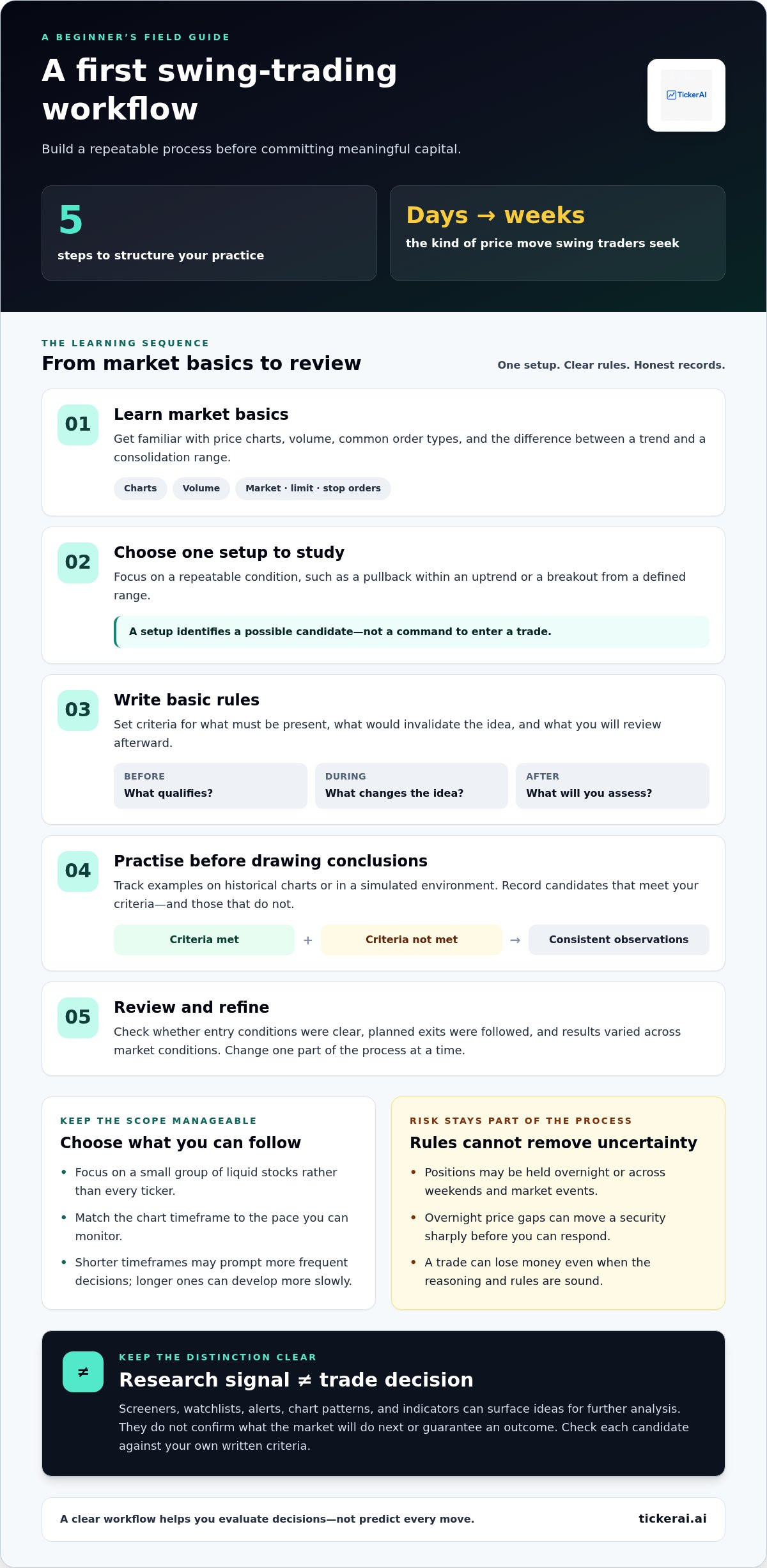
A useful starting point is a sequence, not a search for the perfect indicator. The goal is to move from basic knowledge to a testable setup, then gather observations before deciding whether the approach deserves further study. This workflow gives beginners a way to learn how to get started in swing trading without treating every market signal as an instruction.
- Learn market basics. Get familiar with price charts, volume, order types, and the difference between a trend and a consolidation range. You don’t need to master every technical indicator. Start with the information you’ll use to describe a potential setup and explain why it interests you.
- Choose one setup to study. A setup is a repeatable condition to research, such as a pullback within an uptrend or a breakout from a defined range. It identifies a possible candidate, not a command to enter a trade. A swing trade setup finder guide can help you develop a more structured approach to finding setups.
- Write basic rules. Describe what must be present before you consider a candidate, what would invalidate the idea, and what you’ll review afterward. Keep the criteria specific enough that you can apply them to different charts without changing your interpretation each time.
- Practise before drawing conclusions. Track examples on historical charts or in a simulated environment. Record both candidates that meet your criteria and those that don’t. Consistent observations make it easier to assess the setup than relying on a few memorable wins or losses.
- Review and refine. Look for patterns in your records. Were the entry conditions clear? Did you follow your planned exit? Did results vary in different market conditions? Change one part of your process at a time so you can understand what the adjustment affects.
Choose a market, timeframe, and setup to study
Keep your observation list manageable. For example, focus on a small group of liquid stocks you can follow rather than scanning every ticker. Choose a chart timeframe that matches the pace you can monitor: shorter timeframes may prompt more frequent decisions, while longer ones can make a setup develop more slowly. Fidelity’s overview of swing trading methods and strategies offers additional context on approaches and candidate selection. Study one setup at a time; stacking unrelated indicators can make it harder to identify what actually informs a decision.
Turn an idea into a practice plan
For each example, write down the entry condition, the point at which the idea no longer holds, and the criteria you’ll use to review the outcome. Then apply those notes consistently and record observations, including cases where no trade would have been considered. For a deeper framework covering position and risk rules, use this rule-based trading plan guide.
Research tools can also help surface potential candidates for your own review. TickerAI’s AI stock opportunity discovery can serve as an input to that research, while your written criteria remain the filter. A surfaced idea still needs independent evaluation before you decide what to do.
Swing Trading Compared: Which Approach Fits Your Schedule and Experience?
Trading styles differ in how often decisions arise, how long capital remains in a position, and what kind of attention the process demands. A shorter holding period doesn’t automatically mean greater skill, and fewer daily decisions don’t make an approach risk-free. Use the comparison to identify what you can realistically monitor and what you want to learn.
| Approach | Typical holding period | Monitoring and decisions |
|---|---|---|
| Day trading | Positions usually open and close within the same session | Frequent monitoring and quick intraday decisions |
| Swing trading | Positions may span several sessions or weeks | Active research and periodic checks, with decisions as the setup develops |
| Long-term investing | Often months to years | Generally less frequent decisions, focused on longer-term goals and ownership |
Swing trading versus day trading and longer-term investing
Day trading concentrates activity within market hours. Swing trading gives a setup more time to develop, but a position can remain exposed while the market is closed. Overnight or weekend gaps, earnings announcements, and other news can move a stock sharply before a trader has a chance to respond. Longer-term investing involves a different decision horizon, where short-term price changes may be less central to the original ownership rationale.
Each approach has trade-offs. Day trading may demand sustained attention during the session. Swing trading may fit a schedule with check-ins rather than constant observation, but requires planning for moves that occur outside those checks. Long-term investing can mean fewer trading decisions, yet still involves uncertainty and the possibility of losses. Leverage and short selling can add financing, execution, and risk-management complexity. Beginners can focus on learning the basics without starting with either.
How to assess whether swing trading suits your routine
Consider the full cycle, not just time spent watching a chart. Can you set aside time to research candidates, review open positions at intervals, and assess decisions after a trade closes? If your schedule makes those tasks inconsistent, the practical demands may not match your expectations.
- Time: Identify when you can review charts, check relevant news, and update your records.
- Uncertainty: Consider whether you can tolerate price fluctuations and the possibility that a position moves against your plan.
- Learning goal: Decide whether you want to practise active setup evaluation or focus on a longer-term ownership approach.
Be honest about your reactions. If routine price changes prompt impulsive decisions, practise observing and recording them before committing meaningful capital. Suitability isn’t guaranteed by having a particular job, schedule, or experience level. As you consider how to get started in swing trading, treat the fit as something to assess through careful practice, not an assumption that one style is best for everyone.
How Beginners Can Practise Swing Trading and Control Risk
Practice gives you a chance to test whether you can follow your process before putting meaningful capital at risk. Paper trading lets you rehearse decisions using simulated trades, but it isn’t a substitute for live-market experience. Simulated fills may not reflect real execution, and without money at stake, it can be easier to follow a plan than it would be during an actual loss.
Practise entries and exits before trading live
Choose a setup you can describe clearly, then record each hypothetical trade from start to finish. Capture the entry condition, planned exit, reason for the decision, and relevant market context. Include candidates you reject, too. That record helps reveal whether you’re applying the same criteria consistently or adapting them after seeing what the price did.
Review a series of examples rather than drawing conclusions from one outcome. A profitable simulated trade doesn’t prove a setup works, just as a losing one doesn’t automatically disprove it. Compare what happened with what your rules anticipated. Note whether a move followed your plan, whether the setup was still valid, and what you would change, if anything, before testing again.
Set risk boundaries and review each decision
Before considering a live trade, decide how much you’re prepared to risk if the idea fails. That decision informs position sizing: the number of shares should reflect the planned exit and the amount of potential loss you can accept, rather than confidence in a prediction. Set the exit logic before entry, and avoid moving it simply to postpone acknowledging that the setup has changed.
A stop order or other planned exit can help structure a decision, but it can’t guarantee a particular execution price or remove risk. Prices may gap past an order, and volatility can make exits less predictable. Before acting, consider upcoming earnings, scheduled announcements, broader market events, and the possibility of overnight or weekend price gaps. If those risks don’t fit your plan, passing on the candidate is a valid decision. For mechanics and terminology, see this stop-loss and take-profit guide.
After each practice or live trade, compare the decision with the original plan. Record whether the entry met your criteria, whether the exit followed your rules, and what market conditions influenced the result. A consistent review can expose impulsive changes, including chasing a move or trying to recover a loss immediately. This guide to systematic trading discipline explores how process can help keep decisions structured.
Learning how to get started in swing trading means treating risk limits as part of the setup, not an afterthought. TickerAI’s research tools can surface swing-trade ideas for independent review. Explore swing-trade research tools, then evaluate any candidate against your own criteria before making a decision.
How Research Tools Can Support Your First Swing-Trading Workflow
Research tools can reduce the time it takes to find stocks worth studying. Screeners filter a broad market by selected conditions. Watchlists keep potential candidates organized, while alerts draw attention to changes that may deserve a closer look. These tools help surface ideas. They don’t establish that a trade is suitable or confirm that your setup is valid.
Keep discovery and decision-making separate. When a tool surfaces a ticker, compare its chart and relevant context with the written criteria you’ve chosen to study. If a candidate doesn’t meet those conditions, leave it on the watchlist or move on. A notification is a prompt to investigate, not a reason to act immediately.
What automated stock discovery can and cannot do
Automated scanning can organize market information and highlight possible opportunities for further analysis. TickerAI’s AI stock opportunity discovery, swing-trade setups, smart watchlists, and alerts can contribute research inputs to that process. They aren’t personal financial advice or brokerage execution, and an alert is not a guaranteed prediction. For a structured way to assess generated signals, use this guide to interpreting AI stock signals.
A practical next step after learning the basics
Start with one documented setup and a small watchlist you can review consistently. When a candidate appears, use the same questions each time rather than changing your standards to fit the chart:
- Setup: Does the price action match the condition you’re studying?
- Context: Is there relevant market or company news that could affect the idea?
- Plan: Can you identify what would support the setup and what would invalidate it?
- Decision: Does the candidate meet your criteria, or is it only interesting because an alert appeared?
Record the result, including candidates you decide not to pursue. Over time, those notes can help you see whether your criteria are clear enough to apply consistently and where your research process needs refinement. Don’t treat a stream of new ideas as a requirement to trade. Selectivity is part of a repeatable workflow.
As you learn how to get started in swing trading, use discovery tools to focus your research while keeping evaluation and trade decisions in your hands. Explore TickerAI’s stock opportunity discovery to surface ideas for independent review against your own criteria.
Make Your Next Step a Measured One
The most useful next step isn’t rushing into a trade. Choose one setup to observe, keep a record of what you learn, and let your notes guide what you practise next. Progress comes from improving the quality and consistency of your decisions, not from reacting to every market move.
If you want a research layer for that process, TickerAI brings together AI-powered stock opportunity discovery, curated swing-trade setups, smart watchlists, and real-time market alerts. These tools can help surface ideas for your own review. They don’t make the decision for you or guarantee a result. Pro and Full-Access subscription tiers provide options for exploring TickerAI’s tools.
Explore TickerAI’s AI-powered stock discovery tools and use them as inputs to a workflow that stays grounded in your own criteria. Start with curiosity, practise with care, and keep refining your process. Each deliberate review can make your next decision more informed.
Frequently Asked Questions
How much money do you need to start swing trading?
There’s no universal amount that makes swing trading appropriate for every beginner. The amount you can trade depends on your financial situation, the securities you’re considering, and how much you could afford to lose. Account requirements and trading costs also vary. Before funding an account, test your rules in simulation and work out how a planned exit could affect your position. Don’t use money needed for essential expenses or emergency savings.
Can you learn swing trading with paper trading?
Yes. Paper trading lets you practise analyzing a chart and recording hypothetical decisions without risking trading capital. For example, note the price at which your setup would qualify, the reason you’d exit, and what happened afterward. Simulated results don’t fully reproduce live execution or the pressure of a real loss, so treat them as a way to test your process, not proof that future trades will perform the same way.
How long does it take to learn swing trading?
There’s no fixed learning timeline. It depends on how often you study, the complexity of your approach, and how consistently you document and review decisions. Rather than setting a deadline to trade live, set learning milestones: explain your setup clearly, identify when it no longer applies, and apply the same criteria across different examples. If your notes show inconsistent decisions, keep practising before increasing your exposure.
Is swing trading suitable for beginners?
It can be a way for beginners to study active trading, but it isn’t automatically suitable for every person or schedule. Start by asking whether you can tolerate uncertain outcomes, follow written criteria, and review positions as planned. A beginner learning how to get started in swing trading can begin with observation and simulation. Consider your financial circumstances and comfort with possible losses before deciding whether to trade with real money.
What is the difference between swing trading and day trading?
Day trading generally involves opening and closing positions during the same trading session, while swing trading can keep a position open across multiple sessions. That changes the type of attention each approach demands: day trading involves decisions during market hours, while swing trading requires planning for price changes that may occur while markets are closed. Neither approach removes risk, and the better fit depends on your availability and decision-making preferences.
Do you need technical analysis to start swing trading?
You don’t need advanced technical analysis before you begin learning, but you do need a consistent way to assess price behavior. Start with basic chart features such as trend direction, support and resistance areas, and volume, then study how they relate to one setup. Avoid adding indicators simply because they’re available. If you can’t explain how a tool informs your criteria, leave it out until you understand its role.
Can AI alerts tell you when to buy or sell a stock?
AI alerts can flag information or potential setups for further research, but they shouldn’t be treated as automatic buy or sell instructions. They can’t guarantee a price move or account for every part of your situation. TickerAI provides AI-powered stock opportunity discovery, curated swing-trade setups, watchlists, and alerts as research inputs. It doesn’t provide personal financial advice or brokerage execution. Evaluate any alert against your own criteria before deciding what to do.


