
AI can make investment research faster, clearer, and easier to tailor, but it can’t predict future market performance. The benefits of using AI for investing include quickly scanning information, summarizing complex reports, and explaining technical terms as you build your understanding. Treat its output as a starting point for further research, not as a final investment decision.
It’s easy to lose time sorting through market updates and dense analysis. AI can group information into useful themes and surface potential opportunities, leaving you more time to assess the evidence. This article explores how AI can support learning and research, where it may help reduce advice costs, and how personalized suggestions fit into the process. It also covers important limitations: AI-generated information can be outdated or inaccurate, and historical patterns can’t tell you exactly what markets will do next.
Key Takeaways
- Use AI to organize historical data and surface questions for further research, not to treat predictions as facts.
- Compare how advice fees are structured and what support you need before deciding which approach fits your investing process.
- Personalized suggestions can help focus research, but you still need to assess whether an idea aligns with your goals and risk tolerance.
- Automated scanning and report summaries can reduce manual research time; learn what to verify before acting on an AI-generated insight.
AI-assisted investment research and analysis
AI analyzes investment data by comparing historical records, detecting patterns, and flagging potential risks or opportunities. The benefits of using AI for investing include a faster way to organize research, but its output should guide your investigation, not decide for you.
Market Analysis and Forecasting
AI-powered market analysis examines historical information to identify patterns, market shifts, and changes in volatility. This helps you see how an investment behaved under different conditions instead of relying on isolated headlines. AI can also generate thousands of synthetic market scenarios, drawing on historical events such as the 2008 financial crisis and the 2020 pandemic selloff. These scenarios let investors explore how a strategy might respond to possible conditions. They don’t predict what markets will do next.
Faster Data-Driven Decisions
AI can quickly compare data signals, helping investors focus on the factors behind an opportunity. For example, when researching a company, use an analysis to identify changes in historical performance, then investigate what drove them. One benefit of using AI for investing is that it can organize findings into focused questions. Check whether a pattern reflects an unusual period, incomplete information, or a factor that still matters today.
Predictive Analytics for Risk Management
Predictive analytics uses historical data to estimate possible risk patterns and show how an investment might behave under different conditions. It can flag warning signs, such as rising volatility or recurring declines. Past performance cannot predict future performance, and no investment tool can predict the next stock market crash with 100% accuracy. Treat results as prompts for further research, not final answers. Before deployment, investment AI models should be validated, backtested, and stress tested to assess how they perform when conditions differ from historical inputs.
Cost efficiency compared with financial advisors
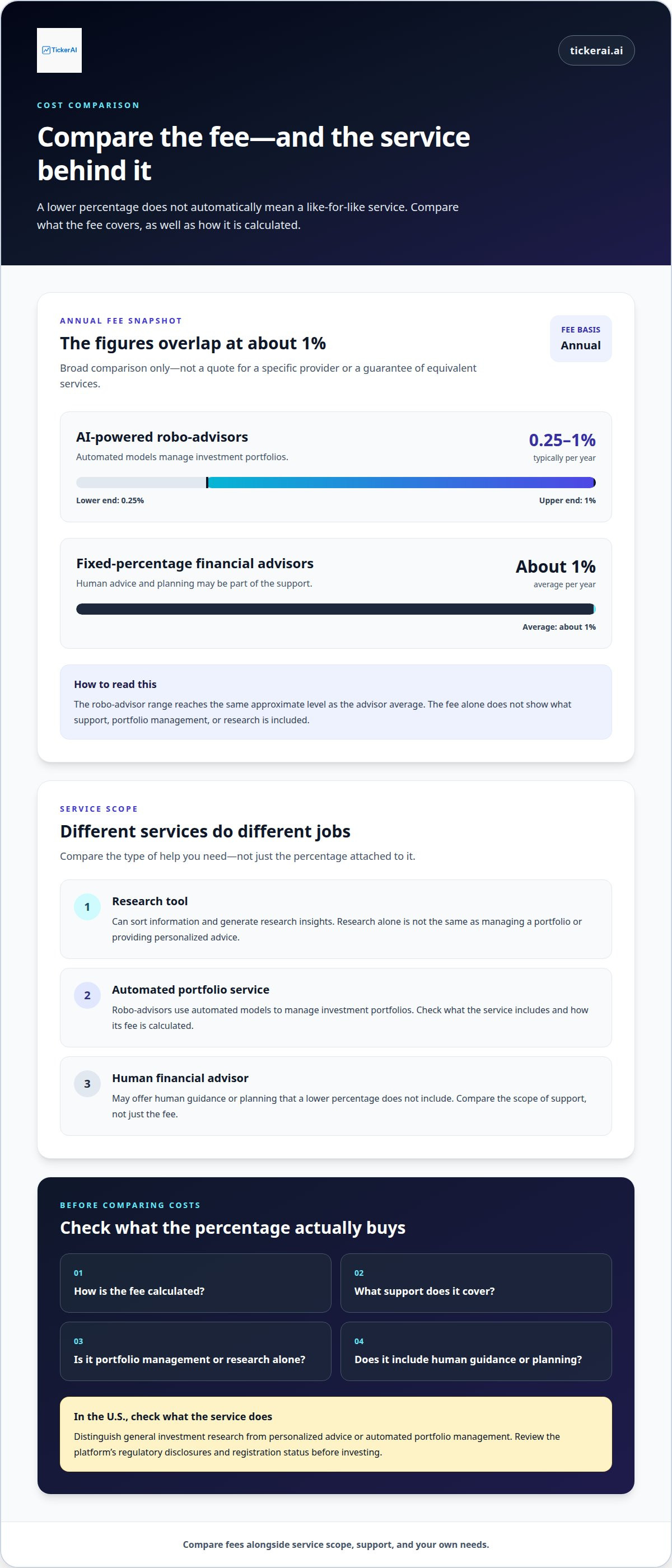
AI can sort information and generate research insights, while robo-advisors use automated models to manage investment portfolios. Which costs less depends on what each service does. A research tool, an automated portfolio service, and a human advisor provide different capabilities, so compare the scope of each service as well as its fee.
AI-powered robo-advisors typically charge an annual fee of 0.25-1%, while fixed-percentage financial advisor fees average about 1% annually. These figures offer a broad comparison, not a like-for-like quote for every service. Before choosing, identify how the fee is calculated, what support it covers, and whether the service provides portfolio management or research alone. A lower percentage may not include the same human guidance or planning as an advisor.
In the U.S., the relevant regulatory question is what a service does, not simply whether it uses AI. Distinguish general investment research from personalized advice or automated portfolio management, then review the platform’s regulatory disclosures and registration status before investing.
AI can process information quickly, but that doesn’t make every output accurate. Models can organize data and surface patterns, but they can’t replace your judgment about goals, risk tolerance, or changing circumstances. For example, use an automated suggestion to identify an investment for further research, then assess its assumptions and suitability before deciding. This keeps speed separate from authority.
For investors who want research ideas without treating automated output as personal advice, long-term investment ideas can provide a focused starting point for further analysis.
Personalized investment suggestions
AI tools can tailor investment suggestions by comparing market data with information a user provides, such as goals, time horizon, risk tolerance, and existing holdings. Someone focused on long-term growth, for example, may receive different research prompts from someone prioritizing income. The output reflects those inputs, but may not account for every detail of that person’s financial situation.
A personalized strategy starts with clear parameters. Define a goal, describe your preferred level of risk, and identify areas for further research. AI can then organize relevant information and produce suggestions that reflect those preferences. If your goal is long-term growth, for instance, consider whether a suggested idea fits that horizon and how its risks compare with your current holdings. Assess the reasoning, not just the suggestion.
Personalized investment advice is different from an AI-generated suggestion. A platform can sort ideas according to selected criteria, but a recommendation based on limited inputs may miss important context. A change in income, a near-term cash need, or concentrated holdings could affect how you evaluate the same opportunity. Add relevant context where the tool allows, then review the result against your full circumstances before acting.
Use suggestions as a research filter, not an instruction to trade. For each idea, identify which preference shaped the result, what market data supports it, and which risks need closer review. If a suggestion aligns with a growth-oriented strategy, for example, consider whether its volatility fits your risk tolerance. This turns personalization into a structured way to prioritize research while keeping decisions grounded in your own assessment.
AI can make investment research more time-efficient
AI can make investment research more time-efficient by scanning websites and information from varied sources, then summarizing complex reports into key points. Instead of opening each source and extracting every detail manually, an investor can use automated processing to create an initial research brief. For example, ask an AI tool to summarize a company report by identifying its revenue drivers, stated risks, and unanswered questions. This speeds up the first pass, while the original evidence remains essential for evaluating important claims.
The main advantage is prioritization. Algorithms can organize information around a research question, helping you focus on relevant patterns instead of reading every market update in full. Suppose you’re comparing two companies in the same industry. An AI summary can help distinguish reported financial changes from management commentary, giving you a clearer list of topics to investigate. Examine each company’s underlying figures and their context before drawing conclusions.
Use AI to structure research, not to make investment decisions for you. Start with a specific question, such as which risks a company describes in its latest report. Use a summary to find relevant sections, then read those sections in the original document. This focused workflow can reduce time spent locating information and help you track unanswered questions as you compare research sources.
Speed alone doesn’t establish accuracy. AI-generated information may be outdated or incorrect, and a summary can omit context that changes the meaning of a statement. If a tool reports a shift in revenue or volatility, compare the claim with the original company filing and related market data. Check the date, definitions, and assumptions behind the information. This review helps distinguish a recurring trend from a one-off result or a misleading summary.
Put focused research into practice with long-term investment ideas as a starting point for your own analysis.
TickerAI: AI Stock Opportunity Discovery
When manual research leaves too many market signals to sort, TickerAI offers a focused way to explore AI Stock Opportunity Discovery. Its offerings include Swing Trade Setups, Smart Watchlist & Alerts, and Long-Term Investment Ideas. These tools may serve as starting points for further research, whether you’re tracking shorter-term setups or researching a longer investment horizon.
Treat these ideas as research inputs: review the reasoning, compare it with your goals, and make your own investment decisions. TickerAI supports opportunity discovery and monitoring, not personalized financial advice or brokerage execution.
Explore TickerAI’s AI investing tools to see how they fit your research process.
Turn AI insights into a disciplined research habit
The benefits of using AI for investing become practical when research leads to deliberate decisions rather than automatic reactions. Set a clear question before reviewing an idea. Then assess its evidence, assumptions, and fit with your goals. Apply the same process as market conditions and priorities change. AI can help organize research, but it can’t guarantee investment returns.
TickerAI offers AI Stock Opportunity Discovery, Swing Trade Setups, and Smart Watchlist & Alerts to support opportunity research and monitoring. Use these tools as inputs to your own analysis, considering the evidence behind each insight and the risks relevant to your strategy.
Ready to explore how these research tools fit your process? Contact TickerAI to learn more. Make your next investment decision with a clear method and a focused view of the information.
Frequently Asked Questions
Can AI help me learn about investing?
Yes, AI can help you learn investing concepts by explaining terms and organizing unfamiliar information. For example, ask it to distinguish diversification from concentration, then compare the explanation with trusted educational sources. Ask follow-up questions to clarify assumptions or request a plain-language example. Treat AI as a learning aid, not your only source, because it can misunderstand a topic or confidently present inaccurate details.
Can I use AI to get rich quickly?
No. AI can’t guarantee investment returns or remove the risks of investing. Be skeptical of claims promising sure-thing strategies, risk-free trading, or guaranteed fast returns. Instead, use AI to develop research questions, examine assumptions, and understand potential risks. A confident forecast is still an estimate, not proof that an investment will produce a particular result.
Can I use AI to predict market crashes?
No AI tool can predict the next stock market crash with 100% accuracy. A model may identify historical warning patterns or help explore possible market conditions, but a sudden event can differ from the data it analyzed. Use signals to consider exposure and research risks, not as a precise crash forecast. A prediction that sounds certain should not replace an independent assessment of the evidence.
Is AI better than a human?
Neither is universally better; each has different strengths. AI can process large sets of information and apply consistent filters, while a person can interpret priorities and context that a tool may not capture. For example, an AI-generated company comparison can help structure research, while you decide which factors matter to your goals. The right choice depends on the task and the judgment it requires.
Is everything AI says accurate and up to date?
No. AI can misinterpret information, fill gaps with plausible but false details, or produce outdated material. A company summary, for example, may omit a recent filing or confuse similarly named businesses. Check important claims against trusted, current sources, especially before relying on financial figures or company statements in a decision. Unclear sourcing or missing dates are reasons to investigate further.
What are the top 4 ways to use AI-driven investing?
Use AI to structure research, not to hand over your decisions. Practical applications include:
- Build a glossary of unfamiliar investing terms and examples.
- Compare company reports using the same research questions.
- Organize a watchlist around sectors or themes you want to study.
- Generate a checklist of risks and assumptions to investigate before acting.
For each output, check its evidence and date before relying on it.


