

A faster price ping won’t give you a trading edge. The best stock alert app in 2026 should help you spot relevant opportunities before market noise and emotion take over. If generic notifications fill your screen or you notice promising moves only after they have run, the question is not which app sends the most alerts. It is which one helps you find and assess setups that fit your process.
This guide compares stock alert tools by how they support an active investor’s workflow: automated scanning, signal quality, alert speed, watchlists, and transparency. You’ll learn how AI-powered discovery can narrow a broad market to a more focused set of swing trade setups, and where independent research and risk management still matter. AI can support your process, but it should not make decisions for you.
TickerAI combines AI stock opportunity discovery, smart watchlists, and curated swing trade setups to make market monitoring more systematic. The goal is a repeatable, data-driven workflow, not another stream of noise.
Key Takeaways
- Assess the best stock alert app by how well it surfaces relevant opportunities, not simply by how often it reports a price change.
- Use unusual volume and price action as prompts to investigate possible market anomalies, not as proof of a trade opportunity.
- Organize stocks by sector, catalyst, or theme with smart watchlists to focus your review.
- Build a scanning workflow around clear criteria, then tailor your discovery process to swing trading or longer-term research.
- Consider how TickerAI’s AI discovery, swing trade setups, and subscription tiers can support systematic market monitoring.
Beyond Price Pings: Why Most Stock Alert Apps Fail Active Traders
A price alert answers one question: did a stock cross a level? It does not explain whether the move reflects unusual activity, fits a trade thesis, or deserves attention. If every threshold crossing triggers a notification, you still have to decide what matters. That extra filtering can encourage reactive entries, unnecessary trades, or decisions driven by fear of missing out instead of a defined plan.
News alerts have a different limitation. A headline can explain a catalyst, but the stock may already have moved by the time you see and assess it. News is useful context, but it is not the same as discovering a potential setup. Generic alerts also treat every ticker alike, leaving you to do the filtering. The result can be more information without more insight.
The Cost of Information Overload
Frequent interruptions can split your attention, make watchlist priorities harder to follow, and wear down discipline. A stream of apparent opportunities may trigger FOMO and tempt you to chase a breakout without checking it against your criteria. A systematic process creates a pause between signal and decision. Explore using AI to remove emotion from trading to see how structured discovery can support more consistent evaluation. AI can organize and surface candidates, but it cannot eliminate risk or replace independent research.
Discovery vs. Notification
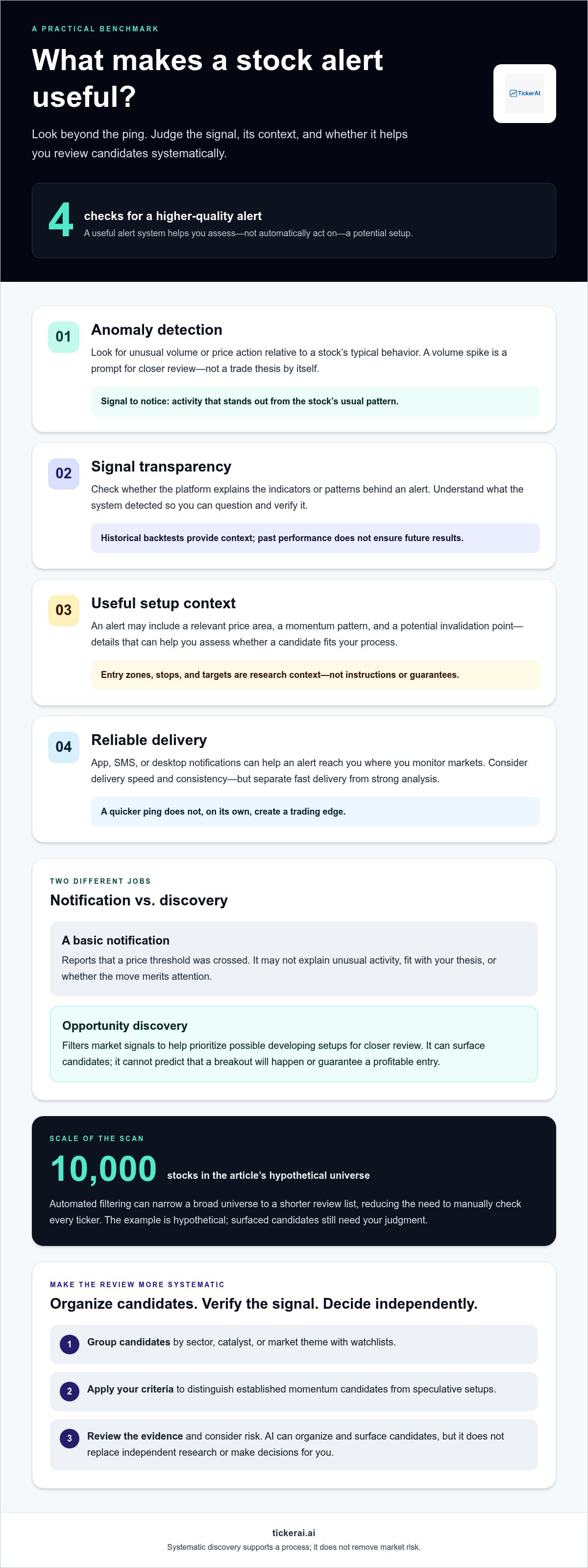
Discovery means identifying a stock that may be developing a setup before a breakout is fully underway. It does not mean predicting that a breakout will happen. The distinction matters. A basic alert is a megaphone: it announces that a threshold was crossed. A discovery system acts more like a filter, applying market signals to help prioritize candidates for closer review. No alert guarantees a profitable entry.
Automated market scanning can cover a broad universe of stocks in an initial research pass. Rather than manually checking every ticker, you can review surfaced candidates and decide which fit your strategy. This is related to an Automated Trading System (ATS), which uses programmed rules, but scanning for ideas is different from automatically executing trades. In 2026, the best stock alert app should move beyond notifications toward useful, understandable insight. TickerAI’s automated scanning, smart watchlists, and AI-driven swing trade setups help individual traders organize discovery more systematically, without making decisions for them.
The 2026 Benchmark: Core Features of a High-Performance Alert System
Real-time quotes and push notifications are only the starting point. Alert quality depends on the logic behind the ping: what the system detects, how it filters candidates, and whether you have enough context to assess a setup. The best stock alert app should help distinguish unusual activity from routine market movement, not simply deliver more updates.
- Anomaly detection: Look for alerts that flag unusual volume or price action relative to a stock’s typical behavior. A volume spike alone is not a trade thesis, but it can prompt closer review.
- Signal transparency: Check whether the platform explains the indicators or patterns behind an alert. Backtests can offer historical context, but past performance does not ensure future results.
- Useful context: A thoughtful alert may show the relevant price area, momentum pattern, and potential invalidation point. Treat entry zones, stops, and targets as research context, not instructions or guarantees.
- Reliable delivery: App, SMS, or desktop notifications can help alerts reach you where you monitor markets. Consider delivery speed and consistency, but do not confuse fast delivery with strong analysis.
AI-Powered Opportunity Discovery
AI-driven stock market analysis can scan broad market activity for combinations of momentum, volume, and price behavior that merit attention. That is different from a basic RSI or MACD threshold notification: pattern recognition can assess multiple conditions together, while you still verify the signal and consider its risks.
Some traders also look for signs of large-participant activity, sometimes called “smart money” flow. Treat these as clues, not proof of institutional buying. A credible system should make its signal logic understandable enough for you to question it.
Smart Watchlists and Thematic Filtering
Smart watchlists add structure to discovery. AI-assisted thematic research can help organize candidates by sector, catalyst, or market theme, making shifts in leadership easier to review. For example, you might separate established momentum candidates from speculative setups, then apply different research criteria to each group.
Imagine narrowing a hypothetical universe of 10,000 stocks to a short review list. Automated filtering can reduce the manual scan, but the results still need your judgment. TickerAI combines AI opportunity discovery with smart watchlists and swing trade setups to help structure that review. Explore TickerAI stock opportunity discovery and consider how it fits your workflow.
Comparing the Top Stock Alert Platforms for Different Trading Styles
Choose an alert platform based on your holding period and decision process. A tool for rapid intraday trades has different priorities from one designed to surface multi-day momentum or longer-term investment ideas. The best stock alert app for you should fit your strategy, not simply offer the most notifications.
- Day trading: For scalping and fast intraday setups, prioritize timely data, dependable delivery, and alerts you can assess quickly. Sub-minute latency may matter for these strategies, but fast notifications alone do not establish an edge.
- Swing trading: Look for multi-day momentum discovery, clear setup context, and practical exit considerations. TickerAI focuses on AI-driven swing trade setups and opportunity discovery for this style.
- Long-term investing: Favor tools that help identify themes and candidates for deeper fundamental research, rather than treating short-term price movement as a long-term thesis. Learn more about AI tools for long-term investors.
Free plans can be useful for exploring features, but data access and delivery may vary by platform and plan. Some services may delay quotes or limit alerts. Compare stated data timing with your strategy: a delay that is immaterial for long-term research could matter more for an intraday decision.
The Swing Trader’s Toolkit
Do not assess a swing alert by its wording alone. Review how the platform identifies a setup, whether it provides enough context to evaluate the thesis, and how the potential reward compares with the risk. Historical examples can help you test a signal, but accuracy and risk/reward are not guarantees of future results. Before acting, define what would invalidate the setup and how you will manage an exit.
TickerAI is designed to discover short-term swing opportunities, including multi-day momentum setups. Use its alerts as research inputs, then apply your own criteria for timing, position sizing, and risk.
Institutional Tools for Retail Investors
Quantitative investing applies defined rules and data analysis to evaluate opportunities. This systematic approach contrasts with relying only on headlines or manually checking a small watchlist. TickerAI brings automated discovery, smart watchlists, and swing trade setups into an individual trader’s workflow. Think of algorithmic alpha as a way to structure research, not a promised outcome or a replacement for independent analysis.
To explore AI-powered discovery and curated swing trade setups, visit TickerAI stock discovery.
Step-by-Step: Setting Up an Automated Market Scanning Workflow
An alert becomes useful when it feeds a consistent process. Define what qualifies as a candidate, record what happens next, and review the results before changing your rules. This turns scanning from a stream of prompts into a workflow you can evaluate.
- Set your criteria: Write down the signals you want to monitor, such as unusual volume, price momentum, or a defined catalyst. Separate swing-trade criteria from long-term research, rather than using one alert threshold for every time horizon.
- Configure discovery: Apply filters that reflect those criteria. Start with a manageable set, then adjust based on your journal instead of loosening rules after a missed move.
- Choose delivery channels: Enable the app or desktop notifications you will reliably see. If the service supports multiple channels, consider a backup for priority alerts and test that notifications arrive as expected. No system can guarantee zero missed alerts.
- Log each signal: Record the ticker, timestamp, alert reason, market context, whether it met your criteria, and the eventual outcome. Define “hit” consistently, and include alerts you passed on so you do not judge the system only by selected examples.
- Review and refine: At a regular weekly review, compare outcomes by signal type and watchlist category. Change one filter at a time so you can assess whether it improves relevance or simply reduces the number of alerts.
Build a Smart Watchlist
Group candidates by why they are on your radar: earnings, regulatory developments, mergers, sector momentum, or another catalyst. These labels organize your research; they do not confirm that an event will move a stock. You can also separate higher-priority setups from speculative ideas, then set a second review condition, such as a volume threshold or price level, before giving an alert closer attention.
TickerAI’s smart watchlists help organize ideas by theme, while AI-driven discovery and swing trade setups support a more structured review. Keep the watchlist aligned with your criteria, not with every headline that attracts attention.
Integrate Risk Management
Before acting on an alert, estimate how much capital you could lose if the idea fails. A basic position-sizing framework divides the amount you are willing to risk by the distance between a potential entry and your planned invalidation level. Adjust for volatility, and remember that stop orders may not execute at the exact price during fast moves. An alert is not an execution instruction.
Review each signal through a systematic approach to stock investing, with risk limits defined before emotion enters the decision. To put AI scanning and smart watchlists into your discovery workflow, explore TickerAI stock discovery.
TickerAI: The Professional Standard for AI-Driven Opportunity Discovery
The best stock alert app should do more than report a price change. It should help surface opportunities for review and organize research. TickerAI brings AI-powered stock opportunity discovery, automated market scanning, smart watchlists, and curated swing trade setups into one workflow. The aim is focused research, not a promise that every alert will become a winning trade.
For individual investors, this creates a more systematic way to monitor markets. Instead of manually checking every ticker, traders can use AI-driven alerts to identify candidates, then evaluate each against their own thesis, timing, and risk limits. The system supports decision-making. It does not replace it.
Automated Opportunity Discovery in Action
Think of TickerAI as a proactive scout. Automated scanning can review market activity and bring potential momentum candidates to your attention, reducing the need to perform every initial check by hand. That can help you focus on evaluating setups instead of sorting through an undifferentiated list of tickers.
“Scanning while you sleep” is best understood as a metaphor for reducing manual monitoring, not a guarantee that every emerging move will be detected or that alerts will arrive at a particular time. TickerAI provides real-time alerts for swing trade opportunities, but each signal still needs context. Check the underlying setup, assess the downside, and decide whether it fits your plan.
Choosing Between Pro and Full-Access
TickerAI offers Pro and Full-Access subscriptions. Choose based on the level of discovery and market monitoring that suits your trading frequency and research workflow. If you focus on selected swing setups, consider how alerts fit into your review routine. If you want a broader discovery workflow, consider how smart watchlists and opportunity scanning support the way you organize ideas. Compare the subscription details and select the tier that aligns with your needs, without assuming that more alerts automatically mean better decisions.
Start by defining your focus: the types of opportunities you want to track, the themes you follow, and the criteria you will use to review an alert. Then use a smart watchlist to organize relevant ideas and keep your process consistent. That structure helps make AI discovery practical from the outset.
Algorithmic discovery can systematize the first pass of market research for individual investors. Put TickerAI’s opportunity discovery and smart watchlists to work in your workflow. Explore TickerAI Full-Access and start discovering stock opportunities.
Turn Market Signals Into a More Systematic Workflow
The best stock alert app does more than send price notifications. It helps filter market activity, surface potential setups, and organize research around your trading style. Strong alert systems pair timely discovery with watchlists and clear signal context, while leaving independent analysis and risk management in your hands.
TickerAI brings these elements together through AI market scanning, curated swing trade setups, and smart watchlists. Use them to focus your review, track opportunities consistently, and reduce the pull of reactive decision-making. Alerts can support a disciplined process, but they cannot guarantee results or replace your judgment.
Ready to make opportunity discovery part of your workflow? Start your AI-driven discovery journey with TickerAI Full-Access. Build a more focused process, stay consistent, and approach each market signal with a clear plan.
Frequently Asked Questions
What is the best stock alert app for swing traders in 2026?
TickerAI is built for traders seeking AI-driven stock discovery and curated swing trade setups. Its automated scanning, real-time alerts, and smart watchlists can help surface and organize potential opportunities for review. The right app still depends on your workflow: assess how signals are generated, what context each alert provides, and whether the tool suits your holding period. No platform can guarantee profitable trades.
Do stock alert apps really work for retail investors?
Stock alert apps can help retail investors monitor market activity and identify candidates for further research. Their value depends on signal quality, data timing, and how well alerts fit a defined process. Use an alert to prompt analysis, not as an automatic instruction to trade. Check the underlying price action, relevant context, and potential risk before making an independent decision.
How do I filter out market noise in my alert app?
Start by defining which signals matter to your strategy, such as unusual volume, momentum, or a specific catalyst. Set thresholds that exclude routine movements, then organize candidates into focused watchlists by theme or time horizon. Keep a journal of alerts and outcomes, and review it regularly. Adjust filters based on consistent evidence, not because one missed move creates FOMO.
Can AI stock alerts predict market movements accurately?
AI stock alerts can identify patterns and conditions associated with potential opportunities, but they cannot predict market movements with certainty. Prices respond to changing conditions, and a signal can fail even when its logic is sound. Look for understandable signal criteria and evaluate historical results cautiously. Use alerts as research inputs, then apply independent analysis and risk management before acting.
What is the difference between a price alert and a discovery signal?
A price alert notifies you when a stock reaches a specified price or crosses a set threshold. A discovery signal aims to surface a potential setup by assessing market conditions, such as momentum or unusual activity, so you can investigate it. Neither confirms that a trade will succeed. Discovery can help prioritize research, while a price alert tracks a level you already chose.
Is it worth paying for a premium stock alert subscription?
A paid subscription may be worthwhile if its discovery tools, alert context, watchlists, and data access support your actual workflow. Compare the features you will use with the time they may save, and consider whether the alerts are relevant to your strategy. A higher tier does not ensure better returns. Track alert usefulness over time, and avoid paying for features that do not improve your research process.
How many stock alerts should I receive per day?
There is no ideal daily number for every trader. Set alert criteria so the results remain manageable enough to review carefully, rather than aiming for a particular volume. If alerts routinely go unread or trigger impulsive decisions, tighten your filters or narrow your watchlists. If few alerts appear, check whether your criteria are too restrictive. Use your journal to guide adjustments.
Can I use TickerAI for long-term investment ideas?
Yes. TickerAI provides long-term investment ideas alongside AI-driven stock discovery, swing trade setups, smart watchlists, and real-time alerts. Use long-term ideas as starting points for your own research, including a review of the company and your investment thesis. TickerAI offers data-driven discovery, not personalized financial advice or a guarantee of performance. Match the tool to your time horizon and decision process.


