

What if better stock research came from fewer, stronger signals rather than more tabs, charts, and commentary? A repeatable stock research workflow turns an initial idea into a decision by testing it against evidence at each stage. That matters when filings, market data, headlines, and opinions compete for attention, and a promising setup still needs a clear risk case.
Research can feel fragmented, but a consistent process helps you separate verified facts from assumptions and unanswered questions. Automated stock scanning can surface candidates for your research queue, while watchlists and alerts can help you track developments. Neither replaces checking the evidence or deciding whether the risks fit your approach.
This guide lays out a practical sequence: define the investment case, review the business and its financials, assess valuation and catalysts, test the downside, then document a conclusion you can revisit. At each checkpoint, identify what supports the idea, what could weaken it, and what still needs verification. The goal isn’t certainty. It’s a clear, risk-aware decision record you can monitor as new information arrives.
Key Takeaways
- Use a stock research workflow to move from an initial idea to a documented decision through clear evidence checkpoints.
- Start with company filings, financial statements, and relevant market data, then separate verified facts from assumptions and open questions.
- Compare fundamental evidence, technical context, news, and sentiment by what each can indicate and what it cannot prove.
- Record your thesis, sources, risks, timeframe, and review triggers so you can monitor the idea and revisit your reasoning.
- Use AI discovery, watchlists, and alerts to surface candidates and flag changes, then verify the evidence yourself.
What a Stock Research Workflow Does Before You Consider a Trade
A stock research workflow is a repeatable sequence for testing an investment idea against evidence, recording uncertainty, and deciding what to examine next. It gives each candidate the same basic review instead of letting a compelling headline or sudden price move set the agenda.
The workflow is a research tool, not a forecast. It can help you assess a company’s business, financial position, valuation, and risks, but it can’t remove uncertainty or market risk. Fundamental analysis examines economic and financial factors to evaluate a security, providing a structured lens for investigating the company behind a ticker.
Keep the boundaries clear. Research evaluates an idea; execution is the separate act of placing a trade. Portfolio construction considers how an investment fits with other holdings, objectives, and risk exposure. A research process can inform those decisions, but it isn’t personalized financial advice or a guarantee of returns.
Why repeatability matters when researching stocks
Headlines and isolated price moves can demand attention without changing a company’s underlying prospects. A documented process creates a pause between the signal and your response. Ask the same questions each time: What is the thesis? Which evidence supports it? What could invalidate it? What remains unknown?
Applying those questions across candidates makes ideas easier to compare. You can also review your reasoning later, including whether a conclusion relied on verified information or an assumption. That’s process discipline, not certainty. New disclosures, market conditions, or business developments can change the picture.
What the workflow should produce
Keep the output concise enough to revisit. A useful research record captures:
- Thesis: The reason the company merits further consideration.
- Evidence: The relevant sources and what they show.
- Risks: Factors that could undermine the thesis.
- Assumptions and open questions: What you’re inferring and what still needs verification.
- Review triggers: Developments that would strengthen or weaken the case.
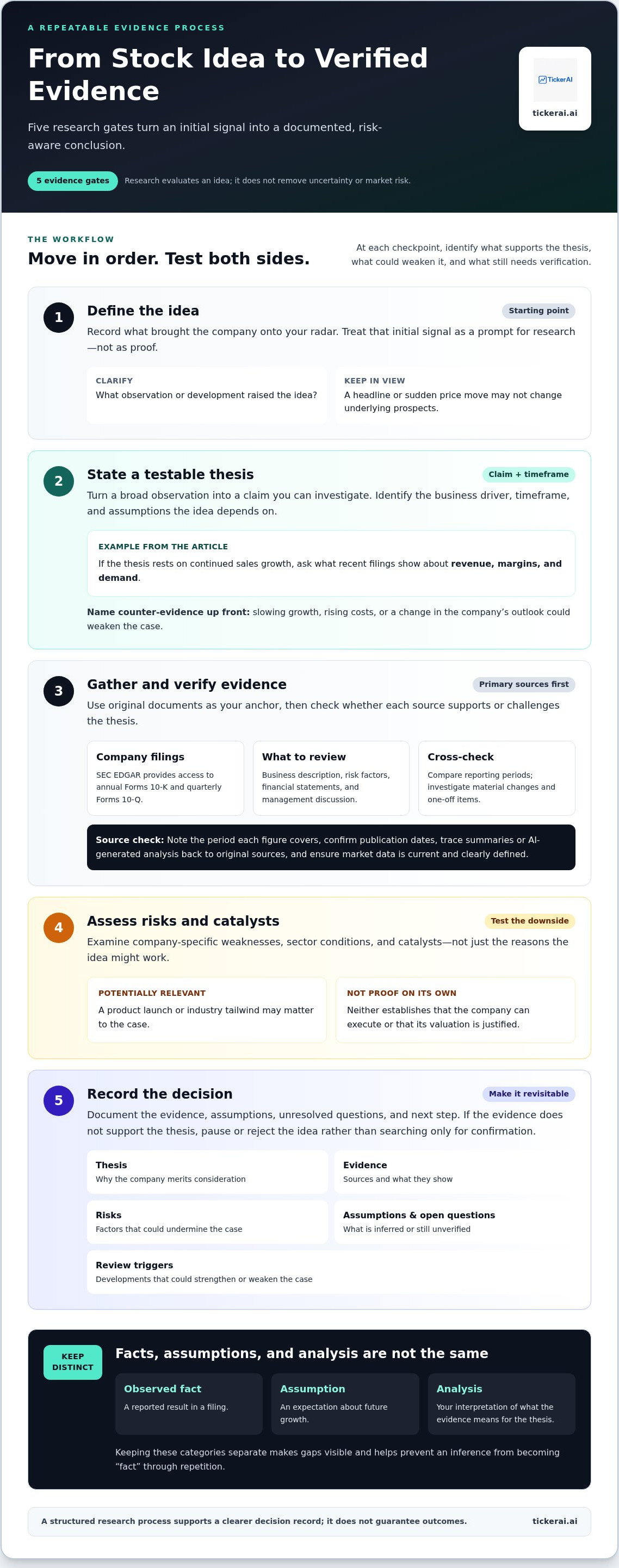
Label each point accurately. A reported result in a filing is an observed fact; an expectation about future growth is an assumption; your interpretation of what either means for the thesis is analysis. Keeping those categories separate makes gaps visible and prevents an inference from becoming “fact” through repetition.
Finally, record the idea’s status: under review, on a watchlist, rejected, or considered for a decision. This creates a clear handoff from initial research to later monitoring. The next sections explain how to gather evidence and compare different research signals.
The Core Research Stages: From Stock Idea to Verified Evidence
A useful stock research workflow moves in order: define the idea, state a testable thesis, gather primary evidence, assess risks, and record the result. Each stage answers a different question. If the evidence fails to support the thesis, pause or reject the idea rather than searching only for confirmation.
Start with a testable thesis and research question
Turn a broad observation such as “this company could benefit from rising demand” into a claim you can investigate. Identify the business driver, the timeframe you’re considering, and the assumptions the idea depends on. For example, if the thesis rests on continued sales growth, ask what recent filings show about revenue, margins, and demand.
Define the counter-evidence up front. Would slowing growth, rising costs, or a change in the company’s outlook weaken the case? Naming possible disconfirming evidence helps keep research balanced. This overview of how you can research stocks can also help you organize questions before reviewing a specific company.
Verify company information before drawing conclusions
Use original documents as your anchor. SEC EDGAR provides access to company filings, including annual Forms 10-K and quarterly Forms 10-Q, where relevant. Review the business description, risk factors, financial statements, and management discussion. Compare results across reporting periods, and investigate material changes rather than relying on a headline or a single figure.
Check whether an apparent shift reflects ongoing operations or a one-off item, and note the period each figure covers. Confirm publication dates and trace summaries or AI-generated analysis back to original sources. Market data can add context, but make sure it’s current and clearly defined before using it to support a conclusion.
Move through the evidence gates
- Define the idea: Record what brought the company onto your radar, without treating the initial signal as proof.
- Identify the thesis: State what you believe may happen, why, and over what timeframe.
- Gather evidence: Review filings, financial statements, and relevant market data. Check whether each source supports or challenges the thesis.
- Assess risks: Examine company-specific weaknesses, sector conditions, and catalysts. A product launch or industry tailwind may matter, but neither establishes that the company can execute or that its valuation is justified.
- Record the decision: Note the evidence, assumptions, unresolved questions, and next step. The outcome may be further research, watchlist monitoring, or rejection.
Source quality and publication date determine how much confidence a stock data point deserves. A figure from an original filing carries different weight from an undated summary, and even reliable information can become stale. Automated scanning can surface candidates for review. AI stock opportunity discovery can support that first pass, while you verify the evidence behind each idea.
How to Compare Research Signals Without Mistaking Them for Proof
Research signals answer different questions. A filing shows what a company reported; a price chart shows how the market has traded; a headline may flag a possible catalyst. Your stock research workflow gets stronger when you compare each input by its purpose, limits, and source rather than treating every signal as equally strong evidence.
| Input | What it can indicate | What it cannot establish | Useful verification source |
|---|---|---|---|
| Fundamental evidence | Reported financial performance, business changes, and disclosed risks. | Future growth, fair value, or whether the market will reward the company. | Company filings, financial statements, and investor relations materials. |
| Technical context | Historical price and volume behavior, including trends or changes in trading activity. | The cause of a move or the direction of future performance. | Historical market data from a clearly dated source. |
| News catalysts | Developments that could affect the company or influence expectations. | Whether the impact will be lasting, material, or already reflected in the price. | The company announcement, relevant filing, or original source cited in the report. |
| Sentiment signals | Market attention, expressed opinions, or available indicators of positioning. | Business quality, intrinsic value, or a reliable forecast of price direction. | The original data provider, with its date, methodology, and defined measure. |
Fundamental evidence versus market and technical context
Start with the research question and timeframe. If you’re assessing a company’s long-term operating performance, filings and financial statements are central. Price and volume can add context about market behavior, but a breakout or sell-off doesn’t verify the underlying business thesis. For a shorter-term question, technical context may be more relevant, but it still can’t prove what happens next.
Be cautious when several indicators appear to agree. They may reflect the same underlying event, such as a widely reported announcement driving price movement, trading volume, and online discussion. Agreement can increase interest in an idea, but it doesn’t turn uncertain signals into certainty. For more on evaluating algorithmic outputs, see how to interpret AI stock signals.
Catalysts, sentiment, and conflicting information
Before relying on a catalyst, check whether it’s confirmed, when it occurred, and how it connects to the thesis. A rumor and a company filing aren’t equivalent. Even a confirmed event may be immaterial to the business or already anticipated by the market.
Treat sentiment as attention, not valuation. If positive commentary conflicts with weaker reported fundamentals, record both signals and identify what could resolve the disagreement: a later company disclosure, updated financial results, or confirmation from the original catalyst source. Preserve the conflict in your notes instead of selecting only the evidence that supports your preferred conclusion.
Turn Stock Research Into a Decision Record and Monitoring Plan
Research has more value when you can return to the reasoning behind it. A concise decision record captures what you believed, what supported that view, and what could change it. It also makes the next step explicit, whether that’s continued research, watchlist monitoring, or a decision to move forward independently.
Create a concise, reviewable stock research record
Summarize the thesis and supporting evidence in plain language before settling on a conclusion. Keep source details close to each claim so you can verify what you relied on and whether it’s still current. A practical template includes:
- Thesis: The central claim and why the company merits consideration.
- Sources: Document or data source, publication date, and relevant finding.
- Assumptions: Conditions you’re relying on but can’t yet treat as established facts.
- Risks and open questions: Factors that could weaken the case or need further investigation.
- Timeframe: The period your thesis concerns, not a prediction that an outcome will occur by then.
- Review triggers: Company developments, reported results, or changes in assumptions that warrant another look.
Record what would invalidate the thesis, but don’t mistake that note for a universal exit rule. The record makes your reasoning testable and reviewable. Systematic quantitative investing offers a broader example of a rules-based approach, though the purpose of this record is to make the reasoning behind an individual research idea clear.
Set monitoring triggers and review the process
Assign the idea a clear status. An investment decision means you’ve reached a conclusion for your own situation; a watchlist candidate needs more evidence or a relevant change before you reconsider it; a rejected idea doesn’t currently meet your research criteria. This distinction keeps an interesting ticker from being confused with a completed decision.
Monitor the evidence tied to the thesis, not every price fluctuation or passing headline. If the case depends on sales growth, a reported result or revised company outlook may deserve review. If it depends on a stated catalyst, look for a verified update. Smart watchlists and alerts can bring relevant changes back to your attention, but they don’t determine what those changes mean. Smart stock watchlists and alerts can help organize this monitoring.
Use each review to assess the quality of the process separately from the stock’s short-term performance. Ask whether your sources were reliable, assumptions were visible, risks were considered, and new information was handled consistently. A sound process can still lead to an uncertain outcome.
Where AI Stock Research Tools Fit in a Human-Led Workflow
AI tools can widen the discovery funnel and help organize attention. They can scan for patterns, surface candidates, or flag changes. That’s an efficient input to a stock research workflow, not a verdict on whether a company is worth buying. Treat each output as a prompt for verification, not as a certified thesis or a prediction.
Use automation to widen discovery, then verify
Start by identifying the tool’s role. A scanner may identify stocks that meet selected criteria; a summary may organize information; an alert may call attention to a change. These functions can help you decide what to investigate next, but they don’t remove the need to check the underlying evidence.
Before relying on a generated summary, trace important claims to original company filings, financial statements, or the source of the market data. Check dates and reporting periods. If an AI-generated note says a company’s revenue is accelerating, confirm the figures and compare them across relevant periods. If you can’t verify a claim, keep it labeled as an open question rather than treating it as fact.
The researcher remains responsible for interpreting evidence and making any investment decision. AI-generated ideas and alerts can be useful signals, but they don’t guarantee outcomes or establish that a thesis is sound.
Choose workflow support that matches the research task
Different research horizons call for different follow-up. For a swing trade candidate, curated setups and alert monitoring can bring price or market developments back to your attention. Recheck whether the change matters to the setup and its assumptions; an alert by itself isn’t an instruction to act.
For longer-horizon research, use long-term investment ideas as discovery inputs, then track company developments against the thesis. Smart watchlists and real-time alerts can surface updates for review without making every market fluctuation a reason to revisit the entire case. If a sector theme shapes your search, thematic investment opportunity research can be another way to frame discovery.
TickerAI provides AI stock opportunity discovery, curated swing trade setups, long-term investment ideas, smart watchlists, and real-time alerts through its Full-Access and Pro subscription tiers. These tools support finding and monitoring candidates; they don’t provide personal financial advice or execute trades. Use them to focus your research, then verify the evidence and make your own decision.
Make Your Next Stock Idea Easier to Review
A reliable stock research workflow turns scattered information into a reasoned, reviewable decision. Define a testable thesis, verify it against credible sources, and compare fundamental evidence with market context without treating any signal as proof. Then document assumptions, risks, and the developments that would prompt another review.
That record matters after the initial analysis, too. Watchlists and alerts can bring thesis-relevant changes back into focus, while the final interpretation and decision remain yours. A disciplined process won’t remove uncertainty, but it can make your reasoning clearer and more consistent.
TickerAI supports discovery and follow-up with AI-powered market scanning, smart watchlists, real-time alerts, and investment ideas through Full-Access and Pro subscription tiers. Use these tools to surface candidates and organize research, then verify the evidence yourself. Explore AI-powered stock discovery with TickerAI and build a more structured research queue.
Start with one idea, apply the same evidence checks, and keep a record you can learn from. Better decisions begin with a process you can repeat.
Frequently Asked Questions
What is a stock research workflow?
A stock research workflow is a repeatable sequence for evaluating an investment idea against evidence. It can include defining a thesis, gathering company and market information, assessing risks, documenting a conclusion, and setting review triggers. Keep reported facts separate from assumptions and your own interpretation. A consistent process can make decisions easier to compare and revisit, but it can’t remove uncertainty, guarantee performance, or replace personal judgment.
How do you research a stock step by step?
Start with a testable thesis and a timeframe. Review current company filings and financial information, then assess relevant industry context, market behavior, catalysts, and risks. Verify material claims against original sources, such as company filings or announcements. Record the evidence that supports or challenges your thesis, along with assumptions and open questions. Then decide whether to keep researching, monitor the stock, or close the review, and note what would trigger another look.
What sources should I use for stock research?
Begin with company filings and financial statements. Relevant annual Forms 10-K and quarterly Forms 10-Q are available through SEC EDGAR. Add company announcements and reliable market data when they help answer your research question. News and commentary can point you toward issues to investigate, but verify important claims using primary sources. Record each source’s publication date and the reporting period it covers, since context and recency affect interpretation.
Can AI help with stock research?
Yes. AI tools can surface stock ideas, organize information, and flag developments for further review. TickerAI offers AI-powered stock discovery, curated swing trade setups, long-term investment ideas, smart watchlists, and real-time alerts. Treat generated summaries and signals as research inputs, not forecasts or personalized recommendations. Verify important claims against original sources and check dates and context. You remain responsible for interpreting the evidence and making your own investment decisions.
How long should stock research take?
There’s no fixed research time that suits every company or question. A straightforward business may require less investigation than a complex company with changing operations or unclear disclosures. Let the evidence, not an arbitrary deadline, guide the process. A consistent stock research workflow can focus attention on material information, but don’t rush source checks to reach a conclusion. If important questions remain unresolved, record them and keep the idea open for further review.
What is the difference between stock research and stock screening?
Stock screening narrows a broad set of stocks using selected criteria, such as financial or market characteristics. Stock research examines an individual candidate in greater depth by testing a thesis, reviewing evidence and risks, and documenting what could change the assessment. Screening can help generate ideas for further investigation, but meeting a filter’s criteria doesn’t establish whether a stock is appropriate for a particular investor or portfolio.
How do I know when a stock research process is complete?
Research is ready for a decision checkpoint when you’ve documented the thesis, relevant evidence, assumptions, risks, and unresolved questions. Completion doesn’t mean every uncertainty has disappeared. Identify what could invalidate the thesis and which developments would prompt a review. If critical evidence is missing or conflicting, keep the idea under review rather than forcing a conclusion. A clear record also helps you revisit the reasoning when new information arrives.


