

What if the strongest early clue isn’t a dramatic breakout, but several smaller signals lining up first? Finding stocks before they explode 2026 isn’t about predicting a sudden surge. It means spotting a developing setup early enough to assess the evidence, before a sharp move turns a promising candidate into a tempting chase.
If you’re sorting through too many tickers, conflicting predictions, and indicators that don’t agree, the challenge is separating meaningful evidence from market noise. This guide lays out a repeatable workflow for screening stocks in 2026, checking whether momentum has support, and defining risk before considering a trade. No single signal makes a stock a sure thing.
You’ll learn how to combine price action, liquidity, catalysts, and risk checks, then monitor candidates for confirmation instead of reacting to every spike. AI-powered discovery tools such as TickerAI can help surface and track ideas through smart watchlists and alerts. These tools support research; they don’t validate a thesis or guarantee a result. The goal is a focused shortlist with clear next steps, not a prediction or a reason to chase.
Key Takeaways
- For finding stocks before they explode 2026, look for developing evidence and keep candidates under observation instead of treating early activity as a buy signal.
- Filter a defined stock universe for meaningful trading activity, then assess each candidate in its broader market and company context.
- Compare early clues with breakout confirmation and warning signs. RSI and MACD add context, but don’t make decisions on their own.
- Record each setup’s thesis, catalyst, timeframe, invalidation conditions, and next review point to make monitoring more disciplined.
- Use AI-powered scanning, watchlists, and alerts to organize discovery and follow-up, then independently assess whether the evidence still supports your thesis.
What Does Finding Stocks Before They Explode in 2026 Actually Mean?
“Finding stocks before they explode” is shorthand for noticing evidence that a stock may be developing momentum before it attracts widespread attention. It doesn’t mean knowing which ticker will surge or treating a screening result as an instruction to buy. In technical analysis, momentum in technical analysis describes patterns in price movement. It helps frame what the market is doing, not predict with certainty what comes next.
Quotable definition: Finding stocks before they explode means identifying and monitoring developing evidence of potential momentum. No screening signal guarantees future performance.
Keep four stages distinct. A watchlist candidate meets criteria worth following but may have no actionable setup. A developing setup shows improving evidence, such as firmer price action or changing trading activity, that still needs context and follow-through. A confirmed move has passed a confirmation point you defined in advance, though it can still fail. An extended stock has already moved substantially relative to its recent pattern, which may leave less room for a measured entry and increase the risk of chasing.
Early momentum versus chasing a stock after a sharp move
A ticker may reach headlines, social feeds, and screening results only after a large part of its move has happened. That visibility can feel like confirmation, but attention alone doesn’t show whether momentum is durable or whether the price has become extended.
Early observation means spotting a candidate, recording what would strengthen or weaken the thesis, and waiting for relevant evidence. Buying solely because a chart is trending online is different: it lets urgency replace a plan. A watchlist entry is a prompt to investigate, not a trade or investment decision.
Why no indicator can identify every future market winner
Indicators summarize observable market conditions. They can help compare price behavior or flag a change in activity, but they can’t account for every new development, shift in sentiment, or change in the broader market. A signal may look promising and then reverse. That’s a false breakout: the price moves beyond an observed level but fails to sustain the move.
Signals also depend on the evidence available at the time. Company information may be incomplete, and market conditions can change while a setup is developing. For finding stocks before they explode 2026, the practical goal isn’t to eliminate uncertainty. It’s to separate what you’ve observed from what you’re assuming, then review the candidate as new evidence arrives.
How to Screen for Stocks Showing Early Signs of Momentum
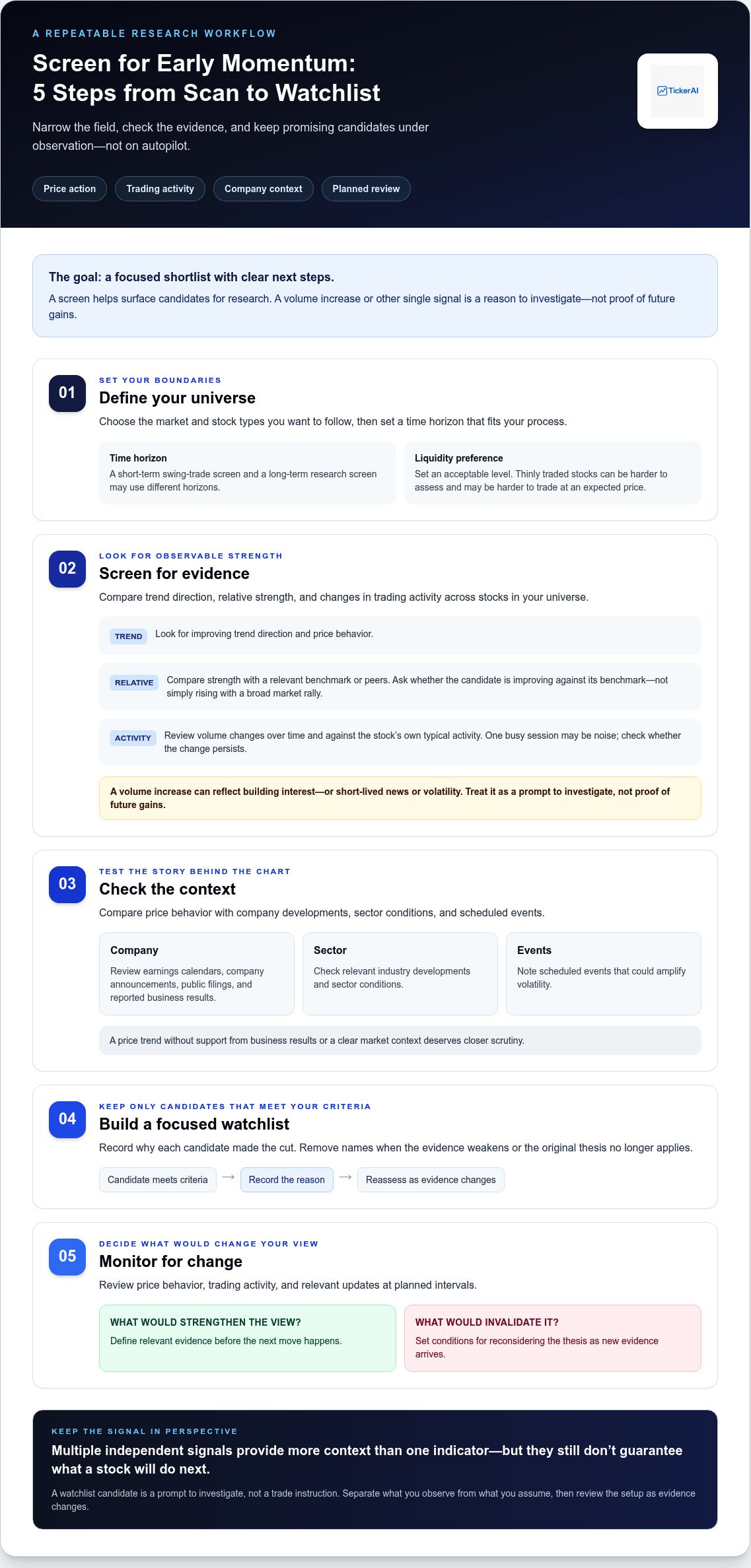
A useful screen narrows the field without pretending to predict the next big move. For finding stocks before they explode 2026, use a repeatable sequence: set your boundaries, identify observable strength, check what may be driving it, then monitor the strongest candidates.
- Define your universe. Choose the market and stock types you want to follow, then set a time horizon that fits your process. Decide what level of liquidity is acceptable to you. Stocks with thin trading activity can be harder to assess and may be more difficult to trade at an expected price.
- Screen for evidence. Look for improving trend direction, relative strength compared with a relevant benchmark or peers, and changes in trading activity. A volume increase can signal building interest, but it may also reflect short-lived news or volatility. Treat it as a reason to investigate, not proof of future gains.
- Check context. Compare the chart with company developments, sector conditions, and scheduled events. A price trend without support from business results or a clear market context deserves closer scrutiny.
- Build a focused watchlist. Keep candidates that meet your criteria and record why each one made the cut. Remove names when the evidence weakens or the original thesis no longer applies.
- Monitor for change. Review price behavior, trading activity, and relevant updates at planned intervals. Define what would strengthen or invalidate your view before the next move happens.
Quotable rule: Multiple independent signals provide more context than one indicator, but they still don’t guarantee what a stock will do next.
Build a useful first-pass stock screen
Start with constraints you can apply consistently. A short-term swing-trade screen and a long-term research screen may use different time horizons, but both benefit from a clear liquidity preference. Then compare trend direction and relative strength across stocks in your universe. Ask whether a candidate is improving against its benchmark, rather than simply rising alongside a broad market rally. Check volume changes over time and against the stock’s own typical activity. One busy session may be noise, so look at whether the change persists.
Check catalysts and fundamentals before adding a candidate
Before adding a ticker, review its earnings calendar, company announcements, and relevant industry developments. Use public filings and reported business results to test whether the market narrative matches the company’s performance. Note upcoming events that could amplify volatility, such as an earnings release, or weaken the technical setup if results or news disappoint. AI-powered scanning and smart watchlists, such as TickerAI stock discovery tools, can help organize candidates and follow-up. Use them as research support, then assess the evidence independently.
How to Compare Early Signals, Breakout Confirmation, and False Positives
A stock can show promising clues without having a confirmed breakout. Separating the stages helps prevent an early signal from being mistaken for proof, or a late, extended move from being treated as a fresh setup. Use the comparison below to assess what the evidence says now and decide what would change your view.
| Stage | Evidence to assess | What to watch for |
|---|---|---|
| Early clues | Relative strength is improving, price structure is firming, or trading activity is changing. | Look for agreement across different evidence types. Treat each clue as a reason to investigate, not a forecast. |
| Breakout confirmation | Price moves through a level you identified in advance and shows follow-through consistent with your thesis. | Check whether the move holds up over your chosen timeframe and whether volume and catalyst context support it. |
| Possible failure | Price quickly falls back below the level, follow-through fades, or the original catalyst changes materially. | Reassess the thesis. A failed move may weaken the setup even if one indicator still looks positive. |
Risk statement: Confirmation can reduce ambiguity about what the market is doing, but it can never eliminate the risk that a breakout will fail.
Which signals may suggest a setup is developing?
Start with observable behavior. Relative strength can show whether a stock is improving against a relevant benchmark or its peers. Changing volume may indicate a shift in participation, while price structure can show whether the stock is holding gains or repeatedly retreating. None of these clues reliably forecasts an explosive move.
Look for different evidence types to reinforce a hypothesis, rather than stacking indicators that measure similar price behavior. RSI and MACD can help describe momentum or a change in trend, but neither is a standalone buy instruction. An alert, chart pattern, or screener result can’t remove uncertainty or replace independent judgment. For finding stocks before they explode 2026, use signals to prioritize research, then test them against the stock’s context and your own criteria.
What can invalidate a breakout thesis?
Reassess when price fails to follow through, trading activity no longer supports your interpretation, or new information materially changes the catalyst. A pullback alone doesn’t automatically invalidate a setup. Its meaning depends on the stock’s structure, timeframe, and the conditions you defined beforehand.
Write down those conditions while the setup is still under review. For example, specify what price behavior, volume context, or company development would make you revisit the thesis. That record helps distinguish a normal fluctuation from evidence that the original case may no longer hold. A screener can flag a change; your review determines its significance.
How to Turn a Promising Stock Candidate into a Monitored Setup
A screen identifies names to investigate. A monitoring plan makes the next review more disciplined. For finding stocks before they explode 2026, treat each candidate as a working thesis: capture the evidence, note what could change it, and decide when you’ll reassess. An alert can prompt that review. It shouldn’t automatically trigger a trade.
Create a watchlist entry that is useful later
Keep the entry concise enough to scan, but specific enough to test. Record:
- Signal observed: What changed in price structure, relative strength, or trading activity?
- Thesis and context: Why might the move be developing, and what company or industry information supports that view?
- Catalyst and timeframe: What event or condition matters, and is this a short-term swing-trade candidate or a longer-term research idea?
- Invalidation conditions: What evidence would make you reconsider the thesis?
- Next review point: When will you check the chart, company updates, and catalyst again?
Separate short-term setups from long-term ideas. Their timeframes and review questions differ. Use conditions you define for reassessment rather than relying on a vague price target. For a swing candidate, you might monitor whether price holds a level identified in advance. For a long-term idea, you might focus on whether new reported results still support the business thesis.
Review risk before acting on a fast-moving setup
Before making an independent decision, assess volatility, liquidity, upcoming events, and the potential downside if the thesis fails. An earnings date, for example, can change the risk profile of a chart setup. Consider whether the stock’s trading activity fits your requirements and whether a sudden price move leaves room to follow your plan.
Position size and stop placement depend on your circumstances, timeframe, and risk plan. There’s no universal setting that suits every stock or investor. Define these choices before urgency takes over, and reassess them if the evidence changes. A written process can also help separate a deliberate decision from an emotional reaction. The principles in “Using AI to Remove Emotion from Trading” offer another lens on maintaining discipline.
Smart watchlists and real-time alerts can keep a candidate visible and flag conditions for review. Treat each alert as a prompt to check the evidence, not an instruction to act. Explore TickerAI smart watchlists and alerts to support candidate discovery and monitoring within your own research process.
How TickerAI Helps You Discover and Track Stock Opportunities
Finding stocks before they explode 2026 takes more than a scan. It takes a process for surfacing candidates, checking the evidence, and tracking what changes. TickerAI fits as a discovery and monitoring layer in that process. Its AI-powered stock opportunity discovery helps surface ideas for further research, while smart watchlists and real-time alerts help keep selected candidates on your radar.
TickerAI offers Full-Access and Pro subscription tiers with AI-driven stock discovery, smart watchlists, and real-time market alerts. Subscribers also receive curated swing trade setups and long-term investment ideas based on automated market analysis. These tools can organize discovery and monitoring, but a surfaced idea isn’t a validated thesis or an instruction to trade. Assess the company and market context, compare signals with your timeframe, and decide what would strengthen or weaken the setup.
Use AI discovery to surface candidates for further research
Automated scanning can bring potential opportunities across market data into view, reducing the need to manually track every ticker. Use a surfaced candidate as a starting point: review its price behavior, trading activity, relevant company information, and any catalyst before deciding whether it merits a place on your watchlist.
TickerAI also provides curated swing trade setups and long-term investment ideas. These offer different research starting points, but each needs to be assessed against your own objectives and evidence standards. For more context on how this type of tool fits a research process, read a guide to the AI stock discovery platform.
Choose a consistent way to monitor ideas
Once a candidate passes your initial screen, add it to a smart watchlist and use real-time alerts to flag developments for review. An alert can draw attention to a price or market change; it can’t determine whether that change supports your thesis. Compare each notification with your original rationale, timeframe, catalyst, and risk rules. If those no longer fit, reassess the candidate rather than reacting automatically.
Consistency matters more than alert volume. Keep the watchlist focused, record why each name remains under review, and revisit the evidence when an alert or planned review point prompts you to do so. A buyer guide on evaluating an AI stock picking service can help frame what to consider when assessing an AI-assisted research tool.
Put discovery and monitoring into practice with TickerAI stock discovery. Use surfaced ideas to build a focused research list, then make each decision through your own analysis.
Build a Repeatable Process for Your Next Stock Candidate
Finding stocks before they explode 2026 is about recognizing developing evidence, not calling a guaranteed winner. A repeatable workflow helps you narrow the field, compare momentum clues with company and market context, and distinguish a developing setup from a confirmed or potentially failing move.
Keep candidates on a focused watchlist with a recorded thesis, timeframe, catalyst, and conditions for reassessment. Treat alerts as prompts to review the evidence, not automatic trade instructions. Screening can bring opportunities into view, but independent research and risk decisions remain essential.
TickerAI supports that workflow with AI-powered stock opportunity discovery, smart watchlists, real-time alerts, and curated swing trade setups and long-term investment ideas. Use these research inputs to organize what to investigate and monitor, then decide whether each candidate fits your own criteria.
Explore TickerAI's stock discovery tools to organize your research and monitoring. Stay curious, stay selective, and let the evidence guide your next review.
Frequently Asked Questions
Can you really find stocks before they explode?
Yes, you can identify stocks showing developing momentum, but you can’t know in advance which will surge. Finding stocks before they explode 2026 means screening for observable clues such as improving relative strength, changing volume, and constructive price structure, then monitoring for follow-through. Treat a candidate as a research lead, not a forecast. False breakouts, new information, and changing market conditions can all alter a setup.
What indicators can help identify a stock before a breakout?
Trend direction, relative strength, volume behavior, and price structure can help flag a stock for closer review. RSI and MACD may add context about momentum, but neither should function as a standalone buy signal. Compare indicators with independent evidence, such as company results, scheduled earnings, or relevant industry developments. The aim is a clearer view of the setup, not a metric that predicts every breakout.
How do I find stocks before they become popular?
Start with a defined market universe and time horizon, then screen for improving price behavior, relative strength, and trading activity that fits your liquidity needs. Check company announcements, public filings, and reported results to test the story behind the chart. Add candidates that meet your criteria to a watchlist and note what would strengthen or weaken the thesis. This keeps discovery systematic instead of relying on trending posts.
Is a volume spike a reliable sign that a stock will rise?
No. A volume spike shows increased trading activity, but it doesn’t establish why activity increased or whether the price move will continue. It may accompany a catalyst, a temporary news reaction, or a move that quickly reverses. Compare volume with the stock’s usual activity, price behavior, and company or sector context. Use an unusual change as a prompt for further research, not as proof of future gains.
Can AI identify stocks before they make a big move?
AI-powered tools can scan market data and surface stocks for further research, but they can’t guarantee which candidates will make a big move. TickerAI provides AI-powered stock opportunity discovery, curated swing trade setups, and long-term investment ideas, along with smart watchlists and real-time alerts. Treat surfaced ideas as research inputs. Review each one against your own thesis, relevant company information, timeframe, and risk rules before making an independent decision.
What should I do after finding a potential breakout stock?
Record why the stock caught your attention, the catalyst or context, your timeframe, and the evidence that would invalidate your thesis. Add it to a focused watchlist and set a clear point to review it again. Before acting, assess liquidity, volatility, upcoming events, and potential downside. A promising chart is a reason to investigate and monitor, not an obligation to enter a position.
Are stock alerts enough to make an investment decision?
No. An alert can flag a price or market change, but it can’t determine whether that change fits your investment goals or confirms your thesis. Use it as a prompt to review the stock’s current evidence, company context, timeframe, and risk. Then decide independently whether the setup still meets your criteria. Alerts support monitoring; they don’t replace research or make the decision for you.


