

A high AI score doesn’t automatically make a stock research tool the right fit. The best TickerAI alternatives depend on where their signals come from and how they fit into your process. Tools range from stock scorers to real-time screeners and trading bots, so comparing headline features alone can hide important differences.
If you’re unsure how stock discovery differs from alerts or trade execution, start by separating those tasks. An AI-generated idea is a research input, not a personalized recommendation or a guaranteed prediction. A tool should support your decisions, not replace your risk controls.
This comparison breaks down TickerAI alternatives by signal source, workflow, and fit, helping you build a practical shortlist for your trading horizon. You’ll see how different platforms approach stock scoring, technical analysis, monitoring, and automation, plus what to check before relying on their outputs. TickerAI is included as a stock research and discovery option, with smart watchlists, alerts, and stock ideas, not brokerage execution or personal financial advice.
Key Takeaways
- Compare TickerAI alternatives by the signals they analyze, the research task they support, and how their alerts fit your process.
- Separate idea discovery and technical analysis from monitoring and brokerage execution before choosing a platform.
- Match tool categories to your horizon, whether you’re researching swing-trade setups, long-term ideas, chart patterns, or alternative data.
- Before subscribing, inspect sample alerts, methodology, market coverage, update cadence, limitations, and cancellation terms.
- Assess TickerAI as a research option for stock discovery, watchlists, alerts, and curated ideas, then verify current plan details and platform features.
What counts as a TickerAI alternative for stock research?
A TickerAI alternative is any tool that supports a similar research need, even if it uses different data or handles a different step in your workflow. One platform may scan for stock ideas; another may analyze chart patterns or monitor company-related signals. A shared purpose doesn’t mean the tools have identical features.
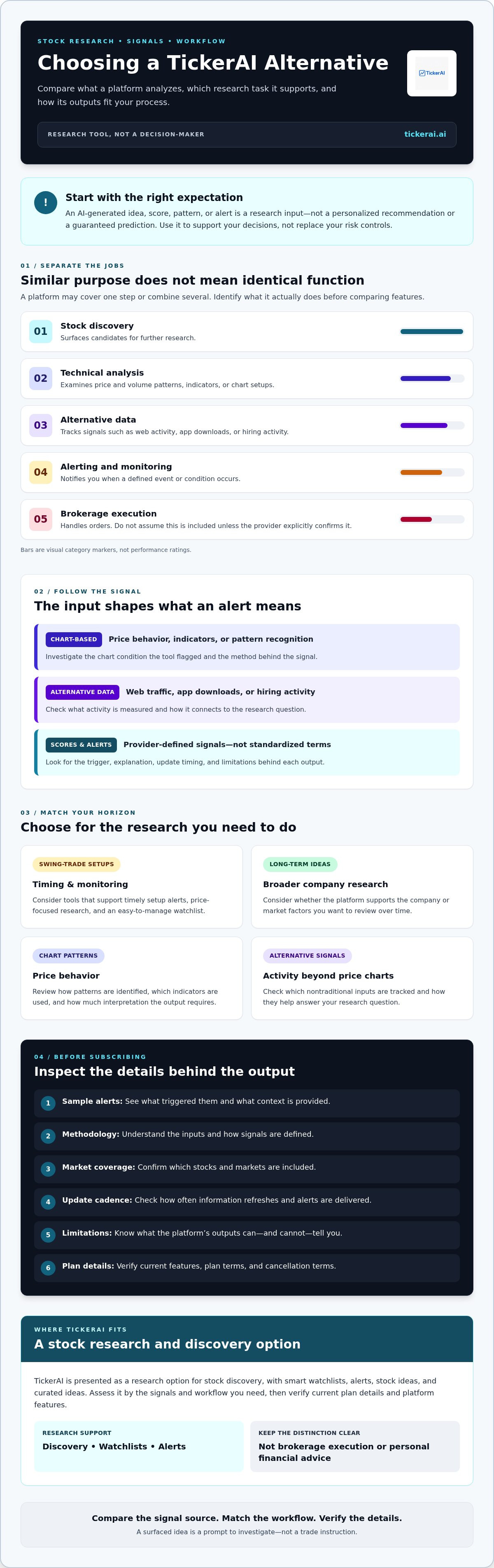
Separate the main functions before comparing platforms:
- Stock discovery: Surfaces candidates for further research.
- Technical analysis: Examines price and volume patterns, indicators, or chart setups.
- Alternative data: Tracks signals such as web activity, app downloads, or hiring activity.
- Alerting: Notifies you when a defined event or condition occurs.
- Brokerage execution: Handles orders. This is distinct from research, and should only be assumed when a provider explicitly confirms it.
Some platforms combine several functions; others focus on one. Their shared purpose is to help organize research, not to make the decision for you. Algorithm-based methods are part of algorithmic trading, but an AI score, alert, or pattern is still an analytical input. It can help filter information, but it can’t guarantee a market outcome or establish that an investment suits your circumstances.
Which jobs can an AI stock research tool perform?
A research tool may scan a market, surface candidates that match its signals, organize them into watchlists, and notify you when conditions change. Some tools focus on short-term swing setups, where timing and price movement may be central to the research task. Others support longer-horizon investment research, where you may focus more on business or market factors over time.
Check what happens after an alert. Research platforms typically provide information for review; order placement belongs to a brokerage unless the provider explicitly confirms execution functionality. Treat a surfaced idea as a prompt to investigate, not a trade instruction.
Why are stock research platforms not interchangeable?
The inputs shape what a platform can help you investigate. A technical-pattern tool may flag price behavior, while an alternative-data service may track activity beyond conventional price charts. Compare data coverage, alert timing, and the explanation behind each signal. Consider how much interpretation the output requires before it becomes useful to you.
Your time horizon also changes the trade-offs. A swing trader may prioritize timely setup alerts and an easy-to-manage watchlist. A long-term investor may value broader company research and a slower review cadence. An AI score, forecast, and alert aren’t equivalent evidence: each communicates something different, and none removes the need to check the method, context, and limitations. That distinction is central when shortlisting TickerAI alternatives.
How TickerAI alternatives generate stock ideas and alerts
Tools can surface similar-looking stock ideas from very different inputs. A chart-based scanner may flag a price pattern, while an alternative-data platform might track shifts in web traffic, app downloads, or hiring. The signal source determines what an alert means and what you should investigate next. Compare the process behind an idea, not just the notification or score.
Technical signals, market scans, and alternative data
Technical tools analyze price or chart behavior, sometimes using indicators or pattern recognition to identify conditions for review. Alternative-data tools monitor nontraditional indicators that may offer another view of company or market activity. Neither approach is inherently better; each answers a different research question. A broader discussion of AI’s role in the future of investing can help put specialized platforms in context.
Check provider descriptions for the details that affect how you’ll use a signal: which inputs are actually used, which stocks and markets are covered, how often data updates, and how the platform defines each signal. Terms such as “score,” “setup,” and “alert” aren’t standardized across providers. For more background on discovery workflows, read this AI stock discovery platform guide.
Alerts, watchlists, and actionable research context
An alert is more useful when you can tell what triggered it and what to check next. Review its timing, explanatory context, customization options, and whether it links to relevant research. A brief price-condition notification may require more follow-up than an alert that explains the signal. Neither is an instruction to trade.
A discovery platform can connect market scanning with watchlists and alerts: candidates are surfaced, organized for monitoring, then flagged when conditions change. A watchlist helps structure research; it doesn’t automatically manage a portfolio. TickerAI’s stated scope includes stock discovery, smart watchlists, real-time alerts, and curated swing-trade and long-term ideas. Its outputs are research inputs, not personalized advice or brokerage execution.
| Signal source | Research task | Alert format | User oversight |
|---|---|---|---|
| Price and chart patterns | Review technical conditions | Pattern or indicator trigger | Check chart context and risk controls |
| Alternative data, such as web activity or hiring | Investigate company or market signals | Change or threshold notification | Verify the data, definition, and relevance |
| Stock discovery scan | Build a research candidate list | Candidate or setup alert | Research each idea before acting |
Use the table to shortlist TickerAI alternatives by the research question you need answered, then confirm signal definitions and update frequency with each provider. To see how discovery, watchlists, and alerts fit together, explore TickerAI’s stock discovery workflow.
Which TickerAI alternative fits your trading or investing style?
Start with the task you need to handle, not a platform’s ranking or headline AI score. A focused signal tool may fit an existing process but require more manual validation. A broader platform may reduce tool-switching while adding setup complexity. Use your time horizon and preferred research inputs to narrow the options.
| Research need | Tool category to consider | Key trade-off to assess |
|---|---|---|
| Swing-trade discovery | Stock discovery tools with curated setups, watchlists, or timely alerts | Check how much setup context an alert provides and how quickly you can validate it. |
| Long-term idea research | Platforms that surface investment candidates or organize company and market research | Idea discovery can help build a review list, but may not replace fundamental research or portfolio decisions. |
| Technical analysis | Charting and pattern-analysis tools | Inspect the indicators and patterns used, and be prepared to interpret the chart yourself. |
| Alternative data | Tools monitoring nontraditional company or market indicators | Confirm data coverage, definitions, and relevance; extra data can add complexity without resolving the research question. |
For active traders seeking swing trade setups
Prioritize clear setup context, alert timing that suits your routine, and watchlist organization that makes candidates easy to review. Set your risk plan separately. A signal is a prompt to investigate, not an instruction to enter a position. For a more focused checklist, see the swing trade setup finder guide.
For investors researching longer-term ideas
Look for research inputs and update patterns that match your horizon, then distinguish ongoing idea discovery from deeper fundamental analysis. A platform can help surface candidates; you still need to assess the company and decide whether an investment belongs in your portfolio. Explore the AI long-term investment strategies guide for additional context.
For either style, check whether the signal is transparent enough to evaluate, whether alerts feel relevant rather than noisy, and how much manual checking remains. TickerAI is one option for discovery, smart watchlists, alerts, swing-trade setups, and long-term ideas. Compare TickerAI alternatives against the specific task you want to support, not an assumed promise of performance.
How to evaluate a TickerAI alternative before subscribing
Apply the same checks to each provider. A feature list shows what a platform offers, but not whether its signals are understandable or fit your research routine. Before subscribing, work through this evaluation process and verify plan details directly with the provider.
- Define the use case. Decide whether you need swing-trade discovery, longer-term idea research, technical analysis, or alerts for stocks you already follow. Write down your time horizon and the task you want the tool to handle.
- Inspect the methodology. Find out what data and rules feed each score, setup, or alert. Look for clear definitions, source explanations, timestamps, coverage details, update cadence, and explicit risk language. If a provider makes accuracy or return claims you can’t verify, treat them cautiously rather than as evidence of future results.
- Test the workflow. Review sample alerts. Can you understand the trigger, organize a candidate, and complete your follow-up research? Note how much manual work remains before a signal is useful to you.
- Review limitations and terms. Check market and stock coverage, known data or feature limitations, subscription inclusions, and cancellation terms before subscribing. Confirm current details with the provider, since features and terms can change.
Check methodology, transparency, and limitations
A useful alert should give you enough context to investigate it. Ask how ideas are generated and what information accompanies each notification. Can you identify the signal, its timestamp, and the conditions that produced it? Are the methodology and limitations explained in plain terms? These checks help distinguish a transparent research input from a claim that’s difficult to assess.
Historical results need careful interpretation. A backtest or past alert record describes a previous period, not what a signal will do next. For a structured approach to reviewing claims and records, use this stock alert performance tracking guide.
Test the workflow against your own rules
Paper-track alerts in a journal before relying on them. Record the signal, your predefined entry and exit criteria, risk rules, and why you would accept or reject the idea. Apply the same rules consistently. This can show whether the tool supports your process and how much independent validation each alert requires. Paper results don’t guarantee live outcomes.
Once you’ve set your criteria, compare them with TickerAI’s stock research features, including discovery, watchlists, alerts, and curated ideas. Check current plan inclusions and decide whether the workflow fits your needs.
Where TickerAI fits among AI stock discovery alternatives
TickerAI’s stated role is to support stock research and discovery. Its offerings include AI stock opportunity discovery, smart watchlists, real-time alerts, curated swing trade setups, and long-term investment ideas. That combination may suit people looking to surface and organize ideas across different research horizons. It won’t fit every workflow, so compare its confirmed features with the task you need help with.
When TickerAI may fit a research workflow
If you want help finding potential opportunities and keeping candidates organized for review, TickerAI may be worth assessing alongside other discovery tools. Swing-trade setups and long-term investment ideas address different horizons, so consider which kind of research you need. Review each idea independently and apply your own risk controls. TickerAI doesn’t provide personalized financial advice, custom trading coaching, or brokerage execution.
That scope matters. If your priority is chart analysis, alternative-data monitoring, or placing trades, compare providers that explicitly confirm those capabilities. A discovery tool can support one part of your process without replacing other research or execution tools you use.
What to do before choosing a subscription
Use the criteria established earlier to assess fit. Check whether a provider’s confirmed features support your use case, then review its methodology, alert context, coverage, limitations, and terms. For TickerAI, verify current availability and the inclusions of Full-Access and Pro directly before subscribing. Don’t assume that plan names alone tell you which features are included.
Keep the decision tied to your workflow:
- For swing-trade research: Confirm that the available setups and alerts provide context you can evaluate against your own rules.
- For longer-term idea discovery: Check whether the ideas support your research process, while accounting for the additional company analysis and portfolio decisions you’ll make independently.
- For monitoring: Review how watchlists and alerts fit into your routine, and whether the information helps you prioritize follow-up research.
Among TickerAI alternatives, the right choice is the one whose signal sources and workflow match your needs, with limitations you understand. Treat every platform as a research input, not a promise of results. Once you’ve defined your criteria, explore TickerAI’s AI stock discovery tools and review the current Full-Access and Pro details before deciding.
Build a Research Workflow That Fits
The strongest choice among TickerAI alternatives isn’t necessarily the platform with the most features. It’s the one whose signal sources, alert context, and research workflow match your time horizon and risk controls. Treat scores and alerts as prompts to investigate, then validate ideas independently. Discovery, monitoring, and trade execution are separate parts of the process.
TickerAI may suit researchers looking for AI-supported stock discovery, smart watchlists, real-time alerts, curated swing trade setups, and long-term investment ideas. Full-Access and Pro subscriptions are available; review current plan inclusions and terms directly before deciding. Its tools support research, not personalized financial advice, custom coaching, or brokerage execution.
Ready to see whether its research features fit your criteria? Explore TickerAI’s AI-powered stock discovery tools, compare the current subscription details, and choose a workflow that keeps your decisions and risk management in your hands.
Frequently Asked Questions
What are the best alternatives to TickerAI for AI stock research?
The right alternative depends on your research task, not a universal ranking. Danelfin and Kavout focus on stock scoring; Trade Ideas targets real-time screening for active traders; TrendSpider emphasizes technical analysis; and AltIndex focuses on alternative data. Compare their signal sources, market coverage, alert context, and methodology. The best fit is the tool that supports your workflow and still leaves you able to validate ideas independently.
How does TickerAI compare with other AI stock analysis tools?
TickerAI focuses on stock opportunity discovery, smart watchlists, real-time alerts, curated swing trade setups, and long-term investment ideas. Other platforms may specialize in technical chart analysis, stock ratings, or alternative-data signals. Compare the information each tool uses and the research step it supports. TickerAI provides research insights, not personalized financial advice, custom coaching, or brokerage execution. Check current plan inclusions before comparing subscriptions.
Is there a free alternative to TickerAI?
Yes. Danelfin offers a free tier with access to its top 10 daily stock picks. Trade Ideas also has a free plan, but it uses delayed data and doesn’t include AI features. Free access can help you assess a tool’s interface or basic research workflow, but check its coverage and limitations. Confirm current terms directly with each provider before signing up.
Can AI stock alerts tell me when to buy or sell?
No. An alert can flag a condition, candidate, or pattern for review, but it can’t determine whether a trade fits your goals or risk limits. Check what triggered the notification, its timestamp, and any supporting context. Then assess the idea against your own research and predefined rules. Treat alerts as prompts for investigation, not instructions or guaranteed predictions.
What is the difference between stock discovery tools and brokerage platforms?
Stock discovery tools scan or organize information to help you find investment candidates and monitor signals. Brokerage platforms are used to place and manage orders. Some companies may offer both, but don’t assume execution is included in a research subscription. Check each provider’s stated features. TickerAI supports research and discovery; it doesn’t provide brokerage execution.
Are AI-generated stock ideas reliable?
They can help organize information and surface candidates, but their reliability depends on the data, methodology, and market conditions. An AI score or historical backtest doesn’t establish how a signal will perform in live markets. Check how the tool defines its outputs and whether it discloses limitations. Validate ideas independently, and never treat a model’s output as a certain outcome.
How should I compare AI stock alert subscriptions before choosing one?
Compare the signal source, stock and market coverage, alert timing, explanation, update cadence, limitations, and subscription terms. Review sample alerts to see how much follow-up research each requires. You can also paper-track alerts against predefined entry, exit, and risk rules before relying on them. Verify current plan inclusions and cancellation terms directly with each provider. Past results don’t guarantee future performance.


