

Manual charting is no longer a competitive strategy; it's a bottleneck. In a market where the AI fintech sector has surged past $40 billion, relying on human eyes to scan thousands of tickers is a recipe for missed entries. You've likely felt the exhaustion of information overload, watching a perfect breakout trigger while you were buried in a different sector's noise. Learning how to find swing trade setups in 2026 requires a shift from manual labor to algorithmic oversight. It's a data-filtering competition, and speed is the only currency that matters.
It's frustrating to watch emotional fatigue lead to premature exits or hesitant entries. You need a repeatable discovery workflow that prioritizes clarity over volume. This guide provides a systematic framework for identifying high-probability swing trade setups using advanced technical analysis and AI-powered scanning. We'll break down the transition from manual research to automated filtering. You'll learn to deploy a proactive scout that monitors market mechanics in real-time. This approach reduces your research time and targets higher win rates through superior technical filtering.
Key Takeaways
- Identify high-probability signals by distinguishing multi-day momentum opportunities from high-volatility market noise.
- Prioritize a strict indicator hierarchy, ensuring price and volume lead technical confirmation for every entry.
- Learn how to find swing trade setups by leveraging AI to filter thousands of tickers in seconds, removing the bottleneck of manual research.
- Establish a systematic discovery workflow that qualifies liquidity and sector strength before scanning for technical triggers.
- Utilize TickerAI Pro to automate your observation-to-action flow with Smart Watchlists and real-time alerts.
Defining the High-Probability Swing Trade Setup in 2026
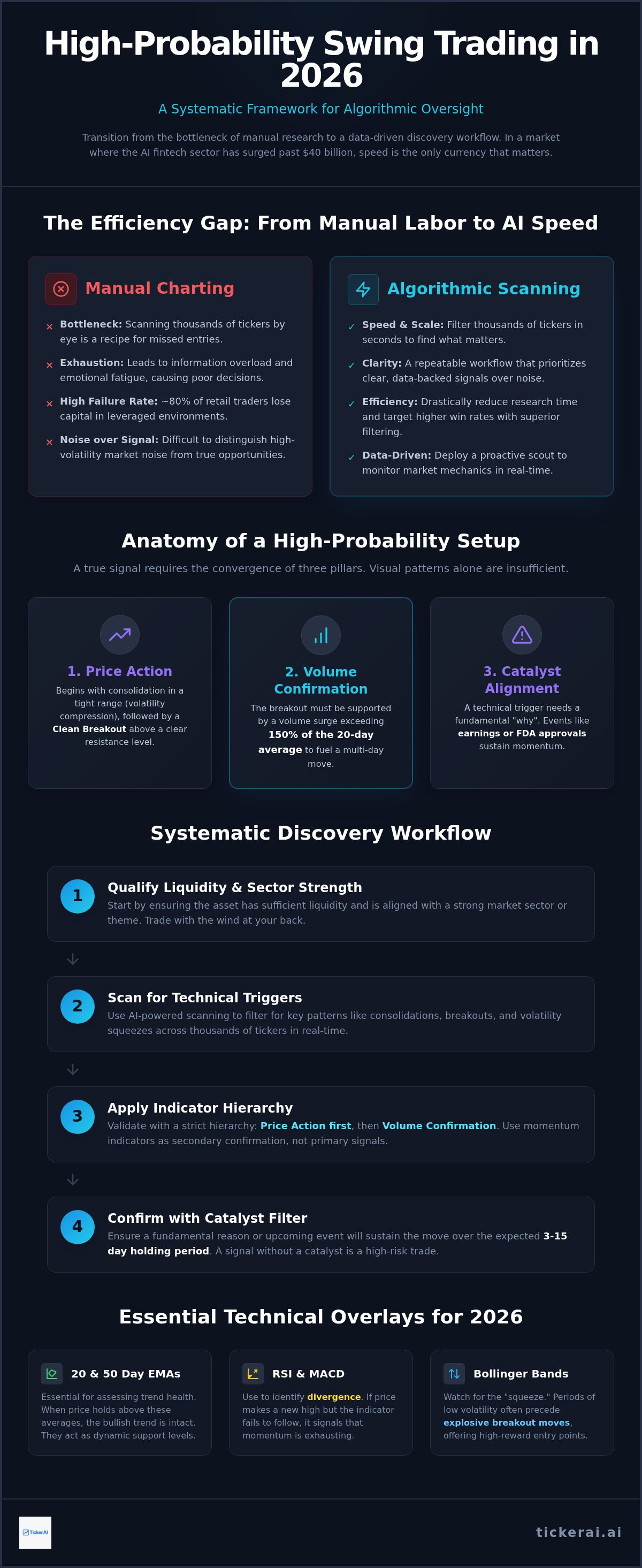
Swing trading in 2026 is no longer about finding "pretty" charts. It is a calculated capture of multi-day to multi-week momentum. To understand What is Swing Trading in the current environment, you must distinguish between market noise and high-probability signals. High volatility and algorithmic dominance mean that visual patterns alone are insufficient. A true signal requires the convergence of three pillars: Price Action, Volume Confirmation, and Catalyst Alignment.
Traditional methods often fail because they lack quantitative validation. You might see a classic flag pattern, but without institutional volume or a sector-wide tailwind, it's just noise. Learning how to find swing trade setups requires moving beyond the surface. You need data that confirms a shift in the supply and demand balance. In a market where approximately 80% of retail participants lose capital in leveraged environments, precision is your only defense against fragmented momentum.
The Anatomy of a Modern Setup
Modern setups begin with consolidation. Price coils within a tight range, compressing volatility before an expansion. During this phase, professional traders look for relative strength. If the S&P 500 is flat but your ticker is making higher lows, it's a leading indicator of institutional accumulation. A Clean Breakout is defined as a price move above a clear resistance level supported by volume exceeding 150% of the 20-day relative average. Without this volume surge, the breakout lacks the fuel to sustain a multi-day move. Quantitative filters must replace gut feelings to ensure you aren't chasing a "bull trap."
Timeframes and Duration Expectations
The 4-hour and Daily charts remain the gold standard for swing discovery. They filter out intraday whipsaws while providing enough resolution to manage risk effectively. Typical holding periods in 2026 range from 3 to 15 trading days. This duration allows the technical thesis to play out without exposing the trader to the decay of day trading or the long-term risks of a macro shift. Success depends on aligning these individual setups with broader thematic investment opportunities with AI. This ensures you are trading with the wind at your back. When you align a technical trigger with a powerful market theme, your probability of a successful exit increases significantly.
Technical Indicators and Market Catalysts That Matter
In a market dominated by high-speed algorithms, your indicators must follow a strict hierarchy. Price action is the primary truth. Volume provides the necessary validation. Momentum and sentiment serve as secondary filters to confirm the strength of the move. Many traders fail because they treat all indicators as equal. They aren't. A Moving Average crossover in 2026 is often just a liquidity trap for retail traders unless it's backed by institutional buying patterns. Tracking "Smart Money" flow requires observing volume spikes at key structural levels, indicating that large players are positioning for a multi-day move.
Success in understanding how to find swing trade setups depends on this layered validation. Technical signals require fundamental fuel. Earnings reports, FDA approvals, and macro shifts act as the catalysts that turn a chart pattern into a profitable swing. Without a catalyst, even the cleanest technical setup risks stalling. You can streamline this discovery by using real-time algorithmic signals to filter for these convergences while you focus on execution.
Essential Technical Overlays
The 20-day and 50-day Exponential Moving Averages (EMAs) are essential for assessing trend health. When price holds above these levels, the trend is intact. RSI and MACD shouldn't be used for simple overbought or oversold readings. In 2026, these are tools for identifying divergence. If price makes a new high but the MACD histogram fails to follow, the momentum is exhausting. Additionally, watch for Bollinger Band "squeezes." These periods of low volatility often precede explosive breakouts, providing a high-reward entry point for swing traders who value precision over guesswork.
The Catalyst Filter
A technical trigger without a fundamental "why" is often a fakeout. You must identify upcoming events that will sustain momentum over the 3 to 15-day holding period. This is where automated stock market analysis becomes a competitive advantage. It allows you to quantify sentiment and track event timelines across thousands of tickers simultaneously. This systematic approach filters out the noise of fragmented momentum.
- Earnings: Look for "earnings beats" coupled with raised guidance to sustain multi-day runs.
- Macro Shifts: Align setups with interest rate cycles or sector-wide rotations.
- FDA/Regulatory: Crucial for biotech and energy sectors where news drives significant volatility.
Quantifying the sentiment impact helps you assign a probability score to each setup. This ensures you only execute on the highest-conviction ideas, avoiding the emotional drain of low-probability trades.
Manual Charting vs. Algorithmic Scanning: Efficiency Gaps
The efficiency gap between manual charting and algorithmic scanning has reached a critical breaking point. A trader manually reviewing 1,000 tickers spends roughly eight hours to find three viable setups. An AI filter accomplishes this in under 30 seconds. This isn't just about time; it's about cognitive load. Reviewing hundreds of charts creates mental fatigue that leads to "revenge trading" or hesitant entries. Algorithmic discovery eliminates this human error, providing a tireless, objective oversight that human eyes can't match.
Scalability is your greatest asset when learning how to find swing trade setups. AI doesn't get tired. It scans the NYSE, NASDAQ, and crypto markets simultaneously, identifying opportunities in the energy sector while monitoring breakouts in tech. This multi-sector coverage ensures you aren't limited to a single "favorite" watchlist. You trade the best opportunities across the entire market, not just the ones you happened to see before your focus faded. Using logic-based filters reduces human bias, ensuring every trade is based on data rather than a "gut feeling" about a specific ticker.
The Limitations of Traditional Screeners
Most brokerage screeners rely on static, backward-looking data. Filtering for a "P/E ratio under 15" or "52-week highs" doesn't capture the nuance of a momentum breakout. These tools often use delayed data, meaning the entry window has closed before you even see the signal. This is why quantitative investing tools are now essential for retail traders. They bridge the gap by providing the same real-time filtering capabilities once reserved for institutional desks. Static filters miss the "coiling" effect of a true swing setup because they can't analyze the relationship between price and volume over time.
The AI Discovery Advantage
AI discovery offers real-time anomaly detection. It spots unusual volume spikes minutes before they trigger a news headline. This early detection is the difference between catching a move at the bottom and chasing it at the top. Algorithmic models perform pattern recognition at scale, identifying complex structures like the "Volatility Contraction Pattern" (VCP) or "Cup and Handle" across thousands of charts instantly. The focus shifts from searching to deciding. You receive action-oriented alerts that meet your specific criteria. This systematic approach effectively solves the problem of how to find swing trade setups without the burnout of manual research. You prioritize execution while the AI handles the discovery.
A Repeatable Workflow for Swing Trade Discovery
Success in swing trading isn't about luck. It's about a repeatable process. Most retail traders start their morning by chasing "Top Gainers" lists. This is a reactive, low-probability strategy. Learning how to find swing trade setups effectively requires a proactive "Observation-to-Action" framework. This starts with setting your universe. Filter for liquidity and sector strength first. You want to trade stocks with high average daily volume and institutional interest. Once the universe is set, run an automated scan for technical pattern triggers like high-volume breakouts or volatility contraction.
Validation is the next critical phase. A technical signal alone is a guess; a signal backed by a catalyst is a trade. Check for upcoming earnings, analyst upgrades, or sector-wide momentum. Finally, calculate your risk/reward ratio. If the setup doesn't offer at least a 3:1 potential, discard it. Deploy automated alerts to notify you of price triggers, ensuring you never miss a breakout while away from the terminal. You can access professional-grade swing setups today to see this logic applied in real-time.
Step-by-Step Validation
Confirming your "Trading Edge" is a mathematical exercise. You must ensure your profit target is at least three times larger than your stop-loss. Use Average True Range (ATR) to set your stops. This technical measure of volatility helps you place stop-losses outside the "noise" of daily price action, reducing the risk of being stopped out by a temporary dip. Adopting systematic stock research ensures you maintain this discipline. It prevents the emotional decision-making that often leads to premature exits or oversized losses.
The Watchlist Refinement Process
Discovery is only half the battle. You must manage your findings. Move your high-conviction signals from a "Master List" to a "Smart Watchlist." This list should be dynamic. Prune setups that lose momentum or violate key trendlines immediately. If a stock closes below its 20-day EMA, the swing thesis is likely dead. Journaling your discovery failures is equally important. It helps you refine your future scans by identifying which patterns or sectors are currently underperforming. This constant feedback loop is essential for mastering how to find swing trade setups in a shifting market environment.
Leveraging TickerAI for Real-Time Setup Identification
TickerAI Pro eliminates the manual search. It automates the "Observation-to-Action" flow. This allows you to focus on decision-making rather than data entry. Finding how to find swing trade setups becomes a matter of setting parameters and reviewing filtered results. By integrating AI stock signals, you align your strategy with institutional-grade logic. Smart Watchlists further streamline this process. They organize setups by sector or theme, ensuring your capital is always deployed in the strongest market pockets. This modular organization allows for rapid reassessment as market conditions shift in real-time.
Full-Access vs. Pro: Discovery Capabilities
TickerAI Full-Access provides high-conviction, curated setups. It is designed for traders who want actionable insights without managing the underlying data. TickerAI Pro expands this with raw algorithmic data for deeper customization. Real-time alerts are your competitive edge. They trigger the moment a technical threshold is crossed. This often beats the retail crowd by several minutes. This speed is critical for capturing the meat of a move before slippage erodes your profit margin. Automated market analysis also uncovers "hidden" small-cap movers. These are stocks with low float and high relative volume that manual scanners often overlook until the move is nearly over.
Removing Emotion from Discovery
Emotion is the primary cause of trading failure. TickerAI acts as a clinical filter for market noise. It doesn't care about social media hype or "gut feelings." It prioritizes verifiable data points like volume spikes and price consolidation. This objective oversight helps you avoid FOMO and stay disciplined during periods of high volatility. Trusting the data-driven process allows for a more robotic, and therefore more consistent, execution of your plan. You stop guessing and start executing based on high-probability triggers. The tireless nature of the AI ensures you never miss a setup due to fatigue or distraction.
Discover your next swing trade setup with TickerAI
Transitioning to Algorithmic Alpha
The market environment of 2026 rewards precision and speed over manual persistence. Success requires a shift from visual charting to clinical, data-driven filtering. You've seen the efficiency gap; manual scanning is a bottleneck that induces fatigue and emotional bias. Mastering how to find swing trade setups now depends on your ability to deploy automated oversight. By prioritizing the hierarchy of price, volume, and catalyst alignment, you move from reactive chasing to proactive execution. This systematic approach ensures your capital is always positioned where momentum is strongest.
TickerAI Pro provides the AI-powered anomaly detection necessary for early breakout identification. You gain access to real-time alerts delivered via TickerAI Full-Access, ensuring you never miss a high-probability entry. This clinical filtering removes the psychological weight of information overload. It's time to replace manual research with high-speed intelligence. Master the Market with TickerAI Pro and start trading with the clarity of a professional scout. Your edge is waiting.
Frequently Asked Questions
What is the best indicator for finding swing trade setups?
Price action remains the definitive indicator for any swing strategy. While technical overlays like the 20-day EMA and RSI divergence provide context, they're secondary to volume confirmation. High-probability setups require a surge in relative volume to validate institutional interest. Without this specific data point, price moves are often temporary whipsaws. A disciplined approach prioritizes the hierarchy of price and volume above all other technical oscillators.
How many swing trade setups should I track at once?
Professional traders typically maintain a focused list of three to five high-conviction setups. Attempting to monitor dozens of tickers simultaneously results in information overload and execution errors. Utilizing Smart Watchlists allows you to organize these opportunities by sector or theme. This modular approach ensures you only track stocks that meet your specific liquidity and momentum criteria, reducing the mental fatigue that leads to missed entries.
Can AI really find better setups than a human trader?
Algorithmic discovery provides a significant efficiency advantage over manual charting. AI models scan thousands of tickers in seconds, identifying complex patterns like the VCP or cup and handle instantly. This clinical approach eliminates human emotional bias and revenge trading tendencies. By using anomaly detection, AI spots institutional buying patterns and volume spikes before they become obvious to the retail crowd, providing a distinct timing edge.
How much capital do I need to start swing trading these setups?
The capital requirement for swing trading has shifted significantly in 2026. Following the elimination of the Pattern Day Trader (PDT) rule in June 2026, the previous $25,000 minimum equity requirement no longer applies to margin accounts. Traders can now execute strategies with smaller balances, though position sizing remains critical. You should ensure your capital allows for proper risk management, typically risking no more than 1% of your total account on a single setup.
What is a good win rate for a swing trading strategy?
A sustainable win rate for swing trading generally ranges between 40% and 60%. High-probability trading isn't about winning every time; it's about maintaining a positive expectancy. Professional workflows prioritize a reward-to-risk ratio of at least 3:1. This mathematical edge ensures that even with a 50% win rate, your profitable trades significantly outweigh your losses. Focusing on setup quality over frequency is the most effective way to protect your capital.
How do I avoid "fakeout" setups in a volatile market?
Avoiding fakeouts requires strict volume and catalyst validation. A breakout must be supported by volume exceeding 150% of the 20-day average to be considered legitimate. Additionally, you should only trade setups that align with a clear market catalyst, such as earnings or sector rotation. Using stop-losses based on the Average True Range (ATR) helps you stay in the trade through normal volatility while protecting against a true trend reversal.
Is TickerAI suitable for beginner traders?
TickerAI is designed for both developing and professional participants. For those learning how to find swing trade setups, TickerAI Full-Access provides curated, high-conviction ideas that simplify the discovery process. Beginner traders benefit from the clinical, data-driven filtering that removes emotional decision-making. As your industry knowledge grows, you can graduate to TickerAI Pro to access raw algorithmic data and customize your own real-time market alerts.
How often does TickerAI generate new swing trade setups?
TickerAI functions as a tireless proactive scout, monitoring global markets in real-time. New setups are generated whenever the underlying algorithms detect a convergence of technical triggers and fundamental catalysts. This isn't a scheduled report; it's a dynamic stream of opportunities. Real-time alerts ensure that you're notified the moment a ticker meets your specific criteria, allowing you to move from observation to action without delay.


