

42% of retail investors admitted to losing money due to emotional trading decisions in the last twelve months, with an average loss of $1,606 per person. This isn't a failure of willpower. It's the biological cost of manual discovery. When you spend hours monitoring charts, your brain eventually fatigues, leading to impulsive entries and analysis paralysis. Learning how to remove emotion from trading is the only way to protect your capital and your mental health in 2026.
You've likely felt the sting of a trade you knew you shouldn't take or the frustration of hesitating on a perfect setup. It's an exhausting cycle that turns a professional pursuit into a high-stress gamble. We promise to show you how to break this cycle by transitioning to a clinical, AI-driven workflow that replaces gut feelings with data-backed execution. We will explore a repeatable, stress-free routine that leverages automated discovery to ensure your entry and exit signals are driven by logic rather than luck. This systematic approach filters the market noise, allowing you to focus on decision-making while the technology handles the heavy lifting.
Key Takeaways
- Understand how decision fatigue triggers impulsive trades and why willpower is an insufficient defense against market volatility.
- Discover how to remove emotion from trading by transitioning from manual market scanning to an AI-driven discovery workflow.
- Eliminate the sunk cost fallacy by offloading the research phase, preventing the urge to force trades after hours of analysis.
- Build a repeatable routine using hard quantitative rules that replace subjective gut feelings with clinical execution.
- Reduce mental drain and FOMO by utilizing curated swing trade setups that prioritize logic over luck.
The Biological Cost of Manual Trading: Why Willpower Fails
Emotional trading is not a character flaw. It is a physiological response to market volatility. When price action becomes erratic, the brain interprets uncertainty as a physical threat. This triggers a chemical cascade that compromises objective judgment. Understanding how to remove emotion from trading starts with acknowledging that your biology is wired to sabotage your P&L in high-stakes environments.
Manual discovery is the primary catalyst for this failure. Traders who spend hours scanning hundreds of charts experience severe decision fatigue. Every ticker analyzed is a micro-decision. Over time, these decisions deplete your cognitive reserves. By the time a high-probability setup finally appears, your logical brain is exhausted. You either hesitate due to analysis paralysis or enter prematurely due to impulsivity. Willpower is a finite resource; it cannot compete with the 24/7 nature of modern markets.
The Amygdala Hijack in Modern Markets
Rapid price fluctuations trigger the amygdala, the brain's emotional center. This bypasses the prefrontal cortex, where logical processing occurs. When a stock drops 3% in seconds, your logic is sidelined by a fight-or-flight response. Cortisol levels spike. This chemical shift leads to "revenge trading," an attempt to claw back losses through high-risk, low-logic entries. Manual chart monitoring is the leading cause of trading burnout because it keeps the brain in a perpetual state of high-alert stress.
Cognitive Biases that Sabotage Returns
Even the most disciplined traders fall victim to hardwired cognitive biases. These mental shortcuts are efficient in nature but lethal in finance. Confirmation Bias causes you to seek only the technical indicators that support a losing position while ignoring clear exit signals. Loss Aversion is even more destructive. Research suggests the psychological pain of losing $1,000 is twice as powerful as the satisfaction of gaining $1,000. This leads to holding losers too long and cutting winners too short. Recency Bias further complicates execution, forcing you to overweight the results of your last three trades rather than trusting a long-term statistical edge.
The myth of the "emotionless trader" is dead. In 2026, the reality is the "systematic trader." Success no longer depends on suppressing feelings but on building workflows that bypass them. This is the logic behind the growth of Algorithmic trading. By offloading discovery and execution to rules-based systems, you eliminate the biological triggers that lead to ruinous decisions.
Systematic Discovery: Using AI to Solve the Uncertainty Problem
The transition from searching for trades to validating AI-discovered setups represents a fundamental shift in professional trading. Most retail traders operate as "hunters," manually scouring the market for opportunities. This process is inherently flawed. It leads to an emotional attachment to the ticker. If you spend three hours finding a setup, your brain feels invested before you even place the order. Systematic discovery solves this by removing the hunch from stock selection. It replaces the "I think" with "the data shows." This structural change is the foundation of how to remove emotion from trading.
The Shift from Hunter to Pilot
When you hunt for stocks, every discovery feels like a personal victory. This pride clouds judgment. By using a professional AI stock discovery platform, you maintain a clinical distance. You're no longer the one finding the needle in the haystack; you're the pilot reviewing a pre-filtered list of high-probability targets. This automation provides a sterile environment for decision-making. It allows you to act as the final risk manager rather than the exhausted scout. This is a critical step in learning how to remove emotion from trading.
- Clinical Distance: You evaluate the signal, not your own effort.
- Reduced Fatigue: AI scans thousands of tickers in milliseconds, preserving your cognitive energy.
- Objective Filtering: Only setups meeting strict parameters reach your screen, eliminating subpar "boredom trades."
Quantifying Opportunity with Algorithmic Alpha
Subjective technical analysis is the enemy of consistency. A manual trader might say, "this looks like a breakout." An algorithmic approach says, "this ticker meets 95% of momentum criteria based on volume, relative strength, and historical volatility patterns." Replacing vague visual cues with objective data-driven signals eliminates the uncertainty that breeds anxiety. Real-time alerts further stabilize the psyche by reducing the fear of missing out. You don't need to stare at charts 24/7 when you know the system will flag valid setups as they happen. We define systematic discovery as the marriage of high-speed data and human risk oversight. By leveraging TickerAI's smart watchlists, you ensure that every trade is born from logic rather than a desperate search for action. This is the only way to scale your performance without scaling your stress levels.
Manual vs. AI-Driven Trading: A Comparison of Emotional Weight
The mental load of manual scanning is a primary driver of trading errors. When you spend hours looking for a setup, you aren't just analyzing data. You're investing ego. This creates the "Sunk Cost Fallacy" in research. You feel a subconscious obligation to execute a trade simply because you spent four hours looking for one. This "must find something" mindset is the antithesis of professional discipline. In contrast, an AI-driven workflow shifts the psychology to a "take it or leave it" model. The system presents the opportunity; you simply decide if it meets your risk parameters.
Visualizing screen time as a metric for emotional health is essential. Excessive time spent staring at charts correlates directly with increased anxiety and impulsive behavior. Manual traders often equate hours worked with potential profit. This is a false metric. Professional returns in 2026 are driven by the quality of the filter, not the quantity of the screen time. Reducing your active monitoring phase is a foundational step in how to remove emotion from trading.
The Psychology of the Alert-Based Workflow
Receiving a notification is fundamentally less stressful than staring at a 1-minute candle. High-frequency price action triggers the amygdala, but a curated alert allows for a measured response. This is the "Objective Filter" effect. The AI doesn't care about your recent losses or your desire to hit a specific daily target. It only cares about the math. By using AI to remove emotion from trading, you stabilize your equity curve by ensuring that every entry is triggered by a pre-defined technical catalyst rather than a momentary impulse. This workflow protects you from the noise of intraday volatility.
Data Processing: Human vs. Machine
Human attention has hard limits. Fatigue sets in after just 90 minutes of intense focus, leading to missed signals and sloppy execution. TickerAI maintains 24/7 scanning capabilities across thousands of tickers without degradation. This machine precision identifies "hidden" momentum—patterns the human eye misses when tired or distracted.
- Institutional Flow: Machines track large-block orders in real-time, reducing the "surprise factor" of sudden moves.
- Pattern Recognition: AI identifies multi-variable breakouts that manual traders often overlook.
- Bias Elimination: The system ignores ticker names and news sentiment, focusing solely on price and volume dynamics.
By offloading the heavy lifting of market surveillance, you preserve your mental capital for high-level risk management. This transition is the most effective way to understand how to remove emotion from trading while maintaining a competitive edge in a high-speed environment.
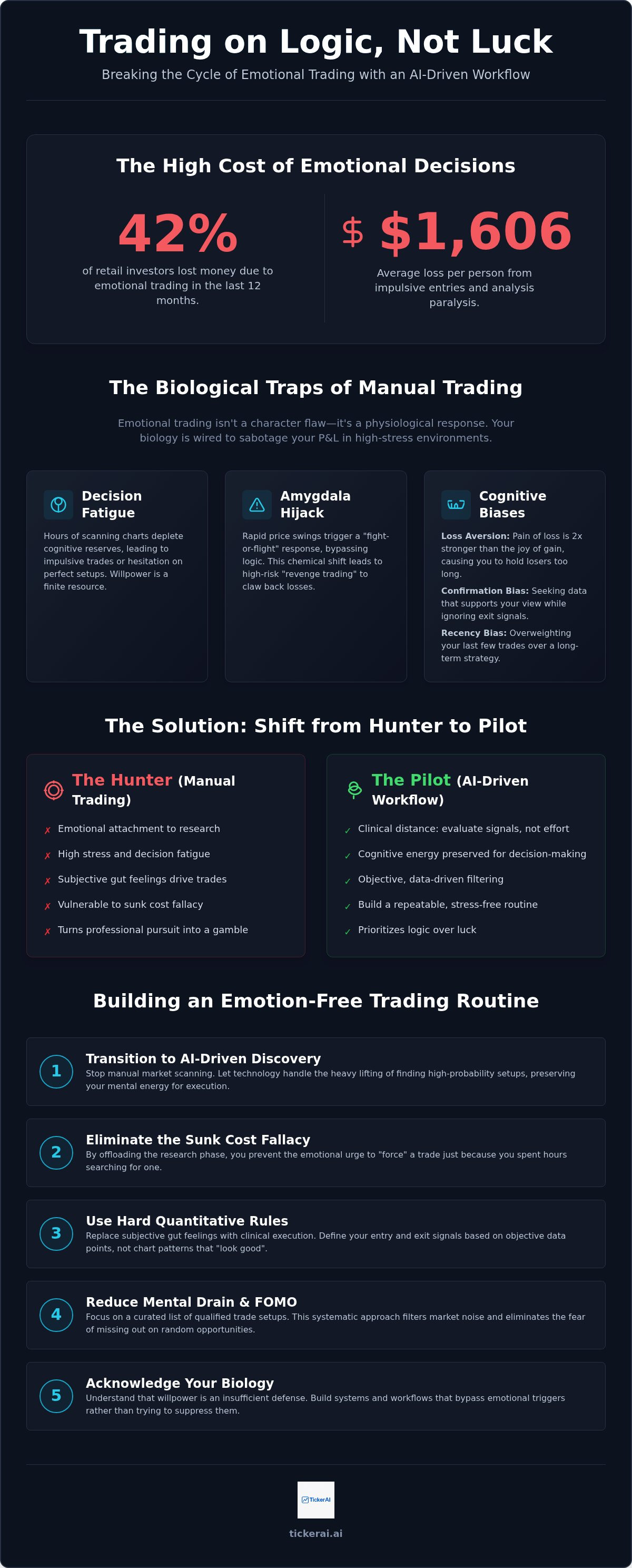
5 Steps to Building an Emotion-Free Trading Routine
Theory alone does not protect capital. To truly master how to remove emotion from trading, you must implement a rigid operational framework. This routine acts as a firewall between market volatility and your execution. By standardizing every action, you eliminate the need for mid-trade deliberation. Logic replaces impulse.
- Step 1: Define Hard Rules. Establish quantitative parameters for every entry. Use specific indicators like volume-weighted average price (VWAP) or relative strength index (RSI) thresholds. If the data doesn't align, the trade doesn't exist.
- Step 2: Offload Discovery. Stop manual scanning. Use an AI-powered alert system to surface high-probability setups. This preserves mental energy for risk assessment.
- Step 3: Wait-and-Verify. Never market-buy on a raw alert. Implement a protocol where price action must confirm the signal on a specific timeframe before execution.
- Step 4: Automate Risk Management. Use bracket orders. Pre-set your stop loss and profit targets immediately. Once the trade is live, your job is to observe, not interfere.
- Step 5: Systematic Review. Use a data-driven journal. Analyze win rates and profit factors. Ignore how you felt during the trade. Focus on whether you followed the protocol.
Offloading the Mental Heavy Lifting
Efficiency starts with organization. Use Smart Watchlists to categorize opportunities by sector or momentum profile. This structure prevents information overload. Configure real-time alerts so you only engage the terminal when specific criteria are met. Learning to interpret AI stock signals correctly is vital. Treat every signal as a hypothesis to be validated, not a command to be obeyed. This mindset ensures you remain the objective decision-maker while the technology handles the surveillance. For those ready to automate their discovery phase, subscribe to TickerAI Full-Access to receive curated swing trade setups directly.
The "if-then" Execution Framework
Impulsivity thrives in the absence of structure. Create a physical checklist that must be cleared before any order is placed. If the ticker fails even one check, you walk away. A powerful tactic for how to remove emotion from trading is separating your discovery screen from your execution platform. This friction prevents click-happy entries. Finally, respect the "Cool Down" period. After a significant win or loss, step away from the terminal for at least 30 minutes. This allows your neurochemistry to reset. It prevents the dopamine-driven errors of overconfidence and the cortisol-driven mistakes of revenge trading.
TickerAI: Your Clinical Partner in Market Discovery
TickerAI acts as the clinical assistant in your daily workflow. It handles the exhausting market surveillance that typically leads to cognitive burnout. By utilizing TickerAI Full-Access, you gain the data-driven edge mandatory in the 2026 environment. This platform is built for professionals who understand that learning how to remove emotion from trading requires a strict separation of duties. The machine scans the noise; the human manages the risk. This structural division ensures your mental capital remains intact for high-level execution.
Curated swing trade setups are your primary weapon against FOMO. When you receive a high-probability alert, the urge to chase random tickers or "force" a trade vanishes. You're no longer hunting for action. You're waiting for technical confirmation. Smart Watchlists further refine this process by organizing opportunities into thematic categories. Whether you're tracking momentum breakouts or long-term reversals, these watchlists filter out the irrelevant data that causes analysis paralysis. You move from being a reactive retail trader to a systematic market participant who values logic over luck.
Pro vs. Full-Access: Finding Your Discipline Tier
Choosing between TickerAI Pro and Full-Access depends on your specific trading frequency and depth of analysis. TickerAI Pro delivers real-time alerts optimized for short-term momentum. These action-oriented alerts are designed to reduce the "hesitation gap" by providing clear, algorithmic catalysts. It's important to clarify that TickerAI does not provide personal financial advisory or brokerage execution. We provide the high-octane data and algorithmic processing required for professional decisions. Full-Access expands this capability, offering deeper smart watchlists and long-term investment ideas that help you maintain a balanced, emotion-free portfolio across multiple timeframes.
The Future of Systematic Investing
The 2026 market moves at a pace that manual observation cannot match. Algorithmic speed is no longer an advantage; it's a requirement for survival. Transitioning to a systematic approach isn't just about software. It's about adopting a process-first mindset. You must value the integrity of your workflow over the outcome of any single trade. This shift in perspective is the final step in how to remove emotion from trading. When you trust the system, the stress of the "unknown" disappears, replaced by the clarity of data-driven execution. Don't let market noise dictate your P&L. Start your systematic trading journey with TickerAI Full-Access and reclaim your mental edge.
Secure Your Edge with Systematic Execution
Relying on willpower in the 2026 market is a high-risk strategy. We have established that emotional trading is a physiological response, not a lack of discipline. By offloading the discovery phase to clinical, data-driven scanning, you eliminate the decision fatigue that leads to impulsive errors. Mastering how to remove emotion from trading requires a fundamental shift from manual hunting to systematic validation. This approach preserves your mental capital for high-level risk management and long-term consistency.
TickerAI provides the infrastructure for this professional transition. With AI-powered swing trade setups and real-time momentum breakout alerts, you can maintain a clinical distance from market noise. The future belongs to those who trust their process over their gut feelings. It's time to replace mental exhaustion with algorithmic precision. Your capital deserves a logical approach that scales with your ambition. Start building a stress-free routine that prioritizes data over impulse.
Master your trading psychology with TickerAI Full-Access.
Frequently Asked Questions
Is it really possible to trade with zero emotion?
Total emotional elimination is a myth because market volatility triggers biological stress responses. However, you can master how to remove emotion from trading by implementing a rules-based system that dictates every action. When your workflow is automated, your feelings become irrelevant to the outcome. You focus on following the protocol rather than reacting to price candles. This shifts your role from an impulsive participant to a clinical risk manager.
How does AI help prevent FOMO (Fear of Missing Out)?
AI prevents FOMO by establishing a "take it or leave it" environment. When you rely on curated swing trade setups, you stop chasing random tickers out of fear. The system only flags opportunities that meet strict quantitative criteria. If the AI doesn't alert you, the move is statistically insignificant for your strategy. This objective filtering ensures you only engage when the data supports a high-probability entry.
Can I use AI stock alerts for long-term investing or just swing trading?
You can use AI alerts for both timeframes. While many associate algorithmic discovery with short-term momentum, TickerAI Full-Access provides long-term investment ideas alongside swing trade setups. The technology scans for different structural patterns, such as institutional accumulation or multi-year base breakouts. This allows you to build a diversified portfolio using the same clinical, data-driven approach regardless of your specific holding period.
What is the most common emotional mistake traders make?
The most frequent mistake is revenge trading, often driven by loss aversion. Traders attempt to win back capital after a loss by taking sub-optimal setups with increased position sizes. This is a direct result of the amygdala hijack. A systematic approach prevents this by enforcing hard rules for daily loss limits and requiring every trade to pass a pre-flight checklist before you place an order.
How do I know if an AI stock alert is reliable?
Reliability is determined by the underlying quantitative parameters. A professional alert should include data points like relative strength, volume surges, and institutional money flow. You validate these signals by checking if they align with your specific hard rules for entry. AI doesn't replace your judgment. It acts as a sophisticated filter that removes 99% of market noise so you can focus on high-alpha opportunities.
Does TickerAI execute trades for me?
TickerAI does not execute trades for you. The platform is a discovery and intelligence tool, not a brokerage execution service. It provides the smart watchlists and real-time alerts needed to find opportunities. You remain the final decision-maker and must execute the orders through your preferred broker. This human-in-the-loop model ensures you maintain total control over your risk management and capital allocation.
How much time can I save by using an AI discovery tool?
Traders typically save several hours of manual scanning per day. Instead of scrolling through hundreds of charts to find a setup, the AI surfaces pre-filtered opportunities in milliseconds. This massive reduction in screen time is a key metric for emotional health. By offloading the discovery phase, you preserve your cognitive energy for high-level strategy and trade validation rather than performing tedious manual surveillance.
What should I do if I feel an emotional impulse to break my trading rules?
Step away from the terminal immediately. If you feel a compulsion to break your if-then framework, your logical brain has likely been sidelined by stress. Implement a mandatory 30-minute cool-down period. This allows your neurochemistry to reset. Remember that your edge is found in the consistency of your process, not in the outcome of a single impulsive trade. Trust the system you have built.


