

A swing trade typically lasts a few days to a few weeks, but the setup, not the calendar, should guide your exit. How long to hold a swing trade depends on whether price action still supports your original thesis and whether your exit rules have been triggered. A fast-moving stock may reach its target in a few sessions; a slower setup may take longer.
It makes sense to want a clear holding period before you enter. But an arbitrary deadline can cut a valid trade short or keep you in after the setup weakens. A more reliable approach is to define what would confirm the trade, what would invalidate it, and how you’ll respond if price stalls. Setup validity, stop and target rules, and your trade history can help you choose a holding period that fits the trade instead of forcing every position into the same timeline.
Key Takeaways
- Let the setup’s price action, not a fixed calendar deadline, guide how long a position stays open.
- Use your closed-trade history to spot how long your winning and losing trades typically take to resolve.
- Set profit-taking, stop, and time-based exit rules before entering, then follow them as conditions change.
- Plan the trade around the chart timeframe and the conditions that would invalidate the setup.
1. How Long is a Swing Trade Supposed to Last?
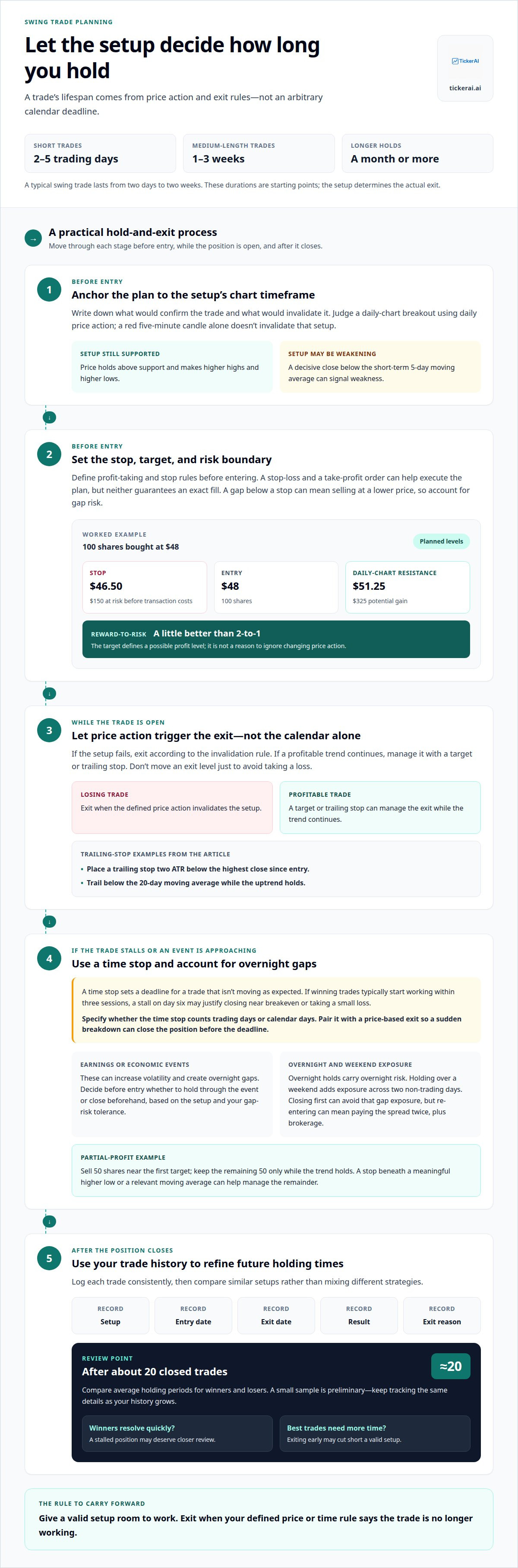
A typical swing trade lasts from two days to two weeks, though the setup determines the actual exit. Short trades may run two to five trading days; medium-length trades often take one to three weeks. A longer hold can extend to a month or more when the chart still supports it. The United States Senate describes swing trades as lasting days or sometimes weeks, depending on projected price movement. A conservative plan may target 5-10% profit, but price can reach that target faster in an active market.
Set exit conditions before entering. A stop-loss order can trigger a sale at a specified level if price falls; a take-profit order can close the position at a planned target. Neither guarantees an exact fill. If a stock opens below a stop, for example, the execution price may be lower than the stop level. Account for this gap risk when deciding whether the planned loss fits your trading rules.
For example, buying 100 shares at $48 with a stop at $46.50 puts $150 at risk before transaction costs. If the next daily-chart resistance sits at $51.25, the potential gain is $325, or a little better than a 2-to-1 reward-to-risk ratio. That target offers a defined profit level, not a reason to ignore changing price action. If the setup weakens before reaching resistance, follow the exit rule rather than waiting for the original target.
Earnings announcements and economic events can increase volatility and create overnight gaps, so account for their timing when setting exits. Before entering, decide whether you’ll hold through the event or close beforehand; the choice depends on your setup and tolerance for gap risk. To take partial profits, sell 50 shares near the first target and keep the remaining 50 only while the trend holds. A stop beneath a meaningful higher low or a relevant moving average can help manage that remainder. Cut losses when the setup fails, not simply because a typical holding period has passed.
Analyzing personal trade holding times
Treat a typical holding period as a starting point, not a rule for every position. In your trade log, group durations from one day to beyond a month. Record each entry and exit, the setup type, the result, and whether your exit rule triggered. Compare winning and losing trades: their different holding patterns can reveal whether you’re taking profits too early or letting losses linger.
After about twenty closed trades, review the average holding periods for winners and losers. If successful trades tend to make their planned move quickly, for example, a stalled position may deserve closer review. If your best trades need more time, exiting early may cut short valid setups. Treat a small sample as preliminary, and keep tracking the same details as your history grows.
You can hold a swing trade overnight if the setup remains valid and your plan accounts for overnight risk. Holding over a weekend adds exposure across two non-trading days. Closing beforehand may avoid that gap exposure, but re-entering can mean paying the spread twice, plus brokerage.
Day trading generally closes positions within the trading day, while swing trading holds them across multiple sessions. Position trading typically spans weeks or months and aims to capture larger moves. Choose a period that matches the setup’s timeframe, not just its label.
Holding too long can expose a position to a reversal after its thesis weakens. It can also tie up capital while another setup develops. Use your trade log to see whether longer holds improved results or simply delayed exits. Compare outcomes by setup and duration, and note when price invalidated the original idea.
Define consistent fields in your log: setup, entry date, exit date, result, and exit reason. Then compare each period across similar trades rather than mixing different strategies. A curated view of swing-trade setups can help you assess potential opportunities alongside your own holding-time records.
3. How exit rules determine swing-trade duration
Your exit rules define the trade’s lifespan more precisely than a calendar estimate. A decisive close below the short-term 5-day moving average can signal that a swing setup has weakened. Conversely, a stock holding above support and making higher highs and higher lows may support staying in the position. The key is whether the original reason for entering remains valid, not whether the trade has lasted a typical number of sessions.
Volatility affects how quickly price reaches a target or stop. An 8% target may be reached in fewer sessions in a fast market and more sessions in a quiet market. Larger price swings can also bring a stop level into play sooner. Adjust the planned holding time to the setup’s price behavior, but don’t move an exit level simply to avoid taking a loss.
For a losing trade, define the price action that invalidates the setup and exit when that condition occurs. For a profitable position, use a target or a trailing stop to manage the exit while the trend continues. One common method places a trailing stop two ATR below the highest close since entry. Another approach trails below the 20-day moving average while the uptrend holds. These rules connect duration to market structure rather than hope.
A time stop sets a deadline for a trade that isn’t moving as expected. If your winning trades typically start working within three sessions, a stall on day six may justify closing near breakeven or taking a small loss. Specify whether the time stop counts trading days or calendar days, since weekends make the difference. A fixed time rule works best alongside a price-based exit, so a sudden breakdown can close the position before the deadline. Review the chart at each planned close and act when a defined exit trigger appears. This keeps a pullback from becoming an excuse to ignore a failed setup, while giving a valid trend room to reach its target.
4. Trade planning and setup validity
Build your swing-trade plan around the chart timeframe behind the setup. If a stock breaks resistance on a daily chart, assess its validity using daily price action. A red five-minute candle alone doesn’t invalidate the trade. Selling based on a faster chart can turn a planned swing into an unplanned short-term trade.
Before entering, define the trigger, the condition that proves the idea wrong, and the planned exit. Tie each decision to the setup’s timeframe. For a daily breakout, identify the level price must hold and the price structure that would signal failure. This gives the holding period a clear purpose: stay in while the setup remains intact, then exit when its thesis breaks.
Indicators can help formalize a strategy, but their signals need context. One EMA method looks for a bullish signal when the 9-period EMA crosses above the 13-period EMA, with the 13-period EMA above or crossing above the 50-period EMA. A bearish signal reverses that relationship. Treat the crossover as a setup condition, not a guarantee; price structure and your exit rules still govern the position.
Plan for gaps as well as ordinary pullbacks. In one example, a stock bought at $48 opens at $46.90 after unexpected news, breaks the prior day’s low, and fails to reclaim $47.80. That sequence weakens the breakout thesis. A prepared trader can act on the invalidation rule instead of waiting for the original target or interpreting the gap as a routine dip.
Review the plan when the relevant chart closes. If support holds and higher lows continue, the setup may remain valid. If price breaks the level that defined the trade, follow the exit rule. For a structured starting point, explore swing-trade setups and assess how each plan defines its timeframe and invalidation conditions.
TickerAI: Swing Trade Setups
TickerAI’s Swing Trade Setups can help you identify opportunities to assess against your own entry, invalidation, and exit rules. Each setup still needs to fit your strategy and risk limits; a signal doesn’t determine how long you should hold.
Use AI Stock Opportunity Discovery and Smart Watchlist & Alerts to track potential market movements and keep relevant tickers visible. If your focus shifts from shorter-term trades to a longer horizon, TickerAI also offers Long-Term Investment Ideas. These tools support opportunity discovery, while your plan and trade history guide position management.
Explore TickerAI’s swing-trade tools to find support for your opportunity-discovery process.
Build a More Deliberate Trading Process
Turn each trade into a clear decision process. Before opening a position, write down what would keep the setup valid and what would prompt an exit. After closing it, record whether you followed your plan. Over time, these notes can help you refine how long to hold a swing trade based on your results, rather than relying on a fixed rule for every stock.
TickerAI supports opportunity discovery with AI Stock Opportunity Discovery and Smart Watchlist & Alerts. Use these tools to surface potential stocks and keep relevant tickers on your radar, then apply your own setup and risk criteria. The goal is a repeatable workflow, not a preset holding period.
Ready to make your trading process more deliberate? Contact TickerAI to discuss your trading. Keep building a plan that fits the setup and the way you manage risk.
Frequently Asked Questions
How Long is a Swing Trade Supposed to Last?
A swing trade is generally held for a few days to a few weeks, with the setup determining its actual duration. It may end sooner if price reaches the planned exit or the original thesis no longer holds. For instance, a breakout that quickly loses its key price level may call for an earlier exit than a steady trend that continues toward its target.
What Is Swing Trading?
Swing trading aims to capture a price move across multiple market sessions rather than opening and closing a position in the same day. A trader might enter after a stock breaks resistance, then manage the position as the next price swing develops. The approach sits between day trading and longer-term investing, with decisions guided by price structure and a defined exit plan.
So – How Long Should You Hold a Swing Trade Before Selling?
Hold the position only while its setup remains valid, and sell when your planned exit condition occurs. If the stock reaches its target, breaks the level supporting your entry, or stalls beyond your planned time limit, follow the rule you set before entering. This offers a practical answer to how long to hold a swing trade without relying on a universal deadline.
What is the typical holding period for a swing trade?
A typical swing trade lasts two days to two weeks. The exact period depends on how quickly the stock moves toward the setup’s target and whether its chart structure remains intact. A fast breakout may resolve within a few sessions; a slower move may take longer. Measure the holding period against your trade plan, not just the calendar.
How many days or weeks do swing traders usually hold positions?
Swing traders commonly hold positions for several days or a few weeks. Shorter trades may last two to five trading days, while medium-length trades often extend one to three weeks. These are broad patterns, not required holding windows. A position may close earlier after a failed setup or stay open longer if the planned conditions still support the trade.
What factors determine when to exit a swing trade?
Exit timing depends on the setup’s invalidation level, profit target, price trend, volatility, and any time limit in your trade plan. Upcoming earnings or economic events can also affect whether holding a position fits your strategy. Consider the chart timeframe used for entry: assess a daily-chart setup using daily price action rather than reacting to every shorter intraday fluctuation.


