

More positions don’t automatically mean better risk control. If you’re deciding how many stocks in a swing trade portfolio to hold, a practical guideline is to keep the number below 20 and size positions according to the risk you can tolerate. Swing trades typically last several days to a few weeks, so the right count also depends on how many setups you can monitor and manage.
It’s easy to focus on the number of tickers and overlook how much capital is exposed if several trades move against you at once. This guide explains how position count, individual trade risk, and total portfolio exposure fit together, so you can choose a number that suits your approach instead of following a one-size-fits-all rule. You’ll also learn what typically determines a swing trade’s duration and why its exit should depend on the setup, not just the calendar.
Key Takeaways
- Set a risk limit for each position and for the portfolio as a whole before choosing how many trades to hold.
- Account for overlapping exposure: several stocks can move together, increasing portfolio risk even when each position seems manageable.
- Let the trade setup and exit criteria guide how long you hold, rather than relying on a fixed calendar schedule.
- Use a focused watchlist and timely alerts to prioritize setups and keep active positions manageable.
What Is Swing Trading?
Swing trading aims to capture shorter-term price moves by holding positions beyond a single trading day. The time horizon and trade selection determine how much capital remains exposed to market swings.
Swing Trading Time Horizon
Swing trading positions typically last several days to a few weeks, with some trades spanning up to several weeks. The goal is to capture part of a price swing, not hold until a long-term investment thesis plays out. This horizon matters because a setup can change before its target is reached. Traders need to monitor price action and respond when the trade no longer fits their strategy.
Advantages and Disadvantages of Swing Trading
Holding a position for days or weeks gives a trade time to develop without requiring every decision to happen in a single session. A clear target can also define the intended move before entry. The trade-off is ongoing exposure while the position is open: prices can move against the setup, and active monitoring takes time. A fast move may also leave little time to act. These demands affect how many positions you can manage at once.
Diversification Across and Beyond Trades
Diversification can reduce dependence on one company or industry, but ticker count alone doesn’t create balance. One portfolio approach spreads exposure across 10 to 20 securities in different industries and countries. For swing trading, consider whether several positions rely on similar market drivers. Positions that move together may add concentrated exposure despite having different ticker symbols. Diversification can also extend beyond short-term trades: a long-term investment plan may use dollar-cost averaging over a 3-6 month period. That separates the longer-term allocation from the timing of individual swing setups.
Trading in the Direction of a Trend
A swing trader may wait for a confirmed change in direction, then trade with the developing momentum. For example, in a rising trend, a trader might wait for a pullback before entering rather than buying simply because a stock has fallen. The target should match the price move the setup is designed to capture. A trend doesn’t remove risk, but it gives the entry, target, and exit a shared market rationale.
Aligning portfolio risk with risk tolerance
Let your risk tolerance guide both position size and the combined exposure of open trades. Set those limits before assessing another technical opportunity.
Limiting Total Capital at Risk
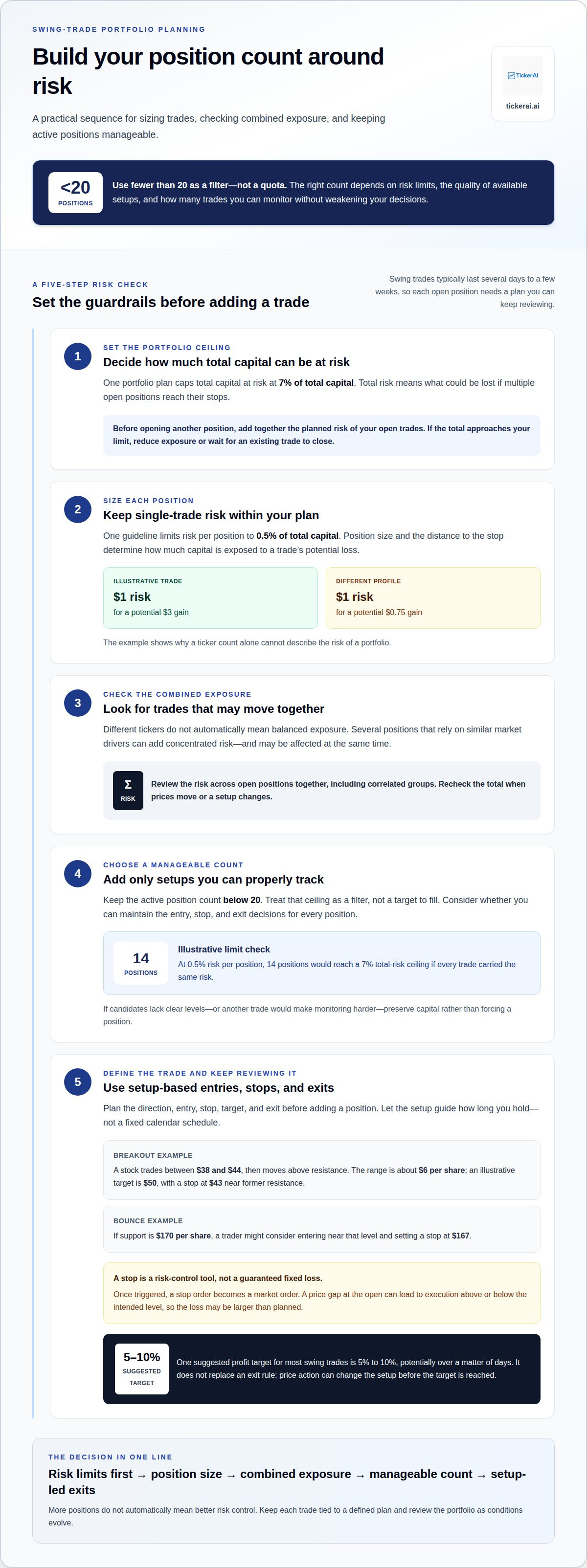
Total capital at risk is the amount you could lose if multiple open positions reach their stops. One portfolio plan caps that exposure at 7% of total capital. This ceiling matters because losses across several trades can accumulate quickly, especially when positions share market drivers. Add each trade’s planned risk together before opening another position. If the total approaches your limit, reduce exposure or wait for an existing trade to close.
Risk per Swing-Trade Position
Risk per position is the share of your capital exposed to a single trade’s potential loss. One guideline limits that amount to 0.5% of total capital per position. At that level, 14 positions would reach a 7% total-risk ceiling if every trade carried the same risk. The count alone isn’t enough: a tighter stop or smaller position can change the risk assigned to each trade.
A protective stop translates a trade’s exit point into a risk-management rule. Place it reasonably close to entry, based on the setup’s structure, rather than choosing a level that leaves losses uncontrolled. For example, a trade risking $1 per share for a potential $3 gain has a different risk-reward profile from one risking $1 for a $0.75 gain. Keeping losses small relative to gains can help a trader remain profitable even when only half of trades finish positive.
Stops don’t guarantee an exit at the trigger price. Once triggered, a stop order becomes a market order, and a price gap at the open can lead to execution above or below the intended level. The resulting loss may be larger than planned. Treat a stop as a risk-control tool, not a guarantee of a fixed loss. Review combined exposure when prices move or a setup changes, since positions in a correlated group may add risk at the same time.
Choosing a target number of positions
Keep the active position count below 20. One sample swing-trading portfolio contains 20 trades, while the guidance recommends fewer than 20 positions. Treat that ceiling as a filter, not a quota. Deciding how many stocks in a swing trade portfolio to hold means assessing how many valid setups you can track without weakening entry, stop, or exit decisions. If candidates lack clear levels, preserve capital for a stronger opportunity instead of forcing a trade.
Technical analysis can help define each setup’s direction, entry, and exit before you add it. In a breakout example, a stock trades between $38 and $44 before moving above resistance. The range is about $6 per share, and an illustrative target is $50. A stop at $43 would place the exit near former resistance. These levels help you assess the potential trade before committing capital.
A bounce trade uses different entry logic. If a stock’s support is $170 per share, a trader might consider entering near that level and setting a stop at $167. The support and stop offer references for judging whether the setup remains intact. The answer to how many stocks in a swing trade portfolio to hold should reflect the quality of available setups, not pressure to fill every slot.
Plan how to manage profit as well as risk. One suggested target for most swing trades is a 5% to 10% profit, potentially over a matter of days. That target isn’t a substitute for an exit rule: price action may change the setup before it reaches the planned level. Review open trades as conditions evolve. Avoid adding another position if it would make monitoring stops, targets, and technical signals harder. A focused portfolio keeps each trade tied to a defined plan.
What are the risks of holding too many stocks in a swing trading portfolio?
More tickers can create the appearance of diversification while increasing total exposure. A portfolio with 25 positions, each risking 1% of capital, could lose 25% if all positions move against the trader at once. This example shows why counting holdings alone doesn’t measure risk. The relevant question is how much capital each trade puts at risk, especially when several setups depend on similar market conditions.
Correlation can make a portfolio more vulnerable than its ticker count suggests. For example, several technology stocks may react to the same sector news or broad market selloff. If their prices fall together, separate positions can behave like one larger bet. Holding companies across different industries can spread exposure, but it doesn’t eliminate market-wide risk. Review what drives each position, not just how many symbols are in the account.
Too many active trades can also stretch your attention. Swing positions may need review during market hours as price action changes. With a long list to track, you may respond late to a broken setup or overlook an exit signal. A weekly review, such as every Friday, can help assess the portfolio, but it doesn’t replace monitoring open trades. Taking on more positions than you have time to review can weaken execution and increase the chance of missed decisions.
A crowded book can also dilute selectivity. If capital and attention are committed to marginal setups, a stronger opportunity may arrive when the portfolio has little room. Set a maximum position count, assess combined exposure, and leave space for trades that meet your criteria. For a focused flow of potential setups, explore AI-filtered stock opportunities before expanding your active list.
TickerAI: AI Stock Opportunity Discovery
TickerAI helps traders find potential setups through AI Stock Opportunity Discovery and curated Swing Trade Setups. Use these tools when your watchlist needs fresh candidates or you want to scan for opportunities without indiscriminately expanding your active positions. Smart Watchlist & Alerts can support ongoing monitoring, while Long-Term Investment Ideas serve a different horizon from short-term trades.
Use these signals as inputs to your process, not as substitutes for position sizing, risk limits, or exit rules. You decide which setups fit your strategy and risk capacity. Explore how TickerAI can support your market research by contacting TickerAI.
Build a Process You Can Sustain
Deciding how many stocks to hold in a swing trade portfolio is useful only if the number supports a repeatable process. Treat your portfolio as a live allocation of attention as well as capital. Before adding a position, consider whether you can still evaluate its setup, monitor changing conditions, and act on your existing plans. If not, preserving capacity may be a better decision than adding another ticker.
Use each closed trade to refine your process. Record why you entered, what changed, and whether you followed your plan when exiting. Over time, these observations can show where your approach may need adjustment, without turning a single winning or losing trade into a rule.
TickerAI can support market research with opportunity discovery, swing setups, and watchlist alerts. Contact TickerAI to discuss your portfolio and identify a research workflow that fits your trading process. Keep the next move deliberate, and let your decisions, not a crowded watchlist, set the pace.
Frequently Asked Questions
How many stocks should a swing trader hold at one time?
Keep fewer than 20 positions as an upper guide, not a target to fill. Your workable count is the number of open trades you can assess against their individual plans and combined exposure. If adding a stock would make it harder to respond when a setup changes, the portfolio is already large enough for your current process.
What is a typical number of positions in a swing trading portfolio?
A sample portfolio contains 20 trades, but that example doesn’t make 20 the required or ideal count. The recommendation is to stay below 20 positions, then adjust based on risk limits and the setups available. For example, a trader with only a few qualifying entries can hold fewer positions rather than add weaker trades just to match a sample.
How should swing traders determine position size for each stock?
Measure the distance between your planned entry and stop, then use the loss you permit on that trade to determine the share quantity. A wider gap between entry and stop generally means fewer shares fit within the same risk limit. This ties position size to the setup’s price structure instead of assigning identical share counts to stocks with different volatility.
How does portfolio size affect swing trading diversification?
A larger portfolio can hold more companies, but extra holdings help only when they add different sources of exposure. Adding another stock with the same industry drivers, for instance, may increase the ticker count without meaningfully broadening the portfolio. Review sector and market sensitivities alongside the number of holdings to judge how a new position changes the overall mix.
How many swing trades can a beginner manage at once?
There’s no fixed number of open trades that suits every beginner. Keep only as many as you can consistently review for changing setups, planned exits, and relevant news. Ask yourself whether you can explain the reason for each position and its next decision point without relying on memory. If not, reduce the active list.
How do correlations between stocks affect the number of swing trade positions?
Highly correlated stocks can respond to the same market event, so several positions may act like one concentrated bet. For example, multiple companies in one industry may weaken after adverse sector news. Account for that shared exposure when deciding whether another trade fits. A position in a different market segment may add more diversification than another similar stock.


