

What if the goal isn’t to eliminate emotion, but to stop it from making the decision for you? If a sharp price move or alert has ever pushed you toward a trade before you could check your plan, you know how quickly urgency can override evidence. Learning how to avoid emotional trading decisions starts with recognizing that moment, not pretending you’ll never feel fear or excitement.
Emotions can surface after you enter a position, when a trade moves against you, or when hindsight makes a different choice seem obvious. A practical response is to follow a repeatable process: identify the trigger, pause, review the evidence against your criteria, then decide whether to act or stand aside.
This guide explains how to spot common emotional triggers, interrupt impulsive entries and changes, and review decisions without confusing outcomes with the quality of your process. You’ll also learn how watchlists and alerts can provide structured inputs for your checklist, while leaving judgment with you. The aim isn’t perfect discipline. It’s a clearer decision, made deliberately.
Key Takeaways
- Spot emotional trading in behaviors such as chasing a price move, freezing after losses, or trying to recover frustration.
- Separate observable market evidence from the story fear, excitement, or confirmation bias may add to it.
- Use a brief five-step pause-and-review process to check your criteria before placing or changing an order.
- Learn how to avoid emotional trading decisions by treating feelings as signals to review, not instructions to trade.
- Use watchlists and alerts to organize research, then evaluate each signal independently rather than treating it as a command.
How to Avoid Emotional Trading Decisions Starts with Recognizing the Trigger
A price surges, and the urge to buy arrives before you’ve checked whether the setup still fits your plan. After a string of losses, you might hesitate over a signal that still meets your criteria, or take another trade to recover what you lost. These moments aren’t proof that you lack discipline. They’re clues that a psychological reaction may be steering the decision.
Emotional trading happens when fear, excitement, frustration, or another reaction overrides a decision you would otherwise make using predefined criteria and available evidence. Emotions are a normal part of decision-making, not a switch you can simply turn off. The useful skill is noticing their influence early enough to examine the trade deliberately. The overview of Emotions in Decision-Making explores how immediate and anticipated emotions can shape choices.
An emotional impulse is a trade urged by the need to relieve a feeling; a planned decision is an action that still meets your criteria after you notice that feeling.
Which emotions most often disrupt a trading decision?
Fear of missing out can make an already-running move feel like a closing window. Attention around a fast-moving ticker may create pressure to enter now, even if the original setup has passed or the risk no longer fits your plan. Ask yourself whether you’d consider the trade if you hadn’t just seen the move.
Loss aversion can make it harder to accept an unfavorable outcome or reassess a position against current evidence. After wins, overconfidence may encourage larger or less selective trades. After losses, fear may lead to hesitation, premature exits, or avoidance of a setup that still meets your criteria. The check is the same in each case: compare the decision with your rules, not your recent result.
What does an emotional trading trigger feel like?
Triggers often show up as observable changes in your process. You feel you must act immediately, check the chart repeatedly, or stop reviewing the evidence you normally require. A trigger doesn’t signal that the market will rise or fall. It’s a cue to slow down and examine what’s driving your next action.
- Urgency: “I have to enter before this moves further.”
- Repeated checking: Refreshing the chart without identifying what new information you’re looking for.
- Abandoned analysis: Skipping your usual criteria because you already feel certain, worried, or frustrated.
To learn how to avoid emotional trading decisions, track the pattern without criticizing yourself. After a pressured moment, jot down the situation, the thought that appeared, and what you did next. For example: “Price jumped; I thought I’d miss the move; I entered without checking my exit criteria.” Over time, these brief notes can reveal recurring triggers and help you identify where to interrupt the pattern. Start with curiosity, not blame. The purpose is to notice when reaction begins to replace analysis.
Why Trading Emotions Override Analysis: Biases, Pressure, and Market Noise
A chart can show a sharp move. That’s a market observation. “If I don’t enter now, I’ll miss my chance” is an interpretation layered on top of it. The two can feel equally convincing, especially when prices are moving quickly, but they aren’t the same kind of information.
Uncertainty adds pressure because the next move is unknown. Volatility and rapid price changes can make that pressure more noticeable, but they don’t produce the same response in every trader or predict what the market will do next. A useful distinction is simple: a signal is something observable in the market; an emotional interpretation is the meaning or urgency you assign to it.
Urgency is a feeling, not proof that a trade is valid. Treat it as a reason to check your evidence, not as evidence itself.
How fear, greed, and loss aversion distort market interpretation
Fear can pull you away from a researched idea before its criteria have changed, or make you avoid reviewing a position because that review may confirm an uncomfortable outcome. Greed can work in the other direction: after a favorable move, you may raise expectations without new evidence to support them.
Loss aversion shifts attention toward avoiding the discomfort of realizing a loss. That can make holding a position feel preferable to reassessing it, even when your original criteria call for a review. The countermeasure isn’t to assume the opposite action is right. Recheck the same evidence and decision rules you would use if you had no position.
Confirmation bias can quietly narrow that review. Once you favor a direction, you may give more weight to information that supports it and discount evidence that challenges it. Before acting, ask: What would make my current view less likely to be right? If you can’t identify disconfirming evidence you’d take seriously, your review may be serving the position rather than testing it.
Why fast-moving markets make reactive decisions more likely
Repeated chart checks and frequent alerts can make every fluctuation feel like a demand for action. A stream of headlines, indicators, and price updates can also create information overload. Under that pressure, the latest candle or headline may dominate your attention, even if it doesn’t change the broader setup.
A predefined review window gives you a practical boundary. Decide in advance when you’ll assess routine updates and what specific change would justify an earlier review. The window isn’t a prediction tool or a rule to ignore material information. It helps separate scheduled analysis from repeated checking driven by discomfort.
- Observation: Record what changed in price, volume, or relevant news.
- Interpretation: Name the conclusion or fear you’re attaching to that change.
- Check: Compare the observation with your existing criteria before considering action.
This distinction is central to how to avoid emotional trading decisions: don’t confuse the intensity of a reaction with the strength of a market case. AI-powered stock opportunity discovery and market research tools can help organize information, but you still need to evaluate each signal independently.
Willpower Is Not a Trading System: Separate Evidence from Impulse
Discipline doesn’t mean feeling nothing, forcing yourself to act, or treating decisiveness as proof of skill. It means noticing a reaction and testing the decision against observable information. A structured review can help, but no checklist removes uncertainty or guarantees an outcome.
Consider a hypothetical stock that makes a sharp upward move. One trader sees a move that may have changed the setup and wants to review the relevant criteria. Another thinks, “It’s going higher, and I’ll miss out if I wait.” The price movement is the same. The first response points toward a question about evidence; the second combines the observation with a prediction and urgency. Neither reaction settles what the market will do next.
Use this comparison to separate what you can observe from what you’re adding to it:
Observable evidence: The price has moved above a level you were monitoring. Emotional interpretation: “This is my last chance to get in.” Next question: What criteria did I set before the move, and do they still apply?
Observable evidence: A new headline has appeared. Emotional interpretation: “This confirms my position is right.” Next question: What does the information actually establish, and what evidence might challenge my view?
Observable evidence: The position is moving against you. Emotional interpretation: “I need to do something now to stop feeling worse.” Next question: Has the evidence or my planned criteria changed, or am I responding mainly to discomfort?
How to test a trading idea without obeying the first reaction
Start with the case, not the conclusion. Name the observable information that supports your idea, then identify what would weaken it. Check whether your reasoning existed before the latest price move or headline. If a key fact is missing, label it as unknown. Don’t fill the gap with a confident prediction simply because certainty would feel better.
When standing aside is a valid decision
Waiting can be deliberate if the evidence is unclear, you’re highly stressed, or your criteria don’t address the situation. That differs from avoiding every review because a possible loss feels uncomfortable. State why you’re pausing and what information or condition would prompt another assessment. A pause manages the process; it doesn’t guarantee a better result.
This distinction is central to how to avoid emotional trading decisions. A checklist should help you examine your reasoning, not dictate an entry or exit. If the evidence doesn’t support a clear decision, recording “not enough information to assess” is more useful than inventing certainty. If you have a defined basis for reviewing the idea, document it and return to that basis rather than repeatedly renegotiating the decision under pressure.
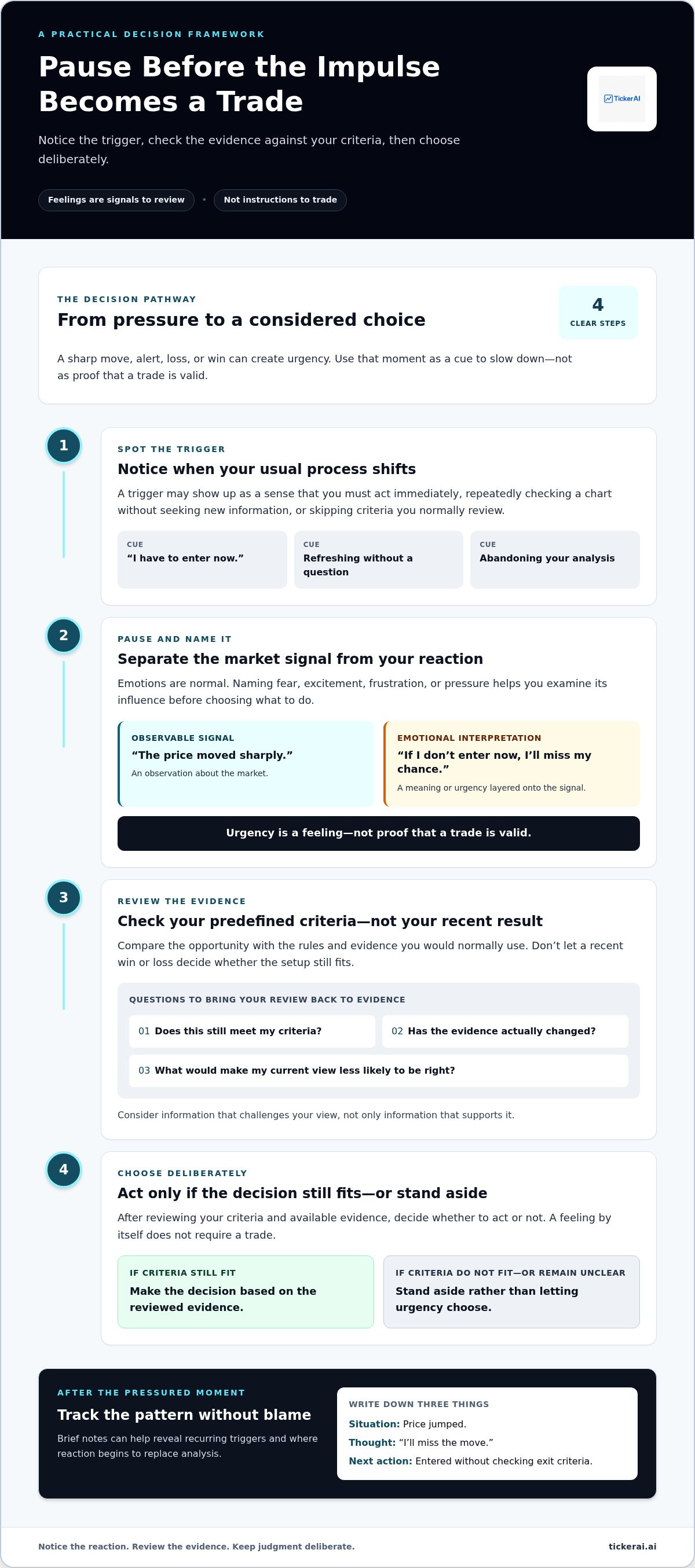
A Five-Step Pause-and-Review Process for Emotional Trading Decisions
A useful pause doesn’t need to become another trading system. Keep it brief enough to use before placing or changing an order, and repeat the same sequence whenever pressure rises. The aim is to make your reasoning visible, not to predict the next market move.
- Name the trigger. Identify what prompted the urge: a price move, alert, headline, recent loss, or frustration. Naming it helps separate the event from your reaction.
- Pause. Step away from the order screen long enough to interrupt an automatic response. Take a breath, then return to the decision rather than refreshing the chart for reassurance.
- Check your criteria. Ask whether the proposed action matches rules you set before this emotional moment. If it doesn’t, identify what changed and why that change matters.
- Assess the evidence. Review the information relevant to your idea. Note what supports it, what challenges it, and what remains unknown. Don’t treat a strong feeling as a substitute for missing evidence.
- Record the decision. Write down what you decided and the reason. Acting, waiting, or declining to act can all be documented without assuming any choice guarantees an outcome.
For example, imagine an alert draws your attention to a stock that has just moved sharply. You feel pressure to act before the move continues. Name the alert and urgency as the trigger, pause, then check whether the situation fits criteria you established in advance. Assess the available evidence and what’s still uncertain. Record your reasoning before proceeding with your own decision process. The example doesn’t point to a particular trade; it shows how to create space between a prompt and a response.
What to check before placing or changing an order
Use three quick questions: Does this match criteria written before the current reaction? What evidence supports or challenges the idea, and what information is still uncertain? Is urgency, frustration, or a recent outcome pushing me toward this action? If you can’t answer clearly, pause rather than filling the gaps with assumptions. A rule-based trading plan can provide criteria to return to under pressure.
How to review the decision after the market moment passes
In your trading journal, capture the trigger, evidence considered, decision, and emotional state. Later, assess process quality separately from the trade’s result: a favorable outcome doesn’t prove the reasoning was sound, and an unfavorable one doesn’t automatically make the process flawed. Look for recurring triggers across decisions. One isolated moment is a prompt to reflect, not a complete pattern.
Learning how to avoid emotional trading decisions means making the pause repeatable, not expecting every decision to feel calm. For structured market research to inform your own review, explore TickerAI’s stock discovery tools.
Use Research Tools to Support Decisions, Not Outsource Trading Discipline
Research tools can help organize what you’re watching. A focused watchlist keeps selected tickers together, while alerts draw attention to potential market activity that may deserve review. This can reduce ad hoc searching during a fast-moving session. It doesn’t decide what a signal means or whether any action fits your plan.
An alert is an input for independent evaluation, not a command or personalized recommendation. Treat it as a prompt to return to your written criteria: What changed? Is the information relevant to your thesis? What evidence would challenge your interpretation? If the alert creates urgency but adds no meaningful evidence, the next step may be to continue reviewing or stand aside.
How alerts can fit into a calmer decision workflow
Build a focused watchlist around the names or research questions you already intend to monitor. When an alert arrives, compare the new information with the criteria you wrote before the alert, rather than searching broadly for reasons to act. This gives the signal context. A separate guide to interpreting AI stock signals can explore how to assess those research inputs; the key here is to make each one part of your own review, not a substitute for it.
For example, an alert may bring a ticker back to your attention during a volatile session. The notification tells you that something met a monitoring condition. It doesn’t establish whether the broader setup remains relevant, whether the information is complete, or whether the trade matches your risk parameters. Evaluate those points independently before deciding what, if anything, to do.
What AI research can and cannot do for trading psychology
AI-powered scanning can surface stock opportunities and help reduce manual market scanning. TickerAI also provides curated swing trade setups and long-term investment ideas to support research and discovery. These tools can organize the information you review. They can’t remove fear, excitement, or frustration, and they don’t replace independent judgment.
Research discovery and emotional discipline solve different problems. No research tool can guarantee that a trader will respond calmly or follow a plan. TickerAI provides research and discovery, not personal financial advice, and it doesn’t execute brokerage trades. You remain responsible for evaluating information and making your own decisions.
To apply how to avoid emotional trading decisions in practice, keep your criteria in charge and use tools to organize the evidence you’ll review. If structured opportunity discovery and watchlists would support that workflow, explore TickerAI’s research tools.
Make Your Next Decision More Deliberate
Consistency is built one decision at a time. For your next few trading sessions, focus on whether you can explain the reason for a decision before acting, even when the market feels urgent. You don’t need to feel perfectly calm. You need a process you can return to when pressure rises.
That shift changes the question from “Was the trade right?” to “Did I evaluate it using the information and criteria I had at the time?” This distinction can make your reviews more useful and help you identify where your process needs adjustment. The aim of learning how to avoid emotional trading decisions isn’t to control every market outcome. It’s to make your own reasoning clearer.
If organized research would support your process, explore TickerAI’s AI-powered stock opportunity discovery tools, including smart watchlists, real-time alerts, curated swing trade setups, and long-term investment ideas across subscription tiers. Use them as research inputs, then make your own assessment.
Start with the next decision. Make it deliberate, record your reasoning, and build from there.
Frequently Asked Questions
Can you trade stocks without emotions?
No. Emotions are part of human decision-making, so aiming to feel nothing while trading isn’t realistic. The practical goal is to keep a feeling from becoming the sole reason for an action. For example, notice if anxiety makes you repeatedly revise an order, then compare the proposed change with your documented rationale. You can acknowledge the emotion without treating it as a reliable forecast of what the market will do.
How do I stop making impulsive trading decisions?
Make impulsive actions harder to take automatically. Before a session, write down the conditions that would make you review a ticker and the conditions that would invalidate your idea. If an unexpected move tempts you to act, write a one-sentence reason for the decision before placing an order. This gives you a moment to inspect your reasoning. It’s a practical starting point for how to avoid emotional trading decisions.
What is the most common emotional mistake in trading?
There isn’t one mistake that is most common for every trader. A frequent reactive pattern is chasing a move after attention has gathered around it, then treating recent momentum as enough reason to participate. To catch this pattern, note whether your interest began with a plan or only after seeing the price move. That distinction can show whether the idea deserves a review or is mainly a response to activity.
Should I stop trading after a loss?
Not automatically. A loss alone doesn’t show whether your decision process was sound or whether you’re in a state to assess another opportunity. Use a pre-set stopping condition, such as reaching a limit you chose in advance or noticing that you can’t follow your own process. If you pause, review what happened before deciding when to resume. Avoid making that decision solely to recover a loss quickly.
Does a trading journal help with emotional decisions?
Yes, a journal can reveal patterns that are hard to spot in the moment. Track whether decisions were planned or unplanned, what was happening around them, and whether the process matched your criteria. Review entries across a meaningful stretch of activity rather than drawing conclusions from one trade. For instance, repeated rule changes after a particular type of headline may point to a trigger worth planning around.
Can AI alerts prevent emotional trading?
No. An alert can draw attention to market activity, but it can’t control your response or ensure you assess a signal objectively. Use alerts as research prompts: compare the information with your own thesis, note what it doesn’t establish, and decide whether further review is warranted. AI-powered discovery can help organize what you monitor, but it can’t replace independent judgment or guarantee a trading outcome.


