

What if the best use of an AI stock scanner for swing trading isn’t to tell you when to buy, but to help you follow the same research process every time? Manual screening can take hours, while a fast alert can tempt you to act before checking whether a setup fits your plan. More signals don’t automatically lead to better decisions.
A disciplined routine separates discovery from execution. Set consistent criteria for potential candidates, review each idea against your entry and risk rules, then record what you decided and why. AI can narrow the field, but your judgment stays in control.
This guide shows how to build a repeatable workflow, from defining scan criteria to reviewing candidates and managing watchlists and alerts. TickerAI’s curated swing-trade setups, AI-generated ideas, smart watchlists, and alerts can support discovery and monitoring without replacing your own analysis. Use these inputs to focus your research, avoid reacting to every notification, and review decisions consistently.
Key Takeaways
- Define your setup conditions before scanning so each candidate is measured against consistent criteria.
- Use an AI stock scanner for swing trading to surface ideas, then independently assess chart context, liquidity, timing, and invalidation points.
- Treat an alert as a prompt to investigate, not a signal that requires an immediate entry.
- Set scheduled review windows and organize candidates by setup status or priority to reduce noise and impulsive decisions.
- Record your decisions and reasoning to make it easier to review and refine your trading process over time.
Why AI Stock Scanners Can Support Swing-Trading Discipline
An AI stock scanner for swing trading filters a broad universe of securities and surfaces candidates that match data-driven criteria. Those criteria might relate to price movement, trading volume, or technical conditions. The main value is focus: screening can reduce the manual work of finding stocks to review. A scanner can’t verify that a trade suits your goals, guarantee a profitable outcome, or replace a consistent decision process.
Swing trading generally involves holding a position across multiple market sessions to capture a potential price move, rather than opening and closing trades within the same session. For a useful overview of the strategy and its challenges, see What is Swing Trading? That multi-session horizon makes ongoing observation part of the process. A candidate may need further review before entry, and its conditions can change while it remains on your radar.
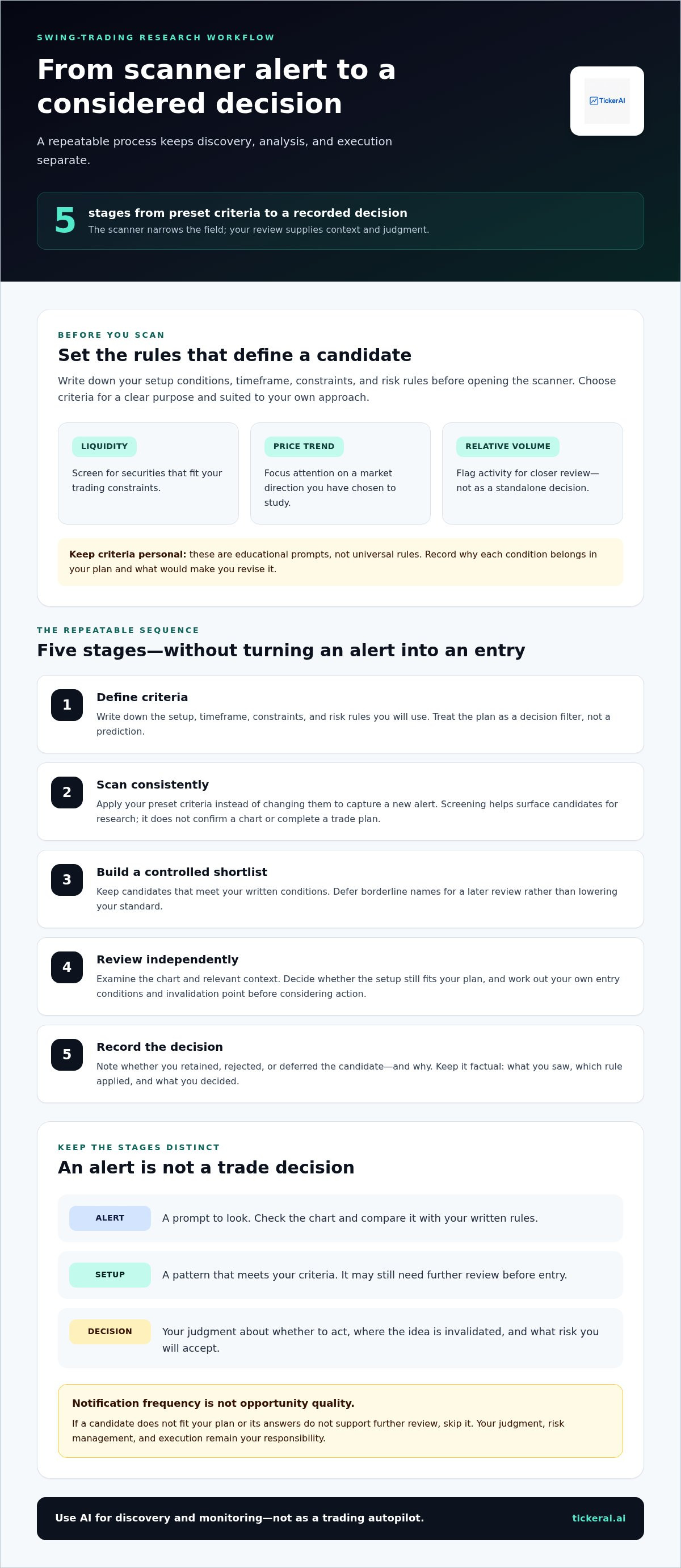
An alert is a prompt to look. A setup is a pattern that meets your criteria. A trade decision is your judgment about whether to act, where the trade is invalidated, and what risk you’ll accept. Keeping these stages separate helps prevent discovery from turning into an automatic entry.
What an AI stock scanner does in a swing-trading workflow
Automated screening helps identify securities for research; it doesn’t issue a command to buy or sell. A smart watchlist gives you a place to organize candidates for continued observation, such as grouping them by setup status or review priority. This is useful when a chart needs more time to develop or a condition hasn’t yet been met.
Real-time alerts can flag a change that deserves attention, but an alert isn’t confirmation. Check the chart and compare it with your written rules before deciding whether the setup still qualifies. The scanner supplies an input; your review supplies context.
Why more alerts do not automatically create better discipline
Frequent notifications can create pressure to react, even when a candidate falls outside your plan. Chasing each new signal can lead to inconsistent standards: one stock gets a careful review, while another gets an impulsive entry because its alert arrived at a busy moment. Alert volume is not the same as opportunity quality.
Set your criteria first, then use the scanner to narrow the field. For each candidate, ask:
- Does it match the setup I planned to trade?
- Is there a clear reason to keep monitoring it?
- What condition would invalidate the idea?
If the answers don’t support further review, skip it. Selectivity protects your attention and keeps decisions tied to a repeatable standard rather than notification frequency. You remain responsible for judgment, risk management, and execution. Used this way, scanning can support a disciplined process without making decisions for you.
Build a Repeatable Process Before Scanning for Swing Trades
Decide what qualifies as a candidate before opening a scanner. Otherwise, your criteria can shift to fit whichever chart looks compelling in the moment. Write down your setup conditions, trading timeframe, and risk limits. A trading plan works as a decision filter, not a prediction. This guide to AI and trading discipline also explores how systematic rules can help reduce emotion in the process.
Keep your rules practical and suited to your approach. A liquidity threshold should reflect what you’re comfortable trading; a trend condition should match your strategy and chart timeframe. There’s no universal screening recipe. The SEC’s Algorithmic Trading in Capital Markets provides broader context on automated trading, but your criteria still need to reflect your own plan and judgment.
Set screening criteria before reviewing candidates
Choose a few criteria, each with a clear purpose. Liquidity can help screen for securities that fit your trading constraints. A price trend can focus attention on a market direction you’ve chosen to study. Relative volume can flag activity for closer review. These are educational prompts, not universal rules. Record why each condition belongs in your plan and what would make you revise it.
Turn scanner results into a controlled shortlist
Use the AI stock scanner for swing trading to discover candidates that match your preset filters, then follow a fixed review sequence. Initial screening is not chart confirmation or a completed trade plan.
- Define criteria. Write down the setup, timeframe, constraints, and risk rules you’ll use.
- Scan. Apply those criteria consistently instead of changing them to capture a new alert.
- Shortlist. Keep candidates that meet your written conditions. Defer borderline names for a later review rather than lowering your standard.
- Review independently. Examine the chart and relevant context, then decide whether the setup still fits your plan. Work out your own entry conditions and invalidation point before considering action.
- Record the decision. Note whether you retained, rejected, or deferred the candidate, and why.
This sequence separates discovery from analysis, and analysis from a decision. A short note such as “deferred, trend condition not met” makes your reasoning visible later. Over time, your log can help you see whether you apply criteria consistently or make exceptions under pressure. Keep records factual: what you saw, which rule applied, and what you decided.
Curated swing-trade setups and smart watchlists can support the discovery and tracking stages of this routine. Explore AI stock discovery and swing-trade setups as inputs to your research, while keeping screening rules, risk judgments, and trade decisions under your control.
How to Evaluate an AI Swing-Trade Alert Without Chasing It
An alert can arrive while price is moving quickly, but urgency isn’t evidence that a candidate fits your plan. Treat each notification as a prompt for a structured review. An AI stock scanner for swing trading may surface an event that merits attention; it can’t decide whether the setup is valid for you or whether the risk is acceptable.
A scanner signal points to something worth checking; a trade thesis explains, through your own analysis, why the setup fits your rules and where it would be invalidated. Keep that distinction clear before considering an entry.
Check whether the alert matches your predefined setup
Start with the alert’s stated rationale, then compare it with your written entry conditions. Review the chart and relevant technical context yourself. If the alert leaves out information you need, mark it as unknown and investigate rather than filling the gap with an assumption. An incomplete review is a reason to pause, not improvise.
- Setup fit: Does the candidate meet the conditions you defined, or is the alert highlighting a different pattern?
- Chart context: Does price action support your thesis on the timeframe you use? Check whether nearby levels or recent movement change the picture.
- Liquidity: Does trading activity meet the standard you set for your plan?
- Timing: Has the condition you planned to monitor occurred, or has price already moved beyond your intended entry criteria?
- Invalidation: What observable price or setup condition would show that your original thesis no longer holds?
Work through each question in order. If an essential condition fails, reject or defer the candidate and record why. This prevents an attractive alert from quietly changing your standards.
Apply risk rules before deciding whether to act
Before considering a position, identify the invalidation point that would tell you the setup no longer meets your thesis. Then check whether the potential trade can fit the position-sizing method and risk limits already in your plan. These are trader-defined decisions, not conclusions an alert can make on your behalf.
For example, imagine an alert flags a sharp move that looks compelling at first glance. Your plan requires a particular liquidity condition, but your review shows that the candidate doesn’t meet it. Rejecting the alert can be the disciplined decision, even if the chart continues to attract attention. The process succeeds by applying your rules, not by trying to participate in every move.
If the setup is unclear, timing conflicts with your criteria, or you can’t define what would invalidate the thesis, step back and document the gap. No alert makes an outcome certain or removes risk. A deliberate review turns a scanner notification into an informed decision, including the decision to wait or pass.
Create a Daily Scanner Routine That Limits Noise and Impulse
A useful scanner routine gives alerts a place in your day without letting them dictate your attention. Choose review windows that fit your schedule and trading timeframe, such as one planned check early in your research day and another later to revisit developing candidates. Set the timing to suit your routine. The key is to review deliberately instead of reopening the scanner every time a notification appears.
Use notification preferences to support those boundaries. Keep alerts that flag changes relevant to your process, and avoid treating every update as a reason to interrupt other work. An alert can wait for your next review window unless your own plan says otherwise. For deeper guidance on assessing what a signal may indicate, read this guide to interpreting AI stock signals.
Use watchlists and alerts with clear review boundaries
Organize watchlist candidates by status so each name has a clear next step. A simple structure could include:
- Actionable for review: The candidate appears to meet your initial criteria and is ready for closer analysis. This status is not an instruction to trade.
- Awaiting confirmation: A condition in your plan hasn’t occurred yet, so keep the candidate under observation.
- Rejected: The setup failed a required condition or no longer fits your criteria.
At each scheduled check, move candidates only when your review supports a status change. A watchlist organizes attention; it doesn’t validate a setup or replace your analysis. This distinction helps an AI stock scanner for swing trading reduce manual searching without turning a stream of alerts into a stream of decisions.
Review process quality, not just trade outcomes
After each review, record what happened and whether you followed your written rules. Separate the quality of your process from a trade’s result: a disciplined decision can still have an unfavorable outcome, and a favorable result doesn’t prove an impulsive decision was sound.
Keep the log practical. Capture the setup, alert context, rationale, decision, and any deviation from your plan. If you rejected or deferred a candidate, note which condition was missing. During a periodic review, look for patterns in your behavior: Are you repeatedly acting before confirmation? Do you ignore a rule when an alert feels urgent? Do you consistently record why candidates were passed over?
Don’t treat a small set of outcomes as proof that a strategy is reliable. Use the record to assess whether you applied your process consistently, then consider changes carefully rather than rewriting criteria after each result. TickerAI’s smart watchlists and real-time alerts can support this monitoring routine while leaving decisions with you. Explore TickerAI’s AI stock discovery as a way to organize candidate review within your own trading process.
Use TickerAI as a Discovery Layer, Not a Trading Autopilot
The routine works best when each tool has a defined role. TickerAI can help surface swing-trade ideas and organize candidates for monitoring. It doesn’t make the final call. Subscribers use AI-driven discovery to inform their research, then remain responsible for evaluating each setup and deciding whether it fits their trading plan.
Think of the platform as a discovery and monitoring layer within a trader-led process. The scanner helps focus attention; your criteria, chart review, and risk plan guide the decision. A curated idea or notification isn’t personal financial advice, an instruction to enter, or a guarantee of an outcome.
Where TickerAI fits in a trader-led process
Use each feature for a specific step, rather than treating the platform as a substitute for your entire workflow:
- Curated swing-trade setups: Treat them as candidates to compare with your written criteria. Review the rationale and chart context independently, then retain, defer, or reject the idea based on your rules.
- Smart watchlists: Organize candidates you want to monitor. You might group them by whether they need confirmation, are ready for closer review, or no longer meet your conditions.
- Real-time alerts: Use notifications as prompts to revisit a candidate or market change. An alert can bring relevant activity to your attention, but it doesn’t confirm a setup or trigger an automatic entry.
This division keeps discovery separate from judgment. If an idea doesn’t meet your criteria, you can pass on it. If an alert arrives outside a scheduled review window, handle it according to the boundaries you’ve set for your routine, not simply because it appeared.
Choose a consistent way to explore TickerAI discovery
TickerAI offers Pro and Full-Access subscription tiers. Consider how AI-driven discovery, watchlists, and alerts would fit the routine you already use. Identify which parts of research or monitoring you want to organize, then evaluate whether those inputs support your established review habits.
Keep your standards consistent as you explore. Review ideas against the same setup conditions, record your decisions, and assess whether the discovery layer helps you focus without encouraging reactive entries. The platform can support research and monitoring, but the analysis and choices remain yours.
Explore TickerAI stock discovery to see how swing-trade setups, watchlists, and alerts can fit into a disciplined, trader-led research routine.
Make Your Next Review More Intentional
Put your process into practice, then use your review notes to see where your decisions follow your rules and where they drift. Keep your criteria stable while you assess how well an AI stock scanner for swing trading supports your research. Refine your routine deliberately, not in reaction to a single alert or outcome.
TickerAI’s curated swing-trade setups, smart watchlists, and real-time alerts can help organize discovery and monitoring. Available through Pro and Full-Access subscription tiers, these tools provide research inputs, not decisions. You remain in control of whether an idea fits your plan and how you manage risk.
Explore TickerAI stock discovery and consider how it could fit into your review routine. Build consistency one thoughtful decision at a time.
Frequently Asked Questions
Can an AI stock scanner improve trading discipline?
Yes, it can support discipline by applying the same screening logic each time, but it can’t set your standards or make decisions for you. For example, save a rule that excludes a ticker below your liquidity threshold, then note whether you followed it even when you skip a candidate. A consistent filter makes exceptions visible. It doesn’t make a strategy profitable or turn every alert into a suitable trade.
How do you use an AI stock scanner for swing trading?
To use an AI stock scanner for swing trading, translate one setup into observable conditions, such as trend direction and a volume requirement. Apply those filters, then inspect candidates on the same chart timeframe you use for planning. Log the alert date, what still needs confirmation, and a next review point. This record helps distinguish a developing idea from one that has already moved beyond your entry criteria.
Can AI stock scanners predict which stocks will rise?
No scanner can establish what a stock will do next. It may surface patterns or candidates based on its analysis, but market conditions can change and a signal can fail. Consider what information the alert reflects and whether current price action still supports further research. Don’t assume a pattern will repeat just because it appeared before, or interpret a scanner result as a promise of future performance.
How often should swing traders check stock scanner alerts?
Choose review times that fit your strategy, timeframe, and alert preferences. A trader monitoring multi-session setups might review candidates at planned points, allowing time to assess changes without checking every notification as it arrives. Keep routine watchlist updates separate from information your own plan treats as time-sensitive. There’s no universal schedule; the useful measure is whether your review habits are consistent and manageable.
Should you buy a stock as soon as an AI scanner flags it?
No. A flag is a reason to investigate, not an instruction to enter. Compare the candidate with your plan and identify what would invalidate the idea before considering a position. For example, if a stock opens beyond the entry area you intended to assess, chasing it may no longer fit your criteria. Passing or waiting for another review is a valid decision when conditions don’t align.
What should you track to measure trading discipline?
Track rule adherence alongside trade outcomes. For each candidate, mark whether it met your setup conditions, whether you respected planned risk limits, and whether you documented the decision before acting. Include skipped alerts, since they show whether you can follow a filter without taking a position. In periodic reviews, compare compliant and noncompliant decisions separately; don’t treat a brief run of results as proof that a method predicts future moves.


