

A popular stock can represent a weak business, and a strong business can still be a poor investment at the wrong price. If you’re wondering how to evaluate a company, start by separating business quality from stock valuation. A familiar name or rising share price doesn’t prove that a company has durable earnings, financial resilience, or an attractive entry point.
Financial statements become more useful when you read them as evidence rather than as disconnected figures. Revenue growth, cash flow, debt, competitive position, and valuation each answer a different question. No single metric settles the decision. The goal is to build a consistent view of what the company does well, where it’s exposed, and what the market may already expect.
This framework helps you assess business quality, test financial strength, compare valuation in context, and identify risks or unanswered questions before deciding whether a stock merits deeper research. Use it to turn scattered data into a more disciplined review, without confusing a good company with an attractive stock.
Key Takeaways
- Learn how to evaluate a company by separating business strength from whether its stock price looks attractive.
- Examine how the business earns revenue, serves customers, and depends on key suppliers or channels.
- Use the income statement, balance sheet, and cash flow statement to put growth, margins, debt, and cash generation in context.
- Follow a repeatable checklist and keep evidence, assumptions, and unanswered questions distinct.
- Treat companies that pass an initial review as candidates for deeper research, not automatic buys.
How to Evaluate a Company Before You Consider Its Stock
A company may attract attention because its products are familiar, its industry is trending, or its share price is rising. Those signals can prompt research, but they don’t show whether the business is resilient or its stock is attractively priced. Start with evidence about the company, then assess what that evidence could mean for an investment.
For a public company, useful starting points include annual and quarterly reports, earnings releases, investor presentations, and management commentary. These sources provide evidence, not a complete picture. Private-company information is often less accessible, so note gaps rather than treating missing data as proof of strength or weakness.
What does it mean to evaluate a company?
Company evaluation is the process of assessing a business’s quality, financial condition, competitive position, and material risks using available evidence. The aim is to understand how the company operates and what could support or impair its performance, not to predict its future with certainty.
Separate observations from interpretations. “Revenue increased in the last reported period” is an observable fact. “Revenue will keep accelerating” is a forecast. “Customers are loyal” is an assumption unless evidence, such as repeat-purchase data or retention disclosures, supports it. Labeling each claim helps prevent an appealing narrative from quietly becoming a conclusion.
Evidence matters more than brand recognition. A familiar name may still face weakening demand, concentrated customers, or rising costs. An unfamiliar company also needs scrutiny, even if its business model appears sound. For background on how analysts think about value, review Business Valuation Methods, including income-, asset-, and market-based approaches.
Company quality is not the same as stock quality
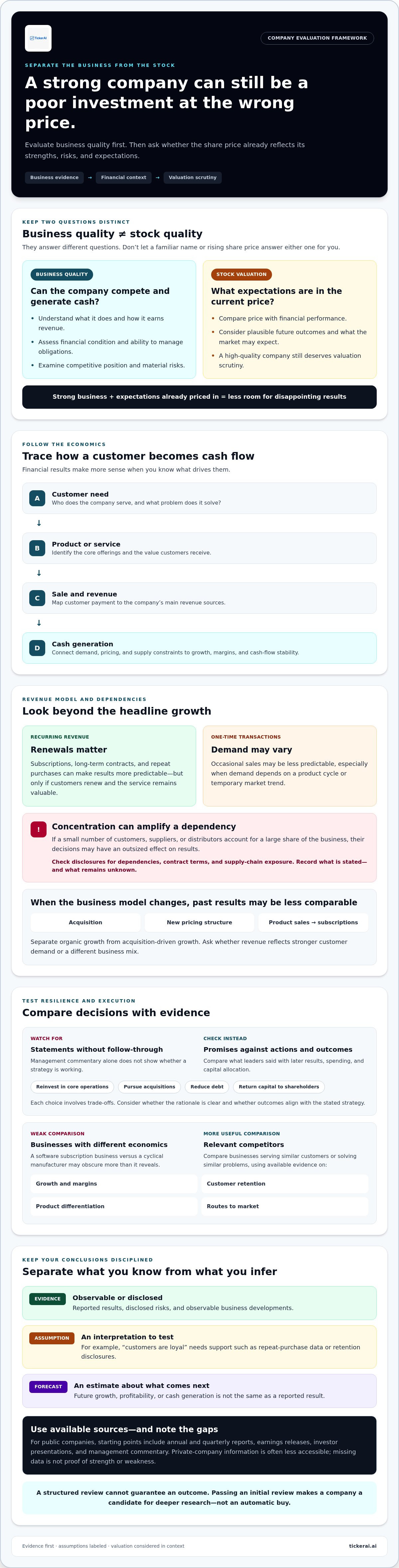
Business analysis and share-price analysis answer different questions. Business analysis asks whether the company can compete, generate cash, and manage its obligations. Valuation asks what expectations are reflected in the current price and how that price compares with financial performance and plausible future outcomes.
That distinction shapes the research sequence. First, determine what the business does and what supports its economics. Then consider whether the market price accounts for those strengths, risks, and expectations. Even a high-quality company deserves valuation scrutiny: investors may already be pricing in strong growth, leaving less room for disappointing results.
A practical review should keep three categories distinct:
- Evidence: reported results, disclosed risks, and observable business developments.
- Assumptions: interpretations that need support or further testing.
- Forecasts: estimates about future growth, profitability, or cash generation.
There’s no universal score that determines whether a company is worth buying, and a structured review can’t guarantee an outcome. Investment decisions also depend on an individual’s goals, time horizon, financial circumstances, and tolerance for risk. Use the process to decide whether the evidence justifies deeper research, not as an automatic buy signal.
Assess the Business Model, Competitive Position, and Leadership
A company’s financial results make more sense when you know what drives them. Trace the path from customer need to product or service, then from sale to revenue and, ultimately, cash generation. This connects business quality to financial evidence: customer loyalty, pricing power, and supply constraints can influence growth, margins, and cash-flow stability.
Test how the company makes money
Identify the core products, customer groups, and main revenue sources. Then ask how customers pay: through repeat purchases, subscriptions, long-term contracts, usage fees, or occasional transactions? Recurring revenue can make results more predictable, but only if customers renew and the service remains valuable. One-time sales may be less predictable, especially when demand depends on a product cycle or temporary market trend.
Look for concentration. If a small number of customers, suppliers, or distributors account for a large share of the business, their decisions may have an outsized effect on results. Company disclosures may identify these dependencies, describe contract terms, or flag supply-chain exposure. Record what the company states and what remains unknown.
Check whether the business model has changed. An acquisition, new pricing structure, shift from product sales to subscriptions, or exit from a business line can make past results less comparable. Separate organic growth from growth driven by acquisitions. Then consider whether revenue reflects stronger customer demand or a different business mix.
Examine leadership and competitive resilience
Assess management through decisions as well as statements. Compare what leaders said they would do with later results, spending, and capital allocation. Did they reinvest in core operations, pursue acquisitions, reduce debt, or return capital to shareholders? Each choice involves trade-offs. Consider whether the rationale is clear and whether outcomes align with the stated strategy.
Identify relevant competitors: businesses that serve similar customers or solve similar problems. Compare available evidence on growth, margins, customer retention, product differentiation, and routes to market. A peer comparison is useful only when the companies have reasonably similar economics. Comparing a software subscription business with a cyclical manufacturer, for example, may obscure more than it reveals.
Treat claims such as “industry-leading” or “hard to replace” as hypotheses. Look for support in customer retention, pricing behavior, market-share disclosures, or sustained operating results. Switching costs, distinctive expertise, network effects, or access to distribution can strengthen a company’s position, but no advantage should be assumed permanent.
A durable competitive advantage is a business strength that helps a company defend customer demand or profitability over time, while remaining vulnerable to competition, technology, and changing customer needs. That strength may help explain financial performance, but it doesn’t settle what the shares are worth. For a framework connecting business characteristics to valuation approaches, see Harvard Business School’s Business Valuation Techniques.
Make how to evaluate a company systematic by recording its revenue drivers, dependencies, peer set, management decisions, and evidence for any claimed advantage. AI-powered stock opportunity discovery can help surface companies for this research. TickerAI’s stock discovery tools can help generate ideas for further investigation.
Read Financial Statements and Interpret Valuation in Context
Financial statements let you test business claims against reported results. Read them together and across multiple periods. Rising sales may look encouraging, but check whether margins hold, cash follows earnings, and debt remains manageable. A mismatch is a research question, not an automatic verdict.
Use financial statements to test business health
The income statement shows revenue, expenses, and profit over a period. The balance sheet captures assets, liabilities, and equity at a point in time. The cash flow statement tracks cash generated and used by operations, investing, and financing. Together, they show whether growth appears profitable, how the company funds itself, and whether reported earnings translate into cash.
Compare several periods. Look for margin changes, rising receivables or inventory, increasing borrowing, and operating cash flow that consistently trails earnings. Interpret each trend in context: an inventory buildup could reflect planned expansion or slowing sales. For U.S.-listed companies, the annual Form 10-K provides detailed financial statements and risk disclosures. Reporting rules and documents differ across markets, so don’t assume every company follows identical disclosure requirements.
| Measure | What it can indicate | Limitation |
|---|---|---|
| Revenue growth | Changes in sales and demand | May reflect acquisitions, price increases, or one-time effects |
| Operating margin | How much operating profit remains from revenue | Varies by industry and can shift with business mix |
| Debt and interest costs | Borrowing levels and ability to service obligations | Debt alone doesn’t show repayment timing or cash availability |
| Operating cash flow | Cash produced by core operations | Can fluctuate with working capital and timing |
Compare valuation measures without relying on one ratio
Valuation measures relate a company’s market price to a financial or operating measure. The price-to-earnings ratio compares share price with earnings per share. Other comparisons may use sales, cash flow, or enterprise value relative to earnings before interest, taxes, depreciation, and amortization. Choose a measure that fits the company’s economics, then compare it with relevant peers and the company’s own history.
Check the period and accounting basis behind each figure. A fast-growing company may trade at a different sales multiple from a mature firm with steadier revenue. Negative earnings make a P/E ratio uninformative, while unusual business models may require different measures. One-off charges or changing share counts can also distort comparisons. Don’t read a ratio in isolation.
No single financial ratio can establish a company’s value; each is a limited signal that must be interpreted alongside the business, its financial condition, and its market price. A disciplined approach to how to evaluate a company uses financial statements to test the business story, then treats valuation measures as comparisons to investigate, not as a final answer.
Apply a Repeatable Company-Evaluation Checklist
A checklist makes research easier to reproduce and review. Use the same sequence for each company, compare similar businesses across consistent periods, and write down what the evidence supports. This turns how to evaluate a company into a working process, not a search for a perfect score. For a broader research workflow, see this guide to systematic stock research.
- Describe the business. Summarize what it sells, who its customers are, and how it generates revenue. If you can’t explain the model clearly, identify what you need to learn.
- Map the key dependencies. Record customer concentration, recurring or one-time demand, supplier reliance, and distribution risks that could affect operations.
- Assess competitive position. Identify relevant peers and compare the company on similar business lines, periods, and measures. Note where evidence supports its differentiation.
- Review financial performance. Track revenue, margins, debt, and cash generation across multiple reporting periods. Investigate material shifts instead of relying on a single year.
- Examine valuation. Select measures suited to the company’s business model, then compare them with relevant peers and historical context. Record the assumptions behind any estimate.
- Identify risks and open questions. List threats that could alter the business outlook, along with the evidence you still need before reaching a view.
Keep peer comparisons disciplined. A business with a different growth profile or revenue model may not provide a useful benchmark, even if it operates in the same broad sector. Use consistent periods and definitions where possible, and flag differences in accounting or reporting that could affect the comparison.
Turn research questions into a decision record
Capture a concise thesis, the evidence supporting it, and the conditions that would challenge it. Keep reported facts separate from interpretations and forecasts. For example, distinguish disclosed customer concentration from an assumption that those customers will renew. Include key risks, unresolved questions, and the next information that could help answer them. A review trigger might be a material change in results, competition, or strategy, rather than a short-term share-price move alone.
Keep the evaluation current as evidence changes
Set a consistent review routine around company disclosures and material business developments. Update your record when new results, competitive changes, or capital-allocation decisions affect the thesis. Don’t preserve an old assumption simply because it supported your original view. If research informs a disciplined trading process, rule-based plans can help structure decisions around predefined criteria rather than impulse.
Use the completed checklist to prioritize companies for further research, not to generate an automatic buy decision. TickerAI’s stock discovery tools can help surface additional companies for your own analysis.
Use Company Evaluation to Guide Further Stock Research
A company that clears an initial review earns a place on a research shortlist, not an automatic buy decision. Deeper analysis can test whether its business strengths are reflected in its financial outlook and whether the current valuation fits your assumptions. Keep those judgments distinct: business quality describes the company, valuation assesses its price, and market signals show how its shares are behaving.
Use a watchlist to organize companies that merit attention and keep the reason for tracking each one visible. Record the thesis beside the ticker, including supporting evidence and what could change your view. Alerts can draw your attention to developments, but they’re prompts to investigate, not conclusions. For more on interpreting discovery inputs, see interpreting AI stock signals.
Connect fundamental research with market discovery
Fundamental research and market discovery serve different roles. Your review of the company helps establish whether its business and finances warrant further attention. Valuation helps frame what expectations may be embedded in the share price. Market signals can surface an idea or flag activity to investigate, but they don’t replace either analysis.
Keep watchlist entries useful by noting what would justify another review: a new company disclosure, a material shift in results, a change in competitive conditions, or an update to your valuation assumptions. Compare new information with the thesis you documented. This is more disciplined than reacting to price movement without checking whether the underlying business case has changed.
Set realistic boundaries for AI-assisted research
AI-powered discovery can help surface companies and investment ideas for further research. TickerAI provides opportunity discovery, smart watchlists, real-time market alerts, curated swing trade setups, and long-term investment ideas. These tools can support research, but automated discovery doesn’t establish business quality, determine whether a stock suits your circumstances, or guarantee an outcome. Verify the underlying information and apply your own judgment.
Use alerts as cues to revisit relevant evidence. A headline or market move may not affect the original thesis, while a change in the company’s results or strategy might. Avoid treating an alert as a prediction or a command to trade. TickerAI supports research and discovery; it doesn’t provide personal financial advice or execute trades.
Bring the process together: use how to evaluate a company to identify a research candidate, document what you believe and why, then monitor for evidence that confirms or challenges that view. Explore TickerAI to see how AI-powered stock opportunity discovery can support your research workflow.
Put Your Next Research Idea to the Test
Apply your framework to a real candidate. Choose one business, write down what would strengthen or weaken your view, and let new evidence guide the next review. A clear record keeps research focused when headlines and market moves compete for attention.
Finding companies worth investigating can be its own challenge. TickerAI brings AI-powered stock opportunity discovery together with smart watchlists, real-time alerts, swing trade setups, and long-term investment ideas. Use these tools to surface and monitor research candidates, then assess the evidence independently. Discovery can help direct your attention, but your analysis remains central to any decision.
Explore AI-powered stock opportunity discovery with TickerAI to build a more organized pipeline for your research. Keep asking precise questions and update your view when the facts change.
Frequently Asked Questions
How do you evaluate a company with negative earnings?
Negative earnings make the price-to-earnings ratio unusable or misleading, but they don’t automatically mean the company is poor. Examine revenue quality, gross margins, cash runway, debt obligations, and whether there’s a credible path to sustainable profitability. Find out why losses exist: heavy investment in expansion differs from persistent operating problems. Compare the company with suitable peers, and treat management’s profitability forecasts as uncertain assumptions, not established outcomes.
Can you evaluate a private company using the same framework?
Yes. Questions about customers, revenue sources, competition, leadership, and financial resilience still apply. The challenge is evidence: private companies generally disclose less than public issuers, which can limit an outside investor’s ability to verify claims. If a company shares only partial financials, mark missing figures and estimates explicitly. Don’t present a rough revenue estimate as a reported fact. Available information and disclosure obligations vary by company and jurisdiction.
How often should you reevaluate a company?
Revisit your thesis when material evidence changes, such as new financial results, a major strategic shift, a financing decision, or a change in competitive conditions. A planned review cadence helps catch stale assumptions, but the right schedule depends on your research horizon and access to information. Checking ordinary price movements constantly isn’t the same as reassessing the business. Keep track of what changed and whether it affects your original reasoning.
What is the difference between a company valuation and its market capitalization?
Market capitalization is the current market value of a company’s outstanding equity, calculated by multiplying its share price by its shares outstanding. Valuation is a broader analytical judgment about what the business may be worth under stated assumptions. Market capitalization is observable, but it doesn’t by itself account for debt, cash, future prospects, or uncertainty. A high share price or large market cap alone doesn’t establish that a company is fairly valued.
Does a strong balance sheet mean a company is a good investment?
No. A strong balance sheet may give a company financial flexibility and reduce near-term pressure, but it can’t answer every investment question. Consider whether demand is holding up, whether the company can compete, and whether its shares reflect realistic expectations. A business with substantial cash could still face shrinking sales or an expensive valuation. Read balance-sheet strength alongside cash flow and operating evidence to understand both its resilience and its limits.
Can AI evaluate a company for you?
AI can help screen markets, organize information, and surface companies or signals for further research, but it can’t replace independent evaluation. Check source material, test assumptions, and assess risks before drawing conclusions. TickerAI provides AI-powered stock opportunity discovery, including smart watchlists, alerts, and investment ideas. Treat these as research inputs, not predictions or a final decision. AI output doesn’t determine whether an investment fits your circumstances or provide personal financial advice.


