

What if the hardest part of a trading idea isn’t spotting a potential entry, but defining exactly what qualifies before the market starts moving? If your entry and exit decisions change under pressure, learning how to create a rule-based trading system starts with turning that instinct into conditions you can observe, record, and test.
A promising setup can still be too vague to evaluate. A backtest that looks strong can also disappoint when it meets live-market costs, changing conditions, or inconsistent execution. The answer isn’t a longer list of indicators. It’s a repeatable decision process with risk limits set in advance.
This guide shows how to translate a market hypothesis into clear entry, exit, position-sizing, and review rules. You’ll learn how to test those rules realistically, interpret results without overfitting, and revise the system methodically. AI-driven discovery, smart watchlists, real-time alerts, and curated swing trade setups can help surface research ideas, but the rules and trade decisions remain yours. The goal is a process you can evaluate and follow, not a signal you have to trust blindly.
Key Takeaways
- Learn how to create a rule-based trading system by starting with a falsifiable market hypothesis, then defining the market universe, timeframe, and data inputs.
- Make each condition observable and specific enough that another person could apply it consistently.
- Compare exit approaches and set risk boundaries in advance, allowing controlled flexibility rather than ad hoc exceptions.
- Use separate historical and validation data, then paper trade to identify bias and real-world frictions before relying on results.
- Use watchlists, alerts, and curated ideas to find candidates, while keeping trade decisions tied to your own rules.
What Is a Rule-Based Trading System, and What Makes It Testable?
A moving average crossing a price chart can create a signal. On its own, it doesn’t tell you which stocks to consider, how much to risk, when to exit, or how to assess the result. A rule-based trading system connects those decisions into one process. Each rule describes an observable condition, so applying the same rules to the same market data should lead to the same decision.
This distinction matters when you’re learning how to create a rule-based trading system. A system is testable when its conditions can be checked against historical or live data without relying on hindsight or personal interpretation. It can help you apply decisions consistently, but it can’t guarantee returns or eliminate the possibility of losses. For background on automated approaches, see Algorithmic trading.
Think of the workflow as four linked stages:
- Research inputs: Market data, screens, watchlists, alerts, or curated ideas identify candidates for consideration.
- Trade decisions: Your written setup and entry conditions determine whether a candidate qualifies.
- Execution: Your process governs order timing, position size, and how planned exits are handled.
- Review: Trade records show whether you followed the rules and what the results reveal.
Research helps surface possibilities; it doesn’t replace the rules that determine whether a trade fits. Keep that distinction clear, especially when using AI-powered discovery tools.
The building blocks of a rule-based trading system
Define the system’s scope before judging its signals. State the market, instrument universe, chart timeframe, and intended holding period. For example, a stock swing-trading system might consider U.S.-listed shares using daily bars and seek trades held for several days. This description sets the test’s boundaries; it isn’t a recommendation.
Give each rule a specific job. Setup conditions identify a potential opportunity. Entry conditions specify the trigger. Exit conditions define when to close a position. Sizing rules control exposure, while review rules specify what to record and how to assess results. A stock trading above its 50-day moving average could serve as a setup filter, but it doesn’t define an entry, exit, or risk limit by itself.
A strategy idea versus a usable rule
“Buy strong stocks” leaves room for conflicting interpretations. Does strong mean recent price momentum, relative performance against a benchmark, rising volume, or something else? Replace the phrase with defined inputs and thresholds, such as a specified lookback period and a measurable comparison. These are examples, not universal settings. State your choices before testing rather than adjusting them trade by trade.
A testable trading rule is a clear condition that specifies what to observe and what action follows when that condition is met. Include the data source, timeframe, and evaluation point where relevant. Precision makes comparisons meaningful: if two people reviewing the same data reach different conclusions, the rule needs clarification. That clarity is the foundation for a falsifiable market hypothesis and a testable strategy.
How to Turn a Trading Hypothesis into Explicit Rules
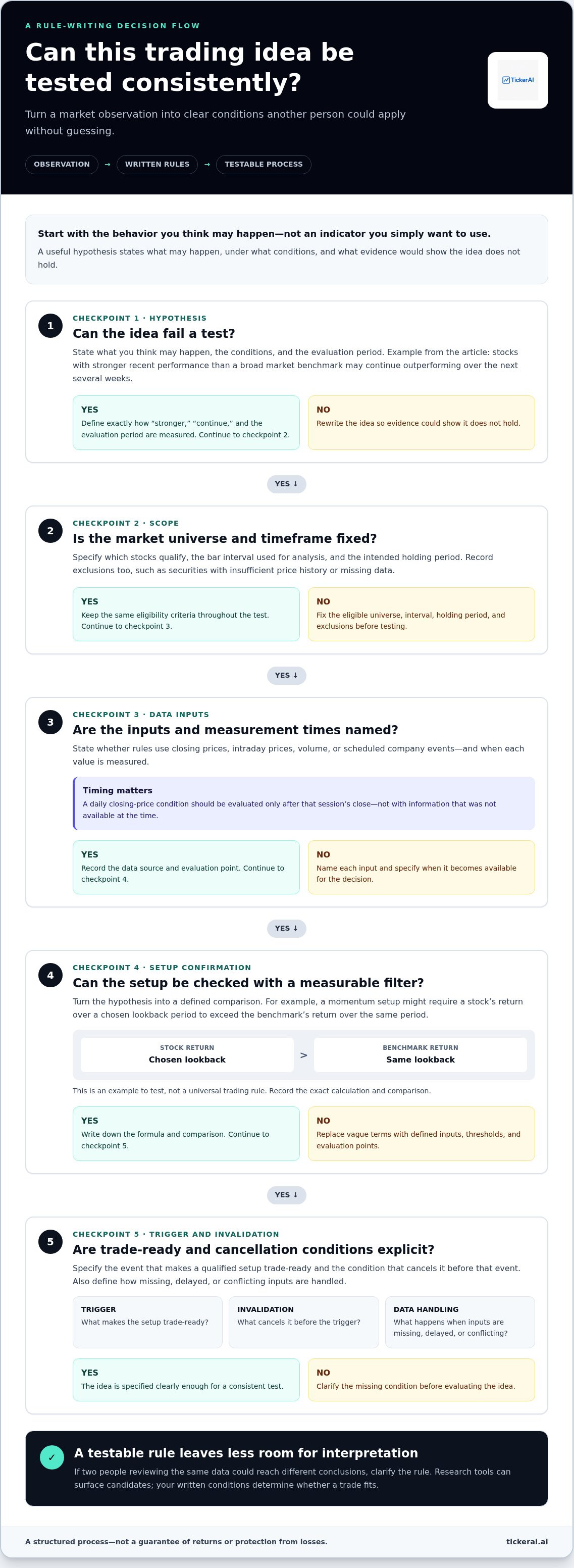
Start with a market behavior you can test, not an indicator you want to use. A hypothesis should specify what you think may happen, under what conditions, and what evidence would show that the idea doesn’t hold. This gives you a basis for choosing which data to collect and which rules to write.
This is the practical core of how to create a rule-based trading system: translate a broad observation into a specification another trader could apply without guessing. Quantitative investing fundamentals can help distinguish systematic analysis from a complete strategy. Analysis may identify patterns; a strategy also needs defined decisions and procedures.
- Write a falsifiable hypothesis. For example: “Stocks with stronger recent performance than a broad market benchmark are more likely to continue outperforming over the next several weeks.” Define how you’ll measure “stronger,” “continue,” and the evaluation period. The hypothesis must be capable of failing a test.
- Fix the universe and timeframe. Specify which stocks qualify, the bar interval used for analysis, and the intended holding period. Document exclusions too, such as securities with insufficient price history or missing data. Apply the same criteria throughout the test instead of changing the eligible list after seeing results.
- Name the data inputs. State whether the rules use closing prices, intraday prices, volume, or scheduled company events. Specify when each value is measured. For example, evaluate a condition based on a daily closing price only after that session’s close, not with information that wasn’t available at the time.
- Define setup confirmation. Turn the hypothesis into measurable filters. A momentum setup might require a stock’s return over a chosen lookback period to exceed the benchmark’s return over the same period. Record the exact calculation and comparison. Treat this as an example to test, not a universal trading rule.
- Set trigger, invalidation, and data handling. Specify what event makes a qualified setup trade-ready and what condition cancels it before that event. Define how to handle missing, delayed, or conflicting inputs, such as excluding a candidate until required data is available. Don’t fill gaps with judgment after seeing the outcome.
Write entry conditions that another trader can identify
Replace “buy on momentum” with conditions that name the input, measurement window, and decision point. For example, define a return lookback, compare it with a stated benchmark, and evaluate both using completed daily bars. If volume is part of the confirmation, specify its reference period and threshold. Precise definitions reduce interpretation drift between trades and make the rule reproducible in a spreadsheet or test script.
Define the setup, trigger, and invalidation separately
A watchlist candidate passes an initial screen. A setup meets the full conditions for further consideration. A trigger is the specific event that makes the entry rule true. Invalidation removes the idea before that trigger occurs, such as when a setup filter no longer holds at the defined review point. A signal identifies a condition; a complete trading system also defines what happens before and after it.
Research tools can help surface candidates, but your specification determines what qualifies. TickerAI’s stock discovery, smart watchlists, real-time alerts, and curated swing trade setups provide research inputs for a trader-defined process. Explore AI stock opportunity discovery to organize candidate research; it doesn’t replace your rules or independent trade decisions.
How to Specify Exits and Risk Without Making Rules Brittle
Systematic doesn’t have to mean inflexible. The distinction is between flexibility defined in advance and exceptions made under pressure. You can build conditional responses into a system, such as changing an exit rule when a volatility measure crosses a stated threshold. Write down the condition and response before testing; otherwise, discretion can quietly reshape the strategy after a loss.
Research signals and trade decisions have different roles. An alert may flag a stock for review, but it doesn’t set your exposure or determine what would invalidate the trade. AI signal interpretation can help frame research inputs; your system’s rules must govern decisions and risk.
Specify how a trade thesis ends
Separate the condition that proves the setup is no longer valid from the methods used to take profits or limit time in a trade. These answer different questions: “Is the original thesis intact?” and “What ends the position?” A price-based invalidation might close a position after a defined level is breached. A profit-taking rule might act at a preset condition, while a time exit might close the trade if it hasn’t progressed within the system’s stated window.
There’s no universally correct exit type. Choose an approach that fits the hypothesis, then evaluate it in testing.
- Fixed-condition exit: Closes when a predefined level or event occurs. It’s straightforward to document and test, but may not respond to changing volatility or other market conditions.
- Condition-based exit: Closes when a defined market condition changes, such as a volatility measure crossing a threshold. It can adapt within specified bounds, but adds complexity and requires careful testing.
Neither rule guarantees execution at the observed price. A stock can gap past a threshold between sessions, volatility can affect available prices, and thin liquidity can make execution near the intended level more difficult. Record the trigger separately from the assumed execution price when evaluating results. Don’t treat a stop or target as a promise of a particular fill.
Build risk limits into the process
Define risk before a signal appears. Document how position size is calculated from the chosen invalidation point and the system’s risk constraint. Don’t change the limit to fit a particular stock. Set boundaries for simultaneous exposure too, including how overlapping positions or concentrated holdings affect total exposure. A portfolio-level stop condition can specify when to pause new entries or reassess the system after a defined drawdown or operating event.
Risk rules constrain exposure; they don’t predict a trade outcome. Make them operational by recording the sizing inputs, maximum permitted exposure, and what happens when a limit is reached. If a signal source surfaces candidates, use it for discovery, not as a reason to override those controls. TickerAI’s AI stock research insights can support candidate discovery within a trader-defined process, while the trader retains responsibility for decisions and execution.
How to Test and Refine a Trading System Before Relying on It
A backtest shows how rules behaved on historical data; it can’t establish that they’ll work in live markets. A disciplined test separates development from validation, then checks whether real-time observations match the model’s assumptions. This staged process is central to how to create a rule-based trading system without mistaking a polished historical curve for proof.
- Test historical data. Use one period to develop the rules and inspect how they would have behaved. Account for execution assumptions and avoid repeatedly tuning conditions to improve results on this sample.
- Validate on separate data. Freeze the rules, then apply them to a distinct period that wasn’t used for development. Compare results across different market environments and with a relevant benchmark.
- Paper trade the unchanged system. Track signals and hypothetical orders as they occur. Check whether data arrives when expected, triggers can be identified, and assumed fills resemble observable market conditions.
Each stage can expose a different weakness. Backtesting strategies and evidence can help clarify what historical tests can and can’t establish. Build realistic assumptions into the test: slippage is the difference between an expected price and an actual or modeled fill; transaction costs reduce returns; survivorship bias can exclude companies that disappeared from a dataset; and look-ahead bias occurs when a test uses information that wasn’t available at the decision point.
Check whether historical results are robust
Keep development and validation periods distinct, and resist changing rules to rescue weak validation results. Assess performance across market conditions and against a benchmark suited to the strategy’s universe and timeframe. Look beyond net return: drawdown shows the depth of declines, while risk-adjusted measures put returns in context with variability or risk. Win rate alone can mislead because it doesn’t show the size of wins relative to losses. Historical performance doesn’t establish future results.
Use paper trading and a review log
Before risking capital, record each paper trade’s signal, expected execution, observed price, and outcome. Note whether you followed the rules, where execution differed from assumptions, and why any manual intervention occurred. Set review intervals in advance, such as after a defined number of observations or on scheduled dates. Don’t rewrite a system in response to one isolated loss; look for repeatable evidence of a mismatch or a rule-design flaw.
Keep a change log. If you revise a condition, treat the revised version as a new system and test it again on data that wasn’t used to make the change. This preserves a clear record of what was tested and why.
For additional backtesting context, read backtesting strategies and evidence. To add AI-driven stock discovery and research ideas to your workflow, explore TickerAI research tools, then evaluate candidates against your own rules.
How to Put a Rule-Based Stock Workflow into Practice with AI Research
A research tool can widen the field of candidates you review, but it shouldn’t change the rules that decide whether a trade qualifies. Keep the workflow in sequence: discover potential candidates, apply your predefined conditions, make an independent decision, record the outcome, and review the process. This keeps idea discovery separate from your system’s decision logic.
Separate opportunity discovery from trade execution
TickerAI’s smart watchlists, real-time alerts, and curated swing trade setups can bring stocks to your attention for evaluation. Treat each as a research input, not a trade instruction. Check the candidate against your written setup, trigger, invalidation, and risk rules. An alert can prompt a review; it doesn’t establish that an entry condition is met. For more context on research workflows, see this guide to AI stock discovery platforms.
Keep the decision boundary explicit. You decide whether a candidate meets your system’s conditions, whether to place an order, and how to manage your risk limits. TickerAI provides research insights, not personal financial advice or brokerage order execution.
A practical workflow can be recorded in a simple log:
- Discover: Use a screen, watchlist, alert, or curated idea to identify a candidate.
- Evaluate: Check the candidate against the system’s predefined conditions using the data and timeframe specified by the rules.
- Decide: Determine independently whether the setup qualifies and whether the risk rules permit a trade.
- Record: Log the signal, decision, rule status, and any order details relevant to your review.
- Review: At your planned review interval, compare actual decisions and observations with the system’s assumptions.
Choose the right level of automation for the workflow
Automation can support different tasks, and those tasks aren’t interchangeable. Manual screening means you search for candidates yourself. Automated discovery uses tools to surface potential opportunities for review. Automated execution goes further by sending orders through a brokerage process. This guide focuses on repeatable decision rules, not coding a trading bot or configuring brokerage execution.
Start with the level that helps you apply your process consistently. Even with automated discovery, your rules should define what counts as a qualifying setup and what happens next. If you’re learning how to create a rule-based trading system, a research tool should improve candidate discovery without turning an alert into an automatic decision.
Use TickerAI stock research tools to explore AI-driven opportunity discovery, watchlists, alerts, and curated ideas as inputs to your own rule-based workflow. Keep your criteria, risk controls, and final decisions in your hands.
Put Your Rules to Work One Review at a Time
Your next step doesn’t need to be a complex model. Start with a written version of one market hypothesis, then use it to guide what you observe and record. Treat each review as a chance to check whether your process remains clear and usable, not as a reason to rewrite it after every unexpected result.
Research can help generate candidates for that process. TickerAI’s Pro and Full-Access subscriptions provide AI-driven stock opportunity discovery, alongside smart watchlists, real-time alerts, curated swing trade setups, and long-term investment ideas. Use those insights as research inputs, then make decisions according to your own rules.
Learning how to create a rule-based trading system is an iterative exercise: define, test, observe, and refine with care. TickerAI provides research insights, not personal financial advice or brokerage execution. Explore TickerAI stock discovery tools to add structured opportunity discovery to your workflow. Build the process deliberately, apply your standards consistently, and let evidence guide your next revision.
Frequently Asked Questions
Do I need to know how to code to create a rule-based trading system?
No. You can write and follow rules manually, then add code if you want to automate monitoring or test a larger dataset. A spreadsheet can track conditions such as ticker, signal date, and whether each criterion passed; a checklist can guide decisions in real time. Neither validates the strategy by itself. The rules still need clear definitions, reliable data, and testing that accounts for realistic trading conditions.
Can a rule-based trading system be used for stocks and ETFs?
Yes, the design process can apply to both, but the rules need to fit the instruments being tested. Stocks and ETFs can differ in liquidity, trading hours, volatility, and available historical data. For example, a rule that depends on a stock-specific event may not transfer directly to an ETF. Define the intended instruments and timeframe first, then test the rules on that specific universe rather than assuming results will transfer.
How many rules should a trading system have?
There’s no ideal rule count. A system needs enough conditions to make decisions unambiguous, but each added filter can make the logic harder to interpret and may increase overfitting risk. Ask what purpose each rule serves and whether you can measure its effect during testing. Document why you’re keeping a condition, including what you expect it to filter out. Remove rules that add complexity without a testable reason.
Can a rule-based trading system still involve human judgment?
Yes. Rules structure decisions, but you’re still responsible for applying them, respecting risk limits, and handling situations the system wasn’t designed to address. For instance, a data outage or trading halt may require a predefined pause procedure. That’s planned discretion. Changing your decision because a signal feels uncomfortable is an impulsive exception. Log any deviation and its reason so you can evaluate whether the rules or their application need review.
What is the difference between a rule-based system and an automated trading bot?
A rule-based system is the decision logic; a bot is software that may monitor conditions or send orders automatically. You can apply a system manually; automation changes how some tasks are carried out. It doesn’t make the rules sound or profitable. Research alerts and brokerage execution are separate functions: TickerAI supports stock research and opportunity discovery, not personal financial advice or order execution.
Can AI alerts create a rule-based trading system for me?
No. Alerts can surface stocks or setups for you to assess, but they don’t create a complete system or determine whether a trade fits your circumstances. You still need your own conditions for entry, exit, position sizing, and risk, then decide whether an alert meets them. TickerAI provides AI-powered stock opportunity discovery and research insights. It doesn’t provide personal financial advice or execute brokerage orders.


