

What should AI stock selection software actually do: pick winners, or help you find and assess opportunities faster? With more tickers and market signals than most investors can review manually, the right tools can help narrow the field. But a screen or alert isn’t investment advice, and a confident signal isn’t a guarantee.
It’s reasonable to ask how an AI-generated idea was produced, whether its inputs are reliable, and how much weight to give its output. Useful software supports your research; it doesn’t replace your judgment. The goal is a clearer, more repeatable process, not a shortcut around due diligence.
This guide explains how AI-assisted stock discovery works, what to evaluate before subscribing, and how to use signals responsibly. You’ll compare screening, alerts, and investment ideas by workflow fit, clarity, and practical value, then see how TickerAI’s smart watchlists, real-time alerts, curated swing trade setups, and long-term investment ideas can support a user-led research routine.
Key Takeaways
- Use AI stock selection software to narrow a broad market universe into research leads, not to outsource investment decisions.
- Assess how a tool supports discovery, watchlist organization, alerts, and different kinds of investment ideas within your research routine.
- Review each surfaced idea against company context, market conditions, and your own criteria before acting.
- Distinguish screening signals and alerts from personalized financial advice or brokerage execution.
- Use TickerAI’s discovery tools, watchlists, alerts, swing trade setups, and long-term ideas to support a repeatable research workflow.
What AI Stock Selection Software Does, and What It Does Not Do
AI stock selection software organizes market information and surfaces stocks for further research; it does not decide whether an investor should buy or sell. It can narrow a broad universe of tickers by identifying candidates that match a tool’s screens or patterns. The output is a starting point for analysis, not a conclusion about a company’s value or future performance.
Several different functions can appear under the same “AI investing” label. A screening tool filters securities against criteria. Discovery software brings potential candidates to the user’s attention. Alerts notify users when a tracked stock or condition merits review. These features can support research, but they aren’t automatically forecasting systems, personalized advice, or trading services.
- Discovery: Surfaces potential research leads from a wider set of stocks.
- Screening: Filters stocks based on selected conditions or criteria.
- Alerts: Flags developments or signals tied to ideas a user is monitoring.
- Advisory: Applies recommendations to an individual’s financial situation, goals, or risk tolerance.
- Brokerage execution: Places or manages trades through a brokerage account.
How AI-assisted stock discovery fits into research
Discovery tools can make the first pass more manageable. Instead of manually reviewing every ticker, an investor can use surfaced candidates to build a focused research queue. Watchlists help organize ideas for ongoing review, while alerts can draw attention to a change that may warrant another look. Neither feature determines what action to take.
For example, a candidate on a watchlist might prompt an investor to examine the company’s latest results, competitive position, valuation, and relevant market conditions. An alert can serve as a reminder to revisit the thesis, not as an instruction to trade. This is one practical layer of automated stock market analysis: technology helps organize attention while the investor evaluates the evidence.
Some systems also relate to Algorithmic trading, a broader concept involving computer-driven trading strategies. Stock discovery and automated trade execution are not synonymous. A discovery tool may identify or organize an idea without placing an order or managing a position.
Selection, prediction, and advice are not interchangeable
A selected stock is a candidate, not a forecast. A prediction makes a claim about what may happen; individualized advice considers a person’s circumstances and suitability. A surfaced idea may not reflect an investor’s time horizon, portfolio concentration, liquidity needs, or ability to tolerate losses. Those judgments remain with the user.
AI-generated ideas can be opaque or wrong, and no signal guarantees a profitable outcome. Treat each one as a prompt to verify context, examine risk, and apply your own criteria. The useful question isn’t “What should I buy?” It’s “Does this lead deserve deeper research?”
How AI Stock Selection Software Turns Market Data into Research Leads
Automated discovery is most useful as a sequence, not a verdict. The software helps reduce the number of stocks competing for attention; the investor decides which leads merit deeper analysis. A disciplined workflow keeps those roles clear, from the first scan to any eventual decision.
From broad market scanning to a focused candidate list
AI stock selection software can scan information and surface candidates through its screening or discovery process. The purpose is to make a large market universe more manageable, not to certify that a stock is attractive. A candidate list is a queue for investigation, not proof of quality, a forecast, or a buy recommendation.
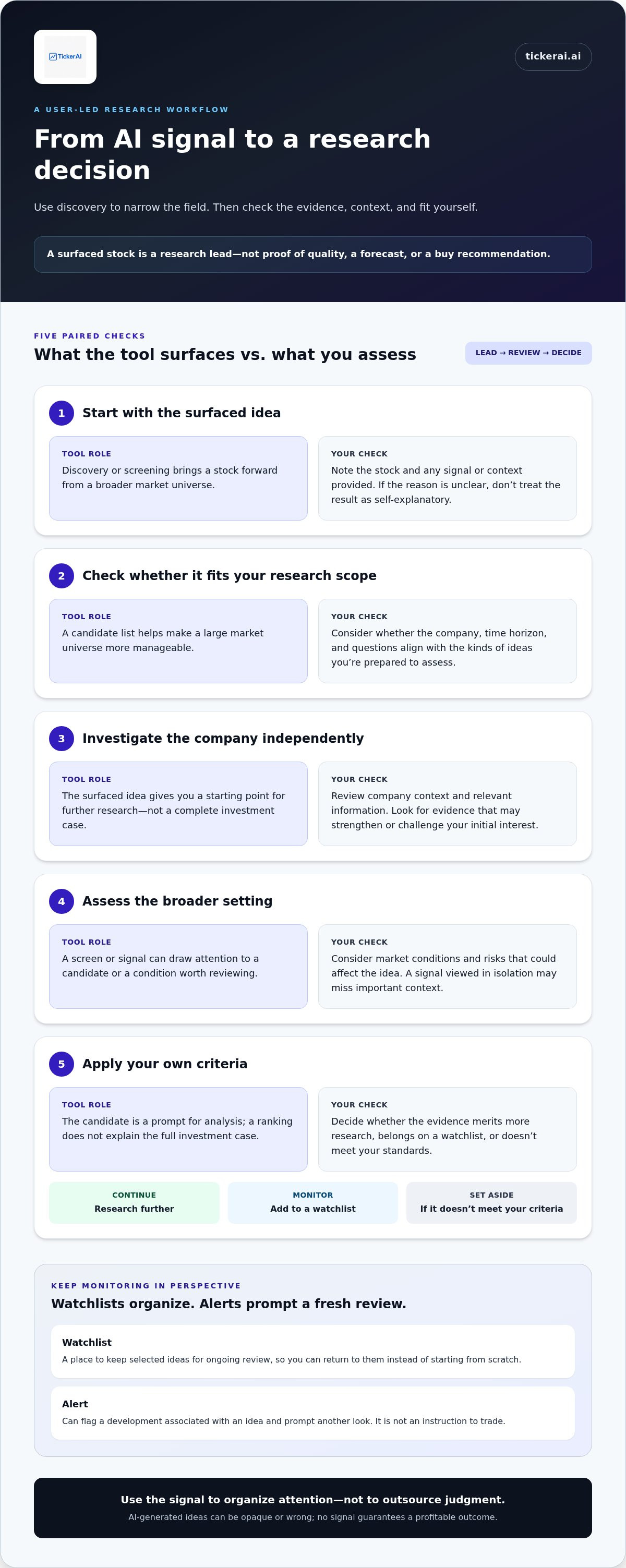
Treat each surfaced name as a prompt to ask what drew your attention to it and what evidence would support further review. Don’t assume a ranking explains the full investment case. Use a consistent process:
- Review the surfaced idea. Note the stock and any signal or context the tool provides. If the reason for surfacing it isn’t clear, don’t treat the result as self-explanatory.
- Check whether it fits your research scope. Consider whether the company and idea align with the kinds of stocks, time horizon, and questions you’re prepared to assess.
- Investigate the company independently. Review company context and relevant information using sources you consider appropriate. Look for factors that may strengthen or challenge your initial interest.
- Assess the broader setting. Consider market conditions and risks that could affect the idea. A signal viewed in isolation may miss important context.
- Apply your own criteria. Decide whether the evidence justifies more research, belongs on a watchlist, or doesn’t meet your standards. You can set a surfaced idea aside.
This process turns discovery into a research lead with a clear next step. It also creates a useful record of what caught your attention, what you verified, and why you chose to continue or stop. Those notes can help keep later decisions consistent instead of driven by the urgency of a new signal.
From watchlist and alert to a user-led decision
A watchlist gives selected ideas a place in your research routine, so you can return to them instead of starting from scratch. Real-time alerts can flag a development associated with an idea and prompt a fresh review. They don’t tell you what action to take. Before responding, identify what changed, whether the original case still holds, and whether the new context affects your criteria.
For a closer look at evaluating outputs before acting, see this guide to how to interpret AI stock signals. The distinction is simple: automated discovery can surface and organize research leads, but autonomous trade execution is a separate function. Investors exploring a discovery and watchlist workflow can also review TickerAI’s stock discovery tools.
How to Compare AI Stock Selection Software Without Chasing Promises
Compare tools by the work they help you complete, not by the number of features or the confidence of their claims. AI stock selection software should fit into a research process you can sustain. Ask what the tool helps you discover, how it organizes ideas, and whether its signals are clear enough to review independently.
Evaluate workflow fit, not just feature count
Start with your current routine. Does a tool reduce repetitive scanning, or add another feed to monitor? Consider whether watchlists and alerts help you revisit ideas at useful times, or create more notifications than you can assess. Fit also depends on your time horizon: short-term swing trade setups and long-term investment research call for different review rhythms and decision criteria.
Use this framework to compare capabilities, limitations, and practical fit:
| Area | What to assess | Fit question |
|---|---|---|
| Discovery | Whether the tool surfaces candidates relevant to your research scope. | Does it help narrow your starting list? |
| Organization | Whether you can group ideas and return to them consistently. | Does this match how you track research now? |
| Alerts | Whether alerts prompt useful review, with enough context to understand why they matter. | Can you respond thoughtfully rather than react automatically? |
| Idea variety | Whether the ideas align with the horizons you actually research. | Are swing or long-term ideas more relevant to your process? |
| Clarity | Whether the tool explains the purpose and limits of its outputs. | Can you assess an idea without treating it as a recommendation? |
A broad feature set isn’t automatically an advantage. If you focus on long-term company research, a stream of short-term setups may distract more than it helps. If you review swing ideas, a tool that helps organize candidates and prompt timely reassessment may be more relevant than one built around a different cadence. Judge a feature by whether it earns a place in your actual workflow.
Assess clarity, limitations, and evidence
Look for understandable context around an idea and clear boundaries around what the software does. If a signal is difficult to interpret, it may be hard to test its relevance against your own criteria. For a more detailed framework, this guide to evaluating an AI stock picking service explores how to assess a service beyond its headline claims.
Historical outcomes deserve careful scrutiny. Separate a documented record from promotional language, and check what period and conditions the record describes before drawing conclusions. Past results don’t establish how a signal will perform in different market conditions. Avoid comparisons based on unverified performance claims or unsupported rankings.
The best fit is a tool that complements your process, time horizon, and tolerance for risk while keeping you in control of the review. Compare clarity and practical usefulness first. Treat promises of effortless decisions or certain outcomes as a reason to slow down, not a substitute for analysis.
A Practical Checklist for Using AI-Selected Stock Ideas
A surfaced stock idea earns attention, not automatic action. Before responding to a signal, run it through the same review process you’d use for any research lead. A checklist can slow impulsive decisions, expose missing context, and make your reasoning easier to revisit later.
Review each idea before taking action
Start with fit. An idea designed for a short-term swing trade may not suit a long-term investment plan, and a company that interests you may still fall outside your goals or risk tolerance. AI stock selection software can bring candidates into view, but it can’t determine whether a particular investment is suitable for you.
- Confirm the idea and its context. Identify what prompted your interest. Treat the alert as a starting point, then seek relevant company information and consider what could challenge the initial case.
- Review market conditions. Consider whether broader conditions could affect the idea. A signal viewed alone may not reflect risks that matter to your decision.
- Check your time horizon. Ask whether the idea belongs in your short-term strategy, long-term research, or neither. Don’t force it into a plan simply because it appeared in a tool.
- Apply your own criteria. Compare the idea with your established requirements for research, portfolio fit, and risk. A surfaced candidate may not fit every investor or every market condition.
- Set risk limits and decision rules first. Before taking action, define what level of risk you’re prepared to accept and what conditions would change your view. Avoid making those rules up in the heat of the moment.
- Choose a reasoned next step. Continue researching, keep the idea on a watchlist, reject it, or make a decision consistent with your plan. No action is also a valid outcome.
A signal is not a complete investment thesis. Seek context beyond the alert, and make sure you can explain why the idea does or doesn’t meet your criteria. If the rationale remains unclear, pause rather than treating urgency as evidence.
Turn discovery into a repeatable process
Set a regular time to review watchlists and alerts that works with your research routine. Consistency helps distinguish a considered response from a reaction to every new notification. A systematic approach to stock investing can help structure that review and keep decisions tied to a process.
Keep a trading journal for each idea, whether you act or pass. Record the alert and date, why you reviewed it, the company and market context you considered, your decision, and the rationale behind it. Revisit the entry later: did the original reasoning hold up, or did new information change your view? The goal isn’t to justify every past call. It’s to learn how well your process separates useful leads from distractions.
Build a clearer discovery routine with TickerAI’s stock discovery tools, including watchlists, alerts, swing trade setups, and long-term investment ideas.
Where TickerAI Fits in an AI Stock Selection Workflow
TickerAI fits at the discovery and organization stages of an investor-led research process. Its tools bring potential ideas into view, help users keep them organized, and provide alerts that can prompt further review. The investor remains responsible for assessing the evidence, considering risk, and deciding what to do next.
Use discovery tools for swing and long-term research
TickerAI offers curated swing trade setups and long-term investment ideas to support research across different time horizons. These are inputs to your own process, not personalized recommendations. A swing setup may lead you to assess whether its context fits your short-term approach. A long-term idea may prompt a closer review of the company and its role in your investment research.
Smart watchlists can help organize ideas you want to revisit, while real-time alerts can bring a tracked idea back to your attention. Build these tools into a routine: review an idea, examine the relevant company and market context, and decide whether it meets your criteria. An alert is a prompt to reassess, not an instruction to trade.
TickerAI provides a discovery layer to structure your research without handing over the decision. The platform doesn’t provide personal financial advice or brokerage execution, and it can’t guarantee that an idea will perform as hoped. Keep independent analysis and risk assessment at the center of your workflow.
Choose a subscription tier around your research needs
TickerAI offers Pro and Full-Access subscription tiers. Start by considering what you want discovery software to help you do: find ideas, organize a watchlist, respond to alerts, or explore both swing trade setups and long-term investment ideas.
Then compare those needs with the research habits you already maintain. If you regularly revisit tracked stocks, watchlists and alerts may have a clear role. If you explore ideas across different time horizons, curated swing and long-term ideas can complement the way you evaluate candidates. The practical fit depends on your process, not on the number of features a tool appears to offer.
As with any AI stock selection software, use TickerAI to support discovery rather than replace independent judgment. A repeatable routine might be to review a surfaced idea, record why it interests you, check its context, and decide whether it belongs in your research queue. That keeps the platform in its proper role: a research aid, not an autonomous decision-maker.
If that workflow aligns with your research needs, explore TickerAI’s discovery tools.
Make Your Next Research Decision More Deliberate
Start by defining what a useful research lead looks like for you. Set a few criteria before reviewing new ideas, then apply them consistently. This gives you a clearer basis for deciding which leads deserve attention and which you can set aside.
That’s the practical role of AI stock selection software: make opportunity discovery more manageable while leaving interpretation and decisions in your hands. The tool should support a research routine you can explain, repeat, and adjust as your needs change. Keep the process focused on evidence, not the excitement of a new signal.
Ready to apply that approach with a dedicated discovery layer? Explore TickerAI's stock discovery tools. Build a research routine that works for you, and take your next decision with greater clarity.
Frequently Asked Questions
What is AI stock selection software?
AI stock selection software uses automated analysis to help identify stocks for investors to investigate. Think of it as a research filter: it can bring a smaller set of names to your attention, while you decide whether any deserve more time. The label covers different tools, so consider whether a service focuses on discovery, alerts, research summaries, or another task before relying on its outputs.
How does AI stock selection software find stocks?
AI stock selection software processes market-related information according to the capabilities and rules of the particular tool, then presents candidates or signals for review. The approach varies across services, so don’t assume every platform examines the same information or ranks companies in the same way. If a stock appears in a results list, investigate what the tool explains about its appearance and verify the company context independently.
Can AI stock selection software predict which stocks will rise?
No tool can guarantee that a stock will rise, and a surfaced idea should not be treated as a certain forecast. Market prices can respond to new information and changing conditions that alter an investment case. If a platform presents a projected outcome, examine the assumptions and evidence behind it rather than relying on the headline. Consider what could invalidate the thesis before making any decision.
Is AI stock selection software suitable for beginners?
It can help beginners organize research, but it shouldn’t replace learning how to assess investments. Start by following a small number of ideas and writing down why each one interests you. Then compare that reasoning with company information and your own goals. If you can’t explain why a signal matters or what risks it involves, pause and build understanding before acting.
What should I look for in AI stock selection software?
Look for a clear explanation of what the tool does, how it presents ideas, and what its outputs can’t establish. Try assessing a sample idea: can you understand why it merits review, identify what you’d investigate next, and fit that work into your routine? Also consider whether its idea types match your time horizon. Avoid choosing based on confident claims alone.
Does AI stock selection software execute trades automatically?
Not necessarily. Stock discovery, trade alerts, and brokerage execution are separate functions. TickerAI supports research and discovery through its platform; it doesn’t provide brokerage execution. If you use discovery software, treat an alert as information to review, then make any investment decision through your own process and the appropriate account or service.
How is AI stock selection software different from a stock screener?
A stock screener typically filters stocks according to criteria, while AI stock selection software may offer broader discovery features, such as surfacing ideas or organizing them for review. The categories can overlap, and labels alone aren’t enough to judge a tool. Compare the actual workflow: does it simply return matches, or also help you track and revisit potential research leads?


