
More data doesn’t automatically produce better investment decisions. The value of artificial intelligence in investment decision making is its ability to help prioritize market evidence, not decide what to buy or sell. That distinction matters when information is overwhelming and AI-generated insights can sound more certain than the evidence supports.
AI can speed up research, surface patterns, and help you focus on opportunities worth examining. But every signal needs context: its source, the risks, current market conditions, and your own objectives. Human judgment remains essential, especially when evidence is incomplete or an output makes a bold prediction.
This guide explains where AI can strengthen investment research, how to assess its insights, and when to treat a confident recommendation with caution. You’ll also see how TickerAI supports discovery through AI-powered stock opportunities, smart watchlists, real-time alerts, swing trade setups, and long-term investment ideas. The goal is a clearer research process, with AI as decision support rather than an automatic decision-maker.
Key Takeaways
- See how artificial intelligence in investment decision making can organize market evidence without turning analysis into a prediction.
- Learn which tasks AI can scale and where your objectives, context, and accountability must guide the decision.
- Use a five-step framework to review AI outputs, verify evidence, assess risk, and document your reasoning.
- Recognize why patterns surfaced by machine learning can inform research but can’t remove uncertainty or investment risk.
- Explore how TickerAI’s opportunity discovery, watchlists, alerts, and curated ideas can support investment research.
What artificial intelligence in investment decision-making means
Artificial intelligence in investment decision making means using computational systems to organize, analyze, or prioritize information that may inform an investment decision. A system can filter a broad set of market evidence into patterns, summaries, or candidates for further research. It doesn’t make the evidence complete, remove uncertainty, or determine what is suitable for a particular investor.
AI analysis can surface and structure evidence; investment judgment decides how that evidence fits an investor’s objectives, constraints, and risk tolerance.
Think of the process as a handoff, not an autopilot: information is processed, a system produces an output, and the investor reviews it before deciding what to do next. This connects with quantitative analysis in finance, where mathematical and statistical methods are applied to financial questions. AI may make the results easier to scan, but an output is still a starting point for investigation.
Decision support is different from autonomous trading, which executes actions without the investor making each decision. It is also different from personal financial advice tailored to someone’s full circumstances. A pattern or forecast is not a guarantee of future performance. A useful system can help frame a question; it cannot make an uncertain outcome certain.
Which investment decisions can AI support?
AI can help surface stock opportunities, organize a watchlist, and flag changing market information for review. These functions can support different research horizons. Short-term trade research may focus on candidates to monitor, while long-term investment research may help organize ideas for deeper review. In either case, a candidate is only a prompt to investigate. It doesn’t establish suitability, expected performance, or a reason to act.
TickerAI supports discovery through stock opportunities, smart watchlists, real-time alerts, swing trade setups, and long-term investment ideas. These are research inputs, not personalized recommendations or brokerage execution.
What AI does not decide for the investor
The investor remains responsible for setting objectives and time horizon, considering risk tolerance, and deciding whether a position fits their circumstances. AI may detect a pattern or summarize information, but neither task proves what prices will do next. Models can produce outputs that appear precise while leaving important context unresolved. Review the underlying evidence and its limits before relying on a signal.
For example, an alert that flags a stock for attention is a signal to investigate, not a decision to buy. The investor still needs to assess the evidence and risks, then consider whether the idea fits their plan. AI can help prioritize research, but judgment and accountability remain human.
How AI turns market information into investment evidence
Investment research starts with more information than any person can review at once. AI can help process that material, surface patterns, and organize results for examination. The practical value of artificial intelligence in investment decision making is shortening the route from a broad information set to a focused research question, not making the question disappear.
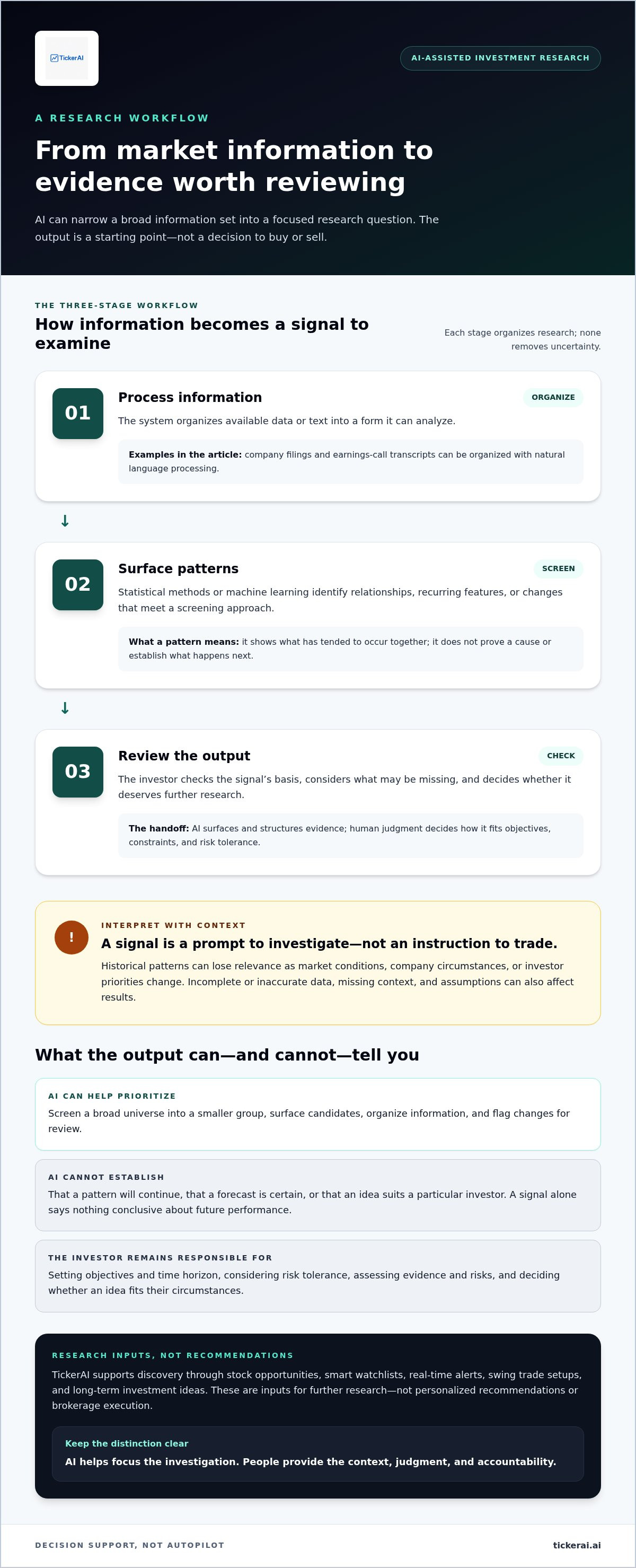
A typical workflow has three stages:
- Process information. A system organizes available data or text into a form it can analyze.
- Surface patterns. Statistical methods or machine learning identify relationships, recurring features, or changes that meet a screening approach.
- Review the output. The investor checks its basis, considers what may be missing, and decides whether the signal deserves further research.
Machine learning finds patterns in data; it doesn’t establish that those patterns will continue. Natural language processing, a branch of AI focused on working with text, can help organize material such as company filings or earnings-call transcripts. It may direct attention to repeated topics or notable changes, but the investor still needs to interpret them in context. IBM’s overview of AI in finance discusses how these systems can support analysis and decision-making across financial workflows.
Pattern recognition identifies what has tended to occur together; it doesn’t explain what caused it or prove what will happen next.
From financial data to a signal worth reviewing
Automated screening can narrow a broad universe of securities to a smaller group that meets defined research criteria. That helps prioritize what to examine instead of manually scanning every candidate. The result is a signal, not an instruction to trade. Review the evidence behind it, check whether the information is relevant to your question, and decide whether further research is warranted. A signal alone says nothing conclusive about future performance.
Why model outputs need context
Historical patterns can lose relevance as market conditions, company circumstances, or investor priorities change. Results may also be affected by incomplete or inaccurate data, missing context, or assumptions built into the analysis. Treat an output as a claim to test: identify what it appears to show, then look for evidence that supports or challenges that interpretation. For a closer look at evaluating outputs, see this guide to interpreting AI stock signals.
Apply the same review mindset to discovery tools. TickerAI’s AI-powered stock opportunity discovery can bring candidates into focus for further research. Explore AI stock opportunity discovery to organize that first pass, then apply your own analysis before reaching an investment decision.
AI analysis versus human judgment: what belongs in each decision
AI can review information at scale and apply a consistent screening process. But a relevant-looking output is not a complete investment case. It may highlight a pattern without explaining its cause, showing what evidence is missing, or establishing whether the idea fits an investor’s needs. Use AI analysis as an input, then test it against independent evidence and a defined investment thesis.
AI can prioritize evidence, but it cannot assume investor responsibility. More sophisticated analysis doesn’t eliminate uncertainty or investment risk.
| AI can help with | The investor must provide |
|---|---|
| Reviewing information at scale and applying consistent screening criteria | Objectives, time horizon, risk tolerance, and investment thesis |
| Surfacing patterns, summaries, or candidates for closer review | Context, independent verification, and accountability for decisions |
| Organizing evidence to make research easier to prioritize | A judgment about whether the evidence is relevant and sufficient |
The division is practical: automation can help answer, “What deserves a closer look?” The investor must answer, “Does this make sense for my plan, and what could make the thesis wrong?” A signal may seem relevant because it matches a familiar pattern. That alone doesn’t validate the reasoning or account for risks outside the model’s view.
Where automation helps and where it can mislead
Automation can process a broad set of information consistently, reducing repetitive screening work. But speed can also scale blind spots. Noisy or incomplete data may shape the output, while model assumptions can narrow what it considers. A result may reflect its inputs rather than the full investment case. Treat it as a focused prompt for review, not proof of quality, accuracy, or market-beating potential.
How to verify an AI-generated investment idea
Before relying on an idea, trace it back to evidence. Review relevant company information, confirm key claims against reliable sources, and look for material counterarguments that could weaken the thesis. Then assess whether the idea aligns with your objectives, time horizon, and risk limits. This grounds the review in both the evidence and your circumstances.
- Test the thesis: State why the idea may be worth researching and what evidence would challenge it.
- Check the context: Look for relevant company developments or risks that the output may not capture.
- Assess personal fit: Compare the idea with your time horizon and risk limits before deciding what, if anything, to do.
When assessing a tool, consider how clearly it presents its insights and what role those insights play in your research. This guide to evaluating an AI stock picking service offers criteria for examining that role without confusing analysis with a decision.
A practical framework for using AI in investment decisions
A repeatable process keeps AI-generated ideas in the right role: useful research inputs, not ready-made decisions. Before reviewing suggestions, define the question you’re trying to answer, the relevant time horizon, and the constraints that matter. This reduces the temptation to change your criteria just because an output looks compelling. The framework below supports disciplined research and monitoring. It isn’t individualized financial advice.
Set the decision criteria before reviewing suggestions
Be specific about the research task. Are you monitoring a short-term opportunity or reviewing a long-term investment idea? What evidence would make the idea relevant, and what risks or constraints would rule it out? Setting these criteria first gives you a consistent basis for assessing outputs and helps limit hindsight bias and impulsive reactions.
- Define the decision. State the question, research purpose, time horizon, and constraints before opening AI-generated suggestions.
- Review the output. Identify what the system is presenting, what evidence it appears to emphasize, and what remains unclear. Treat an alert or surfaced idea as a reason to investigate, not as a trade instruction.
- Verify the evidence. Check key claims against relevant company information and other reliable sources. Look for omissions, conflicting evidence, and assumptions that could change the interpretation.
- Assess risk. Consider what could challenge the idea, whether the evidence fits the chosen horizon, and how the potential risks align with your own limits.
- Document your reasoning. Record the evidence, your rationale, and what new information would cause you to reassess the idea.
The same checklist works across time horizons, but the review focus changes. For a short-term opportunity, keep the analysis tied to the monitoring period and the conditions that could quickly make the signal less relevant. For a long-term idea, examine whether the supporting case remains relevant over a broader horizon and note developments that could weaken it. Neither approach turns a signal into a forecast.
Review, record, and revisit the reasoning
A record makes it easier to distinguish a sound process from a fortunate short-term outcome. Note what you knew at the time, why the idea met your criteria, and which conditions could invalidate your reasoning. Revisit the analysis when material information changes. Don’t treat an old signal as permanently valid simply because it remains in a watchlist or once aligned with your thesis.
This structured approach reflects the logic of quantitative investing: define a method, apply it consistently, and review the evidence rather than relying on impulse. AI can help organize discovery, while the investor remains responsible for interpreting results and decisions. To apply a consistent research workflow to surfaced stock opportunities, explore TickerAI’s AI-powered stock discovery.
How TickerAI supports AI-assisted investment research
After setting criteria and deciding how to review AI-generated ideas, find a practical way to organize your research. TickerAI supports discovery with AI-powered stock opportunity discovery, smart watchlists, real-time alerts, and curated ideas. These tools can bring potential candidates into a focused research queue, helping you direct attention to ideas that merit independent review.
From market scanning to a focused research queue
Broad market scanning can take time. AI-powered discovery surfaces stock opportunities for consideration, while watchlists help organize names for ongoing review. Real-time alerts can draw attention to changes related to monitored ideas. Together, these capabilities structure research and monitoring, but they don’t promise to identify every relevant opportunity or replace verification.
The research horizon matters. Curated swing trade setups support short-term research, while long-term investment ideas provide a different starting point for evaluating companies and investment theses over a longer horizon. Neither type of idea establishes that a security is suitable for you or indicates how it will perform. Assess each candidate against your own criteria.
In practice, a surfaced opportunity may prompt you to review supporting information, compare it with your thesis, and decide whether it warrants continued attention. A watchlist can keep the idea organized; an alert can flag a reason to revisit it. You determine what the signal means and whether the available evidence supports further consideration. This is where artificial intelligence in investment decision making can help: it prioritizes research without taking ownership of the conclusion.
Use TickerAI as decision support, not a substitute for judgment
TickerAI provides research insights, not personal financial advice or brokerage execution. It doesn’t make decisions on your behalf, and subscription access doesn’t guarantee returns, accuracy, or a personalized recommendation. Your objectives, time horizon, risk tolerance, and other constraints remain central to evaluating any idea.
Apply the same discipline to a TickerAI insight as you would to any research lead. Check the evidence, consider what could challenge the idea, and decide whether it fits your defined approach. If important facts change, reassess rather than assuming an earlier signal remains relevant. Use the platform to support discovery and monitoring, then make your own informed decision.
To bring AI-powered stock opportunity discovery into your research process, explore TickerAI’s AI-powered stock research.
Make your next research session more deliberate
Put your process to work on the next market question you want to investigate. Start with a clear objective, use AI to focus your research, and decide in advance what evidence would change your view. That discipline keeps artificial intelligence in investment decision making connected to your goals rather than driven by whichever signal stands out first.
TickerAI can help create a starting point with AI-powered stock opportunity discovery, smart watchlists, real-time alerts, and curated swing trade setups and long-term investment ideas. Use these research inputs to organize what deserves attention, then apply your own context and judgment before making a decision.
Explore TickerAI’s AI-powered stock research and take a focused next step in your investment research. Build a process you can review, question, and refine.
Frequently Asked Questions
How is artificial intelligence used in investment decision-making?
Artificial intelligence in investment decision making can filter, summarize, and compare market information so investors can focus their research. For example, a system may group company news by theme, flag a change in a watchlist, or screen stocks against selected criteria. These outputs help shape a research queue; they don’t establish a complete thesis. Assess source quality, relevance, and what the analysis may leave out.
Can artificial intelligence make investment decisions without human input?
Some investment systems can be designed to act automatically under preset rules, but that doesn’t make their actions suitable for every investor. Human input is still needed to set the mandate, constraints, and oversight process. For individuals using AI research tools, an idea or alert should prompt review. Don’t assume a system understands personal circumstances or has made a decision on the investor’s behalf.
Is AI reliable for predicting stock prices?
AI can generate estimates or identify patterns in historical and current information, but no output can establish a future stock price with certainty. An estimate may change as new information arrives, and unexpected events can disrupt patterns. Treat a price forecast as one scenario to assess, not a target that must occur. Compare its assumptions with other evidence, and consider how your view would change if the forecast proved wrong.
What are the main risks of using AI in investment decisions?
Key risks include inaccurate or incomplete inputs, outputs that omit important context, and analysis that relies on assumptions that don’t fit current conditions. Generative systems may also produce plausible-sounding errors. Trace important claims to dependable source material and avoid relying on a single output. Be especially cautious if you can’t explain what evidence supports an idea or what could contradict it.
How should investors verify an AI-generated investment idea?
Start by checking whether the idea’s factual claims match current company information, such as its latest public filings or earnings materials. Confirm dates and figures, then look for evidence that challenges the idea, not just information that supports it. Finally, ask whether the thesis still makes sense under different assumptions. If key claims can’t be independently checked, treat the output as unverified research rather than a basis for action.
Can AI help with both short-term trading and long-term investing?
Yes. AI tools can support research for different horizons, but the review questions should match the intended use. Short-term research focuses on whether an opportunity remains relevant to the monitoring period. Long-term research calls for attention to the durability of the investment thesis and developments that could undermine it over time. In either case, an AI-generated idea is a research lead, not evidence that a particular outcome is likely.
Does TickerAI provide personal investment advice or execute trades?
No. TickerAI provides AI-powered stock opportunity discovery, smart watchlists, real-time alerts, and curated swing trade setups and long-term investment ideas as research insights. It doesn’t provide personal financial advice or brokerage execution. Users decide whether an idea fits their own objectives and risk considerations, and remain responsible for their investment decisions. The platform helps organize discovery and monitoring; it doesn’t guarantee returns or investment outcomes.


