

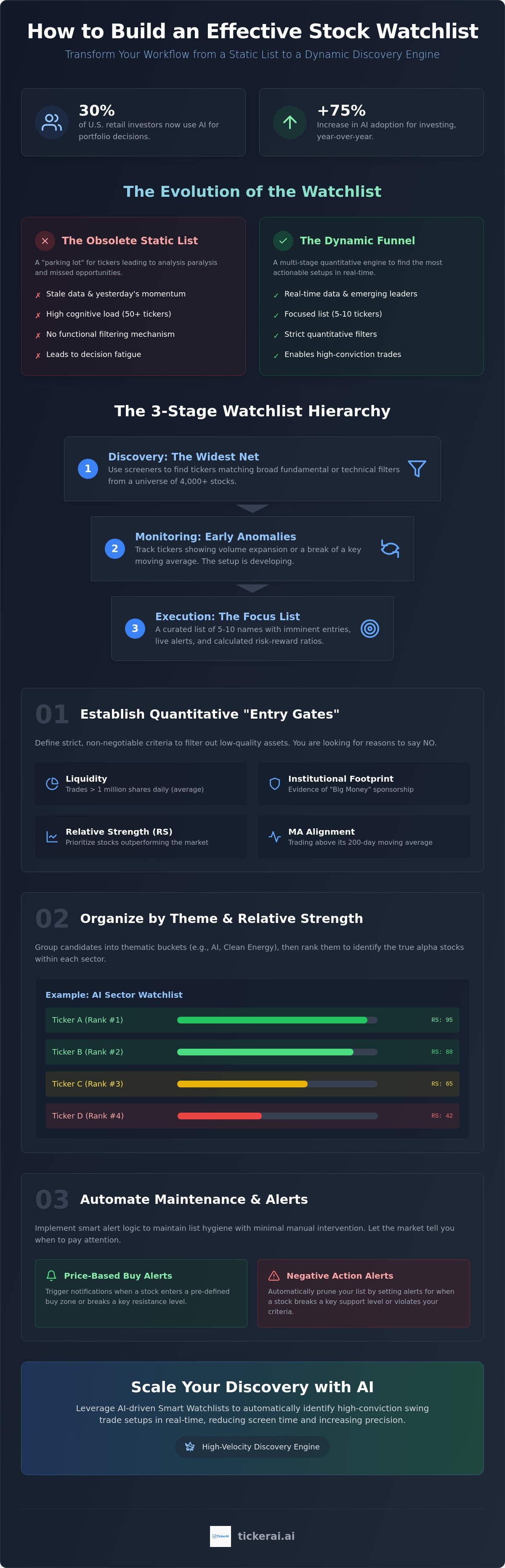
Approximately 30% of U.S. retail investors now utilize AI for portfolio decisions, representing a 75% increase year-over-year. In a market moving at this velocity, knowing how to create an effective stock watchlist is the difference between capturing alpha and chasing ghosts. Static lists are obsolete. You need a dynamic funnel that filters noise in real-time. Observation leads to action. Precision leads to profit.
You likely recognize the sting of missing a momentum move because your list was too long and poorly organized. Information overload is a choice, not a requirement. We understand the frustration of analysis paralysis caused by unstructured data. This guide will transform your workflow into a high-velocity discovery engine using quantitative criteria and AI-driven filtering. We will examine the repeatable systems used by professionals to reduce screen time and build high conviction trade setups through clinical precision. By the end, you will have a clear roadmap to transition from a casual observer to a calculated participant using automated market scanning and smart alerts.
Key Takeaways
- Master how to create an effective stock watchlist by transitioning from a static list of tickers to a dynamic discovery engine powered by quantitative filters.
- Establish strict "Entry Gates" using liquidity and institutional footprint data to ensure only high-quality assets reach your primary monitoring screen.
- Organize candidates into thematic buckets and utilize relative strength rankings to identify the alpha stocks within specific sectors.
- Implement automated alert logic for price-based buy zones and negative price action to maintain list hygiene with minimal manual intervention.
- Scale your market coverage by leveraging AI-driven Smart Watchlists that identify high-conviction swing trade setups in real-time.
The Evolution of the Strategic Stock Watchlist
The traditional stock watchlist is dead. Most retail traders treat their watchlist as a "parking lot," a static collection of tickers they heard about on a podcast or saw on social media. This approach fails because it lacks a functional filtering mechanism. In 2026, understanding how to create an effective stock watchlist requires shifting your perspective. A watchlist isn't just a list; it's a multi-stage quantitative engine. Your primary objective is to filter more than 4,000 tradeable tickers down to the 10 most actionable setups. High-volatility environments punish hesitation. If your list doesn't update based on real-time data, you're essentially looking at a museum of yesterday's momentum.
Why Static Lists Lead to Analysis Paralysis
Monitoring 50 tickers at once is a psychological trap. It creates a heavy cognitive load that leads to decision fatigue. When everything looks like a potential trade, nothing is a high-conviction setup. Most static lists suffer from the "stale data" trap. You watch a stock that moved 20% last week, hoping for a repeat, while new leaders are emerging elsewhere. Successful traders focus on "Watchlist Velocity." This is the speed at which a ticker moves from initial discovery to a trade execution, or is discarded for failing to meet criteria. If a ticker sits idle for three weeks, it clutters your field of vision. It must be pruned. Clinical precision requires you to focus only on what is moving now.
The 2026 Hierarchy: Discovery, Monitoring, and Execution
To scale your research, you must organize your workflow into a structured hierarchy. This prevents the "all-in-one" list chaos that leads to missed entries. Effective discovery involves three distinct stages:
- Discovery: This is your widest net. You use stock screens to find tickers matching specific fundamental or technical filters. This stage is about finding thematic investment opportunities with AI to identify sectors with unusual capital inflows.
- Monitoring: Tickers move here when they show early technical anomalies or fundamental shifts. You're looking for volume expansion or a break of a key moving average. The data is fresh, but the setup isn't yet perfect.
- Execution: This is the "Focus List." It contains 5-10 names where entries are imminent. Alerts are live. The risk-to-reward ratio is calculated. The plan is ready for execution.
Step 1: Establishing Quantitative Selection Criteria
The "Entry Gate" is the most critical phase in how to create an effective stock watchlist. You must define strict, non-negotiable criteria that a ticker must meet before it earns a spot on your screen. Professional discovery begins with liquidity. If a stock trades less than 1 million shares daily on average, it's often a liquidity trap. High institutional footprint is equally vital. You want to see "Big Money" sponsorship, as these players provide the fuel for sustained price moves. Technical baselines like Relative Strength (RS) and Moving Average (MA) alignment act as your final gatekeeper. A stock trading below its 200-day MA rarely deserves space on a momentum-focused list. Observation leads to exclusion; you're looking for reasons to say no.
Technical Filters for Momentum Discovery
Precision filtering requires looking beyond simple price action. High-velocity traders utilize automated market sector rotation analysis to pinpoint which groups are attracting capital in real-time. Once you identify the leading sector, look for Average Daily Range (ADR) expansion. This is a technical volatility signature indicating a stock is "waking up" from a consolidation period. Institutional volume signatures, often called "Pocket Pivots," provide the confirmation needed to move a stock from your broad discovery pool into your active monitoring list. These signals suggest that large players are accumulating shares without driving the price to extreme levels yet.
Fundamental Catalysts and Event Tracking
Technical setups provide the "when," but fundamental catalysts provide the "why." Your watchlist notes should prioritize hard data points such as earnings release dates, FDA clinical trial windows, or SEC filing anomalies. Insider buying and aggressive share buyback programs act as powerful conviction builders. These events signal that those with the most information are betting on the company's future performance. You don't need to guess; you only need to track.
Validating these opportunities at scale requires automated growth stock screening to ensure the underlying business matches the technical strength. While established platforms offer foundational advice on automating maintenance and alerts, the 2026 trader needs more. For those looking to bypass the manual grind, utilizing AI-powered discovery tools ensures your criteria are applied 24/7 without human error. This data-driven approach removes the emotional bias that often leads to holding stale tickers for too long.
Step 2: Organizing Watchlists by Theme and Relative Strength
Organizing your discovery is as important as the discovery itself. If your lists are a jumbled mess of 50 unrelated tickers, you'll miss the rotation. To master how to create an effective stock watchlist, you must categorize tickers into "Thematic Buckets." Focus on specific drivers like AI Infrastructure, Biotech Breakouts, or Fintech. This structure allows you to see sector-wide moves before they hit the mainstream. You can also utilize AI-powered small-cap stock discovery to identify emerging themes in hidden markets that haven't yet reached large-cap visibility. Relative strength rankings within these buckets identify the "Alpha" stock, the leader of the pack. If you find a stock with a perfect setup but poor timing, move it to the "Bench" list. This keeps high-potential names on your radar without cluttering your active execution screen. It's a professional triage system.
The Power of Thematic Grouping
Grouping stocks by theme uncovers "Sympathy Plays." When a leader like NVIDIA breaks out, its suppliers and competitors often follow. By watching an entire thematic bucket, you recognize when a sector is under institutional accumulation. This is where market research and competitive analysis becomes a technical advantage. You aren't just looking at a chart; you're understanding the competitive landscape. However, avoid over-concentration. Don't let your entire monitor be filled with AI stocks. Diversification of themes protects your capital when one sector rotates out of favor. Clinical precision requires balance.
Relative Strength: The Ultimate Tie-Breaker
Relative strength is your ranking mechanism. Compare your watchlist tickers against the S&P 500 or Nasdaq. In a flat or down market, stocks that hold steady or move higher are your future leaders. These are the "Leadership" names. Conversely, stocks that drop faster than the index are "Laggards" and should be purged immediately. Be careful of the "strongest stock in a weak sector" trap. If the entire Biotech sector is crashing, even the best-looking Biotech chart is likely to fail. Momentum requires a tailwind. Relative strength provides the data you need to choose the path of least resistance. Observation leads to ranking. Ranking leads to execution.
Step 3: Automating Maintenance and Alert Logic
Static lists are a liability in high-velocity markets. To master how to create an effective stock watchlist, you must transition from manual observation to algorithmic maintenance. Your watchlist should function as a self-cleaning filter that prioritizes actionable data over historical noise. Set price-based alerts to trigger only when a ticker enters a predefined "Buy Zone." Conversely, implement "Negative Alerts" to flag stocks that violate your technical thesis. If a ticker drops below a critical level, such as the 50-day moving average, it should be pruned immediately. Automation handles the monitoring. You focus on the execution.
Setting Action-Oriented Alerts
Standard price alerts often create unnecessary noise. Professional-grade logic requires multi-factor triggers. Move away from simple price points and implement "Logic Alerts" that combine Price, Volume, and RSI signatures. This ensures you only receive notifications when the probability of a successful move is statistically significant. Understanding how to interpret AI stock signals allows you to replace manual chart scanning with automated discovery logic. Maintain strict alert hygiene. If your notifications are too frequent, they become meaningless. Every alert must demand a specific trade decision.
The Weekly Pruning Process
Efficiency depends on a lean execution list. Implement a "Three-Strike Rule" for your monitoring bucket. If a stock consolidates for three consecutive weeks without a volatility expansion or a thematic catalyst, remove it. Your capital and attention are finite resources. Rotate from stalled themes into fresh momentum discovery. Aim to maintain an Execution List of 5-10 stocks max. This level of concentration prevents analysis paralysis and ensures you are only watching the highest-conviction setups in the market.
Scaling this process manually is a recipe for burnout. To maintain clinical precision without the screen time, leverage TickerAI’s smart alerts to automate your list maintenance. This ensures your focus list is always populated with real-time swing trade setups that meet your quantitative criteria.
Scaling Discovery with TickerAI Smart Watchlists
Manual systems provide the logic. TickerAI provides the scale. While understanding how to create an effective stock watchlist is a foundational skill for any serious participant, manual execution eventually hits a ceiling. You cannot scan 4,000 tickers for institutional volume signatures every five minutes. TickerAI Smart Watchlists act as a tireless, high-tech scout that never sleeps. It scans the entire market in real-time, detecting technical and fundamental anomalies before they appear on standard retail screens. This is the systematic edge required for the 2026 market environment. Observation leads to automation. Automation leads to consistency.
Automated Market Scanning for High-Potential Moves
TickerAI’s AI-driven engine identifies high-potential movements by analyzing algorithmic signatures and institutional volume flows simultaneously. This isn't just a basic screener. It is an automated market scanner that categorizes opportunities into specific discovery tiers. You can customize these tiers within your dashboard to align with your specific risk profile. Whether you're tracking long-term investment ideas or immediate swing trade setups, the platform integrates them into a unified, high-velocity workflow. It identifies the "Alpha" stocks within your thematic buckets automatically. You are always positioned in the strongest names without the manual grind.
From Discovery to Execution: The TickerAI Advantage
The TickerAI advantage lies in its ability to take the principles of how to create an effective stock watchlist and scale them beyond human capacity. It reduces research time from hours to seconds by applying clinical filters in the background. It replaces emotional, manual trading with data-driven alerts that trigger only when a high-conviction setup is confirmed. You aren't just watching a list; you're monitoring a discovery engine. This shift significantly reduces screen time and eliminates the fatigue of analysis paralysis. It allows you to focus entirely on trade management and risk-adjusted returns.
Efficiency is the ultimate currency in professional finance. By automating the "Entry Gate" and maintenance logic, you ensure your execution list remains lean and actionable. Stop manually chasing yesterday's winners. Start your TickerAI Full-Access journey today and transform your research into a professional-grade intelligence partnership. The market doesn't wait for manual updates. Neither should you.
Transitioning to High-Velocity Discovery
The 2026 market doesn't wait for manual scanning. You need a partner that identifies technical anomalies as they happen. AI-driven swing trade setups and real-time market anomaly detection are no longer optional for those seeking to scale their performance. It's time to replace the manual grind with professional-grade smart watchlists that work while you focus on high-level strategy. Upgrade your discovery with TickerAI Full-Access alerts to secure your systematic advantage. The logic is clear. The next breakout is waiting for you to detect it.
Frequently Asked Questions
How many stocks should be on an effective watchlist?
Limit your execution watchlist to 5-10 high-conviction tickers. While your broader discovery list might contain 20-30 names, active monitoring requires extreme concentration. Professional traders prioritize quality over quantity to avoid decision fatigue. If you're tracking 50 stocks simultaneously, you aren't monitoring; you're just guessing. Focus on the leaders showing the most clinical technical setups.
What is the difference between a watchlist and a screener?
A screener is a broad discovery tool used to filter the entire market based on specific quantitative parameters. It's the top of your funnel. A watchlist is the curated output of those screens. You use a screener to find potential candidates and a watchlist to monitor their price action for a specific entry signal. Screener finds the setups; watchlist manages the execution.
How often should I update my stock watchlist?
Perform daily maintenance on your active list and a comprehensive audit every weekend. In high-velocity environments, stale data is a liability. You must remove tickers that violate their technical thesis or fail to trigger an alert within a reasonable timeframe. A professional workflow requires constant pruning to ensure your execution screen remains populated with fresh, high-potential momentum.
Can I use AI to automate my stock watchlist?
AI automation is the standard for professional discovery in 2026. Approximately 30% of U.S. retail investors now utilize AI for portfolio decisions, representing a 75% increase year-over-year. Understanding how to create an effective stock watchlist now involves leveraging algorithmic scanning to detect anomalies in real-time. This eliminates manual chart monitoring and ensures you only focus on stocks hitting high-probability logic triggers.
What technical indicators are best for a swing trade watchlist?
Focus on Relative Strength (RS), Moving Average alignment, and Average Daily Range (ADR) expansion. RS identifies stocks outperforming the broader indices, while Moving Averages provide the trend context. ADR expansion acts as a volatility signature, signaling that a stock is waking up. These indicators provide the objective data needed to move a ticker from your monitoring list to your execution list.
How do I avoid "information overload" when tracking multiple sectors?
Utilize thematic buckets and multi-tier hierarchies to organize your research. Categorize stocks by sector or theme, such as AI Infrastructure or Biotech, and only focus on the relative strength leaders in each group. This modular approach allows you to identify sector rotation without being buried by noise. Use automated alerts to notify you only when a specific sector theme becomes actionable.
Is it better to have one big watchlist or several small ones?
Several small, thematic lists are far superior to a single massive list. This structure is essential for anyone learning how to create an effective stock watchlist that identifies leadership. Small lists allow you to compare peer stocks directly, making it easier to spot the alpha stock in a group. One big list obscures relative strength and makes it difficult to detect institutional rotation patterns.
How do I know when to remove a stock from my watchlist?
Remove a stock immediately if it hits a "Negative Alert" or violates its technical thesis. If a ticker drops below a critical moving average or its volume dries up during a consolidation, it's no longer a priority. Implement a "Three-Strike Rule" where stocks that stagnate for three weeks are purged. Capital is finite. Don't let dead money clutter your execution screen.


