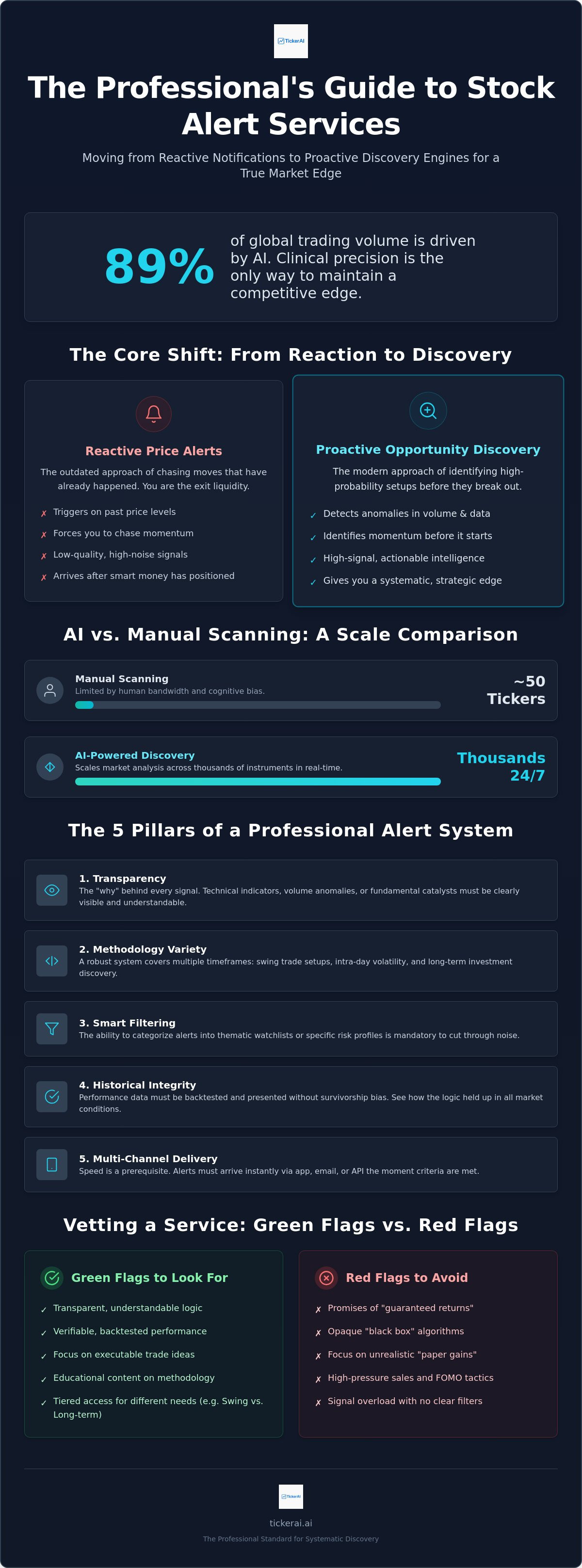
A professional stock alert service is an automated discovery engine, not a notification system for moves that have already peaked. If you're still chasing price spikes after the liquidity has dried up, you aren't trading; you're reacting. Understanding what to look for in a stock alert service in 2026 requires a shift from simple price triggers to sophisticated algorithmic signal detection. In an environment where AI drives nearly 89% of global trading volume, clinical precision is the only way to maintain a competitive edge.
You've likely felt the exhaustion of information overload from low-quality notifications that lack transparent logic. It's time to move past the noise and adopt a data-driven approach to market scanning. This guide will help you master the criteria for selecting a high-performance service that delivers actionable alpha through systematic discovery. We'll preview the essential technical indicators, regulatory compliance standards, and automated filtering workflows that define professional-grade intelligence tools.
Key Takeaways
- Shift your perspective from reactive notifications to systematic discovery engines that filter for actionable intelligence.
- Master the critical criteria of what to look for in a stock alert service, prioritizing transparency and data-driven logic over generic market noise.
- Leverage AI-powered anomaly detection to scale your market scanning across thousands of tickers in real-time, identifying setups impossible for manual traders.
- Protect your capital by recognizing red flags like guaranteed returns and learning to distinguish between paper gains and executable trades.
- Implement professional-grade discovery workflows using TickerAI’s Pro and Full-Access tiers to capture high-signal swing and long-term setups.
Beyond Notifications: Defining a High-Performance Stock Alert Service
Most traders mistake a notification for an edge. It isn't. A notification is just raw data delivered to a device. An edge is the filter applied to that data before it reaches you. When evaluating what to look for in a stock alert service, the first step is recognizing that you aren't buying a messenger. You're subscribing to a discovery engine. In the 2026 market, where retail participation is increasingly sophisticated, the difference between profit and loss often comes down to the quality of your filtering system.
Market noise is the constant stream of generic headlines, social media sentiment, and lagging indicators. It creates a false sense of urgency. Actionable intelligence is the extraction of high-probability setups from that chaos. High-performance services prioritize the latter. They don't just tell you a stock is moving. They tell you why the move matters based on rigorous technical filters. This is the shift from reactive trading to proactive discovery.
Speed and logic are the two non-negotiable metrics for any professional system. Latency kills returns; if an alert reaches your terminal after the liquidity has been absorbed, it's a liability. But speed without logic is just fast failure. The methodology must be transparent. You need to understand the underlying mechanics of every signal. This is "Discovery-as-a-Service." It's a tireless, high-tech scout that monitors the market while you focus on high-level decision-making.
To maintain this level of performance, professional-grade systems often prioritize operational transparency through tools like StatusPulse, which offers public status pages and uptime monitoring to keep users informed of any service disruptions.
Price Alerts vs. Opportunity Discovery
Basic price alerts are inherently reactive. They trigger when a stock hits a pre-defined level. By the time that alert pings, the smart money has often already positioned itself. You end up chasing the move. Opportunity discovery is different. It identifies momentum or value before the breakout occurs. Manual charting is limited by human bandwidth; you can track maybe fifty tickers effectively. Sophisticated systems often rely on algorithmic trading principles to scan thousands of instruments simultaneously. This isn't just about watching price levels. It's about detecting anomalies in volume, volatility, and order flow that signal a shift in market regime.
The Role of Systematic Alpha in 2026
The gap between retail and institutional tools has effectively closed. Professional-grade discovery is no longer reserved for hedge funds. In the current environment, alpha is found in the efficiency of your research process. Manual scanning is a bottleneck that prevents growth. Adopting a systematic approach to stock investing is the only way to scale your operations without sacrificing signal quality. Alpha is the excess return generated by superior detection. It's the difference between guessing on a trend and executing a trade setup backed by quantitative logic. When you determine what to look for in a stock alert service, prioritize systems that provide systematic alpha over those that simply echo the news cycle.
The 5 Essential Pillars of a Professional Alert System
A notification without a rationale is a gamble. Professional systems aren't just loud; they're logical. When you evaluate what to look for in a stock alert service, you must look past the flashy win-rate claims and examine the underlying architecture. A high-performance discovery engine rests on five specific pillars that ensure the signals you receive are executable, not just interesting.
- Transparency: The service must provide the "why" behind every signal. Technical indicators, volume anomalies, or fundamental catalysts should be clearly visible.
- Methodology Variety: Professional traders don't limit themselves to one timeframe. A robust system covers swing trade setups, intra-day volatility, and long-term investment discovery.
- Smart Filtering: Signal density is useless without organization. The ability to categorize alerts into thematic watchlists or specific risk profiles is mandatory.
- Historical Integrity: Performance data must be backtested and presented without survivorship bias. You need to see how the logic held up in bear regimes, not just bull runs.
- Multi-Channel Delivery: Speed is a prerequisite. Alerts should arrive via app, email, or API the moment the criteria are met.
Most retail services fail because they focus exclusively on short-term day-trading noise. They ignore the structural setups that drive swing trading and long-term wealth. A professional-grade tool filters for quality across all horizons. If you're ready to upgrade your process, exploring systematic discovery tools can help you move from reactive chasing to proactive execution.
Transparency and Algorithmic Logic
Black-box systems are a significant red flag. If a service refuses to disclose the logic behind its alerts, it's impossible to validate the risk. Professional traders require data points like RSI divergences, moving average crossovers, or specific candlestick patterns to confirm a setup. Learning how to interpret AI stock signals is essential for turning raw data into a conviction-based trade. This transparency allows you to audit the signal before committing capital.
Filtering for Your Specific Strategy
Alert fatigue is a real threat to performance. Receiving 50 notifications a day is counterproductive if only two fit your risk profile. Smart watchlists solve this by prioritizing signals that match your predefined criteria. Your discovery engine should adapt to your lifestyle. An active swing trader needs different scanning parameters than a passive investor looking for value. Customization is the difference between a high-speed intelligence partner and a source of constant market noise. Don't settle for a one-size-fits-all list that ignores your specific trading edge.
AI-Powered Discovery vs. Manual Scanning: Choosing Your Edge
Manual scanning is a relic of a slower era. In the 2026 market, a human trader can effectively monitor perhaps thirty to fifty tickers before cognitive fatigue sets in. AI doesn't have these limitations. It scans thousands of instruments across multiple timeframes simultaneously. When determining what to look for in a stock alert service, the ability to scale your research through automation is no longer optional. It's the baseline for survival. If your discovery process relies on manual charting, you're competing with algorithms that have already processed the data before your screen even refreshes.
Anomaly detection is the primary differentiator for modern AI systems. While a human might notice a price breakout after it happens, AI identifies the subtle shifts in volume, volatility, and order flow that precede the move. It detects institutional accumulation patterns that are invisible to the naked eye. This level of technical sophistication is fundamental to what is a trading edge and how to get one in a high-speed environment. You aren't just looking for alerts; you're looking for a technological advantage that filters for systematic alpha.
AI also removes the most dangerous element from the discovery phase: human emotion. Algorithms don't get tired. They don't have "gut feelings." They operate on cold, rule-based logic. By the time a setup reaches your terminal, it has been validated against millions of historical data points. This clinical precision ensures that you spend your time executing trades rather than hunting for them.
Speed and Scale in the Algorithmic Era
The efficiency gains from automated stock market analysis are transformative. Professional traders save hours of daily research time by delegating the initial scan to an AI engine. This "tireless scout" never misses a 2:00 AM regulatory filing or a pre-market volume surge. It identifies thematic rotations, such as capital moving from tech into energy, days before the trend hits mainstream headlines. This speed allows you to position yourself ahead of the herd rather than chasing the tail end of a move.
Removing Human Error from the Equation
The "FOMO" trap is a direct result of manual discovery. When you spend hours searching for a trade, you feel pressured to take a setup even if it's sub-optimal. AI eliminates this bias. It sticks to its programmed logic regardless of market sentiment. Institutional desks moved away from manual scanning years ago for this exact reason. They prioritize data-validated setups over subjective interpretation. A professional alert service should act as a high-tech assistant that prioritizes your intelligence, allowing you to focus on the only thing that matters: decision-making.
Vetting a Service: Performance, Proof, and Red Flags
Vetting a service requires a clinical audit of its methodology, not just a glance at its highlight reel. Many retail traders fall for "paper gains" that ignore the reality of slippage and order execution. When you research what to look for in a stock alert service, you must demand a distinction between theoretical performance and executable setups. High-performance engines focus on discovery. They provide the technical context necessary for you to manage your own risk. Paper gains are easy. Live execution is difficult. Slippage eats returns.
Immediate disqualifiers include any mention of "guaranteed" returns or perfect win rates. These claims are statistically impossible in a liquid market. Professional discovery tools prioritize setting realistic expectations for AI stock signals, acknowledging that even the most advanced algorithms operate on probability, not certainty. You're buying a scout to find setups, not a crystal ball. A professional service provides a discovery engine, not a blind betting slip.
The Backtesting Fallacy
Historical data is often manipulated through curve-fitting to look flawless. This is the "backtesting fallacy." A transparency report should highlight drawdowns and losing streaks alongside the wins. You need to see how the logic performs during market regime changes. A service that admits when the environment is unfavorable is more valuable than one that forces trades in a low-probability regime. Look for sample sizes that span multiple years and diverse volatility environments. Performance without context is just noise.
Community vs. Professional Vetting
Crowdsourced hype is a lagging indicator. By the time a ticker is trending on social media, the institutional alpha has usually been extracted. Algorithmic discovery identifies these moves during the accumulation phase. This is long before the retail "pump" begins. Identifying "pump and dump" schemes disguised as research is a critical skill for the 2026 trader. If you want a professional edge, access systematic discovery tiers that prioritize data over sentiment. This ensures your trades are based on technical logic rather than community noise.
TickerAI: The Professional Standard for Systematic Discovery
TickerAI represents the final evolution of what to look for in a stock alert service. It is not a notification tool; it is a high-speed intelligence partner. The platform functions as a tireless scout, scanning thousands of tickers to identify high-probability setups. By utilizing AI-powered discovery, TickerAI provides a clinical filter for a chaotic market. It delivers actionable alpha through systematic detection rather than generic news aggregation. This is the professional standard for the 2026 trader.
The core of the platform is the "Observation-to-Action" flow. Every alert is grounded in technical logic. The system identifies a pattern. It validates the volume. It pings your terminal. This structure ensures you never chase a move that has already happened. Smart Watchlists further refine this process by organizing ideas into thematic sectors. Whether you're tracking AI infrastructure or energy rotations, the platform prioritizes the most relevant data. It's a tool built for execution, not just observation.
Full-Access vs. Pro: Choosing Your Research Tier
Professional discovery requires a tier that matches your trading frequency. TickerAI Pro is built for the active swing trader. It focuses on short-term setups and real-time alerts. Speed is the priority here. TickerAI Full-Access is the comprehensive solution for institutional-grade research. It includes the full discovery suite, covering both swing trade setups and long-term investment ideas. Pro users get the speed; Full-Access users get the entire strategic landscape. Both tiers maintain a strict focus on a high signal-to-noise ratio.
Integrating TickerAI into Your Workflow
Systematic trading requires a repeatable funnel. TickerAI alerts act as the "Top of Funnel" for your decision-making process. The discovery engine handles the heavy lifting of market scanning. You focus on the final validation and execution. There's a direct synergy between the smart watchlists and your brokerage execution. By automating the discovery phase, you remove the emotional bias that leads to sub-optimal entries. This is how you scale. Start your systematic discovery journey today and move from market noise to data-driven confidence.
Mastering Systematic Discovery in 2026
The transition from manual scanning to automated intelligence is the defining shift for professional traders. You now possess the framework to evaluate what to look for in a stock alert service, focusing on clinical transparency and scalable discovery. By prioritizing systematic alpha over generic market noise, you position yourself ahead of institutional rotations. High-speed detection is no longer a luxury. It is a structural requirement for any serious trading plan.
TickerAI provides the technological edge needed to navigate this fast-moving environment. Our platform delivers AI-driven swing trade setups in real-time and performs comprehensive market scanning across thousands of tickers simultaneously. You gain access to data-driven insights from our Full-Access and Pro tiers, ensuring every setup is backed by rigorous logic. It's time to stop chasing and start executing with precision.
Upgrade to TickerAI Pro and start discovering systematic alpha today. Your discovery process should be as calculated as your execution. Take the next step toward a more efficient, data-validated trading workflow.
Frequently Asked Questions
Is paying for a stock alert service worth it in 2026?
Paying for a service is worth it if the platform delivers a quantifiable time-saving edge through automated discovery. In a market where AI drives nearly 89% of global trading volume, manual scanning is a liability. A professional service filters thousands of tickers in real-time; it allows you to focus on execution rather than hunting for setups. If the service provides systematic alpha, the cost is an investment in efficiency.
What is the difference between a stock picker and an alert service?
A stock picker typically provides static "buy" or "sell" recommendations without explaining the underlying mechanics. A professional alert service acts as a discovery engine, identifying technical or fundamental setups based on rule-based logic. It provides the technical "why" behind every move. This transparency allows you to validate the opportunity against your own risk parameters before committing capital.
How do I avoid alert fatigue when using a market scanner?
Avoid alert fatigue by utilizing smart watchlists and granular filtering tools. A quality service allows you to categorize alerts by theme, timeframe, or risk profile. By narrowing the scanner's focus to only those setups that match your specific trading plan, you maintain a high signal-to-noise ratio. This prevents cognitive overload and ensures you only react to high-conviction signals.
Can an AI stock alert service replace my own research?
AI services are designed to augment, not replace, your final decision-making process. They function as a "top of funnel" discovery tool that handles the heavy lifting of market scanning. You should still perform a final audit of every setup to ensure it aligns with your personal risk management. The AI scans the horizon; you make the final call on the trade.
What technical indicators should I look for in a quality alert?
When determining what to look for in a stock alert service, prioritize platforms that utilize a combination of volume anomalies, RSI divergences, and moving average crossovers. Quality alerts should include specific technical data points that validate the setup's momentum or reversal potential. This transparency is essential for professional-grade trade confirmation. It moves the process from guessing to data-validated execution.
How fast do alerts need to be for swing trading vs. day trading?
Day trading requires sub-second latency to capture intra-day volatility before the liquidity vanishes. Swing trading allows for a slightly slower pace, often focusing on hourly or daily closes. However, real-time delivery remains critical for swing setups. You need to enter before the price extends too far beyond the initial breakout point. Speed ensures you don't end up chasing the move.
Do alert services provide entry and exit prices?
Professional services typically provide suggested entry ranges and technical exit levels rather than fixed prices. This approach acknowledges market slippage and individual risk tolerance. Look for services that define the technical "invalidated" level. This acts as a logical stop-loss based on the chart pattern rather than an arbitrary dollar amount. It provides a structured framework for managing the trade.
How can I verify the historical performance of an alert service?
Verify performance by reviewing detailed transparency reports that include win/loss ratios, average drawdowns, and sample sizes across different market regimes. Avoid services that only show winning trades. A credible service provides an honest audit of its historical logic; it demonstrates how the discovery engine performed during both bull and bear cycles. Performance without context is just noise.


