

A strategy identifies a potential trade. A trading plan governs the full decision: what you trade, when you enter and exit, how much you risk, and how you review the outcome. Learning how to develop a trading plan means setting those rules before market moves put pressure on your decisions.
You may already have entry signals or a preferred trading style. The challenge is applying them within consistent limits, especially when a trade moves against you. A plan makes your process explicit: it sets expectations, defines risk, and gives you a routine to follow without assuming any outcome is certain.
This guide explains what belongs in a trading plan and how it differs from a strategy. It then walks through practical steps for setting objectives, sizing positions, defining exits, building daily and periodic routines, and reviewing trades so you can refine your approach as conditions change.
Key Takeaways
- Set objectives, risk limits, and exit rules before entering a trade so decisions stay consistent under pressure.
- Separate your strategy, which defines trade signals, from your plan, which governs risk, routines, and review.
- Use a trading journal to capture each trade’s rationale and outcome, then look for patterns during regular reviews.
- Build daily preparation and scheduled weekly and monthly reviews into your routine to keep your process responsive to changing conditions.
Risk management
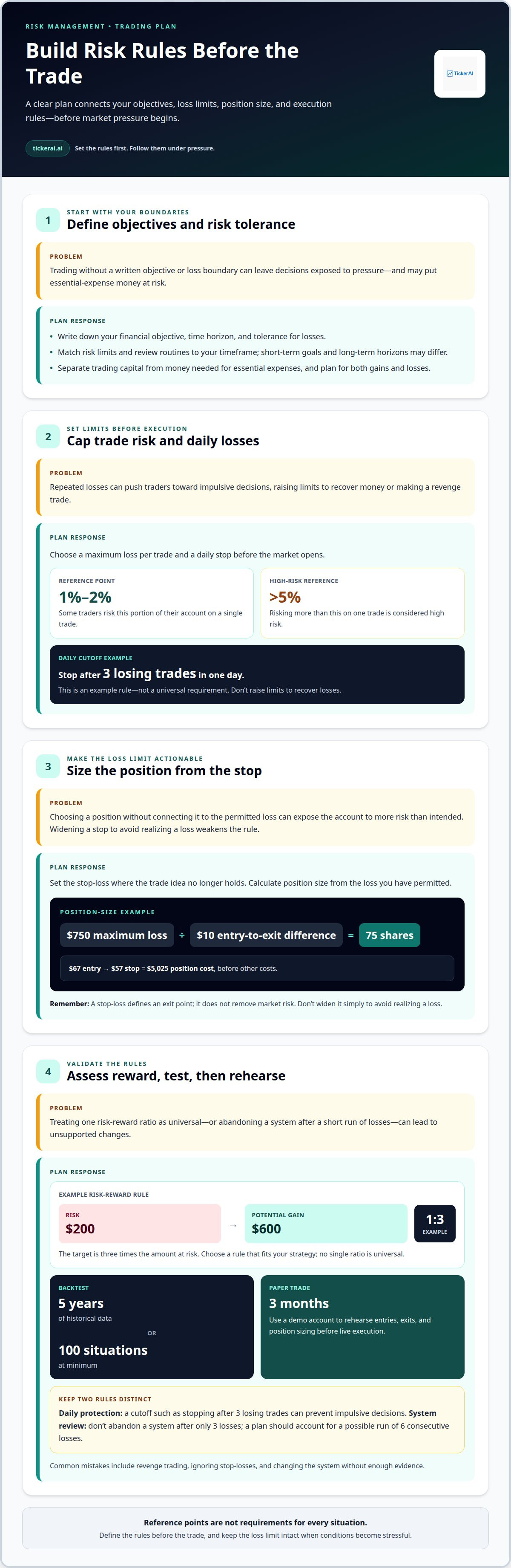
Set risk rules before trading so every position has a defined loss limit. Use these steps to connect your objectives, position size, and execution rules.
-
Define Objectives and Risk Tolerance
Write down your financial objective, time horizon, and tolerance for losses before choosing a trade. A short-term goal and a long-term investing horizon may call for different risk limits and review routines. Separate trading capital from money needed for essential expenses. Avoid setting return expectations without accounting for losing trades; your plan should allow for both gains and losses.
-
Set Trade and Daily Risk Limits
Choose a maximum loss per trade and a daily stop before market execution begins. Some traders risk 1%-2% of their account on a single trade; risking more than 5% is considered high risk. These are reference points, not a requirement for every situation. Set a daily cutoff that prevents repeated losses from driving impulsive decisions. For example, a rule could be to stop after 3 losing trades in one day. Don’t increase limits to recover losses or make a revenge trade.
-
Manage Position Size and Stop-Loss Orders
Set the stop-loss at the point where your trade idea no longer holds, then calculate position size from the permitted loss. For example, a $750 maximum loss divided by a $10 difference between entry and exit gives 75 shares. At a $67 entry and $57 stop, that position costs $5,025 before other costs. A stop-loss defines an exit point, but it doesn’t remove market risk. Don’t widen it simply to avoid realizing a loss.
-
Assess Risk-Reward and Test the Strategy
Choose a risk-reward rule that fits your strategy rather than treating one ratio as universal. A 1:3 example risks $200 for a potential $600 gain; the target is three times the amount at risk. Before live execution, backtest the rules using five years of historical data or at least 100 situations. Then paper trade in a demo account for three months to rehearse entries, exits, and position sizing. Common mistakes include revenge trading, ignoring stop-losses, and abandoning a system after only three losses. A plan should account for a possible run of six consecutive losses.
What is a trading plan?
A trading plan is a written framework for making and reviewing market decisions. To develop one, record what you do and why, then use those records to identify useful adjustments.
-
Keep a Record of Trades
Create a trading journal and update it after each position closes. Record the instrument, entry and exit points, rationale, outcome, and whether you followed your rules. Note when emotions affected a decision. These details help distinguish a sound process from a favorable result, and a weak decision from a lucky gain.
Review your log weekly for patterns, such as entering before a setup confirms. Keep the format practical: a spreadsheet or written diary works if each entry captures the same details. Review the record monthly or quarterly, and adjust only when the evidence supports a change. Don’t rewrite rules after one losing trade. Consistent recordkeeping gives you a practical foundation for a trading plan that can adapt over time.
-
Account for Trading Costs and Requirements
Record the costs and obligations that apply to your United States trading activity. Include commissions, spreads, and transaction charges shown in your account records so your journal reflects results after costs. Track realized gains and losses alongside transaction dates and account details. Tax treatment can depend on the instrument, account, and transaction, so don’t assume every trade is treated the same way.
Regulatory obligations also depend on the security and trading activity. Keep relevant confirmations and account statements with your trade log, then use those records to assess results or prepare tax information. A practical plan accounts for these factors without guessing at a tax rate or applying one rule to every situation.
Building daily, weekly, and monthly routines
Give each market task a place in your schedule, from preparation to review. A consistent routine helps you decide when to assess opportunities and when to step away.
-
Establish a Daily Trading Routine
Set a preparation window that fits your trading style and other commitments. One sample routine reserves two hours, from 6 a.m. to 8 a.m., for trading. Before considering a position, review relevant market news, identify setups that match your rules, and note the target and planned action. During the trading day, take a 10-minute break every hour to reset attention. Keep “guaranteed profit” out of your plan; record targets as objectives, not promises.
Protect decision quality outside market hours, too. A routine can include 7-8 hours of sleep each night or a 30-minute morning jog before trading. Choose habits you can repeat, then document whether they help you follow your process. Avoid adding tasks that crowd out preparation or encourage rushed execution.
-
Review Trades Through Journaling
Set aside a regular review slot to compare each trade with its original rationale. Update your journal after a position closes, then review it weekly for recurring execution patterns. Note whether the entry followed your setup, whether you changed your plan, and which market conditions influenced the decision. A brief, consistent record is more useful than notes that leave out losing trades or emotional reactions.
Use your weekly review to identify one process question for the next session. For example, check whether you entered before your signal appeared. Don’t change a rule because one trade lost; first look for a repeated pattern in your journal.
- Schedule market research across the week. Set aside at least two hours a week to read financial news, then record which developments affect your watchlist or existing thesis. Separate information that changes your analysis from headlines that don’t alter your predefined rules. This keeps new opportunities in context instead of turning every update into a reason to trade.
- Review your full routine every month. Compare planned activity with actual decisions, missed setups, and profit or loss outcomes. If a recurring scheduling conflict prevents preparation, adjust your calendar before changing your trading strategy. Keep the review focused: document what worked, what disrupted execution, and one practical change to test next month.
What a trading plan includes and how it differs from a strategy
A strategy defines the conditions for a trade. A plan connects that method to your objectives, routine, review, and disciplined execution.
- Write your plan as an operating document for your trading activity. Include your objectives, preferred markets, schedule, decision rules, and review routine. Treat projected costs, revenues, and market conditions as assumptions to monitor, not guaranteed outcomes. This broader framework helps keep analysis and execution consistent.
- Describe your strategy separately. It specifies how you identify an opportunity, enter, manage, and exit a position. Strategies can use technical indicators, fundamental analysis, or both. For example, a rule might require a close above the 50-period moving average and a break above resistance on the 1H chart.
- Choose a strategy that fits your investing horizon and available time. Day trading opens and closes positions within the same day; swing trades can last several days to weeks. Position trading may hold positions for weeks, months, or years. A method that requires constant monitoring may not suit a schedule with limited time for market activity.
- Test a candidate strategy against its stated rules before relying on it. Use historical market data to assess how signals behaved, then paper trade to rehearse decisions without committing real capital. Compare the results with your intended reward profile and note where execution differs. To choose and test a strategy, match its timeframe and decision demands to your situation, then apply the same rules consistently.
- Review your plan weekly, separating process quality from individual outcomes. Record whether each decision followed your strategy, then monitor recurring deviations or changing market conditions. Adjust the written rules only when your analysis supports a change, and document what changed and why. The plan governs the whole process; the strategy supplies the logic for each trade.
To scan potential setups while keeping your own rules in control, explore structured trade ideas.
TickerAI
TickerAI supports your trading process with AI Stock Opportunity Discovery, Smart Watchlist & Alerts, Swing Trade Setups, and Long-Term Investment Ideas. Use these insights to identify potential opportunities, then assess each one against your strategy, risk limits, and time horizon.
The platform can help narrow the flow of market information and surface ideas for further analysis. Your trading plan still guides each decision: evaluate the setup, define your risk, and determine whether it fits your rules before acting. TickerAI’s insights complement your process; they don’t replace your judgment or guarantee an outcome.
To learn more about how TickerAI can support your market research, contact TickerAI.
Put your process into practice
A written plan becomes useful when you apply it consistently. Treat the next stage of developing your trading plan as a process of observation: follow your rules, record where execution diverges, and use those patterns to decide what to review. Change a rule only when your analysis gives you a clear reason, not simply because the latest outcome was disappointing.
Keep your plan practical. As your schedule, market focus, or objectives change, assess whether its assumptions still fit. This ongoing discipline helps you respond deliberately instead of improvising under pressure. Your plan is a decision framework, not a forecast of what markets must do.
TickerAI can support your market research as you assess potential ideas against your own criteria. For a next step, contact TickerAI to discuss your trading plan. Keep refining your process, and approach each new market decision with clearer rules.
Frequently Asked Questions
What should a trading plan include?
A trading plan should connect your market focus, decision rules, risk boundaries, and review process. Specify which instruments you’ll consider, what conditions make a setup valid, and what would invalidate it. Add contingencies for missed entries, unexpected volatility, or platform interruptions. Keep the document usable during a live session: clear rules are easier to apply than lengthy explanations or exceptions.
How do you define trading goals and time horizon?
Start by linking each goal to a timeframe and purpose, such as building long-term investments or pursuing short-term trading opportunities. Then distinguish outcome goals from process goals. An outcome might describe a portfolio objective; a process goal could be following your entry criteria consistently. Check that your chosen horizon matches how often you can monitor markets and how much unrealized loss you can tolerate.
How do you set entry, exit, and stop-loss rules?
Define an entry trigger you can observe objectively, such as a price level or indicator condition, and specify when the setup is no longer valid. Set the stop where the trade thesis fails, not where a smaller loss feels more comfortable. Decide in advance whether your exit depends on a target, a changed signal, or a time limit, then apply the same logic consistently.
How do you determine position size and risk per trade?
Calculate position size using two inputs: the maximum loss you’re willing to accept and the distance between entry and stop. Divide the permitted loss by the per-share risk to estimate the number of shares, then consider whether other open positions create overlapping exposure. If the stop needs to sit farther away, reduce the position size rather than raising your loss limit.
How should traders track performance and review their plan?
Track more than your account balance. Compare actual execution with planned entries and exits, then assess win rate, average gain versus average loss, and drawdown across a meaningful sample of trades. Separate rule-following from outcomes: a losing trade can still follow your process. Use recurring deviations or changing market conditions to identify what merits adjustment, and document the reason for each revision.


